
I suppose I am back in my element (earth, mingled with dust), being that I can reminisce at last about my recent trip to New York City from the comfort of my own patch of terra firma across the pond. Okay, so I never managed to turn writing into a living; but I sure can turn life into writing—provided I can go on about past experiences once I am good and ready, once that which has been going on and gone through my mind is bona fide bygone. Not one to multitask, I somehow cannot both be living and writing simultaneously, which is why Twitter is not for me. I am not cut out to be an on-the-spot correspondent. You won’t catch me with my finger on the pulse of anything yet living other than in my thoughts where, quickened by imagination, anything presumably dead and gone is readily revived.
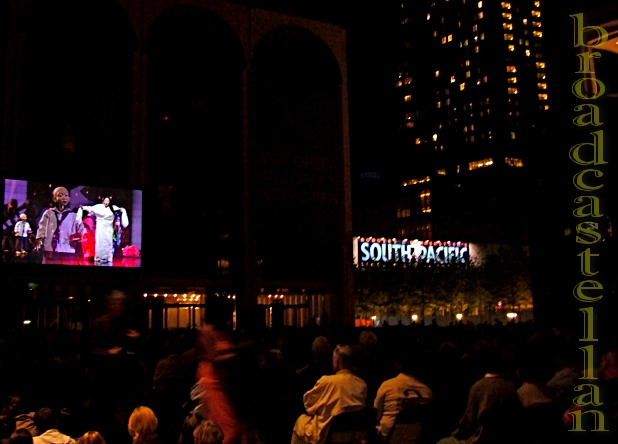
Perhaps, going live is not the same as being in the moment; at least, performances need not be, by virtue of being live, worth a moment of my time. For the record (and this is a new record to me, for I am about to change my tune): canned performances are not necessarily inferior to live ones. At least I thought so a few weeks ago while watching a recorded broadcast of a dazzling Metropolitan Opera production of Madama Butterfly, screened on the plaza in front of the building housing that venerable institution.
There I was (leaning against a trash can, no less), joined by hundreds of strangers, to take in, free of charge, the musical equivalent of cured meat, a pickled delicacy shared out to lure those partaking into the venue to shell out serious money for the supposedly real thing. Maybe I’ll think differently tomorrow at the local cinema, where I will be catching a high definition broadcast of the current National Theatre production of Shakespeare’s All’s Well That Ends Well, live from London; but I sure realized that live is not to be confused with lively when I went to see South Pacific at New York’s Lincoln Center Theater, just a few feet from the screen where Madama Butterfly had flickered before my teary eyes.
South Pacific left my peepers dry, even though I was on the brink of welling up when I reminded myself that I had let go of more than $90 for a discount ticket to for the dubious privilege of beholding said spectacle. What I witnessed was Broadway on an off night, some less than “Enchanted Evening” during which the cast went through the motions like Zombies on sabbatical. I knew as much when I opened my playbill to discover one of those white slips that, on the Great White Way, are equivalent to a pink one: Paulo Szot, the celebrated lead, had been replaced for the evening (and several weeks to come) by one William Michals.
Turns out, Mr. Michals had all the charm and thespian animation of a Bela Lugosi. Not that Laura Osnes (as Nellie Forbush) was out-Mitziying Ms. Gaynor. She did not as much try to wash that man right outa her hair as dispose of him with a purple rinse. As I remarked to my fellow onlooker, the pair had less going on between them as might be generated by a preschooler’s chemistry set.
Almost everything about this potentially engrossing play seemed to have been rehashed on a desperately reduced flame. I, for one, was boiling; it wasn’t “Happy Talk” you’d have overheard had you been eavesdropping on us as we left the theater. Sure, the production had been running for a year and a half and wasn’t exactly “Younger Than Springtime”; but the Pacific, never more deserving of the name, has rarely felt quite this tepid. A rousing rendition of “There Is Nothin’ Like a Dame” and the still-spirited performance of Danny Burstein (as Billis) aside, the promise of Bali Ha’i never left anyone feeling quite this low . . .
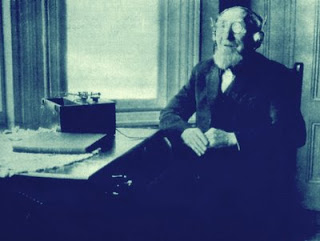 Last night, I felt like an old queen. Granted, that is not an uncommon feeling for me; but the Queen in this case was none other than Victoria, who, in the last years of her reign, enjoyed partaking of live opera without actually having to leave for the theater at which it was presented. Her royal box was a contraption called the Electrophone, a special telephone service that connected subscribers with the theaters from which the sounds of music and drama could be appreciated while being seated in whichever armchair one designated as a listening post. Today, we may be accustomed to live—or, wardrobe malfunctions notwithstanding, very nearly live—broadcasts of sounds as well as images; but last night’s event felt as new and exciting to me as it must have been picking up the electrophone or dialing in to those experimental theater relays during the 1890s and 1920s, respectively.
 Harry Heuser