
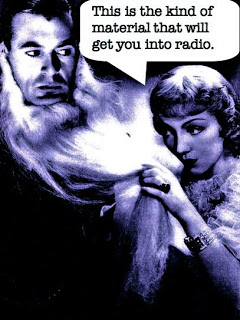
 “Our guest stars might well have been tailored for the celebrated parts of Peter and Ellie,” host Orson Welles remarked as he raised the curtain on the Campbell Playhouse production of “It Happened One Night,” heard on this day, 28 January, in 1940. Quite a bold bit of barking, that. After all, the pants once worn by bare-chested Clark Gable were handed down to William Powell, who was debonair rather than brawny. “Mr. William Powell surely needs no alteration at all,” Welles insisted, even though the material required considerable trimming. Meanwhile, the part of Ellie, the “spoiled and spirited heiress” whom Peter cuts down to size until he suits her, was inherited by Miriam Hopkins. It had “certainly never been more faultlessly imagined than tonight,” Welles declared. Indeed, as I was reminded by Andre Soares’s interview with biographer Allan Ellenberger on Alternative Film Guide, Hopkins numbered among the leading ladies who had turned down the role and, no doubt, came to regret it, given the critical and commercial success of It Happened, which earned Claudette Colbert an Academy Award.
Now, Welles was prone to hyperboles; but, in light of Colbert’s memorable performance, his claim that the part had “never been more faultlessly imagined”—in a radio adaptation, no less—sounds rather spurious. As it turns out, raspy-voiced Hopkins (whom last I saw in a BFI screening of Becky Sharp) does not give the spirited performance one might expect from the seasoned comedienne. Her timing is off, her emoting out of character, all of which conspires, along with the imposed acceleration of the script, to render disingenuous what is meant to be her character’s transformation from brat to bride; and while Powell, a few fluffed lines notwithstanding, does quite well as the cocky Peter Grant (it was “Warne” when those pants were worn by Gable), the only “spirited” performance is delivered by Bernard Herrmann, the composer of the lively score.
In short, there is little to justify Welles’s introductory boast. Was the Wunderkind getting back at Colbert for standing him up two months earlier, when Madeleine Carroll filled her place in “The Garden of Allah”? What’s more, Colbert appeared to have passed on the chance to reprise her Oscar-winning role for Campbell Playhouse, something she had previously done, opposite Gable in one of his rare radio engagements, for a Lux Radio Theater reworking of the old “Night Bus” story.
That same night, 28 January 1940, Colbert was heard instead on a Screen Guild broadcast in a production of “Private Worlds,” in a role for which she had received her second Academy Award nomination. During the curtain call, Colbert was obliged to “pay a forfeit” after incorrectly replying “The Jazz Singer” to the question “What was the first full-length all-talking picture to come out of Hollywood?” For this, she was ordered to recite a tongue twister; but it wasn’t much of a forfeit, compared to the sense of loss both Colbert and Hopkins must have felt whenever they misjudged the business by rejecting important roles or by risking their careers making questionable choices.
In The Smiling Lieutenant, the two had played rivals who ended their fight over the same man by comparing the state of their undies; now, Hopkins seemed to be rummaging in Colbert’s drawers for the parts she could have had but was not likely to be offered again. Well, however you want to spin it, radio sure was the place for makeshift redressing, for castoffs and knock-offs, for quick alterations and hasty refittings. It catered to the desire of actors and audiences alike to rewrite or at any rate tweak Hollywood history. Go ahead, try it on for size.

 Harry Heuser