
Radio at the Movies: Golden Earrings (1947)

Placing Mitchell Leisen alongside Hollywood’s top flight directors is likely to raise eyebrows among those whose brows are already well elevated. Most others will simply shrug their cold shoulders in“Who he? indifference, a stance with which I, whose shoulders are wont to brush against the dusty shelves and musty vaults of popular culture, am thoroughly familiar by now. Respected for his knack of striking box-office gold but dismissed by his peers, the former art director was not among the auteurs whose works are read as art chiefly because it is easier to conceive of artistic expression as a non-collective achievement: something that bears the clearly distinguishable signature of a single individual. Their careful design aside, little seems to bespeak the Leisen touch, which is as light as it is assured. Stylish and slick in the best Paramount tradition, a Leisen picture stunningly sets the stage under the pretense of drama; otherwise, it has few pretensions.

The epitome and pinnacle of Leisen’s dream factory output is Golden Earrings (1947), a sumptuously lensed romance that makes Nazi Germany look like fairyland, replete with quaint villages, enchanted forests, and lusty gypsies. It is a false image conjured up by the words of a paramour with pierced ears. For the darker side of the tale, nearly hidden from view, we are referred to McLuhan’s “tribal drum”—the radio.

One of those gypsies is played by German expatriate Marlene Dietrich, who approaches the brown-face role of Lydia tongue-in-famously-hollow-cheek. To Leisen, Dietrich “was the most fascinating woman who ever lived,” as he later told David Chierichetti, the chronicler of his career. Cast as reluctant lover, Col. Ralph Denistoun, is Ray Milland, whose lack of regard for his older co-star only enhances the screwball dynamics of this improbable coupling. Sheltered by and disguised as one of her kind, Milland’s Romani wry officer is on a perilous mission to evade his Nazi pursuers and get hold of a formula for poison gas, the kind of weapon that would exterminate thousands of gypsies.

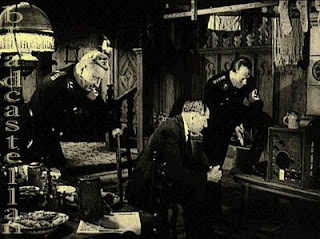
Having previously been captured by the Nazis, Denistoun owes his escape to the master race’s slavish devotion to their master’s voice. He takes full advantage of a radio address by the Führer, guaranteed to distract his captors. The scene in which the Nazi officers rise to hear Hitler’s speech and fall at the hand of their prisoner is an apt metaphor for blind faith and mass-mediated control. Unlike those gypsy earrings, the silence of a people whose ears ring with the brass of Teutonic rhetoric is not golden. A mind closed to independent thought and voices at variance, Golden Earrings suggests, is readily silenced. To be sure, this is retrospective romance; and, its ersatz gypsies roaming quite freely, Leisen’s film shows nothing of the silencing perpetrated by the fascists.
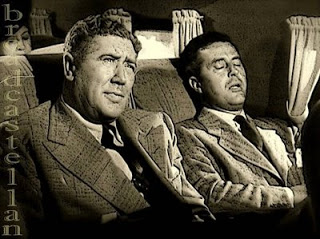
Leisen was not about to denounce the medium he had romanced in two of his earlier revues, The Big Broadcast of 1937 and its 1938 follow-up. Instead, Golden Earrings confronts nationalistic, state-run radio with a distinctly American voice of commercial broadcasting. In the narrative frame, the English officer is seen relating his story to Quentin Reynolds (pictured here with Milland), a news commentator known for his on-air missives to Doktor Goebbels and Herr Schickelgruber.

Rather than spouting anti-Axis propaganda or post-war wisdom, Reynolds is shown as a receiver, a listener tuning in to the wondrous adventure of the strangely un-British Englishman who has come under the influence of a nomadic culture foreign to his people. It is a tall tale a commentator like Reynolds, who would later be libeled in the Hearst press for his alleged lack of patriotism, is not obliged to debunk.

The frame permits Leisen to construct Golden Earrings as a romance, told as it is from the perspective of an unconventional officer summoned by his gypsy love. It is all so fabulously escapist that the enormous gamble of glamorizing Germany so soon after the war paid off without causing much offense. That, in short, is the Leisen touch.

Does Every Cinderella Project Have Its Midnight?

Well (I am saying “well” once more, for old times’ sake), broadcastellan is entering its fourth year today. It all began on 20 May 2005, when I decided to keep an online journal devoted to old times, good or bad, to the culture that, however popular, is no longer mainstreamed, but, as I explained it in my opening post, marginalized or forgotten. Looking at broadastellan through the lens of the Internet Archive’s “Wayback Machine,” you will notice a few changes; but, overall, things are just as they were when I set out. Except that I am much more at ease and far less concerned about my online persona, its definition and reception, more fully aware of my status and the consequences of casting myself in the role of marginalien as I have come to accept and embrace it. No, it wasn’t this way right from the start.

Having earned my doctorate and relocated from New York City to Wales, I felt the want of continuity. I was reluctant to immerse myself in Welsh culture, let alone its language, for fear of not being able to recognize myself as the cosmopolitan I had impersonate with some success for most of my adult life. The dissertation was placed on the shelf; and my career alongside it. Still, I was not done with American popular culture as I had rediscovered it during years of research.

Not having been able to ride my hobbyhorse all the way to the bank, I thought I’d start parading it here on this busy commons. I sure wasn’t ready to put it out to pasture and wash my hands of it with the soap derived from its carcass. Initially, I might have been confused about the purpose of such a vanity production. I wanted this mare to be petted, even though I was prepared to take it out for others to deride. Nowadays, I am mainly writing for myself, for the kick I get out of being kicked by it into the thicket of research and the paths of (re)discovery.

Whenever I see a show, watch a movie, read a book, or listen to a radio program, broadcastellan encourages me to make it relevant to myself, to investigate and connect—and on the double at that. Right now, I have eight books before me, all designed to warrant my title. After all, it was the aforementioned Eve Peabody who declared that “[E]very Cinderella has her midnight.”

Eve Peabody, the self-proclaimed American blues singer who arrives penniless in Paris, posing as a Hungarian baroness, no less. I’ve always related to this Cinderella’s identity crisis—and admired the sheer ingenuity with which she made it all happen all over again. In the words of Ed Sikov, she proves “tremendously elastic,” a quality that prompted New York Times DVD reviewer Dave Kerr to remark on the “unpleasant degree” to which writer Billy Wilder was obsessed “with the theme of prostitution.”

“I thought that Eve Peabody was a very interesting character,” director Mitchell Leisen remarked. “You see, there’s a bit of good and a little bit of bad in all of us.” Yes, Leisen’s Midnight, like all proper Cinderella tales, has an edge; and, at last, it is being brought into digitally sharp focus. Earlier this month, the screwball comedy Elizabeth Kendall referred to as the “ultimate girl-on-her-own fairy tale” was released on DVD, perhaps in anticipation of the by me dreaded remake starring one Reese Witherspoon.

Since Britain has not caught up with this gem, it shall be one of my first purchases next week when I shall once again (and probably again and again) take the train down to J&R Music World. What with our UK DVD/VCR recorder refusing to accept my US tapes, I have long waited for this moment to catch up with what Ted Sennett has called “one of the best and brightest romantic comedies of the [1930s].” Of course, there’s always the radio.

On this day, 20 May, in 1940, stars Claudette Colbert (pictured above, in an autographed magazine cover from my collection) and Don Ameche reprised their roles in this Lux Radio Theater adaptation (>which you may enjoy by tuning in the Old Time Radio Network). Perhaps, though, the wireless is not the proper medium in which to appreciate a Leisen picture, distinguished as his work is for what James Harvey calls “that look of discriminating opulence.”

Still, you get to hear some of the best lines in romantic comedy, albeit soften at times to appease the censors. For instance, when confronted with a cabbie eager to take her for a ride, even though she confessed to having nothing but a centime with a hole in it to her name, she offers to pay him for driving her around town while she goes hunting for a job. “What kind of work do you want?” he inquires. “Well, look,” Eve replies, “at this time of night and in these clothes I’m not looking for needlework.”

Like Eve, I have gone round in circles (apart from the proverbial block). The ride may not amount to much to many, but this is not why I keep on mounting this hobbyhorse of mine. It is the sheer pleasure of taking my mind for a spin. And, to answer my own question, there is still time for a few jaunts. After all, it is not quite midnight . . .

Will It Go Her Way?: Some Seriously Belated Oscar Predictions

As usual, I am slow to catch up. A few years ago, the BBC relinquished the rights to televising the Oscars; and since we are not subscribing to the premium channel that does air them, I am relying on the old wireless to transport me to the events. So, here I am listening to … the 17th Academy Awards (as broadcast on 15 Mar. 1945). Considering that Claudette Colbert is nominated for Since You Went Away, I just had to tune in. Also among the nominees, for his supporting role in the same picture, is Monty Woolley, the man to whom my terrier owes his name. This year, the event is broadcast nationally for the first time in its entirety. The host is Bob Hope; it was rival radio comic Jack Benny last time. There will be scenes from the nominated pictures, which are going to be explained to us radio listeners. While the president of the Academy, Walter Wanger, is saying a few words (at sixty minutes, this is a rather overblown affair), I might as well share my predictions with you.

As much as I enjoyed Since You Went Away, my money is on Double Indemnity in the Best Picture category. Gaslight is just a one dark note affair, and I don’t think that Wilson, which I haven’t seen, or Going My Way got much of a chance. Stanwyck should get the trophy for Best Actress; but, as you may know, I am partial to Colbert, who hasn’t won in a decade. Besides, she’s delivered a beautifully restrained performance, rather than going all maudlin or hysterical.

Hush, the ceremony is getting under way. It is broadcast live from Grauman’s Chinese. Hope just quipped that he never knew it was a theater, but thought “that it was where Darryl Zanuck had his laundry done.” He can joke; after all, he is being honored with a lifetime membership in the Academy of Motion Picture Arts and Sciences for his many services to the Academy (“Now I know how Roosevelt feels”).

Could Agnes Moorehead win this time for Mrs. Parkington, her second Best Supporting Actress nomination? I certainly like her radio acting. Did you catch “Sorry, Wrong Number”? Mark my word: if it ever gets adapted for the screen, she’s sure to get the Oscar for that role. She also was terrific in the brief scenes she had in Since You Went Away, in which Joseph Cotten’s character refers to hers as the voice that haunted him across the Atlantic. I don’t think Angela Lansbury has got much of a chance in this category; Hollywood doesn’t quite know what to do with her. Maybe she’ll find her medium one day.

Gosh, can you imagine all those stars in one big auditorium? According to Hope, “it’s informal dress”—“they only had to send Bing Crosby home twice.” Now, the winner for Short Subjects (Cartoon) is announced; the award goes to Fred Quimby’s “Mouse Trouble”—what’s next, rats winning best animated feature?—and Max Steiner just scored for scoring Since You Went Away.

I know this makes me sound like a nance, but I’d be terribly upset if Art Direction (Color), did not go to the team behind Mitchell Leisen’s Lady in the Dark; the film faces tougher competition in the Cinematography (Color) category, though, where it is up against Kismet and Meet Me in St. Louis. For Black and White, Joseph LaShelle for Laura should come out on top. I was rooting for Leisen’s No Time for Love and its clever dream sequence to win the Oscar for Art Direction (Black and White), which just lost to Gaslight.

Hang on, there is some mix-up about the trophies. Sure sounds unscripted. In fact, Hope, the old pro at the microphone, seems to have forgotten the audience outside the theater, folks like me who don’t get to see what’s going on. At least we are being treated to a few notes from the twelve nominated songs and the voices of Judy Garland, Rita Hayworth, Dinah Shore, Bing Crosby and Frank Sinatra.

Meanwhile, I am testing out my second sight. Best Director is going to be either Wilder or Hitchcock, who faced such tough competition a few years back when Rebecca lost, rightly, to The Grapes of Wrath. A shame, really, that Tallulah wasn’t even nominated for Life Boat, for the Original Motion Picture Story of which John Steinbeck is likely to get awarded. Original Screenplay, of course, will go to Preston Sturges, who, after all is nominated twice (for Hail the Conquering Hero and Miracle of Morgan’s Creek). And if the Screenplay Oscar doesn’t go to Raymond Chandler and Billy Wilder, then I don’t know what what is . . .

On This Day in 1937: Claudette Colbert Gets Her “Hands” on Lombard’s Part

Well, we’ve all got them, I guess. Those lists of favorite books, or blogs, or breakfast cereals, or some such itemized accounts of our current predilections. They are supposed to tell others something we deem important about ourselves at some point of our lives; but, looked upon in retrospect, they can become a revelation to us, confronting us with time capsules of our likes, longings, and limitations. Here, for instance, are the top three entries on a list of all-time favorite movies as I compiled it back in 1986:

  1. Holiday (George Cukor; 1938)
  2. Hands Across the Table (Mitchell Leisen; 1935)
  3. Fade to Black (Vernon Zimmerman; 1980)

Now, I have not seen Fade to Black since the 1980s. It is a slasher movie for cinemaniacs, which is why I could identify with it back then. For reasons I did not yet fully comprehend, I was drawn, fairly early in my life, to the films and figure of Mitchell Leisen, a tremendously successful designer-director, but not a particularly well-remembered or highly regarded craftsman nowadays.

Claudette Colbert and Joel McCrea
on Lux Radio Theatre

Hands Across the Table is a simple you-can-have-your-beefcake-and-eat-it romance starring Carole Lombard as a penniless manicurist, Ralph Bellamy as a rich invalid who’d like to get his hands on her, and Fred MacMurray as a carefree man-about-town with dubious work ethics who eventually sweeps her off her feet. That pretty much sums it up—unless, of course, I’d have to explain the feeling of being torn between having my nails polished by gorgeous Lombard and running my fingers through MacMurray’s hair.

On this day, 3 May, in 1937, Hands Across the Table went on the air in an adaptation produced by that most prestigious and popular of radio theatricals, the Cecil B. DeMille hosted Lux Radio Theatre. It was this series, along with my love for 1930s and early 1940s screwball comedies that got me interested in old-time radio.

Once you have exhausted the classics, you will find a worthwhile substitute in American radio programs like Lux, which give you not only an opportunity to catch a different reading of films so familiar to you that they play before your mind’s eye, but also allow you to re-imagine them with alternate casts.

What, for instance, if Suspicion had starred Olivia de Havilland, rather than her sister, Joan Fontaine? How would Barbara Stanwyck or Ida Lupino fare in Merle Oberon’s role as Cathy in Wuthering Heights [thanks to André Soares for editing]? And what, if anything, could Loretta Young do when called upon to take over for Bette Davis in Jezebel? It all happened on the Lux program.

In Lux‘s audio version of Hands Across the Table, Carole Lombard’s role was performed by Claudette Colbert, who would later be Leisen’s leading lady in Midnight (1939). It was Colbert’s fourth appearance on the show, whose sponsors not only paid handsomely for such brief encounters with the microphone (up to $5000 for top-notchers), but also promoted the stars’ movie careers (by mentioning, in Colbert’s case, the upcoming releases I Met Him in Paris and Tovarich).

Heard in the Fred MacMurray part is Colbert’s Palm Beach Story co-star Joel McCrea (pictured above, with Colbert, reading the “Hands Across” script). Introducing the two leads, showman DeMille credited himself with their discovery:

Greetings from Hollywood.  Tonight’s event, with its glittering stage, its scientific wizardry that carries our voices to all corners of the earth and its audience of millions is a thing that I couldn’t have predicted when I first knew Claudette Colbert and Joel McCrea.  The Lux Radio Theater was then as remote from Hollywood as the moon.  But I predicted the eventual triumph of these two young people and was privileged to contribute to it.  I gave Joel McCrea his first motion picture contract.  Claudette was not then the favorite of millions, allowed to choose her stories, directors, and writers. The studio insisted I give her a dialogue test before casting her.  I did—and starred her in The Sign of the Cross and Cleopatra.

For the privilege of putting her hands on Lombard’s part—and the generous remuneration on the table—Colbert was obliged to declare that they had touched nothing but Lux toilet soap ever since her first appearance on the New York stage (in the 1920s). As I put it in Etherized Victorians, my doctoral study on old-time radio, it was all a matter of one hand washing the other.

Up Frenchman’s Creek; or, How (Not) to Prepare for a Vacation

Well, I’ve been home barely twenty-four hours and already I am packing my suitcase again. After a weekend up north in Manchester, I’ll be off tomorrow on a weeklong trip down south to Cornwall. Instead of flicking through my travel guides this morning, I started reading Daphne du Maurier’s Jamaica Inn. Now, there’s a description of scenery you wouldn’t get from your travel agent:

[There] was a lashing, pitiless rain that stung the windows of the coach, and it soaked into a hard and barren soil. No trees here, save one or two that stretched bare branches to the four winds, bent and twisted from centuries of storm, and so black were they by time and tempest that, even if spring did breathe on such a place, no buds would dare to come to leaf for fear the late frost should kill them. It was a scrubby land, without hedgerow or meadow; a country of stones, black heather, and stunted broom. 

There would never be a gentle season here. [. . .] 

Not much more hospitable is the seascape depicted in the opening chapter of du Maurier’s Frenchman’s Creek:

When the east wind blows up Helford river the shining waters become troubled and disturbed and the little waves beat angrily upon the sandy shores [. . .].

The long rollers of the Channel, travelling from beyond Lizard point, follow hard upon the steep seas at the river mouth, and mingling with the surge and wash of deep sea water comes the brown tide, swollen with the last rains and brackish from the mud, bearing upon its face dead twigs and straws, and strange forgotten things, leaves too early fallen, young birds, and the buds of flowers.

Perhaps reading du Maurier’s Cornish romances is not such an ideal way to get into the spirit of things, especially not when one is hoping for spring and renewal. At least their author was familiar with the locations described. Listening to the 10 February 1947 Lux Radio Theatre version of Frenchman’s Creek, I got no sense of the locale at all; nor, for that matter, much sense of the story. There was too little of it left to suggest the illicit passion of a married woman for a dashing pirate.

The radio version is not so much an adaptation of the novel, but of radio dramatist Talbot Jennings’s screenplay for Paramount’s 1944 technicolor production, which cleaned up du Maurier’s act in accordance with Hollywood’s production code. Mitchell Leisen’s film, of course, was not shot in Cornwall either, but in Jenner, California, which also stood in as Devon in The Uninvited, an old-fashioned ghost story featuring the novelty of a sun rising in the west.

I don’t suppose Alfred Hitchcock’s reworking of Jamaica Inn is any more useful as an introduction to Cornwall; I’ve always confused it with Under Capricorn, another one of Hitchcock’s misguided forays into period piece froufrou (although I confess having enjoyed his Waltzes from Vienna). And since there is little time to dip into the poetry of John Betjeman, I think I’d better get back to my travel guide after all—and finish packing. I will try to relate my impressions upon my return next Wednesday—provided I can find a radio drama angle.