
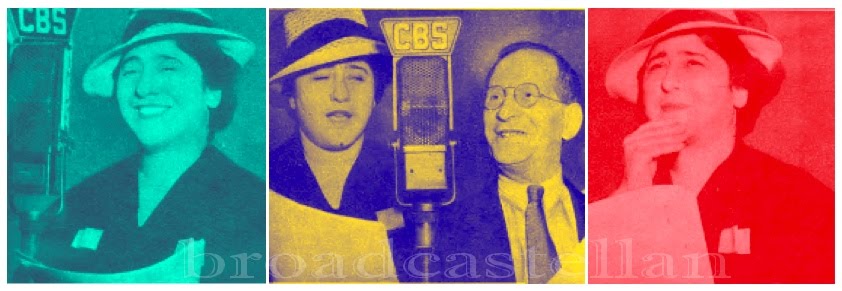
Remembering Gertrude Berg, that is. Having been to Fleischmanns last year (without spotting her tombstone there), I was thrilled to be catching Aviva Kempner’s much reviewed if ultimately unsatisfying documentary Yoo-Hoo, Mrs. Goldberg at the Quad Cinema in Manhattan last week. After all, it is not a film you are likely to see in Europe (or, for that matter, in any US multiplex); and I doubt whether it will ever be released in Wales, my present home. Who, after all, remembers (or ever had the opportunity of) tuning in to The Goldbergs, or The Rise of the Goldbergs, as Berg’s program was initially called in the days before television?
Kempner’s filmic memorial to Berg and her creation—heard on radio and seen on stage, television and the movies—aims at countering the oblivion to which the writer-producer-actress and her signature character have long been consigned; but, judging from the elderly, Jewish audience among which I found myself, aside from my good friend, Brian, Mrs. Goldberg is not likely to find new admirers through Kempner’s polite and downright reverent re-introduction, however deserving she may be of praise.
“Why, for all her popularity and apparent influence, is Gertrude Berg so little remembered today?” Paul Farhi of the Washington Post asked back in July 2009. It is a question Kempner does not trouble herself to answer, other than with a resounding “Why indeed?” Predating but overshadowed by I Love Lucy, The Goldbergs come across as little more than a noteworthy, ethnic curiosity, a historical footnote, the stuff of nostalgia. At least, Kempner’s documentary, which New York Post critic V. A. Musetto called “fawning and formulaic,” did little to convince me otherwise—and I don’t need convincing.
“Ulleright, ulleright!” For all its shortcomings, Yoo-Hoo, Mrs. Goldberg is still a welcome and overdue tribute to of a long overlooked icon of American popular culture—and an enterprising, emancipated woman at that; but it is also a rather perfunctory and historically questionable piece of bio-cinematography, replete with a poorly reenacted scene from Berg’s earliest radio script.
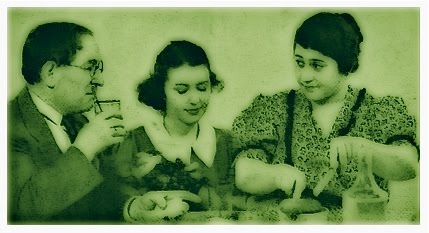 Except for a few tantalizing clips of Edward R. Murrow’s interview with Berg on Person to Person and those seemingly random excerpts from The Goldbergs kinescopes, the documentary, like most pieces of ocular proof, is at a loss to fill the screen, resorting to images only remotely related to the subject; or, else, to talking heads like Ed Asner’s and Ruth Bader Ginsburg (who recalls being addressed as Mrs. Goldberg). Meanwhile, the snippets from Berg’s radio and television broadcasts are often unintelligible, if it weren’t for the subtitles. The result is about as funny as a translated joke—and certainly not remotely as amusing or charming as Berg’s glossy autobiography Molly and Me (1961).
Here, for instance, is how autobiographer Berg made the connection between her parentage and her wireless offspring. Those watching Kempner’s documentary never get to hear about it. To them, Molly is a kindly woman leaning out of a window, chatting to her neighbors—and an audience long since dispersed—or praising the miracle of Sanka Coffee, instead of yelling “Yoo-hoo, is anybody?” into a telephonic darkness just beyond her Bronx apartment:
My father was a special fan of the dumbwaiter and when radio was invented, he gave up the shaftway only because of the better coverage. But until that time it was through the dumbwaiter that he got to know everybody, not by their names, but by their locations. He predicted divorce for Mr. and Mrs. 5-D because of their nightly arguments; he knew that Mrs. 3-A’s son was going to leave home before even Mrs. 3-A. It didn’t take second sight; all it took was a good ear and a comfortable chair near the dumbwaiter door.
Kempner’s film is so reverent and nostalgic, it sentimentalizes the already saccharine confection of Mother Goldberg, whose Jewish Amos ‘n’ Andyisms enliven the early scripts for her radio serial, extant only in print, before the series-turned-daytime serial settled for at times “soap-operaish” melodrama.
“[E]verything about The Goldbergs changed but the theme song, ‘Toselli’s Serenade,’” Berg explains in Molly and Me. Those encountering Molly in Kempner’s documentary are unlikely to see Molly as an early Lucy, or, come to think of it, as a prototype for linguistically challenged immigrant Ricky Ricardo.
“So come down a liddle after,” Mrs. Goldberg once yoo-hooed to her neighbor, Mrs. Bloom, “maybe ve’ll go to a mofie—is playing de Four Horsemen in de Apoplexies.” Well, you almost got it, Molly. Apoplexies are the kind of movie theaters that leave you angry at your lack of choices. Too bad that even the exceedingly rare art house simplexes are not likely to rescue you from the fate of being trampled to death by the pale horse of apathy.
Related writings
The House of [Broken] Glass
Wireless Women, Clueless Men: Gertrude Berg, Everybody’s Mama
On This Day in 1941: Molly Goldberg Nearly Chickens Out
 “I don’t have much respect for biographers,” I once told John N. Hall, noted author of Trollope: A Biography and Max Beerbohm: A Kind of Life. I was being mischievous, knowing my professor to have a sense of humor that makes him just the man to examine the lives and fictions of the humorists who attract him. Indeed, I have rarely met an academic whose mentality was better suited to his subjects. I was not merely being facetious, though. I was also being honest. I don’t read biographies; not cover to cover, at least. I am too impatient to go through a series of incidents designed to trace the traits and career of a famous so-and-so to great-grandparents who were semi-literate peasants from Eastern Europe, to illustrate what impact the childhood agony of losing a balloon during a rainstorm had on an artist’s psyche, or explain what it really means to be a supposed nobody before becoming an alleged somebody.
 You might say that I am not easily impressed by facts and downright doubtful of them; that I am unconvinced a life can be told by means of sundry scraps of evidence culled from contemporary sources or the recollections of contemporaries whose lost marbles are dutifully dredged from the gully of memory lane. It’s all that; but I would like to think that respect has something to do with it as well—respect for a creative mind expressing itself in a work of art by someone who might not be willing or able to open up otherwise. In other words, I take what an artist is willing to give, even if the limited supply of such works are dictated, to some extent, by market demands.
  Harry Heuser