
The Transplanted Mind: A Caligari for Radio?

“Poor print.” That was all I had to say after attending a screening of Das Kabinett des Dr. Caligari (1920) at the Museum of Modern Art in New York City. I was dreadfully disappointed. It felt like walking through an exhibition of Expressionist art in which all the paintings were covered in plastic, the lights dimmed, and the space brightened only by an occasional flash of a camera. I pretty much had the same impression when, preparing for a trip to Prague, I tried to take in Der Golem by exposing myself to the horrors of a cheap copy I had dug out of a bargain bin at a third-rate department store. You might as well experience these films on the radio, where the visuals are as clear and bold as you can make them, provided your mental camera is both creative and focused enough to take pictures that are worth keeping.

Tonight, BBC Radio 3 attempted no less with “Caligari,” a radio adaptation of Robert Wiene’s seminal horror film, one of the few classics of the cinema to rank among the top 250 films on the Internet Movie Database. In the exposition, poet/playwright Amanda Dalton slyly comments on the challenges of such a project. “Caligari” opens with the sound of a board (an advertisement for the fair, a title card for the film, a piece of scenery) being painted and hammered into position. The question this gesture begs is whether the brush and the hammer are being passed on to us. Are we the artist, the audience, or the subject? Can we choose? Must we?

A “strangely arresting” film that succeeds in giving “pictorial interpretation to a madman’s vision,” one early commentator (Carlyle Ellis) said of Caligari. Such a statement drives home that Caligari is itself an exercise in translation: a bringing to light and darkness the workings of a crooked, crazy mind in crooked, crazy images. Rather than a translation, then, Dalton’s “Caligari” (available online until 2 November 2008) should be performing nothing more—and nothing less—than a transplant, a projection of a madman’s vision onto the screen of our own mental theater, sound or otherwise.

By installing a narrator at the changing scene, “Caligari” insists on translating and interpreting, at times so facetiously as to undermine any sense of terror. Irritation, perhaps, but not anxiety. More clamorous and voluble than radio needs to be, Dalton’s frantic, play, whose light-heartedness is weighed down by anachronistic cliches like “over my dead body,” is, for all its irreverence, an unsatisfactorily literal transliteration. Too many voices shouting down our imagination, “Caligari” reviews familiar images it does not permit our mind’s eye to see, let alone re-envision or remake. A running commentary on the original on a familiarity with which it depends, “Caligari” plays itself out as a series of aural footnotes.

Last Friday, during an ostensible lecture on German film prior to a screening of Germany’s latest cinematic export, Die Welle (2008), I once again caught glimpses of Wiene’s seminal work; but its images were taken out of a context that the dull, rambling talk could not create. I had a similar attitude toward Dalton’s adaptations.

A few bars of the German national anthem, as it was once sung (that is, including the first stanza, “Deutschland, Deutschland über alles”), can hardly suffice in assisting us to adopt a Weimar Republican mindset; nor can mentions of an “intricate design” recreate an expressionistic set. And while a babble of tongues may make a failed democratic system audible, “Caligari” is little more than a poor substitute for the experience of either art or history.

Meanwhile, I am sure that the jack-o’-lantern I carved today (and display above) would look better on the air or in anyone’s mind, especially now that Montague, our terrier, has already begun to disfigure it. Is he adopting traits you may have decided to attribute to me?
“A symmetry of unborn generations”: A Guernica for Radio

One of the many attractions of Madrid I will make sure not to miss is Picasso’s Guernica (1937), the most famous 20th-century painting in the Reina Sofía collection. A report from the commonplace-turned-combat zone, Guernica is a piece of anti-totalitarian propaganda commemorating the world’s first civilians-targeting air attack: the 26 April 1937 raid on the busy market town of Gernika-Lumo, masterminded by General Franco and carried out by the Condor Legion of Nazi Germany.

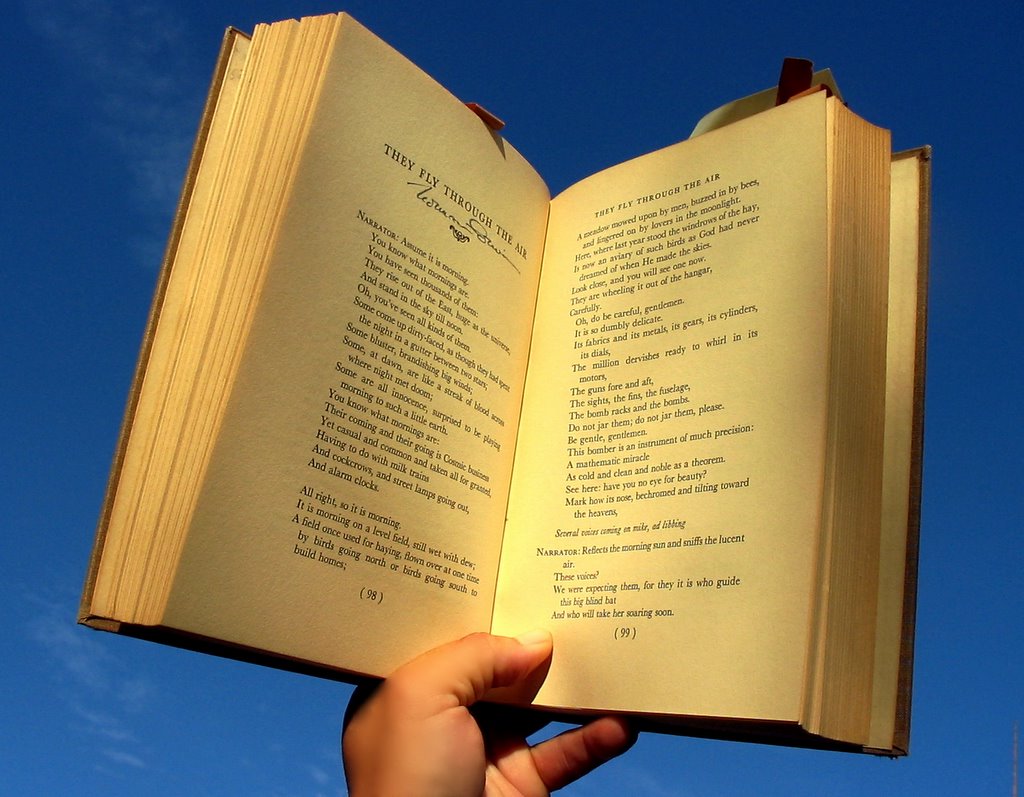
Holding up to the sky my copy of Corwin’s play “They Fly Through the Air,” signed by its author

For a long time, the painting was kept out of Spain and was mostly on display at the MoMA in New York City, where, during the Vietnam War, it became a site for vigils held by members of the peace movement, one of whom went so far as to deface it with red spray paint. It was Picasso’s wish that Guernica be returned to his homeland only after the reestablishment of democratic rule. A swiftly executed and brutally manipulative commentary on modern warfare, it invites comparisons to the three best-known American verse plays for radio, Archibald MacLeish’s “Air Raid,” Edna St. Vincent Millay’s “Murder of Lidice,” and Norman Corwin’s “They Fly Through the Air with the Greatest of Ease.”

MacLeish’s “Air Raid,” in contrast to Picasso’s painting, overtly implicates the civilian population, including his radio listeners, castigating them for their supposed ignorance and inertia. As in “The Fall of the City,” MacLeish attacks those falling rather than sentimentalizing their plight. His are bold performances, but his cruel warning turns listeners eager for news into silent partners of war who are asked to “stand by” as they tune in while women and children, refusing to heed warnings of an impending blitz, are being attacked and annihilated:

You who fish the fathoms of the night
With poles on roof-tops and long loops of wire
Those of you who driving from some visit
Finger the button on the dashboard dial
Until the metal trembles like a medium in a trance
And tells you what is happening in France
Or China or in Spain or some such country
You have one thought tonight and only one:
Will there be war? Has war come?
Is Europe burning from the Tiber to the Somme?
You think you hear the sudden double thudding of the drum
You don’t though . . .

Not now . . .

But what your ears will hear with in the hour
No one living in this world would try to tell you.
We take you there to wait it for yourselves.
Stand by: we’ll try to take you through. . . .

Millay’s “Murder of Lidice” recalls the innocent lives of those slain by Richard Heydrich, Deputy Reich Protector of Bohemia and Moravia, in Lidice. Artistically, the play is indefensible and shockingly inept in its bathos. In Millay’s Grand Guignol of Nazi terror, Heydrich the Hangman, whom the villagers have assassinated, is heard, from the beyond, planning his revenge:

He howls for a bucket of bubbly blood—
It may be man’s or it may be of woman,
But it has to be hot, and it must be human!
Oh, many’s the sweet warm throat he’ll suck.

In “They Fly Through the Air,” Corwin’s narrator goes in search of a language appropriate to the negotiation of art and propaganda. As I point out in Etherized Victorians, the play is a response to the perversion of poetic diction by the fascist cause. Viewed from above, Mussolini reportedly remarked, exploding bombs had the beauty of a “rose unfolding.” Throughout the play, metaphors are at war with plain speech, both in the service of motivating the masses:

What words can compass glories such as we have seen today?
Our language beats against its limitations [. . .].

Our rhythms jangle at the very start.
Our similes concede defeat,
For there is nothing that can be compared to that which lies beyond compare.
You see? We are reduced already to tautologies.
It’s awe does that.
The wonder of it all has set us stammering.

What is the language of war? How does it differ from the idiom of peace? And how shall war—often furious but not always futile—be rendered, recorded, and remembered in words or images? When I look at Guernica this week, I will ask myself these questions. Quite possibly, I will shiver when exposing it to the limitations of my shrinking lexicon.

Hope on the Bottom Shelf; or, What to Do When the Cable Box Seems Barren

Moving to the UK from the movie junkie heaven that is New York City meant having to find new ways of getting my cinematic fix. Gone are the nights of pre-code delights at the Film Forum; no more silent film matinees at the MoMA (which is just concluding a Gregory La Cava retrospective); and no more browsing at J&R Music World—and all just a cab ride away. And yet, judging by who is posting reviews at IMDb, it becomes obvious that cineastes are not exclusively city dwellers (a review of the rarely screened talkie The Hole in the Wall may serve as a case in point). Just don’t count on UK television.

The commercial-free BBC 2 has proven the most reliable source of classic Hollywood fare, even though the screenings of old movies are generally relegated to the after-hours or late-morning time slots. There have been a number of pleasant surprises, such as a Val Lewton series (including the literate horror of The Dead Ship), the film adaptation of the Suspense radio drama “To Find Help” (reworked, not altogether successfully, as Beware, My Lovely) and several Claudette Colbert films (including Texas Lady, which I had never seen in the US).

Silent movies are unheard of, however; nor do pre-1940s films get much airtime (the team efforts of Astaire/Rogers and Laurel/Hardy being a notable exception). Still, this beats the advertisement-riddled offerings at TCM Britain, whose one-shelf library even infrequent viewers are likely to exhaust within a few months.

Since I am not an online shopper and still enjoy hunting trips per pedes, I have been checking out the DVD sections of the major music/video retailers here in the UK. Virgin is least attractive, stocking mainly recent titles at largely unacceptable prices. It is little more than a snazzy second-run theater where all the so-called blockbusters are dumped and repackaged as soon as they are pulled from the movie houses.

Rather better are HMV and MVC. With some luck, DVDs of classics like All About Eve, Sunset Blvd., or The Third Man can be had for under £10, while lesser-known titles may be spotted (and left behind) sporting higher price tags bespeaking their exclusivity. At HMV, for instance, Tod Browning’s Freaks bears the label “An HMV Exclusive.”

And then there is FOPP. A smarter store with a larger number of classic or literary films, it boasts £5 and £7 DVD shelves. It’s a good place to set out from for anyone interested in setting up a library of essential Hollywood films. Many Hitchcock features can be had here for £5, and most DVDs are authorized studio releases, rather than the cheap transfers that end up in supermarket bargain bins. These copies are so washed out that it often difficult to distinguish the features of the players; even the rugged male leads seem to be getting the Doris Day treatment, as if shot through layers of gauze. The problem is exacerbated if the DVD image is projected onto a screen, as I am wont to enjoy my movies whenever possible.

Well, to FOPP I went last weekend; and, once again, hope lay on the bottom shelf: a copy of G. W. Pabst’s Pandora’s Box. So, tonight is going to be spent looking at Lulu, our decidedly other Miss Brooks.