
 I hadn’t dialled YUkon 2-8209 in a while. And when I did so today, I realized that the number was about to go out of service. I managed that final call, but the gal on the line, a sassy number named Candy Matson, was hardly herself. The gal from San Francisco was obviously flustered and admitted to being too “confused” to know just what she was saying. At a loss for words? It’s certainly not the Candy that had become so irresistible to thousands of strangers who tuned in each week to hear the dame with the Ann Sothern comfort in her timbre as she talked herself in and out of precarious situations involving assorted felonies. And talk she did. Hers was the kind of tongue that could arrest even my philandering ear.
To radio historian Jack French, who devotes a chapter of his Private Eyelashes to her adventures, Candy Matson, YUkon 2-8209 was “undoubtedly” the “best radio series featuring a lady detective.” Perhaps, she was not quite a lady. “My name is Candy Matson,” the crime-solving siren introduced herself in April 1949 (an audition recording for the series’ 30 June 1949 premiere), and got straight to the point of her enterprise:
I like money. Lots of it. That’s why I became a private eye. And, too, you meet such interesting people. Mostly dead. But, getting back to the cash angle, that’s why I took on the Donna Dunham case. I knew it was full of dynamite. But a girl has to eat now and then, maintain a penthouse on Telegraph Hill, and keep the moths out of a few mink coats. Doesn’t she? Sure. And a shot fired into your room from across the street at three in the morning is just one of those occupational hazards.
Then, how come Candy was so beside and unlike herself on this day, 21 May, back in 1951? The independent spirit had been knocked out of her; and the screwball banter between the high-heeled gumshoe and Police Lieutenant Ray Mallard, who, as French reminds us, was not initially conceived as a love interest for Candy, made way for connubial cooing and the silence that ensues. During her first outing on the air, she had dodged a bullet; but it was an arrow that ultimately did her in.
To French, Candy’s gushing “in the style of a soap opera ingénue over Mallard’s marriage proposal” made for a “tepid climax to an otherwise remarkable series.” Sure, Candy and Ray could have gone on Nick and Nora-ing it for a while; but even the Charleses were eventually encumbered with a thin man of their own.
Besides, Candy was not cut out to be sidekicked around. She enjoyed the rare distinction of having rather than being an assistant, paired as she was with the cultured, at times boozy, and apparently queer photographer Rembrandt “I squirm with intrigue!” Watson, a sort of aging Asta dubbed by an ersatz Karloff. Mallard, meanwhile, rarely got closer to the titular heroine than an imaginary lover like Mr. Boynton . . . until our Miss Matson set out to solve her final case, which opens with her foreshadowing chase after him.
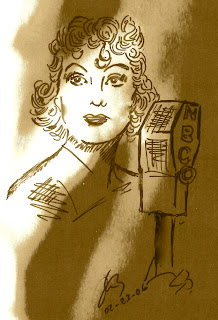
NBC’s ear Candy being stashed away in the keep of matrimony, that 1950s signpost of homebound subordination, of picket-fenced in independence, the lovely voice of Natalie Masters—who was married to the program’s producer—simply dissolved in tears as she accepted the ring and the retirement plan that came with it. That’s what I call giving your devoted followers the third finger, left hand.
A year later, realizing that Candy’s death by marriage might have been premature, producer Monty Masters gave the gal a new if still bell-ringing number (Yukon 3-8309) and tried to start all over again, keeping the police lieutenant and cancellation at bay. “Every time we even get near the subject of matrimony, Mallard ducks,” Ms. Matson sighs as if her marriage had never happened. By that time, however, it was a case of an admiring crowd divorcing the medium. Broadcasters, sponsors, and manufacturers alike began courting a public eager to get a load of the kind of candy that radio had been dangling before their mind’s eye. Boy, did they get the wrong number!
 Harry Heuser