“The lights have gone out!”: Commemorating One Hundred Years of Plays for Radio

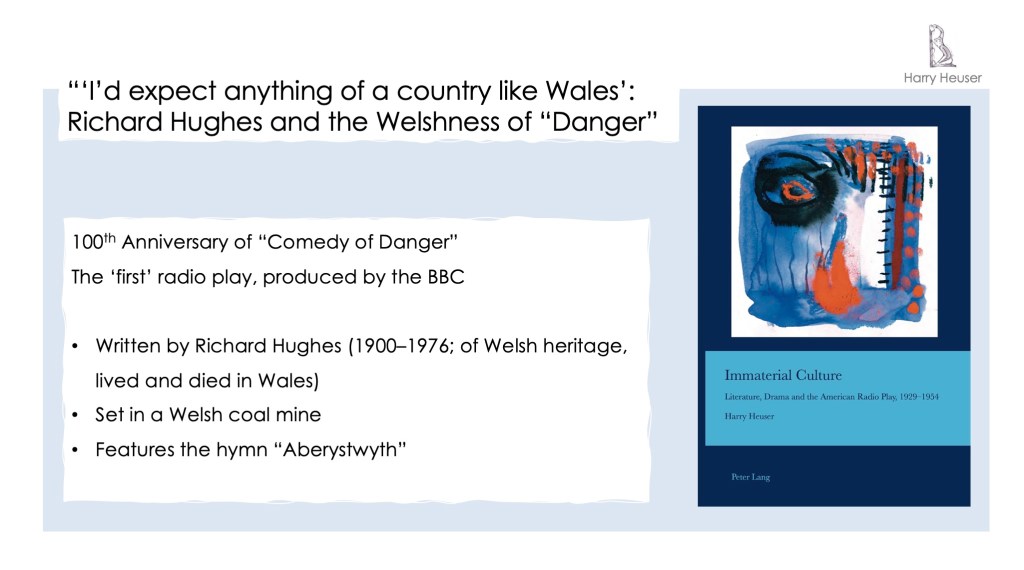
First slide of my presentation

Taking the radio play to the library has long been an ambition of mine, given that dramatic and literary works written for the medium of sound broadcasting occupy comparatively little space on the bookshelves.  Taking the first of its kind to a national librarythe National Library of Wales, no less—is a chance of a lifetime amounting to poetic justice.  Allow me to shed a modicum of light on that, and on my benightedness besides.

So that meaningful conclusions may be drawn from my peculiar challenge of commemorating one hundred years of radio dramatics in just a few minutes, it strikes me as essential that the centenary first be quartered, a fate I hope to escape on 22 February 2024, the date set for the event.

Continue reading ““The lights have gone out!”: Commemorating One Hundred Years of Plays for Radio”

Undone and Dusted: The Long Art of Christopher Williams

“Glory be to God for dappled things,” Gerard Manley Hopkins famously exclaimed—in a poem, no less, that was first published some three decades after his death. The delayed recognition he received makes us now think of Hopkins as a modern poet rather than a Victorian one. Brought to light in the darkest of days, his words spoke to an inglorious post-World War world so different from the perfectly imperfect one he knew that he could hardly have anticipated it. And yet, anticipate us he did—and “[a]ll things counter, original, spare, strange.” Secure in his belief in the One “whose beauty is past change,” Hopkins could revel in all that is “fickle, freckled (who knows how?),” in a life that is protean, fleeting and undone—the ever unfinished and often dirty business of living reconciled to our longing for perfection, permanence, and the eternal.


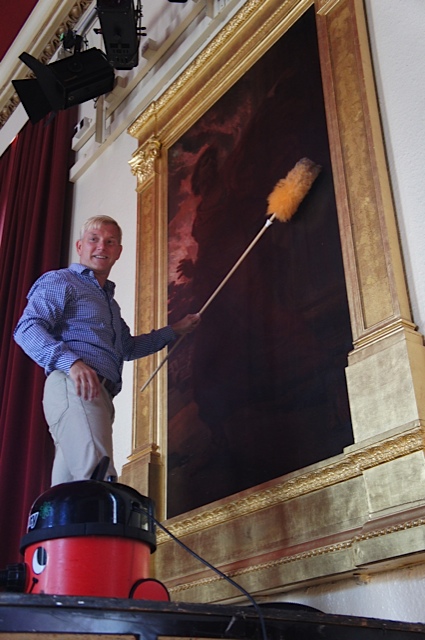
“Glory,” I wanted to shout, for dusty things, for art so long that no one in a single lifespan can ever be done with it—and for a chance to dust off works neglected and ignored to bring them to life anew. Not because they are perfect, not because they are classic or timeless—but because, in all their sketchiness, patchiness and almost-but-not-quiteness, they remind us—and glorify—the long and short of life: the clouds on the horizon, the waves hitting the rocks, the light of the ever setting sun on ancient mountains.

I was too busy tackling the dust (and keeping my mouth shut not to take it in) to wax philosophical and shout then—but I do think and feel it now when I look at some of the smaller canvases of Christopher Williams (1873-1934), a once well known artist, and native of Wales, whose forgotten and, in many cases, never before exhibited works I had a small part in putting back on public display here at the National Library of Wales in Aberystwyth.

Far more than Williams’s monumental paintings of momentous historical, mythological, and biblical themes, which belong to an age fast fading in his day, what is glorious to me are his studies of sea, sky, and rock—of the mutable majesty, the perennial transience of nature that he sought to encapsulate while working against time: the dying light of day, the waves against unwavering cliffs, the clash of the evanescent with the apparently everlasting. 

A few years ago, when I knew little of Wales and less of Williams, I visited one of the spots along the coast he had painted and compared what I saw to what he had depicted. The rocks were the same all right, but the sea and the sky looked nothing like the painting. Had he painted what he wanted to see, wanted us to see, or remembered seeing? Years later, when I returned to the same scene, the sea was turquoise, the sky cerulean—it was as Williams had pictured it. Only then did I appreciate the long hours he must have spent studying the light and the colors it creates. What was before him was fleeting—what is before us is unfinished—but what his quick brush transported one hundred years into his future is the product of a study far from cursory. Perhaps it takes a knowledge of the presence of something past change to see past the unchanging and glory in the changeable.

And there they are now, on view for a short while (until 22 September 2012), these past glimpses of change, these small studies alongside his finished—staid, staged and stately—compositions I helped to ready for the big show. Not that the project is done and dusted, as, together with my partner, Robert Meyrick, the curator of the present retrospective, I shall be co-authoring a book on the artist’s life and work . . .

Bloodshed: Did Freddy Kruger Slay Cocteau?

It can do serious damage to one’s sensibilities. Popular culture, I mean. I sensed its deadening force tonight when I attended a screening of Jean Cocteau’s first film, Le sang d’un poète (1930). It was shown, together with the Rene Clair short Entr’acte (1924), at the National Library of Wales here in Aberystwyth, where it was presented with live musical accompaniment by composer Charlie Barber, who also conducted. However animated the score, the images left me almost entirely cold. Why? I wondered.

There was a time when I was thrilled—or at least tickled—by surrealism. Reproductions of Magritte’s paintings lined the walls of my room. In my drawings and watercolors, I ransacked the surrealist inventory, ripping off Dali’s shadows and reshaping the landscapes of Tanguy and de Chirico. Getting experimental with the camera, I posed in front of designer-cracked mirrors, something standing in for blood oozing from my cheek or brow. That was just about the time when early 20th-century art was being reprocessed on MTV, in music videos and horror film franchises like Phantasm, A Nightmare on Elm Street, and The Evil Dead. This New Wave swept over and wiped out what was once avantgarde but nowadays generate about as much excitement as a can of Campbell’s soup.

Our jaundiced eyes have stared down a multitude of visual assailants. How many times can you be surprised by a mirror turning into a pool of water, startled by violent juxtapositions, or amazed at facile paradoxes? How long does it take to turn an outrage of images into an outage of imagination? Video, it seems, killed something other than the radio star.

Popular culture can make Cocteau’s Poet look like Mr. Potato Head. It exterminates the life of art in the very process of reproduction. Was it this frustration with the fading power of pictures that made me turn to the non-visual arts, to broadcasting in the pre-television age? If so, video did not kill the radio star after all. When you run those digital pictures until the recycled blood on the screen runs dry, you might begin to hunger for a blank slate on which to give new expression to your personal terrors and intimate desires.

Give the poet in you a blood transfusion by taking your eyes from the plasma screen. Close them a while . . . if you have the sang-froid to open your mind’s eye to such a world of possibilities.