
"This . . . is London": Casting John Donne’s Shadow

If Gothic Nightmares at the Tate Britain failed to send shivers down my receptive spine, the National Portrait Gallery’s Searching for Shakespeare sure did nothing less. I am generally not one to wax poetic at the sight of artefacts that may or may not have belonged to some literary so-and-so. For the most part, I don’t really care what a writer looked like, as long as his or her prose or poetry is to my liking. To be sure, having studied and taught Shakespeare during my college and university days, I am sufficiently impressed by the sight of an old Folio edition. Something else caught my mind’s eye at that exhibition; and it was not one of the supposed likenesses of Shakespeare—many of which have long been proven spurious—but the portrait of one of his contemporaries.
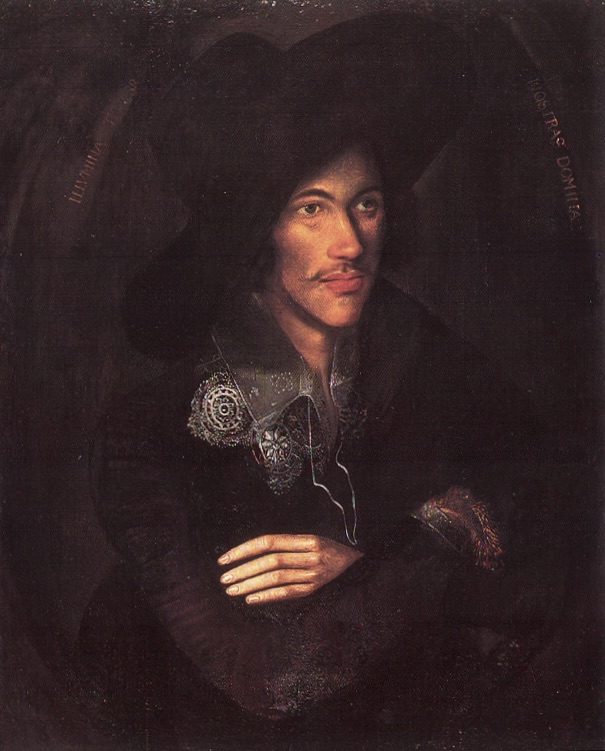
Portrait of John Donne by an unidentified artist (c. 1595) National Portrait Gallery, London

The portrait in question is that of John Donne, a painting currently being offered to the National Portrait Gallery, which is trying to raise funds in the amount of £1,652,000 to obtain it before the purchasing opportunity expires at the end of May. So, the picture now hangs in the Shakespeare exhibition, where visitors have to pay to get a glimpse of it. It is well worth a glimpse, I assure you. I confess the pleasures I derive from being moved by a work of art, whether considered trifling or momentous, and it is not rare that I stand before a painting with tears welling in my eyes or goose bumps sprouting on my skin. Composed by an unknown artist around 1595, the Donne portrait is decidedly of the gooseflesh variety.

It is in poems like “His Picture” and “Witchcraft by a Picture” that Donne speaks to us about attempts at portraiture, about the art or hubris of capturing life, the act of imitating nature or surpassing creation—troubling thoughts for a former Roman-Catholic growing up in the turmoil of the Reformation and its sanctioned smashing of images. In the former poem, Donne writes:

I fix mine eye on thine, and there
Pity my picture burning in thine eye;
My picture drown’d in a transparent tear,
When I look lower I espy;
Hadst thou the wicked skill
By pictures made and marr’d, to kill,
How many ways mightst thou perform thy will?

But now I’ve drunk thy sweet salt tears,
And though thou pour more, I’ll depart;
My picture vanished, vanish all fears
That I can be endamaged by that art;
Though thou retain of me
One picture more, yet that will be,
Being in thine own heart, from all malice free.

In the latter piece, Donne suggests the mental image and the imaged man to be at odds; a painting is a memento mori, which, fixed in time, turns into an unlikeness of fleeting life.

Here take my picture; though I bid farewell,
Thine, in my heart, where my soul dwells, shall dwell.
‘Tis like me now, but I dead, ’twill be more,
When we are shadows both, than ’twas before.

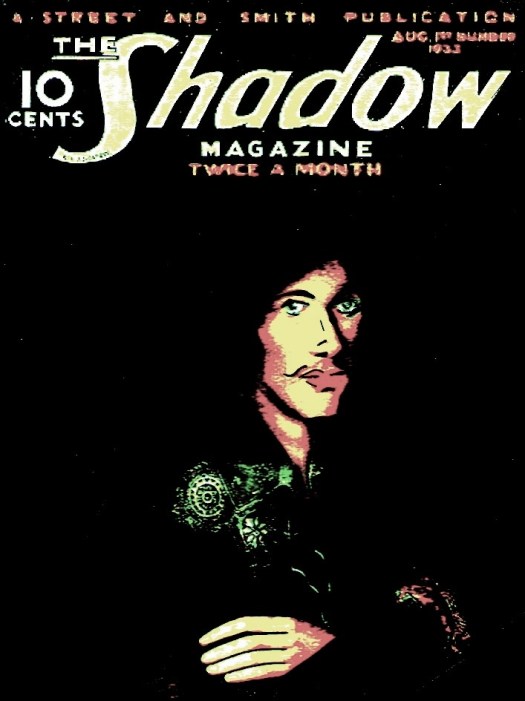
To his own portrait, lost and mislabeled for centuries, Donne referred as “that picture of mine which is taken in shadows.” In my irreverent mind, the striking features of Donne’s shadow-cast face began to resemble that of The Shadow, Lamont Cranston—the secret avenger who, striking hidden from view, laughed death in the face and had a sermon for all who dared to defy the law: “The weed of crime bears bitter fruit.”

Sermonizing Donne, who once wrote “A Lecture upon the Shadow,” approached the challenge of death in one of his most famous sonnets:

Thou art slave to fate, chance, kings and desperate men
And dost with poison, war and sickness dwell,
And poppy or charms can make us sleep as well
And better than thy stroke; why swell’st thou then?
One short sleep past, we wake eternally,
And death shall be no more; death, thou shalt die.

Donne’s portrait has captured my imagination; yet, having too often crossed—and all but crossed out—the uncertain boundaries between high art and low, it is The Shadow who now runs away with it. In my mind, I hear Lamont Cranston’s defiant laugh as I gaze at the poet’s likeness, “taken in shadows.”

"This . . . is London": "Searching for Shakespeare" at the Novello, the National Portrait Gallery, and on My iPod

Well, I hardly need to travel all the way down to London to go in search of him. After all, the man—or a stained-glass likeness of him—looks over my shoulder each time I fetch a volume from my bookshelves. His raised eyebrow and faint smile seem to say, “Come now, there must be something else beside radio drama to pique your interest.” For some time now, Shakespeare’s works, along with those of many other acknowledged topnotchers of western prose and poetry, have been relegated to the shelves upstairs to make room for my growing collection of books on American broadcasting and radio dramatics. Yet the bard need not consider himself debarred; even on American radio, he enjoyed a prominent position.

The Radio Guild, the first major American drama anthology for the airwaves, chose Romeo and Juliet for its premiere back in 1929. Subsequently, Orson Welles brought his acclaimed production of Julius Caesar to radio’s Mercury Theater (as discussed here), the irreverent Norman Corwin invited audiences to “[s]tand by to hear a Dane evaporate” as he faded out a production of Hamlet, and the CBS Radio Workshop went so far as to stage an interview with the playwright to investigate just “who wrote the works of William Shakespeare?”

As has often been argued, few dramatic works are as radiogenic as Shakespeare’s plays. They were written for the “wooden O” of an almost bare stage and, though hardly without action, rely much more on the spoken word than the elaborate masques, pantomimes, and melodramas of subsequent generations of playwrights.

When Shakespeare is translated for the contemporary boards, for big screen or small, text is often in competition and at times at odds with context, as costumes and stagecraft conspire to make the spoken word sound dated or the settings seem anachronistic. On the other hand, producers who opt for the blank canvas of a stripped stage in an effort to let Shakespeare’s words speak for themselves, give the eye so little to play with or feast on that they might as well lead us to the theater of the mind by handing out headphones and recordings.

The Royal Shakespeare Company production of As You Like It, now playing at the newly refurbished Novello Theatre in London’s West End, reduces the forest of Arden (or Ardenne) to a single tree. Yet it proves entirely sufficient to suggest a pastoral setting, to allow for some hide and seek among lovers, and to give poor Orlando, pining for his Rosalind, the requisite branches on which to pin his clumsy (and double entendre peppered) verse:

If a hart do lack a hind,
Let him seek out Rosalind.
If the cat will after kind,
So, be sure, will Rosalind.
Wintered garments must be lined,
So must slender Rosalind.
They that reap must sheaf and bind,
Then to cart with Rosalind.
“Sweetest nut hath sourest rind,”
Such a nut is Rosalind.
He that sweetest rose will find
Must find love’s prick, and Rosalind.

Orlando, of course, doesn’t altogether mind the prick of Rosalind (charmingly portrayed by a somewhat Ellen DeGeneresque Nia Williams); professing to cure his aching heart, she makes love to him while disguised as Ganymede, a simulated shepherd whose name spells boytoy of the gods. To be sure, the gender illusions of dramas designed for an all-male cast play out differently for today’s audiences (unless those of the all-male Propeller Company, whose production of The Winter’s Tale I saw last December). It is in these explorations of gender that radio can be more sophisticated and mature by being less provoking.

Non-visual theater can either obscure differences and tone down what may strike some as Charley’s Auntics and encourage us to look past gender markers like skirts and trousers to discover the humanity underneath. As cross-dressing all but fades into thin air, the sexual confusions take on a new subtlety, however drastic the cuts and unfortunate the synopsizing. Hear for yourself in Margaret Webster’s soundstaging of As You Like It, which was produced by the Columbia Workshop on 7 December 1939, and in which Webster gives her vocal chords a winningly understated if all too brief Victor/Victoria workout.

Regrettably, the single-trunk woods where Orlando woos Rosalind will be felled this weekend, when the Novello will stoop so low as to present an adaptation of the faux ’60s musical Footloose. If you care to go “Searching for Shakespeare” elsewhere, there is an exhibition of artifacts and portraits on display at the nearby National Portrait Gallery, my impressions of which I shall share tomorrow.