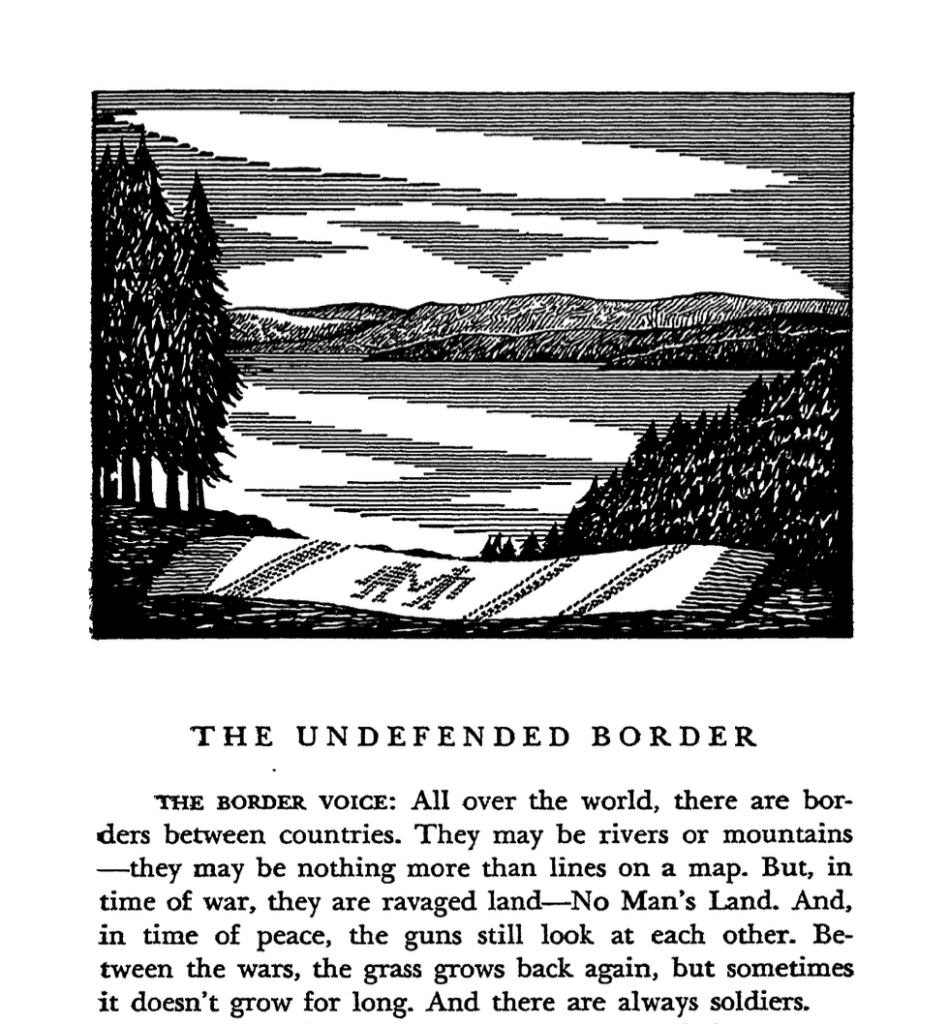
“There is a [loose] cannon”: Stephen Vincent Benét’s “Undefended Border” Revisited

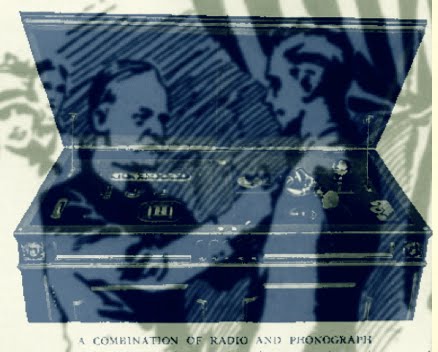
The published script as it appeared in We Stand United, an anthology of radio plays by Stephen Vincent Benét and “decorated” by Ernest Stock.

I commenced this journal back in 2005.   It was intended as a continuation of, and promotional vehicle for, my doctoral study “Etherized Victorians: Drama, Narrative, and the American Radio Play, 1929–1954.”  Its title, broadcastellan, was meant to declare me to be keeper of a vast Luftschloss—a neglected alcazar of the air, immaterially composed of numberless radio recordings I determined to play back.

As of this post, broadcastellan is nearing its twentieth anniversary.  While I do not take this as an opportunity, let alone an excuse, to reissue older posts, I nonetheless wonder: When history seems to be repeating itself, perhaps I may be justified to do the same, if only to demonstrate that not every “been there” necessarily translates into a feeling of “done that,” and that not all twice-told tales are a rehash—not, at least, when you approach them from a perspective that has profoundly, even fundamentally, changed along with the context, your life experience and your attitude toward the world.

I devoted one early entry to “The Undefended Border” (1940), a play by Pulitzer Prize-winning poet Stephen Vincent Benét (1898–1943).  Revisiting it now, in the age of the MAGA tariff wars and annexation threats, I cannot but think of the loose cannon that is recklessly flouting, or at any rate tarnishing, the legacy of the rusty “lone cannon” commemorated in Benét’s play.

Continue reading ““There is a [loose] cannon”: Stephen Vincent Benét’s “Undefended Border” Revisited”

For the Record: Lindbergh and the Electrola

Announcer Graham McNamee called it the “most terrific broadcast [he] ever took part in.” He was referring to NBC’s on-the-spot coverage of Colonel Charles L. Lindbergh’s return from France to the United States on this day, 11 June, in 1927. It certainly was a technical achievement worthy of “this new world hero, this new ambassador of America to all other countries,” as McNamee heralded the “unassuming, quiet boy” who was anxiously awaited “not only the crowd of us ordinary folks but the cabinet of the President of the United States, high officials of the army and of the navy [. . .].”

According to the September 1927 issue of Radio Broadcast, NBC’s coverage of the event set a “new record,” requiring fourteen thousand miles of “wire line” and involved three-hundred and fifty engineers.

Now, the figures differ depending on who does the counting and recounting. In Empire of the Air, for instance, Tom Lewis claims it took twelve thousand miles of wire and four hundred engineers. But never mind those figures now—or the fact that the figure of Lindbergh itself differs now that the man must be held accountable for his fascist views and Third Reich sympathies. It was an historical event on and in the air, in aviation and broadcasting alike.

Awarding him with the Flying Cross, President Coolidge called Lindbergh a “[c]onqueror of the air and strengthener of the ties which bind us to our sister nations across the sea.” When it came to strengthening ties, the public-conquering airwaves were second to none. Not only was NBC’s coverage of Lindbergh’s return home the biggest network hookup to date, it was also, as McNamee reminded listeners, “the first time band music or music has been transmitted from the Atlantic coast to the Pacific coast, which is another epoch.”

As columnist John Wallace argued in the September 1927 issue of Radio Broadcast, the

making known of great national events, while they are actually taking place is, after all, radio’s unique contribution, and the one field in which it reigns supreme without competition from phonographs, theaters, churches, or newspapers.  And it is greatly to radio’s credit that it does this job so thoroughly and well.

Seizing the day, NBC may have rather overdone its coverage of the “hullabaloo incidental to Lindbergh’s arrival.” Commenting on the banquet given in the aviator’s honor, Wallace remarked that he

would have been quite content had all the speeches of eulogy been omitted and only that of the flyer broadcast.  Never have we heard worse blah sprung at a banquet, and sprung by such eminent leaders, divines and statesmen!

Aware that his was no doubt a minority report, the journalist added that “the nation as a whole was interested in every and any detail of the flyer’s reception and credit must be given to the National Broadcasting Company for slipping up on no smallest part.”

What, though, of all those who were unable to be part of that moment because they were away both from Washington, D. C., where the celebrations took place, and from the wireless? Able to annihilate space, radio was nonetheless time-bound. Given the “ephemeral” nature of broadcasting, the effort and money set aside to capture and yet not hold this historic moment seemed almost perverse:

Thousands of dollars are spent to engage talent, wires covering half a continent are hired, advertising is scheduled in newspapers, several studio rehearsals are held, and finally the elaborate program is put on the air. For an hour it lasts but it can never be repeated. If you did not hear it, all the king’s horses and all the king’s men couldn’t put it into your loud speaker again.

For some time, radio listeners had been able to appreciate the voices of their radio favorites on their phonographs. Not only could they take home Sam ‘n’ Henry, Vaughn De Leath, or the Happiness Boys—radio had made that happen—but they could hold and keep them there. “A very great number of well-known radio artists are regularly recording for each of the important phonograph companies,” Radio Broadcast pointed out—and supplied a list of

fine recordings made by the favorites of the Atwater Kent hour, and the famous artists of the Victor, Brunswick and Columbia hours. As for the jazz bands, the comedy duos, and other entertainers with a more local fame, they, too, are forever at your beck and call on the black discs.

What makes the festivities in honor of Lindbergh’s return to America another milestone in the history of radio is that, for the first time, phonograph records of the live broadcast were made available for sale. As Radio Broadcast reported,

Victor has the distinction of pioneering and they offer three double-face records of the national welcome to Colonel Charles A. Lindbergh at Washington. On these three records you have the voice of President Coolidge, the interspersed announcements of Graham McNamee, a short address by Colonel Lindbergh, and his longer speech at the National Press Club. It’s all there and if you close your eyes, it isn’t hard to imagine that the events are just taking place.

True, what has been preserved for us is an edited copy of the live event; the “ceremonies were recorded on forty-six record surfaces” and “edited down” to six. True, editing is judging what matters; it is, to a degree, falsification, intentional or otherwise. Still, without the technology available back then, without the efforts of those broadcasting pioneers, I would not be writing about radio today.

As much as I at times deplore my second-hand experiences, my removal in time and space from thrilling events and fascinating personages, I, as a belated auditor, am indebted to those records. And I am grateful, too, for the “new record” in aviation that marked the beginning of an age in which sound was no barrier.

Related recording
Graham McNamee on Lindbergh’s return to America (11 June 1927)
Recollections at 30, featuring the 11 June 1927 broadcast (26 December 1956)

Hush, Hush, Charlotte Greenwood

You’re sorry?” That was the rather pitiful catchphrase devised for a certain “lovable lady of stage, screen, and radio”—Miss Charlotte Greenwood, who, having done well for herself on stage and screen, added “radio” to her resume in June 1944, when the Charlotte Greenwood Program was first broadcast over NBC’s Blue network as a summer replacement for Bob Hope. Actually, Greenwood had been Mrs. to Mr. Martin Broones for nearly two decades; but whenever another character in her serialized situation comedy addressed her as Mrs.—an assumption based, no doubt, on her far from youthful appearance—and apologized after being duly corrected, Greenwood replied in the fashion of a frustrated spinster by letting off the above retort.

Sorry, indeed. In the fall of 1944, when Hope returned to the airwaves, Greenwood was presented with a vehicle that—after the disappointment of not starring in Oklahoma!, in a part written expressly for her, no less—must have been as thrilling to her as walking off with the unclaimed favors from a cancelled party. It sure wasn’t a surrey with a fringe on top. There’s no way you could confuse that fabulous Broadway hit with the miss that was The Charlotte Greenwood Show (1944-1946), even though the compiler of one Encyclopedia of American Radio did just that, claiming the lovable one was starred “as eccentric Aunty Ellen [sic] from Oklahoma.”

Instead, Charlotte Greenwood was playing Charlotte Greenwood—an actress preparing for her next movie role as a reporter by womanning the desk in the local room of a small-town newspaper. So, for about two and a half months, Greenwood talked long-distance to her manager in Hollywood or had some confrontation or other with the city editor.

Greenwood should have spent more time talking to the show’s head writers—Jack Hasty, who, as stated in the April 22-28 issue of Radio Life (from which the above picture was taken) had previously fed lines to Al Pearce and Dr. Christian, and Don Johnson, who had been one of Fred Allen’s gagmen. Else, she might have had a heart-to-heart with her real-life manager, who also doubled as her real-life spouse. And they all should have had a word with the sponsor, or, rather, the advertising agency handling the Halls Brothers account, since their executives insisted on having a card like Greenwood dispense sentiments as hackneyed as anything printed on cardboard bearing the Hallmark label:

“Friends,” she addressed the listening public in November 1944, a couple of weeks before Thanksgiving,

for most of us, these busy days are filled with big jobs to be done, big problems to be solved.  There’s so little time for the tiny, little everyday things.  The neighborly chat, the letter to an old friend.  And yet, in this swiftly moving world, friendship need not be forgotten.  A few words that say “I hadn’t forgotten” may mean more than you know to someone, somewhere.  There’s an old saying I think all of us should remember: The way to have friends is to be one.

More offensive than such platitudes is the opportunism apparent in advertising copy urging home front folks to drop a line to those on the frontlines, like this reminder from October 1944:

Friends, there has never been a time when so many families were disunited, separated by thousands of miles from those they love.  Our top-ranking officers have told us again and again, there’s nothing so important to our boys and girls as mail from home.  So, look around you today.  Think of some boy or girl out there who would like to hear from you—and do something.  Send something [. . .]

It was left to announcer Wendell Niles to suggest that the “something” in question ought not to be just anything, at least not if listeners truly “cared to send the very best.”

Quite early on in the program’s run, there must have been some debate about its appeal and prospects. As the year 1944 drew to a close, Charlotte Greenwood’s fictional film career came to an abrupt end—as did her musical interludes that had enlivened proceedings—when her character claimed an inheritance that convinced her to retire. The enticement? The Barton estate, replete with a trio of orphans now in her charge.

“You mean, to have three children, all I have to do is just read and write?” Greenwood exclaimed on 31 December 1944. “Oh, judge, isn’t education wonderful!” Perhaps, producers counted rather too much on the lack of education among the viewers. The advent of the minors sure wasn’t a belated Christmas miracle—and the retooled Greenwood vehicle was no immaculate contraption.

Softening the quirky Greenwood persona by placing three orphans in Aunt Charlotte’s lap, the sponsors may well have hoped to win the ratings war by riding the wave of popular sentiment as the all but certain victory in Europe had public attention shift from defeating the enemy and supporting the troops to dealing with the underage casualties of war.

For the remainder of the program’s run—another year, to be exact—Greenwood had do deal with the problems of two teenagers (played by Edward Ryan and Betty Moran) and their prepubescent sibling (Bobby Larson), who, on this day, 3 June, in 1945, gave his Aunt Charlotte some slight grief by being late from school.

Actually, the kid’s temporary waywardness was little more than an occasion for the writers to string together a few cracks about spanked bottoms (“[H]ow can you get anything into a child’s head by pounding the other end?”) and double entendres involving the meaning of “play.”

Not sure whether to punish young Robert for having stayed out “with some boy,” as his sister suggests, Aunt Charlotte remarks: “I know a girl who’s spend her whole life trying to find some boy to play with. Mr. Anthony [the Dr. Phil of his day] called her ‘The Case of Miss C. G.’ It was very touching.” To which she adds for our but not her niece’s amusement: “And what’s more, thirty thousand privates picked her as the girl they’d most like to see marooned on a desert island with their top sergeant.”

Without a consistent tone, let alone situations consistent with the talents of the beloved comedienne, the program’s legs were far shorter than Greenwood’s interminable gams. Apparently, the figures added up as the laughs per episode, which is to say, not. “Well, I’m no expert on arithmetic either,” Charlotte’s on-air alter ego told the nephew she could not bring herself to spank. “If I knew anything about figures, would I keep the one I’ve got?”

Those who did the accounts decided not to keep what they got—and that despite the fact that the series earned Greenwood a star on the Hollywood Walk of Fame. Instead, as Billboard correctly predicted on 22 December 1945, the Charlotte Greenwood Show would “fold as soon as cancellation [could] take effect”—well before the end of the second season—after the sponsor had decided to take over the Reader’s Digest program from Campbell’s.

Charlotte Greenwood left radio, returned to the screen—and, in 1955, she did get to play Aunt Eller after all. You’re sorry?

Many Returns, Mostly Happy: Toscanini at NBC

“I want you to go to Milan and get him. The American radio listener deserves the very best in music. All we can lose is a few weeks of your time and the expenses of the trip. No more cables. Get on a boat.”

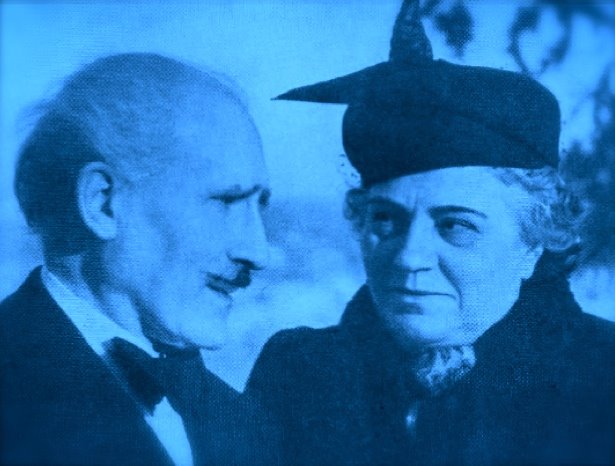
Toscanini and his wife, Carla De Martini

That is what, back in the fall of 1936, RCA president and NBC chairman David Sarnoff told New York Post music critic Samuel Chotzinoff, whom Sarnoff made musical director at NBC. The man that “Chotzy” was to go “get” was none other than the legendary Arturo Toscanini, born on this day, 25 March, in 1867. Earlier that year, Toscanini had announced his retirement from the New York Philharmonic Symphony Orchestra and, on 1 March 1936, he had conducted what he meant to be his final radio concert as guest conductor of the General Motors Symphony. Nearly seventy, Toscanini could hardly be expected to jump at the opportunity of raising his baton in a series of weekly broadcasts; but that is just what General Sarnoff had in mind.

Chotzinoff, who was a friend of the temperamental Maestro and later recalled his career in the somewhat less than faithful Intimate Portrait, sailed for Europe to make Toscanini an offer he could not refuse. He was promised an orchestra “hand-picked from the finest virtuosi available,” along with the enticing sum of $40,000, and the added perk to have his income tax paid by the network.

According to radio historian Thomas DeLong, it took a shrewd businesswoman, Toscanini’s wife (pictured above with her husband), to convince Arturo that it was worth his while to return to the US. The best part of the deal, though, was getting away from Mussolini, whom Toscanini openly despised.

The first of the Saturday evening concerts, broadcast live from studio 8-H at Radio City, New York, was heard on Christmas in 1937. As Francis Chase wrote in the October 1938 issue of Radio Stars, a studio audience of

over 1,400 persons sat breathless as the white-haired, flashing-eyed, dynamic little figure of Toscanini mounted the podium before one of the greatest symphony orchestras ever assembled; certainly the greatest ever presented wholly for the radio audience.  The finest instrumentalists from many great American orchestras sat beneath the master’s baton, while in the brilliant audience, listeners hardly breathed.  There was not the faintest rustle of a program (so that no slightest sound should mar the transmission, programs had been printed on silk).

Less attention was paid to the studio acoustics, which, as B. H. Haggin argues, were “unresonantly dry, flat, hard and made airlessly tight by the audience which filled the studio.” That did not stop the perfectionist from demanding the best from his orchestra, and, judging from the rehearsal recordings shared on NBC’s Biography in Sound tribute that aired on the day after Toscanini died, the Maestro was fierce in his criticism. “Do you believe that I am crazy?” he asked the performers, not waiting for a reply. “No,” he insisted, “sensitive.”

Year after year, the aging and only very gradually mellowed Toscanini vowed to retire—but for seventeen seasons he returned to the studio until, on 4 April 1954, he stepped from the podium for the last time; having faltered and dropped his baton during a performance temporarily taken off the air and replaced with recorded music, Toscanini walked off before the orchestra had played the final chord. He was eighty-seven years old.

The stick with which he conducted the NBC orchestra (if not always too well), must have been a kind of crutch to Toscanini. It enabled him to hold together a body of artists at an age when most men can barely keep their own from falling apart.

Related recordings
“The Man Behind the Legend: A Tribute to Arturo Toscanini,” Biography in Sound (22 January 1957)
Beethoven, Symphony No. 5, NBC Symphony Orchestra, (probably 11 November) 1939

“. . . a world between two sounds”; or, the Librarian Who Turned Up the Volume(s)

I could not have faulted anyone for brushing me off with a terse “none of your lip,” considering that my kisser had taken on the appearance of an over-boiled frankfurter abandoned during a picnic invaded by flesh-eating ants. 

Luckily, sight at the time mattered less than sound, and the painkillers had not entirely divested me of whatever powers of articulating my ideas I yet possess. Yesterday morning, during a meeting with administrators at the local university, interest was once again expressed in a course I had proposed a few years earlier. I fancifully titled it “Writing for the Ear,” which was meant to distinguish the module from more traditional classes in radio writing as they are still being taught here in Britain.

I had previously turned down an offer to teach a course in writing for the medium, as I have no experience in developing scripts aimed at those in charge of productions at the BBC.

Besides, today’s technology makes it possible for anyone to have a voice in the forum, to podcast talks and engage in sonic experimentation. With these opportunities in mind, I outlined a course exploring the relationship between the spoken and the written that would make those who express themselves typographically alive of the value of sounds and the potentialities of silences.

Too much of the most eloquent prose and sonorous poetry is being silenced. Words written hundreds of years ago are still being pored over, but they are far less frequently voiced and heard. In classroom and study, printed words are scrutinized, paraphrased, underlined, crossed out, and annotated; they are dissected like so many toads in the imaginary garden, well before they get a chance to let out a single distinctive croak.

Lending your own voice to written lines is an act of resuscitation—of breathing life into the thoughts of those who came before you, of triggering a startling echo in what was assumed to be a soundproof vault. Silences, too, speak volumes, especially when they enter into a dialogue with the spoken and the sounded.

Someone who had a lot to say on the subject of the word made sound was Archibald MacLeish, the Pulitzer Prize winning poet who, from 1939 to 1944 served as Librarian of Congress. Before being appointed Assistant Secretary of State for Public and Cultural Relations, MacLeish brought to radio a series of lectures titled The American Story. At a time of global conflict, the program was designed to emphasize

the experience in common of the American peoples, the story set down in the accounts of those who knew the American experience at first hand or were part of it. Whatever their race may have been, or their faith, or their language.

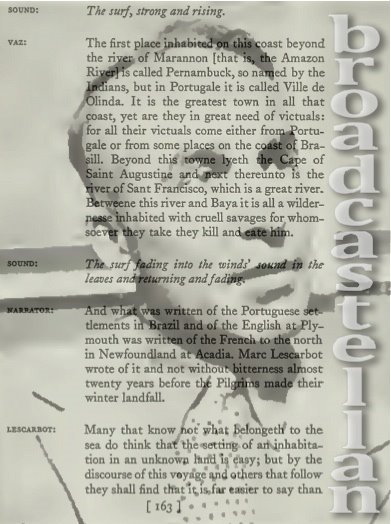
In other words, it took a scholarly approach to what Carmen Miranda accomplished in the conga line of duty. On this day, 18 March 1944, NBC presented “Between the Silence and the Surf,” the eighth broadcast in the series. It related the settlement of the Americas, from Plymouth (as recorded by William Bradford in the 17th century) to Brazil (as documented by Lopez Vaz in the 1580s). I recently rediscovered the program while digitizing my collection of audio tapes; the published scripts, meanwhile, have been shared online. The printed words bespeak the poet’s mission of giving voice to the lost and long unsounded, to lives shelved and shut away in our repositories of knowledge:

SOUND.  A slow surf, the hush of the waves withdrawing.

NARRATOR.  And the wind’s sound in the grass or in the brush or in the forests where they still must go.

SOUND.  The wind in the coarse grass and the solemn trees.

NARRATOR.  The world of the first settlements was the narrow world between the silence and the surf, between the water and the wilderness—between the past cut off by water and the future closed by distance and by danger—but not closed.

According to the April 1944 issue of Radio Age, MacLeish “poured an immense amount of painstaking research,” into this series; and in “addition to the laborious research and authentication,” he included the

most important fillip—his own brilliant style of the prose poem, a style which has won for him the accolades of the literary world. Each line read on the broadcast is a part of this poetic narrative style, giving each program a dramatic sweep so necessary in producing the effect desired.

Yet while the poet claimed to have aimed at creating “new forms of radio expression,” rather than adhering to the formats of “conventional radio drama,” critics were not uniformly enthusiastic, arguing the productions to be “overloaded with conversation” and “self-denyingly austere.” Such gainsayings are representative of the bias toward dramatization and dialogue as opposed to lecture or oratory, no matter how many individual speakers were employed to deliver it.

In the foreword to the published scripts for the series, MacLeish defended his minimalist approach by reasoning that “radio’s unique function and unique opportunity” was simply to convey speech instead of presenting words, “artfully blended” by means of “[s]killful devices,” to “produce dramatic effects”:

Because radio is limited mechanically to sound, and particularly to the sound of speech, radio is capable of a concentration of speech itself, the text itself, which can give words a life and a significance they rarely achieve outside the printed pages—and which they achieve there only for the most gifted and fortunate readers.

The word, to MacLeish, was the beginning and the end. As a documentarian and poet, he inhabited that “world between two sounds,” listening, recording, and readying himself to speak with force and deliberation. His American Story is the story of humanity’s struggles for survival, for voice and representation.

Our daily existence, like that of the first settlers, is this “narrow world between the silence and the surf,” between the calm and the roar, between tumult and tranquility.  Our lives are a string of moments waiting to be seized for having our say, periods of stillness, voluntary or imposed.  We may chronicle our times and leave behind piles of documents to be poured over or neglected by future generations; but it is the sound we make now and the space we leave for listening that define the present we must fill with meaning as we rage against the silence to which we are ultimately condemned . . .

NBC, CBS, and Abe

On the eve of the 200th anniversary of Abraham Lincoln’s birth, I am once again lending an ear to the Great Emancipator. Franklin Delano Roosevelt may have been America’s “radio president”; but in the theater of the mind none among the heads of the States was heard talking more often than Honest Abe. On Friday, 12 February 1937, for instance, at least six nationwide broadcasts were dedicated to Lincoln and his legacy. NBC aired the Radio Guild‘s premiere of a biographical play titled “This Was a Man,” featuring four characters and a “negro chorus.” Heard over the same network was “Lincoln Goes to College,” a recreation of an 1858 debate between Lincoln and Democratic senator Stephen A. Douglas. Try pitching that piece of prime-time drama to network executives nowadays.

Following the Lincoln-Douglas debate was a speech by 1936 presidential candidate Alf Landon, live from the Annual Lincoln Day dinner of the National Republican Club in New York. Meanwhile, CBS was offering talks by Lincoln biographer Ida Tarbell and Glenn Frank, former president of the University of Wisconsin. From Lincoln’s tomb in Springfield, Illinois, the Gettysburg Address was being recited by a war veteran who was privileged to have heard the original speech back in 1863. Not only live and current, the Whitmanesque wireless also kept listeners alive to the past.

Most closely associated with portrayals of Lincoln on American radio is the voice of Raymond Massey, who thrice took on the role in Cavalcade of America presentations of Carl Sandburg’s Abraham Lincoln: The War Years; but more frequently cast was character actor Frank McGlynn.

According to the 14 June 1941 issue of Radio Guide, Lincoln “pop[ped] up” in Lux Radio Theater productions “on the average of seven times each year”; and, in order to “keep the martyred President’s voice sounding the same,” producers always assigned McGlynn the part he had inhabited in numerous motion pictures ever since the silent era. In the CBS serial Honest Abe, it was Ray Middleton who addressed the audience with the words: “My name is Abraham Lincoln, usually shortened to just Abe Lincoln.” The program ran for an entire year (1940-41).

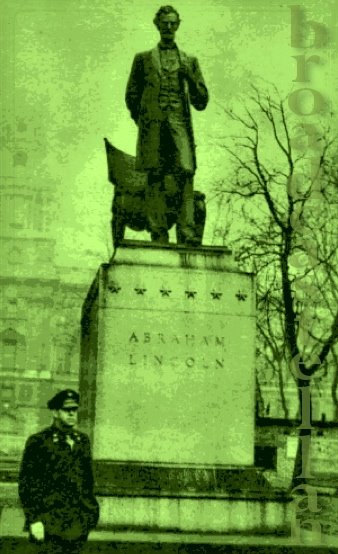
The long and short of it is that, be it in eulogies, musical variety, or drama, Lincoln was given plenty of airtime on national radio, an institution whose personalities paid homage by visiting memorials erected in his honor (like the London one, next to which singer Morton Downey poses above). Nor were the producers of weekly programs whose broadcast dates did not coincide with the anniversary amiss in acknowledging the nation’s debt to the “Captain.” On Sunday, 11 February 1945—celebrated as “Race Relations Sunday”—Canada Lee was heard in a New World A-Coming adaptation of John Washington’s They Knew Lincoln, “They” being the black contemporaries who made an impression on young Abe and influenced his politics. Among them, William de Fleurville.

“Yes,” Lee related,

in Billy’s barbershop, Lincoln learned all about Haiti.  And one of the things he did when he got to the White House was to have a bill passed recognizing the independence of Haiti.  And he did more than that, too.  Lincoln received the first colored ambassador to the United States, the ambassador from the island home of Billy the Barber.  And he was accorded all the honors given to any great diplomat in the Capitol of the United States.  Yes, the people of Harmony have no doubt that Billy’s friendship with ole Abe had more than a lot to do with it.

Six years later, in 1951, Tallulah Bankhead concluded the frivolities of her weekly Big Show broadcast on NBC with a moving recital of Lincoln’s letter to Mrs. Bixby. That same day, The Eternal Light, which aired on NBC under the auspices of the Jewish Theological Seminary of America, presented “The Lincoln Highway.” Drawing on poet-biographer Sandburg’s “complete” works, it created in words and music the “living arterial highway moving across state lines from coast to coast to the murmur ‘Be good to each other, sisters. Don’t fight, brothers.’”

Once, the American networks were an extension of that “Highway,” however scarce the minority voices in what they carried. Four score and seven years ago broadcasting got underway in earnest when one of the oldest stations, WGY, Schenectady, went on the air; but what remains now of the venerable institution of radio is in a serious state of neglect. An expanse of billboards, a field of battles lost, the landscape through which it winds is a vast dust bowl of deregulation uniformity.

Related recording
“They Knew Lincoln,” New World A-Coming (11 Feb. 1945)
Toward the close of this Big Show broadcast, Bankhead recites Lincoln’s letter to Mrs. Bixby (11 Feb. 1951)
“Lincoln Highway,” The Eternal Light (11 February 1951)
My Tallulah salute

Related writings
“Spotting ‘The Mole on Lincoln’s Cheek'”
”Langston Hughes, Destination Freedom, . . .”
A Mind for Biography: Norman Corwin, ‘Ann Rutledge,’ and . . .”
”Carl Sandburg Talks (to) the People”
“The Wannsee Konferenz Maps Out the Final Solution” (on the Eternal Lightproduction of “Battle of the Warsaw Ghetto”)

" . . . within the limits": Radio and the Code

“Will radio writing always be in demand? What will television do to radio writing? Why should anyone learn a new technique in writing when some unexpected development might wipe out the demand for this sort of work almost overnight? Is radio broadcasting basically sound? Will it endure and develop?” Such is the battery of questions with which readers eager for pointers on How to Write for Radio were being confronted upon opening one of the earliest books on the subject. The co-author of this 1931 manual, Katharine Seymour, was an accomplished radio playwright whose work was heard on prestigious programs such as Cavalcade of America. On this day, 12 January 1941, Seymour talked to announcer Graham McNamee about her experience entering the broadcasting business in the mid-1920s, back when it bore little resemblance to the confident, respected, and efficient medium it had become by the late 1930s, by which time Seymour had co-written another book on Practical Radio Writing.
Many such how-to guides followed throughout the 1940s, a testament to the vastness of the industry, its demand for written words and for talent familiar with the codes and regulations to which they were expected to adhere. In the 1920s, when Seymour tried to promote herself from typist to writer, she was told by her boss at WEAF, New York, that “no radio station will ever need more than one script writer,” to which shortsighted remark McNamee, himself one of the old-timers, responded with a resounding “Wow!”

The days of largely unchecked improvisation were over. Being obliged to keep their word, broadcasters had learned that the spoken word needed to become copy (that is, text) and that every dramatic dialogue had to be played by the book the FCC would otherwise throw at them.

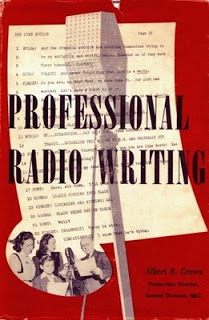
One of the latest addition to my library, Albert R. Crews’s Professional Radio Writing (1946), acquainted readers with what was known as the NAB code. As the author, then production director at NBC, explained, the code was a measure of self-censorship undertaken by the National Association of Broadcasters and adopted on 11 July 1939 to outline the “handling of children’s programming, controversial public issues, educational programming, news, [and] religious broadcasts,” as well as to set down the “acceptable length of commercial copy and its content.”

In keeping with this code, the National Broadcasting Company developed its own guidelines for “continuity acceptance,” “continuity” being anything read on the air. Anyone learning how to write radio drama with the view of hearing it produced had to keep in mind, for instance, that “[w]hite slavery, sex perversion or the implication of it may not be treated in NBC programs” and that the “fact of marriage must never be used for the introduction of scenes of passion excessive or lustful in character, or which are clearly unessential to the plot development.”

In the treatment of crime, the “use of horrifying sound effects as such” was “forbidden.” According to the code, no character was to “be depicted in death agonies,” nor could the “death of any character be presented in any manner shocking to the sensibilities of the public.” The very “mention of intoxicants” had to “be held to a minimum” and “suggestive dialogue and double meaning” was “never [to] be used.”

Responding to the hullaballoo over CBS’s “War of the Worlds” broadcast, NBC also stipulated that

[f]ictional events shall not be presented in the form of authentic news announcements. Likewise, no program or commercial announcement will be allowed to be presented as a news broadcast using sound effects and terminology associated with news broadcasts. For example, the use of the word “Flash!” is reserved for the announcement of special news bulletins exclusively, and may not be used for any other purpose except in rare cases where by reason of the manner in which it is used no possible confusion may result.

Was it any wonder that, as Crews put it, there had been a “tendency on the part of many outstanding writers in [the US] to scoff at radio as a possible medium for their talents”? Such talent-repelling strictures notwithstanding, he found it “heartening” to note just

how many writers of importance radio has itself created. There are dozens of highly skilled dramatic writers who are, for the most part, completely unknown to the public, but who each day do distinguished work in their field. The anonymity of such writers is no measure of their skill or their success.

It is with the efforts of those mostly unheard of and almost entirely forgotten writers that I shall continue to concern myself in this journal; writers who skillfully interpreted the code and somehow managed to subvert it, or who at least found leeway for play “within the limits” set down for them; writers whose works, to take up one of Seymour’s questions, have endured in recordings even if American radio drama, as an art, has largely ceased to develop further.

Having lost their purpose as instruction manuals for an essentially defunct business, books like Professional Radio Writing nonetheless instruct us how to read the plays that went on the air, to account for their limitations and appreciate their qualities.

The Lilt of the Lilliputian

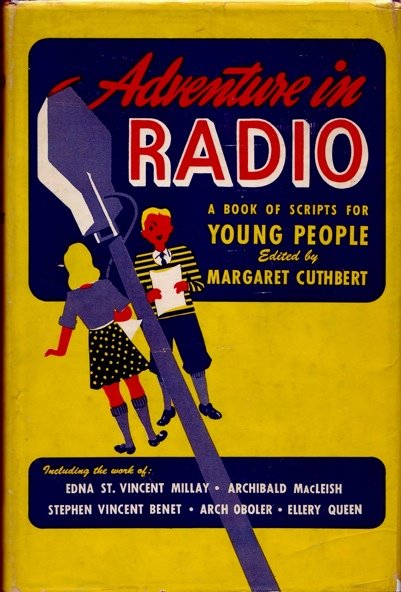
The cover of Adventure in Radio, from my collection

A few years ago, walking home from graduate school one afternoon, I stopped by at a second-hand bookstore in my old neighborhood of Yorkville, Manhattan. Judging from the window display, the shop seemed to specialize in children’s books and memorabilia. While this did not deter me, I hardly expected to make any significant acquisition of a volume on the subject to which this journal is chiefly devoted. I mean, I was not looking for a decoder ring or some such souvenir from the bygone age of radio dramatics. I was, after all, researching my dissertation. There was on the shelves a beautiful copy of Adventure in Radio (1945). Subtitled “A Book of Scripts for Young People,” it may be expected to include juvenile playlets written for the medium, although not necessarily produced on network radio. On such compilations, of which there are many, I was not inclined to waste money or time.

Spiting my assumptions, Adventure in Radio not only contains a number of broadcast scripts from programs like Jack Armstrong and Let’s Pretend but also propaganda plays and wartime commentaries geared toward an adult audience. In addition, it offers insights on the production of radio plays, on sound effects, announcing, and “radio language.” It took a little salestalk from the owner of the by now long closed store, but I was soon convinced. Where (I did not know much about eBay back then) would I ever find such a book again? And how could I claim to be serious about old-time radio if I did not snatch up this copy? So, I handed over my $40 (it was the price tag that made me hesitate) and walked off, eager to continue my studies . . . and determined to find the recordings to match the published scripts now at my fingertips.

That often proved quite difficult; but I had made up my mind that I was not going to write about words divorced from performance. I wanted to hear what was being done with those scripts, how they were edited and interpreted. Take the NBC University Theater’s production of “Gulliver’s Travels,” for instance. It was broadcast on this day, 24 September, in 1948. My appreciation of the challenges of soundstaging the play grew after reading the comments with which Frank Papp, a director of radio drama for NBC, prefaces the script, originally written for the series World’s Great Novels. Papp points out the “unusual problems” Frank Wells’s adaptation posed in production:

In the matter of casting, the Lilliputian was the most difficult.  Here was needed a voice which gave the illusion of a tiny man.  A trick voice in itself would be only a caricature.  What was required was a voice that created a picture of a real human being of Lilliputian size.  After extensive auditioning, an actor was found whose talent and vocal capabilities fulfilled these requirements.

The actor portraying Gulliver was placed in an isolation booth, Papp explains, “so that the Lilliputian’s voice would not spill over into his microphone” and the two voices could be miked separately, with a volume reflecting the size of each character. The voice of the King of Brobdingnag, meanwhile, was “fed” both through an electronic filter to amplify its base quality and through NBC’s largest echo chamber to create the illusion of a giant.

The 24 September 1948 presentation of “Gulliver’s Travels,” starring Henry Hull in the title role, does not quite live up to the expectations raised by Papp’s introduction. Under the direction of Max Hutto, child actor (Anthony Boris) is cast in the role of the Lilliputian, a choice that infantilizes the character and renders pointless the effects achieved by the sound engineer.

While Wells’s script downsizes Swift’s story and diminishes its bitterness and bite, it is the production that contributes to a sense that Gulliver’s Travels is, at heart, a juvenile fantasy, despite its airing on the ambitious if misguided NBC University Theater, a program that linked listening to such bowdlerizations with courses in distant learning. I may have been able to match the script with a production, but it was not the one described in Adventure in Radio.

Squeezed as I am into the isolation booth of my preoccupations, it is my mind’s voice that supplies the lilt of the Lilliputian . . .

On This Day in 1950: Chain-smoking Belle Gives Radio Mouth-to-Mouth

Well, let’s get out the matches. It’s time for some festive display of pyrotechnics. No, I am not responding to the news that Saddam Hussein has been sentenced to death for crimes against humanity. It is Guy Fawkes Day here in Britain, celebrated with rockets and bonfires lit in commemoration of a rather more decisive victory against terrorism than could be claimed in the Middle East: the foiling of a plot to blow up the Houses of Parliament in London back in 1605. “Remember, remember, the Fifth of November”:

Burn him in a tub of tar.
Burn him like a blazing star.
Burn his body from his head.
Then we’ll say ol’ Pope is dead.

As such inflammatory (and subsequently watered-down) rhymes suggest, this all occurred long before Islam came to define what many now so closely associate with terrorism. Then again, organized religion is never far from terror—and often the foundation or instrument, the cinder heap and match of it.

While no radical symbolism was intended, Guy Fawkes Day also marks the second anniversary of my move from the United States to Wales, which, in a symbolic act fully premeditated, was scheduled to coincide with the 2004 presidential election in the US: a leave-taking on a note of triumph or, as it turned out, a sorrowful singeing of bridges. But these political and personal anniversaries are rather beyond the scope of the broadcastellan journal, which breaks its never-on-a-Sunday tradition to salute a firecracker of a Southern Belle who knew how to make a display of herself, simply by lighting another Craven A, her cigarette of choice.

I have already cheered the tar-pitched voice of Tallulah Bankhead in my first podcast, a salute that was promptly answered by what struck me as a nod from the lady herself (as shared in the concluding paragraph of this entry); but another toast is quite in order, since it was on this day in 1950 that Ms. Bankhead made radio history with her debut as mistress of ceremonies for The Big Show, an unseen spectacular of unheard of proportions.

NBC’s Big Show was US broadcasting’s last major investment in aural entertainment. It was also an admission and a compromise: an admission that Americans did no longer take radio seriously enough to sit down for a longer piece of audio theater, and a compromise in the form of a ninety-minute variety program delivering songs, gags, and snippets of drama.

The inaugural broadcast featured old pros like Jimmy Durante and Ethel Merman, as well as newcomers including Danny Thomas and Jose Ferrer (in a scene from Cyrano de Bergerac). Also on mike for this premiere were semi-retired radio comedian Fred Allen, character actor Paul Lukas, and recording artist Frankie Laine. It was musical-variety gone hit-parading: a quick succession of acts introduced by an engaging and radiogenic personality.

This Sunday Night Live spectacular was well received by critic and audiences alike, even though it proved ultimately too extravagant to be at once effective in cost and consistent in quality in an age when money and talent were being siphoned into television, the new everyman’s home theater.

Short-sidedness aside, I don’t see why a variety program like The Big Show could not work on radio nowadays as something you tune in on a long journey or a dull evening to be turned on by contemporary singers, stand-up comedians, and a gaggle of celebrities promoting their latest movies, albums, or books.

Of course, there is no one to take the place of the hot-tempered Ms. Bankhead, a seasoned siren who, aware of the futility, the profligate waste of starting over—Tallulah rasa, as it were—managed to make use of an outmoded medium that allowed her to draw on a life in the limelight while keeping her out of it in prominent invisibility; to send her image up in smoke while firing barbs at the luminaries around her; and to become a breath of fresh air while all along indulging in the excesses of a malignant and much maligned habit.

So, if you got a match to spare, why not dim the lights, listen to the fabulous Tallulah, and spark up a candle (or a cigarette) in her honor!

On This Day in 1942: The Wannsee Konferenz Maps Out the Final Solution

An engagement with old-time radio need not be an escape from the world; it can be a return to the very realities we may have been desirous to avoid or void altogether. Listening to recordings of historical broadcasts can become a confrontation with the past, its representation, and, in the act of relating, with the present itself. Today, for instance, marks the anniversary of the Wannsee Conference at which, on 20 January 1942, the fate of eleven million European Jews was being debated and decided upon with the matter-of-factness and statistical precision known as the “final solution” (the minutes of which genocidal get-together can be found here). Few radio playwrights were as committed to representing the Jewish experience as Morton Wishengrad, whose 1942 play “The Battle of the Warsaw Ghetto” is as chilling and relentless as the calculated cruelty of the master(race)minding behind the massacre on which it comments.

Wishengrad, a prolific and politically engaged playwright whom noted radio actor Joseph Julian once called the only writer beside Corwin to have created a “body of radio literature that deserves a perennial life,” lets the record speak for itself in his chilling echo of fascist calculating and cataloguing—of a nation’s counting, counting down, and accounting of murder millionfold. In “The Battle of the Warsaw Ghetto,” first heard on NBC on the eve of Yom Kippur in 1943, the personal story of a holocaust victim, related from the grave, is reinforced by the sound of “black trucks” rolling out of the Ghetto to the concentration camps, by the three voices of fate (the three fates?) calling up the facts with a statistical precision that echoes the calculated ruthlessness of the acts planned and committed:

VOICE I. July 22, 1942.
VOICE II. Six thousand two hundred and eighty-nine.
VOICE III. Destination . . . Tremblinka.
VOICE I. July 23rd.
VOICE II. Seven thousand eight hundred and twenty.
VOICE III. Destination . . . Oswiantzem.
VOICE I. July 24th.
VOICE II. Seven thousand four hundred and forty-four.
VOICE III. Destination . . . Belzec. 

(Biz: Voices and truck sounds hold under narrator.) 

NARRATOR. Done with method, precise, efficient, recorded.  To Tremblinka, Oswiantzem, Belzec, Sobibor, Majdany—a lethal gas chamber, an electric furnace, a poison pit, an execution field, a cemetery.  And add also ten thousand brave, hopeless, tragic men who seized sticks and stones and knives and bare fists and charged the tanks and tried to halt the trucks.  Add their bodies to the list for the ten days of June, 1942. Make your total and then add two precise, methodical, documented months in August and September, 1942.  Reckon it.  Do it carefully.  You cannot do it on your fingers.  No! Let me give you the sum.  Listen, 275,954 fewer bread cards in the Ghetto! Swift, accurate, final.  Quicker than typhus, surer than hunger.

The records of the Wannsee Konferenz became instrumental in the gathering of evidence for the Nuremberg Nazi trials, another somber occasion dramatized on 16 October 1946 by playwright Arnold Perl, whose docudrama “The Empty Noose” suggested that, while the masterminds of the Third Reich had been hanged, the thoughts behind their actions were still very much alive, both in America and abroad. The regularly scheduled whodunit The Adventures of Ellery Queen was not heard that night.

“The medium needs writers who have something to say about the culture,” Wishengrad remarked in his foreword to The Eternal Light, an anthology of scripts from the series. Old-time radio drama also deserves listeners who take in and respond with their ears and minds open.