
The Lilt of the Lilliputian

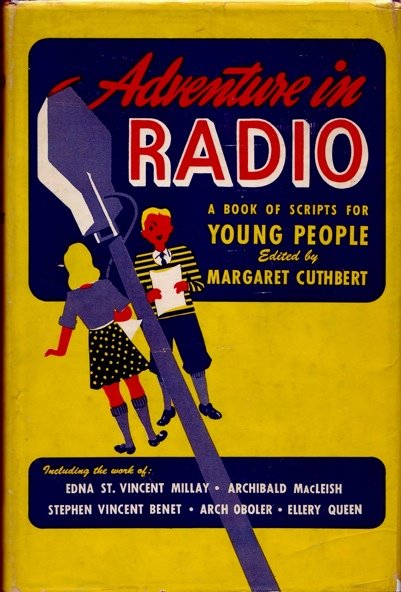
The cover of Adventure in Radio, from my collection

A few years ago, walking home from graduate school one afternoon, I stopped by at a second-hand bookstore in my old neighborhood of Yorkville, Manhattan. Judging from the window display, the shop seemed to specialize in children’s books and memorabilia. While this did not deter me, I hardly expected to make any significant acquisition of a volume on the subject to which this journal is chiefly devoted. I mean, I was not looking for a decoder ring or some such souvenir from the bygone age of radio dramatics. I was, after all, researching my dissertation. There was on the shelves a beautiful copy of Adventure in Radio (1945). Subtitled “A Book of Scripts for Young People,” it may be expected to include juvenile playlets written for the medium, although not necessarily produced on network radio. On such compilations, of which there are many, I was not inclined to waste money or time.

Spiting my assumptions, Adventure in Radio not only contains a number of broadcast scripts from programs like Jack Armstrong and Let’s Pretend but also propaganda plays and wartime commentaries geared toward an adult audience. In addition, it offers insights on the production of radio plays, on sound effects, announcing, and “radio language.” It took a little salestalk from the owner of the by now long closed store, but I was soon convinced. Where (I did not know much about eBay back then) would I ever find such a book again? And how could I claim to be serious about old-time radio if I did not snatch up this copy? So, I handed over my $40 (it was the price tag that made me hesitate) and walked off, eager to continue my studies . . . and determined to find the recordings to match the published scripts now at my fingertips.

That often proved quite difficult; but I had made up my mind that I was not going to write about words divorced from performance. I wanted to hear what was being done with those scripts, how they were edited and interpreted. Take the NBC University Theater’s production of “Gulliver’s Travels,” for instance. It was broadcast on this day, 24 September, in 1948. My appreciation of the challenges of soundstaging the play grew after reading the comments with which Frank Papp, a director of radio drama for NBC, prefaces the script, originally written for the series World’s Great Novels. Papp points out the “unusual problems” Frank Wells’s adaptation posed in production:

In the matter of casting, the Lilliputian was the most difficult.  Here was needed a voice which gave the illusion of a tiny man.  A trick voice in itself would be only a caricature.  What was required was a voice that created a picture of a real human being of Lilliputian size.  After extensive auditioning, an actor was found whose talent and vocal capabilities fulfilled these requirements.

The actor portraying Gulliver was placed in an isolation booth, Papp explains, “so that the Lilliputian’s voice would not spill over into his microphone” and the two voices could be miked separately, with a volume reflecting the size of each character. The voice of the King of Brobdingnag, meanwhile, was “fed” both through an electronic filter to amplify its base quality and through NBC’s largest echo chamber to create the illusion of a giant.

The 24 September 1948 presentation of “Gulliver’s Travels,” starring Henry Hull in the title role, does not quite live up to the expectations raised by Papp’s introduction. Under the direction of Max Hutto, child actor (Anthony Boris) is cast in the role of the Lilliputian, a choice that infantilizes the character and renders pointless the effects achieved by the sound engineer.

While Wells’s script downsizes Swift’s story and diminishes its bitterness and bite, it is the production that contributes to a sense that Gulliver’s Travels is, at heart, a juvenile fantasy, despite its airing on the ambitious if misguided NBC University Theater, a program that linked listening to such bowdlerizations with courses in distant learning. I may have been able to match the script with a production, but it was not the one described in Adventure in Radio.

Squeezed as I am into the isolation booth of my preoccupations, it is my mind’s voice that supplies the lilt of the Lilliputian . . .

Transatlantic Call: From Radio Reportage to Video Conferencing

Now, I am not going to get all sentimental and give you the old “tempus fugit” spiel; but I’d like to mention, in passing, that this post (the 355th entry into the journal) marks the beginning of a third year for broadcastellan. Meanwhile, I am resting with a bad back—in the city that never sleeps, of all places. This afternoon, during an inaugural transatlantic video conference with my two faithful companions back home in Wales, my mind excused itself from my heart and took off in reflections about the ways in which technology has assisted in forging a bond between the US and its close ally across the pond, and the degree to which such tele-communal forgings may come across as mere forgeries when compared to the real thing of an actual encounter.

I was reminded of this again when, a few hours after my chat, I sat, as of old, on a bench by the East River, in a park named after Carl Schurz, a fellow German gone west who likened our ideals to the stars that, however far beyond our touch, yet assist those guided by them to “reach their goal.” In my hand was a signed copy of a newly purchased biography of Edward R. Murrow (by Bob Edwards). It opens with Murrow’s report from the blitz on London, Murrow’s residence during the war.

The broadcasts from London (as featured and discussed here by Jim Widner) did much to enhance the American public’s understanding of the plight of a people, who, due to Hollywood’s portrayal of the British, seemed stuck-up, remote, and about as real as the fog in which Basil Rathbone and Nigel Bruce waded through some of their adventures. Reports from Britain not only brought home a Kingdom but a concept—the notion of brotherhood untainted by the nationalism whose fervor was responsible for the war.

If not as emotional as Herbert Morrison’s report from Lakehurst during the explosion of the Hindenburg, Murrow’s updates from London were delivered by a compassionate journalist who not only listened in but was a part of what he related while on location. On this day, 21 May, in 1950, British novelist Elizabeth Bowen connected wirelessly with her American audience by speaking via transcription on NBC radio’s University Theater. Bowen referred to her novel The House in Paris (1935) as “New York’s child,” the “fruit of the stimulus, the release, the excitement [she] had received here.” Would she have been able to enter into the feelings of a child lost in a strange house, she wondered, if she “had not just returned from another city, equally new and significant to me?”

There are limits to the connections achieved by the wireless, a controlled remoteness that brings home ideas without ever feeling quite like it. Rather than seeing or hearing, being there is believing. I felt far away during my transatlantic call; but I know I will know what home is now once I get back there . . .

Morlock Guys and Eloi Dolls: The Domestic Battles of the Man Who Envisioned the War of the Worlds

I came across a peculiar piece of schlock science today. An evolutionary theorist has uttered the prediction that, within about 100,000 years from now, the human race may develop into two separate and unequal breeds, a scenario akin to the one H. G. Wells created in his sci-fi thriller The Time Machine over a century ago. Our descendants will either be nasty, brutish and short, or else graceful, fragile and overcultivated, enslaved by technology and a fear of Hobbsian life in the state of nature. In other words, a world of Morlock and Eloi.

Wells’s fictions strike me as rather more urgent and compelling than such a pseudo-scientific hypothesizing about the shape of things to come. As Orson Welles and his collaborators drove home when they brought The War of the Worlds to radio (as discussed here), they invite us to translate the grim visions of the future into a commentary on the none-too-bright world of today. If the time machine had not returned home, the ride would be pretty much wasted.

In some of his smartest if lesser-known novels, Wells dispensed with the creation of seemingly distant worlds as stand-ins for close and contemporary ones. Instead, he documented what was separate and unequal in his own society, examining the clash of classes and the battle of the sexes. One such Wellsian commentaries, which I am currently reading, is Ann Veronica (1909), an incisive comedy about women’s struggle for equality.

I owe this discovery, and quite a few others besides, to my daily excursions into the realm of —another trip not worth taking if you are not prepared to transport something back with you into your here and now. It was a remark made by Lost Horizon author James Hilton on the NBC University Theater that brought Ann Veronica to my attention.

On 3 April 1949, Hilton shared his thoughts on Jane Eyre with the listeners of the NBC University Theater, which presented a dramatization of the novel (as discussed here) with Deborah Kerr in the title role.

Considering how frothy the conclusion of the new four-part BBC television adaptation of Jane Eyre turned out to be last Sunday, Hilton’s lecture may serve as a reminder of the original’s “shocking” and groundbreaking qualities as the “first great novel that emancipated woman emotionally by portraying her not merely as the passive recipient of man’s favor, but as the possessor of rightful and independent passion of which she need not be ashamed.” This “battle” of Jane Eyre and her heirs, so Hilton, continued into the twentieth century, until Wells “fired the last shot” with Ann Veronica.

I just had to find out how that shot was going off, even though I could hardly agree that it was to be the last. I am grateful to Hilton for having brought Ann Veronica to my attention, happy to be following its rebellious heroine in her quest to grow up an equal to the men around her. “She wanted to live,” Wells’s narrator sums it up; but

all the world about her seemed to be—how can one put it?—in wrappers, like a house when people leave it in the summer. The blinds were all drawn, the sunlight kept out, one could not tell what colours these grey swathings hid.

Ann Veronica “wanted to know,” but was little helped by a father who held that women were creatures “either too bad for a modern vocabulary, and then frequently most undesirably desirable, or too pure and good for life.” Anxious to mingle with socialists and suffragettes, she very much resented being cast as an Eloi in a sheltered upper-middle class world apart from if beleaguered by the hoi polloi many of her class regarded as terrifyingly Morlockian.

To be sure, that feeling of being segregated, set aside or typecast, can hit you at any time in your life; nor are societal conventions oppressive to women only, as Wells demonstrated in another one of his remarkable comedies, The History of Mr. Polly. Like young Ann Veronica, the middle-aged Mr. Polly is eager to escape the strictures of a narrowly defined existence, a life of many divisions and few diversions.

On this day, 17 October, in 1948, the NBC University Theater presented Mr. Polly starring Boris Karloff, an actor whose career in film was similarly circumscribed by the (di)visions of men who profit from such classifications (as I remarked here exactly one year ago). It feels right to return to Wells now, whose gleefully staged domestic battles are often overlooked in favor of his more somber epic ones. I, for one, don’t require the thrills and frills of an elaborate Halloween party to appreciate an attempt to unmask human nature.

Leaving His Ears Behind, E. M. Forster Steps Inside a Distant Echo Chamber of the Marabar Caves

Well, I wonder whether they will get here tonight. The troupe of the Johannesburg Market Theatre, I mean. Two weeks ago, they were supposed to take me to The Island; instead, they seemed to have gotten stranded somewhere else. I am all set to go, notwithstanding a lingering headache, brought on by alcohol and technology. As sobering as the experience might have been, I succeeded at last in putting my third podcast online. It conjures up the voices of a number of silent screen actresses; among them Mary Pickford, whose Little Annie Rooney was flickering on our screen this weekend, along with a 1924 production of Peter Pan, featuring the aforementioned Anna May Wong as Tiger Lily.

Both of these films are adaptations; but, whether you are familiar with the original or not, they are engrossingly cinematic so as to draw you in rather than draw your attention to their second-handedness. To me, an adaptation succeeds if it manages to make me forget its lineage, at least upon first inspection. I prefer to take in first and take on thereafter, to give a re-production a chance to stand on its own without forcing it to stand up against a text from which it more or less freely borrows.

Now, so-called old-time radio drama depended even more heavily on borrowed material than the movies. With schedules to be filled for weeks on end, there was great demand for stories, but a relatively short supply. Storytellers were, by and large, not paid enough to be original; given the governing principle of commercial sponsorship and the broadcasters’ insistence on groping for the largest audience possible, radio writers were discouraged from attempting anything new. In fact, they were even conservative in their approach to adaptation.

On this day, 12 June, in 1949, the NBC University Theater presented its version of E. M. Forster’s A Passage to India. Intent on proving its literary fidelity, a little passage was cut right through this play. And out walked none other than E. M. Forster himself. The dramatization, as one critic remarked, bore so little resemblance to the novel as to have “missed the boat completely”; as such, it was as much in need of an endorsement as it was unworthy of it. Yet, the listener might feel tempted to conclude, if Forster did not mind lending his ear and commenting on the play, it surely could not be quite as “cumulatively degrading to all concerned—author, producer, and audience” as the captious critic made it out to be.

In fact, however, Forster did not comment on the adaptation at all; he did not even mention it. Instead, he gave a brief lecture on his novel and its significance—a lecture that was taped and inserted into a performance he had not himself auditioned. Remarking on the partition and independence of India and Pakistan, Forster expressed himself “thankful” that his novel was “out of date.” Listeners to the University Theater might not have noticed at all, considering that there was so little left of the debate with which Forster’s novel is concerned.

Entirely squandered in this uninspired adaptation are the aural potentialities of the Marabar Caves. Unlike film, radio drama is not obliged to impose concrete images on a writer’s vision. Like the novel, it allows its audience to co-create those images or to resist them in order to realize the metaphorical potentialities of language.

The caves are such a metaphor; they are an echo chamber for a clash of cultures, the site of cultural blindness where the false shelter of ignorance caves in on itself. Without resorting to much sound effects trickery, the radio adaptation could have suggested the horrors of Marabar—the reverberation of one’s own voice drowning out all others in a choric recital of an ode to blindness.

On This Day in 1948: Boris Karloff Gets Himself In and Out of a “Beastly Silly Wheeze of a hole!”

“Hole!” said Mr. Polly, and then for a change, and with greatly increased emphasis: “‘Ole!” He paused, and then broke out with one of his private and peculiar idioms: “Oh! Beastly Silly Wheeze of a hole!” —H. G. Wells, The History of Mr. Polly (1909)

Well, we’ve all been there, I guess; call it a rut, a depression, or down in the dumps. A hole by any other name is just as deep. To look on while someone you love is stuck in one can make you as miserable as dwelling there yourself; it seems difficult to find a way out either way. One could throw a book, I suppose, in lieu of a rope. Light enough to be hit by without sustaining injury, but profound enough to make what you might call an impact, The History of Mr. Polly is just the right volume to toss. While not exactly a guide to better living without chemistry, it sure is comforting—a friendly reminder to anyone who is deeply dissatisfied with the “hole” of life that it is possible to get out or on with it somehow.

In Mr. Polly’s case, getting out involves a botched suicide attempt, arson and insurance fraud, an unreliable pistol, a pair of stolen trousers, and the fortuitous departure of an abject scoundrel. I didn’t suggest there’s an easy way out, and neither does the author, H. G. Wells.

Middle-aged, mismatched, and miserable, Mr. Polly has very nearly gone crackers; but he learns, at last, that a change of luck or pace is not beyond his own powers. On this day, 17 October, in 1948, Boris Karloff assumed the role of the man in the proverbial ditch, seizing the rare opportunity to step onto the stage for a noteworthy stab at reinvention.

Karloff could probably identify with Wells’s antihero, considering that the actor had been in the beastly hole of typecasting for far too long and was, after a string of horror movies, in danger of becoming a mere caricature. The Grinch of box office calculations had absconded with his thespian options.

The NBC University Theater, a radio program that featured adaptations of literary works of fiction and provided brief lectures between the acts, gave the soft-spoken Londoner an opportunity to take off the Halloween costume he’d been dealt by Hollywood’s costume department and put on the mask of comedy instead.

Some three years later, when Anthony Pelissier’s motion picture adaptation of the novel opened in New York City, the audience was faced with a Mr. Polly who had the features and figure of John Mills; but on radio, it was Karloff who inhabited the role in a moving study of malady conquered and hope restored.

Let’s assume life is a broadcast studio. Consider the possibilities. Grab that microphone, my friend. I’ll be listening.