
Digest, Please!

Well, it’s a different kind of animal. The kind that digests in the very instance of ingestion. Webjournalism, I mean. It matters little whether or not you write for a living, as long as you write what you are living while you are living it, while you experience or witness what is being stored and storied. My digestive system operates far less efficiently, I’m afraid, which is why I frequently end up with a digest of my day-to-day.

It is not that I regurgitate the past. I very much live in the moment, a skill (or nearsightedness) I developed living the United States, the empire of “now.” And yet, by the time I manage to keep up with them, those moments have lost their momentum. They are memories the writing down of which is the reheating of yesterday’s repasts. Instead of journalizing my journey as it happens, I delay the act of relaying it by sharing recollections edited, according to a Wordsworthian scheme of spontaneity, in motionless and remote tranquility.

This is what I feel compelled to do now—catching up with myself. After all, taking bites out of the Big Apple for a month left me with plenty to digest, even if some of pieces of my intake turned out to be as unpalatable as the Tony Award-winning musical Spring Awakening or as bland as the Terrence McNally’s Deuce, a sentimental exchange starring the ill-served if indefatigable Angela Lansbury.

Only a few days ago I spent an afternoon at Coney Island, walking past Nathan’s (not eating the hot dogs that once got me terribly sick) and riding the old Cyclone—whose twists and curves once caused me to break the bones of my best friend sitting beside me. Today, I am cleaning up after a sick dog that swallowed a bone far too large to be digested, hoping he will be spared an operation, hoping I am going to be spared something akin to “The Odyssey of Runyon Jones” (Norman Corwin’s radio play about a boy determined to retrieve his dead dog from “Curgatory”).

It is retrospection that saves me from exposing myself at my most vulnerable—in the in-between of everyday living. It is life tidied up and tied up neatly. It is loose ends woven into a security blanket. Digest, please!

Being Out, Staying In

Well, I know. You can’t catch cold getting caught in the rain. At least, that’s what people keep telling me straight to my weather-beaten face. Meanwhile, I got soaked during one of those torrential New York City downpours a few night’s ago and was not up to meeting an old friend for dinner last night, notwithstanding the fact that my days in the city are numbered and I might have to wait another year for another opportunity to see him. I ended up watching television instead; it’s something I rarely do nowadays, especially while vacationing.
Luckily, I was in for a treat at Turner Classic Movies, whose Screened Out series opened last night with “Algie, the Miner” (1912), a one-reeler concerning an effete Easterner getting the Western treatment to prepare him for the challenge of matrimony. Say—and I say this quoting a line from the subsequently presented comedy-thriller The Monster (1925)—have you “dropped in for some pansy seeds” yet?

Hollywood logic has it that those “seeds” may very well yield hardy perennials; in fact, that is the reason for spreading them in the first place. The conversion myth of growing up straight permitted writers and directors to create outré characters that are both likeable and socially acceptable. Judges according to the mores of early-to-mid 20th-century America, the pansy was an aberration that could be shown to suffer for and snap out of its condition of non-conformity by turning straight. In other words, the pansy was a milquetoasts redeemed by hearty helpings of ham and exorcism.

Otherwise, gender transgressive characters were either buffoons or villains, depending on the state of their sexual (in)activity and their willingness to reform. The Monster, you might say, involves a case of rehabilitation in which feeble Johnny Goodlittle (whose very name suggests the both the need for and possibility of redemption) has to prove his manhood not only by trapping a monster, but by demonstrating himself to be far from one.

The buffoon, by comparison, is a sexually unreformed and consequently frustrated male. Exit Smiling (1926), starring the delightful Beatrice Lillie (in a cross-dressing role), features a supporting player whose Hollywood career depended on such roles: Franklin Pangborn, the Queen of Paramount. “This nervous tension will positively slay me!” his irritable stage actor Cecil Lovelace exclaims when his leading lady is late for the show. On the radio, where his queer voice was heard only infrequently, Mr. Pangborn was simply made out to be “Allergic to Love”.

TCM is also sponsoring the multimedia exhibition Celluloid Skyline, currently (25 May to 22 June 2007) on display at New York City’s Grand Central Station (pictured above). I only had a few moments to walk through before catching a train to the Moving Image museum in Queens, my head not being clear enough to say much more on the subject at present.

Come to think of it, I have yet to post my review of the new Broadway musical Curtains starring the Tony nominated and recently de-closeted David Hyde Pierce. Perhaps I need to stay in more; but it sure feels great to be out . . .

Murder in the Backroom; or, No Place for a Lady

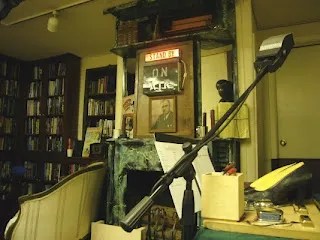
Well, they are still at it. Slamming doors, screaming bloody murder, getting into fisticuffs—all in a perfectly orderly manner, standing upright, their eyes focused on the sheets of paper in their hands. The W-WOW! players, I mean, who meet on the first Saturday of each month, from September to June, to step into the “broadcasting” studio in the (pictured) backroom of the aforementioned Partners & Crime bookstore on Greenwich Avenue in downtown Manhattan

Last night, for their final performance before going on summer hiatus, the W-WOW! troupe recreated episodes from Broadway Is My Beat (“Francesca Brown,” originally broadcast on 2 June 1951) and Richard Diamond, Private Detective (“The Carnival Case,” from 16 August 1950). Capably delivering their lines, the two leading men—Steven Viola as Danny Clover in Broadway Is My Beat and Michael H. Johnson as Richard Diamond—were more than amply supported by the four ladies of the fancifully titled Cranston & Spade Theatre Company. Indeed, they were upstaged by them, and that despite the fact that the titular character of the evening’s first offering was dead before the action got under way.

Sheila York brought sex appeal to the role of a carnival gypsy who beckons Diamond into “the inner sanctum,” which gives the leading man a chance to quip: “Haven’t I heard you on the radio?” As a former DJ, the woman who played her sure has experience in broadcasting. And aside from being a competent voice artist, York is also a published novelist who draws inspiration from the medium in which she worked. Her latest thriller, A Good Knife’s Work, takes readers inside the business of radio drama in the 1940s—with a female detective as a guide.

Voice-over artist and teacher Karla Hendrick has a voice most likely to succeed in that business, standing out even in parts no larger than that of a gum-chewing waitress cracking wise with the gumshoe. In charge of musical transcription and accompaniment was Heather Edwards, while DeLisa M. White handled the sound effects, delivering blows and popping balloons according to the cues in the script.

For now, the ladies of W-WOW! are adjuncts to the dramas presented by the players, deliver commercials, play sidekicks, sirens, or servants. Sure, Diamond’s girlfriend Helen knows how to handle a gun (as is demonstrated in one of the script’s sly takes on traditional gender roles); but maybe the company should take on some of the radio thrillers featured in Jack French’s Private Eyelashes and revive that rare breed of crime-solving radio heroines. So, how about it, Messrs. Cranston & Spade?

"Follow, Follow, Follow, Follow": A Hint from The Fantasticks

Well, “[i]t’s stupid, of course,” and “immensely undignified”; perhaps, “I’ve gone mad.” That is how lovelorn Matt, pining for Luisa, the girl next door, explains his “situation” in The Fantasticks. Earlier this week, I had the good fortune to catch up with the off-Broadway revival of this Mousetrap among the musicals. The current production is staged at the less than enchanting sounding Snapple Theater Center (soon to be renamed after actor Jerry Orbach), a suitably small venue for this intimate play (music by Harvey Schmidt; book and lyrics by Tom Jones, who, nearly fifty years after its conception, still performs in it, night after night, albeit under an assumed name).

I was particularly receptive to the wit and wisdom and whimsy of this literary charmer about love and make-believe, disillusionment and romantic rekindling, to the gentle reminder expressed in “Try to Remember,” the show’s best known tune:

Deep in December it’s nice to remember,
Although you know the snow will follow.
Deep in December it’s nice to remember,
Without a hurt the heart is hollow.
Deep in December it’s nice to remember,
The fire of September that made us mellow.

I had just made up my mind to cancel my flight back home to Wales in order stay in New York City until such time as my one and only would come and fetch me and spend a few days together in the city where we first met. It seems that you can have your Big Apple and eat it, after all.

My appeal to “follow” has not fallen of deaf ears. Like Matt, who’s gone out into the world and left his Luisa behind, I can now look forward to a cheerful reunion and the confidence of we’ll-take-it-from-here. Never mind that I am no longer as agile as former American Idol contestant Anthony Fedorov (who plays Matt) and that my Luisa sings as loudly as he snores and tends to sprout hairs on his back. Still, anyone with a sense of wonder, a penchant for “Metaphor” and a love “[b]etter far than [it]” will not have to stretch or struggle to relate to their story.

“[T]ry to see it,” the Narrator encourages the audience: “Not with your eyes, for they are wise, / But see it with your ears.” It may look “mad” to the world, but my act of folly sure sounds like something to remember once the chill of December comes round. The rest will “follow.”

Alexander Technique: A Matter of Queer Posture

Well, it’s been a few decades since my first (and only) toga party. Last night, I felt as if I were crashing one. A friend of mine took me to a way-off Broadway production of a play called A Kiss from Alexander (book and lyrics by Stephan de Ghelder; music by Brad Simmons). Billed as a “musical fantasy,” it is essentially a backstage stabbing farce—say, All About Abs—wrapped in romance and sentiment. Its tone is considerably less even than the spray tan on the cast’s collective hide.

Borrowing from the Rita Hayworth vehicle Down to Earth, which it references, this gay Band Wagon rolls along merrily enough, confident in attracting an audience steeped in Hollywood myth, in Broadway lore as well as lingo. “Alexander technique,” for instance, which served as a pun in the play, is a way of learning how to rid the body of tension. Alternative culture has been doing just that by leaning on traditions that produce anxieties, irreverence being the release.

Art not quite sure of its standing tends to be self-conscious. Witnessing the return of Alexander the Great in his mission to sabotage a bawdy, low-fidelity account of his private life (in a production called “Alexander Was Great!”), I was reminded of Norman Corwin’s radio fantasy “A Descent of the Gods.” In it, the god of Trivia recalls how Venus, Mars, and Apollo visited Earth, and how they were embraced and degraded by the media, the least respected and most prominent of which being the one in which poet-journalist Corwin operated.

By now, the god of Trivia has been knocked off his throne by the god of Camp. And while I am not a worshipper of either, it is difficult to deny the force of the latter.

If Momma Was Buried: The Gypsies of Grey Gardens

Well, I did not sit around for the no doubt excruciatingly drawn out season finale of American Idol, especially not after Tuesday night’s less than scintillating showdown. Instead, I snatched up tickets for Grey Gardens, Broadway’s current musical must-see. Relying on the New York City subway system, I very nearly the opening scenes. A signal problem and the uncertainty of its timely solution convinced me to alight on Fifth Avenue and 59th, giving me a mere twelve minutes to make a dash for it—past the throngs of sailors in town for the 20th annual Fleet Week—all the way to the Walter Kerr Theater, not far from which venue former Idol Fantasia Barrino stares at passers-by from a giant display for The Color Purple.

After assuring those uneasy about the implications of the beads of sweat on my shiny forehead, that I had used Dial, I squeezed into my allotted space, fanning myself with the playbill, just as Grey Gardens opened its gates, rusty and unhinged. What awaited me was the perfect antidote to the excesses of late 20th and early 21st-century Broadway, which is alive but far from well with the sound of Andrew Lloyd Webberish bombast, with the flashy, the vapid, and the utterly pointless (Legally Blonde, the musical, anyone?). The melancholy and darkly funny Gardens defies this trend; neither Christine Ebersole nor Mary Louise Wilson enter the stage in a helicopter, belt out generic power ballads, or give big names a bad one.

Now, there is nothing novel about the play, inspired by the lives of the Camelot-and-went-nowhere Bouviers, aunt and niece of Jacqueline Onassis, who became the subject of a 1975 documentary (which, my paper fan informed me, is now being dramatized for the screen). The titular mansion is filled with echoes of past lives, fictional and otherwise, which is not to say that it is Gardens variety.

The intrigues and conspiracies of eccentric old dears has long been the stuff of dark comedy and melodrama: those Ladies in Retirement come to mind (and was heard on the Lux Radio Theatre, as do Arsenic and Old Lace (adapted for radio’s Screen Guild Theater), Whatever Happened to Baby Jane?, and radio dramas assortment of weird “Sisters” (such as Lurene Tuttle and Rosalind Russell in a Suspense thriller bearing that title). In musical terms, Gardens is Rose missing her turn and turning her socialite daughter into a spinster maid. Edith and daughter Edie are two “Peas” gone to pot.

Above all, Gardens is a character study. To say that it is neither “little old lady land” camp nor Miss Havisham Gothic is not to imply that it misses any opportunity to give us the tour of a house build on ambitions shattered into lost chances, a house out touch with the times even at the best of times, from its Republican heyday during the Roosevelt administration to its decline in the ’60s and ’70s. Gardens is also refreshingly post-Postmodern, which is to say that the show is reflective rather than self-reflexive. So, get out there and smell the faded flowers. Just don’t count on the subway to take you there.

Transatlantic Call: From Radio Reportage to Video Conferencing

Now, I am not going to get all sentimental and give you the old “tempus fugit” spiel; but I’d like to mention, in passing, that this post (the 355th entry into the journal) marks the beginning of a third year for broadcastellan. Meanwhile, I am resting with a bad back—in the city that never sleeps, of all places. This afternoon, during an inaugural transatlantic video conference with my two faithful companions back home in Wales, my mind excused itself from my heart and took off in reflections about the ways in which technology has assisted in forging a bond between the US and its close ally across the pond, and the degree to which such tele-communal forgings may come across as mere forgeries when compared to the real thing of an actual encounter.

I was reminded of this again when, a few hours after my chat, I sat, as of old, on a bench by the East River, in a park named after Carl Schurz, a fellow German gone west who likened our ideals to the stars that, however far beyond our touch, yet assist those guided by them to “reach their goal.” In my hand was a signed copy of a newly purchased biography of Edward R. Murrow (by Bob Edwards). It opens with Murrow’s report from the blitz on London, Murrow’s residence during the war.

The broadcasts from London (as featured and discussed here by Jim Widner) did much to enhance the American public’s understanding of the plight of a people, who, due to Hollywood’s portrayal of the British, seemed stuck-up, remote, and about as real as the fog in which Basil Rathbone and Nigel Bruce waded through some of their adventures. Reports from Britain not only brought home a Kingdom but a concept—the notion of brotherhood untainted by the nationalism whose fervor was responsible for the war.

If not as emotional as Herbert Morrison’s report from Lakehurst during the explosion of the Hindenburg, Murrow’s updates from London were delivered by a compassionate journalist who not only listened in but was a part of what he related while on location. On this day, 21 May, in 1950, British novelist Elizabeth Bowen connected wirelessly with her American audience by speaking via transcription on NBC radio’s University Theater. Bowen referred to her novel The House in Paris (1935) as “New York’s child,” the “fruit of the stimulus, the release, the excitement [she] had received here.” Would she have been able to enter into the feelings of a child lost in a strange house, she wondered, if she “had not just returned from another city, equally new and significant to me?”

There are limits to the connections achieved by the wireless, a controlled remoteness that brings home ideas without ever feeling quite like it. Rather than seeing or hearing, being there is believing. I felt far away during my transatlantic call; but I know I will know what home is now once I get back there . . .

I’ll Talk Manhattan

Well . . . eventually. As you may have gathered from the snapshot (in case you are among the multitude not inclined to catch up with my keepings-up), I am back in the town I called home for about fifteen years of my life, the town to which I owe more than my academic education, the town that owes me my youth but, I am glad to say, is welcome to it. It sure feels great to be back; to hear the sirens in the avenues, to smell the dusty streets, to see what’s being torn down, remodelled, or in a familiar if progressive state of disrepair. How nice it is to run into old neighbors and catch up on months of gossip, of which the apartment building in which I am staying is full, considering that another story is being added to it and its frame is suffering along with the old tenants who are being expected to put up with dirt, noise, and noticeable structural damage.

It is a treat to inhabit places I otherwise only read about or see online, in journals like Courting Destiny (of which I thought when I passed the Fairway market) or NY Nitty-Gritty. Aside from walking around town and revisiting (or hoping to revisit) places I used to frequent (the Strand bookstores, for instance, which is not far from the South Street Seaport of which I took the picture on the right; or the aforementioned Argosy) I am taking it far easier than the tourist who feels obliged to cram the metropolitan experience into a tight schedule. Sure, I got my eyes on tickets for two Broadway shows: the highly acclaimed Grey Gardens and the much-maligned Deuce (starring Angela Lansbury); but that’ll have to wait until I am good and ready for evenings at the theater.

Luxuriating in leisure, I still need time sit down and to carry on with broadcastellan, which, after all, is a journal about sitting down, closing one’s eyes, and listening to the radio. Since I am enjoying a clear wireless signal (much to the surprise of this piggy-backer), I am able to make a few additions to my old-time radio recordings library. So, I guess I am squirreling it right now, gathering food for thought to be enjoyed in the comfort and quiet of my new home across the Atlantic . . .

Delayed Exposure: A Man, a Monument, and a Musical

Well, I don’t know why I took it. This picture, I mean. Over the years, I must have walked past that plaque hundreds of times without paying attention to it. A few months ago, returning for a visit to my old neighborhood in Manhattan, it insisted I take notice at last. I went to an exhibition at the Cooper-Hewitt Museum on the corner of Fifth Avenue and 91st Street. Erected in memory of the journalist W. T. Stead, this modest cenotaph stands opposite the museum, on the Central Park side of the avenue. I had no knowledge and little interest in the life of Mr. Stead, which (the plaque tells you as much) ended spectacularly aboard the Titanic. Last weekend, some three months after my return from New York, the man insinuated himself into my life once again, this time in the guise of a character in a Welsh musical.

Amazing Grace, staged at the local Arts Centre, tells the story of Evan Roberts, a Welsh miner turned preacher who, in the words of Mr. Stead, became the “central figure” of the early 20th-century “religious awakening in Wales.” Stead followed the movement, interviewed Roberts, and reported about this so-called Welsh Revival. In Mal Pope’s play, he appropriately serves as narrator and commentator on Roberts’s fabulous rise and his equally sudden disappearance from public view.

Unfortunately, Stead doesn’t get all that much to say or sing about Roberts, and the musical, which, in this particular production, featured the aforementioned Peter Karrie as a fierce reverend envious of the enigmatic upstart, suffers from a serious case of anticlimax: whether daunted by his fame or no longer driven to preach, Roberts simply shuts up—a silencing that doesn’t make for a rousing finale.

Unimpressed by Pope’s 1980s-styled power ballads and his by-the-numbers approach to biography, I was easily and gratefully distracted when I saw Mr. Stead walking across the stage and back into my conscious, as if to demand the leading role denied to him in this production. Now I find myself compelled to follow up on Stead’s life and writings.

As it turns out, Stead was fascinated by the spiritual, by premonition and second sight, by ghostly doubles and “long-distance telepathy.” For instance, he wrote about a case in which a telegram, then presumably the fastest means of telecommunication, was several hours slower in conveying a story than a message alleged to have been transmitted by a “disembodied spirit.” It is the extra-scientific (rather than the supernatural) speculated about by those growing up in the age of Darwin, an age of industrialism and shattered systems of belief.

Researching Etherized Victorians, my study on old-time radio, I came across one such comment on modernity by one of Stead’s contemporaries, Rudyard Kipling, whose 1902 short story “Wireless” marvels at psychic phenomena while questioning scientific progress: telepathy as the ultimate wireless connection.

It seems Mr. Stead is anxious to continue the debate from the beyond. I have unwittingly become a ghost writer for the late journalist; recalling him to life in word and image, I am merely his chosen amanuensis.

Terror of Judgment: "The Path to 9/11"

Firefighter memorial, Upper East Side, NYC

I decided to see for myself. So, I watched the first part of The Path to 9/11, which aired last night on BBC2. I am not sure whether or in how far this version differs from the one that aired, a few hours later, on ABC in the US; and aside from the word “Pathetic” hissed by John O’Neill (Harvel Keitel) in response to anti-terror efforts of the Clinton administration, I found little that smacked of partisan fingerpointing. This fictional documentary strikes me as far more significant, thought-provoking and accomplished than Oliver Stone’s World Trade Center, the subdued disaster movie I saw on its opening night in New York City and wrote about in the first of a series of Gotham impressions that is herewith coming to an end.

As I remarked previously, Oliver Stone’s film was exasperatingly a-political, reducing a world-historical event to an intimate portrait of personal suffering. It had more pathos than Path, which, in its first instalment, went astray only once, namely with the emotional outburst of the pseudonymous (and hence factually suspicious) CIA analyst “Patricia.” Otherwise, I commend the forgers of Path, whether they forged history or not, for driving home that the collapse of the Twin Towers was not a senseless tragedy but a hostile response to the west that had been long in the planning.

AOL Tower, NYC

To be sure, what a visual dramatizations like The Path to 9/11 cannot but fall short of showing is the ideological/theological conflict underlying the series of attacks in which we now find ourselves. A clash of ideologies is portrayed as a clashing of minds, and masterminds are made flesh so that they can be tracked, trapped, and presumably rendered innocuous. Fanaticism is far more hazardous than “The Most Dangerous Game.” However comforting the thought, however rewarding the execution, the terror it begets won’t end in the capture of a few ruthless misleaders, just as fascism—to which we still surrender many of our democratic ideals today—did not perish with Hitler in his bunker.

I am not about to reduce this anniversary of the attacks known as 9/11 to another opportunity to advocate sound (or radio) plays as the drama of ideas, even though we might do well to pay more attention to words the articulation of powerful ideas than absorb images of their physical manifestations. New York City is in need of visual reminders of its past. Too often, gleaming surfaces (like the façade of the post-9/11 AOL Tower, shown right) smooth over the scars that document the city’s path and its pathology.