
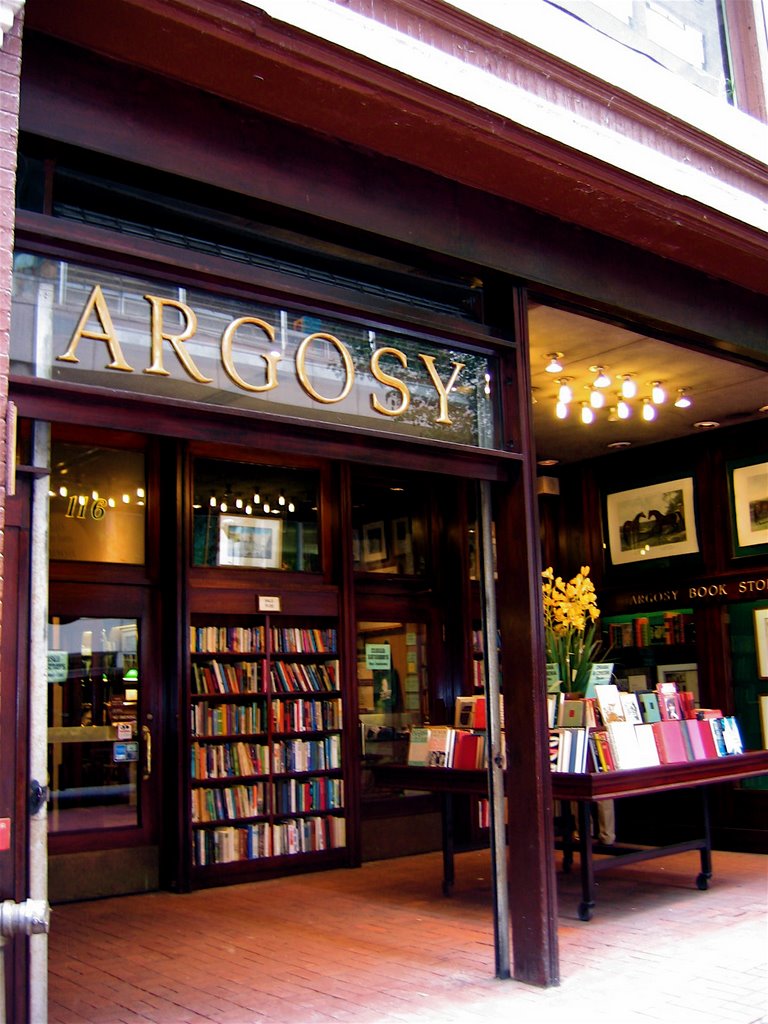
"Panic" Shopping at the Argosy

Sure I love books; but even more than reading, I enjoy hunting them down. It must be an instinct stronger than intellect that makes me want to sniff out volume after volume, many of which remain unread. Last Friday, for instance, en route to Birmingham International Airport to pick up two old friends from Germany who came to visit me for the first time here in Wales, we spent some two hours at Sunnycroft, a late-Victorian suburban villa once owned by a well-to-do, upper middle-class family.

As is often the case on such National Trust properties, there was a second-hand bookstore on the premises, however small and dingy. The piles of paperback romances did not bode well; and still I could not resist and stepped inside what, if I read the map right, was formerly the Sunnycroft boiler room. For something amounting to less than a dollar, to be left in a basket standing in for a salesperson, I snatched up a bound volume of The Snow Image, a British edition of some of Nathaniel Hawthorne’s Twice-told Tales, probably as old as Sunnycroft itself. Here it lies, next to me, waiting for some wintry evening by the fire or such time I deem fit for its perusal.

Nineteenth-century treasures like this one aside, I am thoroughly modern in my choice of books, my library consisting chiefly of texts on that mid-20th century phenomenon known as radio drama. And while I do much of my shopping online nowadays, I still prefer walking around town—be it New York City or Hay-on-Wye—in search of well-worn volumes on my favorite subject.

On the Upper East Side in Manhattan, just around the corner from Bloomingdales, one such supplier of old books on film, theater, and radio is the aptly named Argosy. As I mentioned in the comments section of a previous journal entry, the store is run by the wife of Stuart Hample, whose all the sincerity in Hollywood is a fine introduction to the wit of radio comedian Fred Allen.

On my tour of the Manhattan’s fast disappearing used and antiquarian bookstores a few weeks ago, I was pleased to discover that the Argosy had one of its themed sales, the theme being drama and television. Among the $3 items displayed in front of the store, I found a 1944 copy of Behind the Microphone by one John J. Floherty, a prolific writer of supposed non-fictions like Inside the FBI, Your Daily Paper, and Board the Airline. I expected neither insights nor entertainment; this, I thought, was merely one for the collection. As it turns out, Mr. Floherty was quite the storyteller. Listen to this Daphne du Maurier rivalling introduction to the miracle of Marconi, whose Poldhu station I failed to visit during my Cornwall trip earlier this year:

The State Troopers’ lodge at Montauk Point on the easternmost tip of Long Island stands on one of the loneliest spots along this seaboard. Rolling sand dunes and high bluffs, at which the Atlantic has gnawed for centuries, stretch drearily westward to Montauk village nine miles away. 

It was here that Captain Flynn of the New York State Troopers had me enthralled one stormy Sabbath night with tales of the early days in the lumber towns on the Canadian border, when troopers and lumberjacks fought it out with the accepted weapons of the period and place—bare knuckles. 

Outside the night was storm mad. A sixty-five mile gale machine-gunned rain pellets with battering force against the windowpanes. The pounding surf on the beach a few steps from the door vied with the thunder that came in frequent peals. The crackling fire of driftwood gave the room a coziness for which I was thankful on such a night. 

The captain was in the middle of a story when the door was flung open violently and a woman, tall and blonde, hurled herself into the room in an onslaught of rain and wind. At that hour, on such a night and in such a place, it was as if she had been flung from another planet. She was drenched and dishevelled. Terror was in her eyes. She tried to speak, but gasped instead. She was followed presently by a bedraggled wisp of a man and a thoroughly frightened boy. 

“What’s all the excitement?” the captain said, as calmly as if he had been asking the time. The intruders stared at him for a moment with popping eyes. The woman spoke. “Haven’t you heard, Captain!? Haven’t you heard!!? Thousands of people are being killed in New York and New Jersey. Twenty of your troopers have been murdered. People are jumping into the Hudson River and drowning like rats. It’s a gas or something? Our children are in Brooklyn—do you think they are safe? Do you think the soldiers, or whatever they are, will attack over there?”

I have never read a more melodramatic—yet supposedly authentic—account of the “War of the Worlds” panic. I am glad the industrious Mr. Floherty had enough zest to spin such a yarn, which surely deserves a mention in Etherized, my study on old-time radio. And I am glad I returned to the Argosy, which, after some eighty years, is still afloat in a sea of corporate sameness.
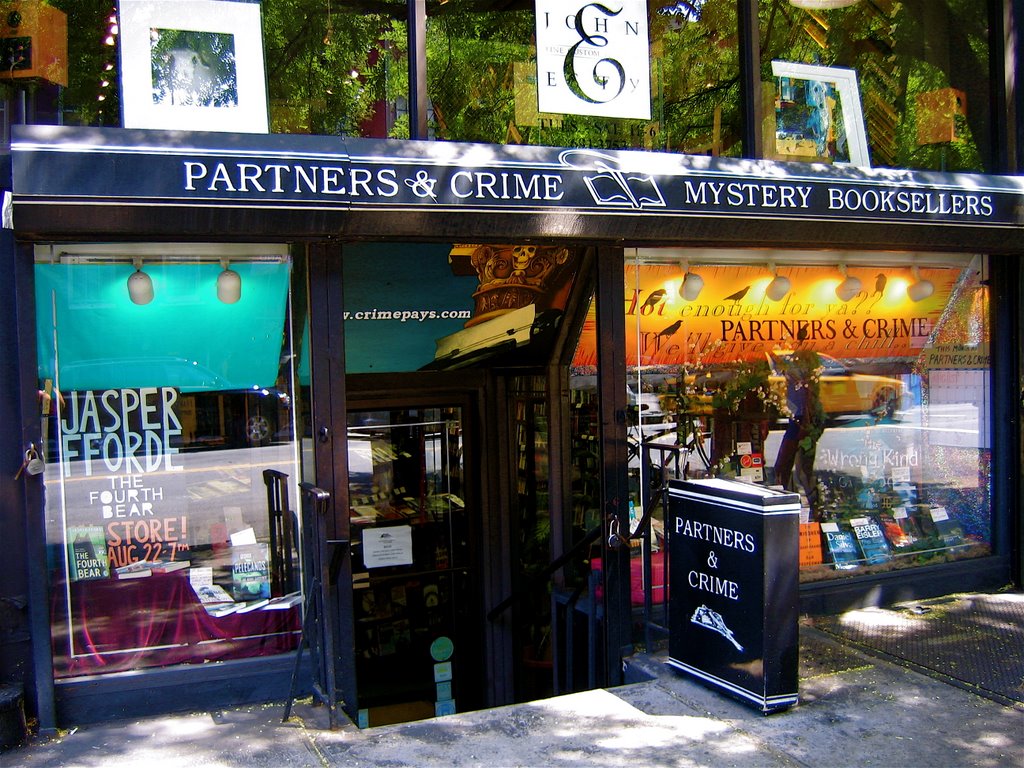
Where Silent Partners Join for Noisy Crime

White trousers may be out of fashion; but there are still a lot of ways to tell that summer is officially over. And I am not even talking about the mist rolling in from the Irish Sea this afternoon. After all, I am reporting from New York City, even though my reports are filed a few weeks late and some three thousand three hundred miles away.

In the United States, the summer season traditionally ends on the first weekend in September, a time when millions of college students abandon beaches for bookstores and a certain band of players reclaims its space behind the shelves. Unlike those students I used to teach during my ten years of adjunct lecturing in the metropolis, the W-WOW! troupe only frequents one exclusive—if academically less than sound—venue: the Partners & Crime bookstore in the West Village.

Ever since the mid-1990s, when the city that presumably never sleeps still bore a slight resemblance to the bawdy and raucous town it had been before naps (and a lot else) became mandatory or derigueur, the W-WOW! players have been gathering on the first Saturday of each month (summer excepting) to re-enact the cases of Sherlock Holmes, Harry Lime, Philip Marlowe, and The Shadow as they were heard on US radio during the 1940s and early 1950s. You know, those days when the city had so much character to spare that a shadier one of it could be knocked off and tossed into the East River without causing more than a RIP-ple. Those days when the city was divided into distinct and clashing neighborhoods rather than being homogenized for the purpose of corporate milking. Those pre-television days during which keeping ones eyes shut to the world to share an imagined one was a national pastime rather than a geo-political hazard.

Anyway. Partners & Crime is a terrific store, one of the few sites that somehow managed to withstand the pressures imposed by chains like Borders or Barnes and Noble. One day, when the millennium was still very young and terrorism something that, from an American perspective, happened mainly to people in Europe and the distant Middle East, I discovered that Partners & Crime had become somewhat of an old-time radio institution—without ever going on the air. In short, it was an intriguing anachronism in a town about to trade in its past for clean facades and the promise of crime-free streets. I’d rather look at the scar above my left eye, dating back to a nightly stroll anno 1989, than walk what now goes for 42nd Street. But, back to fictitious felonies . . .

I was probably browsing for an old copy of Seven Keys to Baldpate or some such chestnut brought to light in my dissertation, when, much to my astonishment and joy, I spotted a microphone at the back of the store. As it turned out, there was an entire studio in the tiny, windowless backroom, a space modelled after station WXYZ in Detroit, as the playbill informed me.

I don’t suppose the goings-on behind the shelves do much for the sales at Partners & Crime. I, for one, immediately forgot all about the volumes around me and inquired about the microphone and its purpose. I was thrilled to learn that it was not set up for a reading of a contemporary crime novel, but for some old-fashioned radio mystery, to be performed for the benefit of a small group of theater-of-the-mind goers who eagerly squeezed into this nook beyond the books. I joined them, of course.

The W-WOW! players recreate old-time radio thrillers—commercials ‘n all—by placing their audience inside the make-believe Studio B of the equally imaginary W-WOW Broadcast Building. It may not further or elevate the art of radio drama and be done largely for camp (a way of misreading I can do without); but watching the performers as audiences once watched live broadcasts over at Radio City is nonetheless an enjoyable experience, particularly if you happen to eye the sound effects artist eager to elicit a few laughs while playing to the onlookers.

It is unfortunate that the W-WOW! troupe, unlike the Gotham Radio Players, do not go on the air to put their skills to the ultimate test of prominent invisibility. Theatrical training insures that some of the voices are fit for radio; and the actors are passionate even when the scripts are ho-hum. One among them, a certain Darin Dunston, not only appeared in a production of Under Milk Wood, but was the lead in Radioman, an award-winning student film about drama.

For a mere five bucks (less than one tenth of the cost of a half-price theater ticket), you may still take in a double feature of thrillers, transcribed from original recordings. Never mind that most of those in attendance at Partners & Crime seem more interested in the corny sales talk than in the plot of the mysteries or in the history of radio dramatics. I, for one, often listen to audio plays to get lost in sound instead of bothering to find much sense in them; and the noise made in the back of that West Village bookstore is quite in keeping with the shots, thuds, and wisecracks heard on US radio during the 1940s.

Manhattan Transcript: Why Oliver Stone Left Me Cold

Well, I am back in town. Getting here (from Wales) was a considerably less sentimental journey than Oliver Stone’s journeyman tribute to the city and its indomitable spirit—and a far more telling reminder of the changes resulting not just from the terrorist attack on the World Trade Center but the subsequent efforts in the so-called war on terror. At our airports, unlike a court of law, we all are presumed guilty unless proven innocent. After a sleepless night in Manchester, England, I was being questioned regarding my passport, asked to provide evidence of my stay in the United Kingdom—the country where I now live and from which was about to leave.

Although issued in London and stating my residence as being Wales, my German passport marks me as a visitor, a cosmopolitan spirit, or some such suspicious subject. Airport (in)security has made international traveling considerably more challenging of late, given the current security alerts and precautionary measures at UK and US airports. Far more than a series of inconveniences, air travel has become an endurance test for a free world locked in a system of terror and liberties impounding counter-terrors.

It seemed right for me to go see World Trade Center on its opening night here in New York City, especially since some of the proceeds will go to charity. I lived in Manhattan on the day of the attack and the anguish of its aftermath. Reminders and memorials far more eloquent and than Stone’s film lined the city’s crowded if quiet streets—candles on the doorsteps, “missing persons” photographs on the walls, and distress signals in the faces of those lingering among strangers whose presence offers some reassurance that the world had not yet come to an end. Today, the World Trade Center site (pictured above, in a photograph I took last Tuesday), is a gash in the cityscape bespeaking the pathology of terror.

Telling the events of that day from the perspective of first responders and their families, Stone’s World Trade Center struck me not merely as sentimental but spurious. Denying the politics of terror and offering instead something akin to Backdraft with a “based on a true story” tag, the film plays a game of “Good cop, bad Capra” with those who are most anxious to attack it. It refuses to be sensationalistic, but falls far short of making much sense of matters so staggering to most of us. It has nothing to share beyond the uplifting message that the human body can endure great pain if sustained by a will to live.

We all are living and fighting for the basics, for the love of someone or the passion for something—including those in our midst who love to hate us and are willing to be consumed by and give their lives for that love. It is the realization of the potential destructiveness of fierce attachments that makes terrorism such a frightening presence in our lives. It is this disconcerting realization that World Trade Center leaves out of the picture, thereby falsifying an historical event that gave rise to the passion-stirring and hate-begetting war on terror.

Unlike the riveting United 93, Stone personalizes the event, embedding the extraordinary in ordinary stories of everyday middle-class and endorsed-as-traditional family living. With a narrative structure fit for a Lifetime television movie of the week and performances so perfunctory as to collapse under the burden of sentiment they are supposed to carry, World Trade Center is an abject failure in Hollywood storytelling.

Turning a landmark event into a Hallmark card, it even manages to reduce the eponymous structure and the smoke rising from its rubble look to a poorly executed CGI effect. Given the footage we have all seen and shed tears over, this faking was most distressing to me. Then again, even the homeless and the streetwalkers—stock figures meant to suggest urban grittiness in films set in the metropolis—came across like so many Hollywood extras dressed up for the occasion.

It was distressing that I could not be made to feel anything but dissatisfaction, having suffered so greatly on that day and being generally so receptive. Other around me even burst into uneasy laughter at the sight of Jesus holding a water bottle, an image of astonishing tackiness. It is telling that the most poignant moments in the film flickered before me in news footage of the world’s response to the attack, images of people who did just what I did when the towers came down: watch in horror.

These snippets also carry the political message that Stone’s dramatizations obscure: that the world’s love for America, so evident on the day of the attack, has been squandered and that neither our homes nor the world beyond are any safer in the age of counter-terrorism.

The Next Voice You Hear; or, Blogging Away

The next voice you hear will still be mine; but it will come to you from the metropolis. Tomorrow morning, I am leaving Wales (my man and Montague, the latter, being more compact, pictured in my arm). After a stopover in Manchester, England, it’s off to New York City, my former home of fifteen years. Last time I was there, I found myself in the middle of an old-time radio serial (I Love a Mystery), the keeping up with which turned out to be somewhat of a chore, appreciated by too few. I also did not enjoy wireless access and was piggybacking wherever I could, a haphazard signal chasing that complicated the webjournalistic experience.

This time around I will suspend all regular programming and write instead about popular culture in relation to Gotham. I am planning to visit and report from various New York City locations where radio drama was produced, is being presented these days, or has been set. I’ll also conduct tours of second-hand bookstores, cultural sites that are fast becoming extinct in the corporately co-opted rental space for advertising opportunities that is today’s cityscape. In short, it will be an old-time radio travelogue.

I might also write about any play or movie I get to see while in town. Unfortunately, the Film Forum has decided upon a retrospective of swashbucklers, as well as a series of Buster Keaton features. Since I don’t care much about either (and went to see Keaton’s The General only a few weeks ago, with silent film music composer Neil Brand at the piano), I don’t think I’ll spend much time at the local movie houses, most of which play the fare that you get to see anywhere else in the western world or the non-hostile elsewhere. I’ll stack up on a few good DVDs while there, snatching whatever bargain I can get my hands on.

I might also flick through the US channels I miss here in the UK, such as the Independent Film Channel, Sundance, and Turner Classic Movies, which has scheduled a Carole Lombard day on August 17, and catch up on some of the television series I’ve read about on the web journals I regularly peruse. I might also take in a few Broadway or Off-Broadway shows. Whatever comes my way or catches my eye, you’ll read about it here.

So, to borrow from Archibald MacLeish’s “The Fall of the City” (previously discussed here), the next “broadcast comes to you from the city,” technology and the general vagaries of life permitting. I hope you’ll tune in.

On This Day in 1938: New York Planetarium Sends Astrologer on an Interplanetary Mission of Peace

Selena Royle

Well, they should all be out tonight. The stars, I mean. One of the great joys of living in the country is seeing millions of them lighting up the sky. On a clear night, you can read by the light of the moon. I grew up in an industrial and smog-shrouded region of western Germany; and when I moved to brightly lit New York City, I got to see no more than a dozen of those distant suns, even on a cloudless night. As if to make up for that firmamental deficiency of our modern world, the Hayden Planetarium in Manhattan once offered Americans an opportunity to commune with the universe by taking a microphone to the heavenly bodies.

On this day, 6 June, in 1938, the planetarium was the site of a dramatic radio broadcast of The Planets, a verse play inspired by the Gustav Holst’s popular orchestral suite and written especially for the medium by New York City poet Alfred Kreymborg. Soundstaged in the planetarium’s Solar Room and broadcast over WEAF and affiliated NBC stations, The Planets was performed by seasoned New York stage actors with experience in radio theatricals, including Charles Webster, Burford Hampden, and Selena Royle (pictured above, all dressed up for an earlier radio play, The Finger of Darkness).

Unfortunately, no recordings of this impressive event seem to have survived; and, as much as I argued against such readings only yesterday, I am left with nothing but the publish script, some cues and an on-the-air-conditioned imagination, to gather how it might have sounded.

Kreymborg took to the airwaves because, as he put it, the “world we live in now is so closely knit that a sudden event touches all people, no matter how far removed from one another. Our local or personal spheres have become universal.” The impending war in Europe was such an “event” touching all—and radio was the medium to bring faraway crises into the living rooms of America. The allegory of The Planets, according to its author,

concerns the earth from the World War up to now [that is, 1938] and then tomorrow. An old astrologer, pointing his glass toward the heavens searching for peace somewhere, is the central figure. In the course of his starry adventure he encounters the planetary gods, roaming the earth as in Grecian times: Mars, Venus, Mercury, Jupiter, Saturn, Uranus, Neptune.

The gods represent the stages of world political events from 1931 to 1938, with Uranus, the father of magic, standing for the global crises of the years just prior to the Second World War. As the earth spins from one age of war to another, the astrologer attempts to dissuade soldiers from going into combat, but dies prophesying “[a]nother hell”

Far greater than the hells of yesteryear,
And greater than the hells of ancient time
When gods laid heaven low and men fought men.

The play, which one contemporary reviewer dismissed as a “diatribe against war,” proved prophetic in this regard; but its author was less of a visionary in his hopes that the theater of the mind might some day attract noted poets and mature into an art akin to the drama of ancient Greece.

“We have all been too impatient with radio in the past,” Kreymborg remarked, “and have based our judgment on the very worst things we could listen to.” Today, we base our judgment of old-time radio on the average thriller and sitcom, rather than on the occasional experiments that, however flawed, suggest what the aural arts might have been or may yet become.

Unless we are content to dig in the muck of culture or delve into the mire of war, it might be worth our while to keep reaching for the stars . . .

On This Day in 1930: Murder Trial Broadcast Summons Millions to Court

Well, it is Black Friday here in New York—the stores are opening at preposterously early hours and shoppers are lured away from their leftover turkey with promises of early bird specials and nest egg busting savings. Too lazy after a sumptuous Thanksgiving meal, I am not partaking of any 5 AM bargain debasements. Instead, I am going to celebrate yet another milestone in radio drama history—The Trial of Vivienne Ware, which opened on this day, 25 November, in 1930 and ushered in a new age of cross-promotional multimediacy.

“There’s murder in the air,” the New York Times had announced in its Sunday radio section, predicting that The Trial of Vivienne Ware would “occupy the attention of listeners over WJZ’s network for six consecutive nights beginning Tuesday.” Considerably more enthusiastic was the New York American, which declared the six-part serial to be “one of the most stirring mystery radiodramas ever presented,” quoting NBC president M. H. Aylesworth as saying that its script “established a new standard in the creation of radio plays. The simplicity and fidelity of the theme, together with the colorful word and character pictures, stand out in this new field of adaptive writing.”

The New York American—the Hearst “paper for people who think”—had good reason to eulogize the as yet unaired serial as “one of the best radio dramas ever written,” given that the program had been conceived by one of its own feature writers.

Every effort was made to prevent the program from appearing like a cheap marketing ploy and to convince WJZ, New York—the flagship station of NBC’s Blue network—to produce the series in its glass-curtained Times Square studio atop the New Amsterdam Theatre and to broadcast the event locally instead of making the required six half-hour spots available to national advertisers.

Certain to impress NBC executives was the fact that—along with Ferdinand Pecora, Assistant District Attorney of New York, and prominent New York attorney George Gordon Battle—none other than US Senator and Supreme Court Justice Robert F. Wagner had agreed to participate in the mock trial by assuming the role of the presiding judge. The titular heroine was played by Rosamund Pinchot, a stage actress who had appeared in Max Reinhardt’s celebrated staging of The Miracle, and the entire spectacular was supervised by well-known Broadway producer John Golden.

“Ladies and Gentlemen of the Radio Jury,” Wagner addressed the audience during the inaugural broadcast:

You have been called to one of the most trying tasks which befalls the lot of a citizen. You are to try a fellow being on a charge of first degree murder.  It is the more difficult for you in that this defendant has everything which would make life for any young woman most desirable.  Yet it may become your solemn duty to deprive her of her enjoyment of that life.

Standing to gain cash prizes for the most convincing verdict, readers of the New York American were advised to prepare themselves by taking in the published “information” daily, since they might miss “important loop-holes” if they did not “carefully follow the testimony and the evidence” as presented on the radio. “By reading the New York American every morning” throughout the trial and by “tuning in on WJZ each night at the specified time,” readers should be able to form their verdict as to Miss Ware’s guilt or innocence—“just like any other juror.”

According to Radio Digest, verdicts, letters of congratulations, and demands for a sequel were received from places as remote as Canada and Virginia, as well as from ships at sea; an estimated 14,000 listeners eventually acquitted the fictional heroine on trial, with about 2000 arguing the “society girl” to be guilty. More significant for the publisher was that the serial had increased the circulation of the New York American “far in excess of expectations,” as a result of which Hearst papers in San Francisco, Chicago, Los Angeles, Washington, and Omaha sponsored the trial with different casts of local luminaries.

A follow-up trial involving the murder victim’s less privileged “friend,” nightclub singer Dolores Divine, was staged a few weeks after the acquittal of the first defendant. A generic version of the radio scripts for both serials, prefaced by excepts from the printed reports and concluding with the audience verdict, was subsequently published by Grosset and Dunlap, which marketed Kenneth M. Ellis’s The Trial of Vivienne Ware as the “first radio novel, an innovation in both the radio and publishing worlds.”

Unfortunately, no recordings of this interactive multi-media event seem to have survived. I sure would have enjoyed tuning in . . .

Catching Up With the Gals

Well, I couldn’t resist seeing the gals today. Bea Arthur, Rue McClanahan, and Betty White were at a DVD signing at a Barnes & Noble down in Chelsea, Manhattan (pictured below). I got to tell Rue that I learned English watching the show, which rather astonished her. It’s quite true.

Picture this. New York City. The late 1980s. I was a small-town German boy on a five-month visit to the Big Apple—flat broke but ready for adventure. One morning, counting my dollars after another night out, I caught a rerun of The Golden Girls. The laugh track suggested that I missed out on quite a bit of fun. Still, I fell instantly in love with those four women: the naive, good-natured Rose, the flirtatious and selfish Blanche, the sarcastic but insecure Dorothy, and her equally sarcastic mother (Estelle Getty, who is apparently too ill now to get about much). Okay, so I assumed at first that Bea Arthur was a drag queen. Not that that kept me from watching.

It didn’t take me long to make my morning visit to Miami Beach part of my daily routine. It took me quite a bit longer to get most of the cultural references (for many of which you’d need footnotes by now, anyway). But once I got them and learned much about American humor besides, I gained the confidence to be funny in English. Quotations from The Golden Girls gradually sneaked into my repertoire of witticisms, my everyday language. Eventually, I went to university here in NYC. I’d like to think that the gals had something to do with that.

Listening to “The Thing That Cries in the Night”; (Chapter Fourteen): Desperation Is a Clash by Night

Well, if prices had plummeted as rapidly as city temperatures, I’d be enjoying some terrific bargains today. Yesterday, I went downtown to my favorite electronics store and went hunting for a few old movies. I am not prepared to pay $25 or more for a copy of, say, Queen Kelly; nor am I eager to get my hands on $5 DVDs that turn Hollywood entertainment into headache-inducing eyestrainers. I always keep abreast of what’s in the stores by reading the notes and reviews posted by fellow bloggers like Brent McKee and Ivan Shreve; so I pretty much knew what to look our for while in town.

I had my eye on The Doris Day Show and the Ann Sothern sitcom Private Secretary, both of which I turned down for the reasons just stated. This time, I walked away with The Harold Lloyd Comedy Collection, a set of seven DVDs containing most of Lloyd’s best films, some shorts, stills, as well as episodes from his Old Gold radio program. With prices for this anthology as high as $100, I was pleased to have snatched it up for the relative bargain of $63. Today I will head downtown again to have a browse at the best second-hand bookstore in town (you know, the one featured in Absolutely Fabulous). Now, on with the show . . . I Love a Mystery that is.

On this day, 17 November, in 1949, creator-writer-director Carlton E. Morse opened the penultimate chapter of “The Thing That Cries in the Night,” the fifteen-part radio thriller I have been following for nearly three weeks now. Compared to the previous installment, today’s 10-minute segment is a decidedly noisy affair. It is the equivalent of a car chase sequence in an otherwise not uninspired detective story. For all its excitement, it is something of a cop-out.

Only yesterday, Morse was demonstrating how terrifying and mysterious a voiceless presence can be when the ambiguities of silence are introduced to challenge the sound-equals-life dynamics of radio drama. Silence, however, was dreaded by none more than the broadcasters, who filled the air with words, noise, and music to prevent listeners from twisting the dial or questioning the soundness of their receivers.

In Jack’s dialogue with death, Morse had found an ingenious way of giving silence a voice. Now, in a desperate attempt to crank up the thrills, his storytelling is in danger of being reduced to a frantic mess of juvenile tumult and shouting, a nocturnal free-for-all during which the stuffy air of the Martin mansion is filled with much mindless clamor and sense-numbing chloroform (the weapon of choice for Morse’s unseen and supposedly ethereal adversaries).

I Love a Mystery was always introduced as an “adventure-thriller”; and in episode fourteen, it is adventure that prevails. If silence is the stuff of mystery, adventure plays itself out in loud noise and boisterous speech. Will “The Thing” shut up when the mystery concludes tomorrow? Time for me to take a break from blogging and signal-hunting. The town beckons.

Listening to “The Thing That Cries in the Night” (Chapter Twelve): Pride Is a Fierce Old Lady

We are experiencing technical difficulties. I arrived in New York City yesterday after what seemed a well-nigh interminable journey by train and plane, prolonged rather than relieved by a sleepless stopover in Manchester, England. Now I can’t seem to get wireless access long enough to update and edit this journal. So far, I resisted having to consume cups of overpriced coffee for the privilege of keeping the silent few abreast of my adventures in living and listening.

Right now, this means resting my laptop under a scaffold while waiting for the rain to ease. Not quite the walk in the park I enjoyed yesterday (as pictured above). I am determined, though, to continue my three-week mission to explore strange goings-on, seek out new death and old civilization, to boldly venture deeper into the house of Martin, whence I’ll be reporting back as regularly as technology, weather, and footwear permit. Today’s installment, the twelfth in the fifteen-part radio thriller “The Thing That Cries in the Night,” was first broadcast during the East Coast revival of Carlton E. Morse’s I Love a Mystery program on this day, 15 November, in 1949.

Jack Packard, one of the three investigators hired to rid the formidable Mrs. Randolph Martin of her “granddaughter trouble,” makes a startling statement. He claims to know the identity of the mysterious “thing,” the menacing no-show that bawls like a baby, supposedly to warn the Martin’s of death and destruction.

It is unclear whether we are to regard the “thing” as a neo-gothic alarm system or as the destructive force that has already caused the death of two people and the injuries of other members of the Martin clan. So, Jack is in a position not only to put an end to the mystery but to prevent further crimes. Yet instead of sharing his knowledge, he keeps his two fellow adventurers, Doc Long and Reggie York as mystified as most of Morse’s listeners are likely to be at this point.

The rules of the game have changed: we are no longer Jack’s secret sharer. A compact has been broken. The police are on the scene of the crime; they, too are being left in darkness. Morse does not as much as give them a voice. They are figures of no consequence; and since they are not given a voice, we cannot expect any assistance from such muffled authorities.

Mrs. Martin is about to go back on another agreement. Just when the case shows promises of being solved, the old woman dismisses the men whose services she had been anxious to secure. So eager to protect whatever secrets are cloistered in her less-than-happy home, she even expresses herself pleased at the prospect that cracking this nut of a case might be the death of Jack.

Is Jack willing to pay so dearly for his supposedly superior position, a fiercely contested vantage point from which he is now able to threaten Mrs. Martin with the disclosure of her deadly secrets? Will the price of knowledge prove higher than the cost of ignorance? And will I manage to post again tomorrow? Please stay tuned.

Listening to “The Thing That Cries in the Night”; (Chapter Eleven): Promise Is a Name Remembered

Well, I am on my way to New York City, the town I once called home. It has been a year since I left, and I am looking forward to catching up with friends, revisiting old haunts, and walking through streets that are so much part of the landscape of my soul that I never thought I would be able to find myself elsewhere. I did, eventually; but I would not be the man I am today, for better or worse, were it not for my New York education—and I don’t just mean earning my PhD. Technology permitting, I will continue my blog from there; it is the first time I am travelling with my laptop and I wonder whether or to what extent being back in town is going to influence the way I am writing here, even though my mind’s eye will remain fixed, for a few days longer, on a certain mansion in Los Angeles—the house of the doomed Martin family.

For two weeks now I have been listening to the old-time radio thriller “The Thing That Cries in the Night,” a serial in fifteen chapters that aired as part of Carlton E. Morse’s I Love a Mystery program back in 1939 and (in its New York revival) in 1949. The eleventh chapter was broadcast in the US on this day, 14 November, in 1949.

So, what’s been going on? The troubled Charity Martin has been carried to her quarters, a room she claims to have “always hated.” During her childhood, it was wallpapered with less-than comforting nursery rhyme figures, creatures that seemed to spring to life in the darkness. When asked to return to the events of the night—a night during which the young woman was found bound and gagged next to the basement furnace, Charity tremulously relates being abducted by a faceless figure in a blood-red hood carrying out the horrors which, she insists, have “got to go on and on and on until there isn’t any of [her family] left.”

Having encouraged this outburst, Jack surprises Charity, his partners, and us listeners with a seemingly unrelated question: “Do you know a girl named Pauline West?” Charity (or Cherry, as she prefers to be called) hesitates, acknowledging little more than a vague recollection. Jack explains that he read the name on a casting sheet he found next to Cherry’s body, and that Pauline West appears to be a radio actress.

What else is down there in that basement: transcription disks? The 1949 transcribed run of Morse’s serial was produced during the early days of tape recording; but the script for “The Thing” is a decade older and dates from the time when radio was live.  Is the titular “Thing” live? Or is it a recording, like Morse’s remake?

Before the chapter closes, another shot is fired—right in our presence. Charity and her sister Hope are struggling for the possession of the gun that killed the family chauffeur. Hope is shot. For once, the “thing” has not cried. Was the shooting accidental? Or did one sister try to do away with the other? And was it all part of the scheme to bring about the fall of the house of Martin?

Now you’ll have to excuse me. I’ve got a plane to catch . . .