
Tonight at 8:30 (or Whenever It’s Convenient)

“You can’t do without it. Supposing you wanna hear Jack Benny, see? But you can’t be at home at that hour. So you tell the maid to turn the radio on when Jack Benny comes on, and this automatically goes on with the radio. . . .” That is how big shot Howard Wagner goes on about his new wire recorder—shortly before giving his old employee the ax. The employee is Willy Loman, the scene from Death of a Salesman. It is one of the references that came as a surprise to me yesterday morning when I reread the play I thought I was done with by the time I left college. At the time he wrote this Pulitzer Prize-winning piece, Miller had not long gotten out of the radio game and was rejoicing in his newfound artistic freedom; so he gives the speech—and the speech recording device—to the bad guy. Having previously gone on record to dismiss radio as commercial and corrupt, Miller now suggested how the medium was about to get worse—that is, farther removed from live theater, from the immediate, the communal, and the relevant.

This “wonderful machine”—for which Mr. Wagner is ready let go of “all [his] hobbies”—is a metaphor for the selfishness of a society that was moving so fast, it could not even give the time of day to its most beloved entertainers—let alone a tired old man like Willy Loman. If Mr. Benny wanted to talk to Howard Wagner, he, like everyone else, had to wait for the hour appointed to him by the big noise.

“You can come home at twelve o’clock, one o’clock, any time you like, and you get yourself a Coke and sit yourself down, throw the switch, and there’s Jack Benny’s program in the middle of the night!”—all for “only a hundred and a half,” an amount for which Willy Loman is willing to work for three weeks and a half.

For decades to come, it was the industry that benefitted most from this new recording technology. Bing Crosby could walk into the studio when it suited his own schedule, rather than having to be there for the public who sat by the radio, as of old, to hear his program go on the air. Nowadays, the Willy Lomans are in charge of scheduling, of making time for whoever vies for their attention.

I would not go so far as to say that I “can’t do without” the latest recording software. It sure makes it easier for me to enjoy more of what I enjoy, though. The BBC’s iPlayer has greatly changed my listening habits and increased the number of plays, documentaries, and musical selections I take in. Currently, I am listening to “The Better Half,” a cheeky if dated sex comedy by Noel Coward. Written and performed in 1922, the unpublished one-acter about “modern” marriage (in the traditional sense we can’t seem to get past) was not staged again until 2007. Earlier this week, it had its broadcast debut on BBC Radio 4.

Okay, so the leading lady is not Gertrude Lawrence (star of radio’s Revlon Revue back in 1943)—but at least I won’t have to listen to Mr. Wagner’s precious offspring (“Listen to that kid whistle”) while begging for a moment of his time. After all, most of us don’t get the impression that, as Noel Coward puts it in “This is a Changing World” (with which the radio adaptation of “The Better Half” opens), “[t]ime is your tenderest friend.” So, it feels good to push a few buttons and get the better of it . . .

Related recording
“Meet Gertrude Lawrence,” Biography in Sound (23 January 1955)

How a Picture Perfect Brief Encounter Dissolved into a Not-So-Still Life

Last night, when it was time to dim the lights, set up the screen, and decide upon a movie to take in, I could be convinced to leave Broadway and Hollywood behind to make it David Lean’s Brief Encounter (1945). Mind you, it did not require much coaxing. I purchased a copy of the film a few weeks ago, but believed myself to be not deserving of experiencing it just yet. Some motion pictures are so grand that they demand not only our attention but our emotional receptiveness.

I have always thought it possible, and indeed imperative, to approach art with a keen eye and an open heart, to feel it and to feel like thinking about it at the same time. To examine Brief Encounter without being enveloped by it would be tantamount to noting the ingredients of a great meal without taking time to savor it.

Only after I had dried the tears I was neither inclined nor able to hold back, did I go in search of another interpretation of the story—cinema reconstituted as radio drama. A while back, I did as much with Lean’s Blithe Spirit, but knew right away that, in this case, radio could not hold a candle to a portrait so delicately outlined and exquisitely lit.

When the Theatre Guild reworked both Brief Encounter and Still Life, the Noel Coward play of which the film is an adaptation, the show’s producers made a number of sensible choices. They managed to bring Ingrid Bergman to the microphone to assume the role of Laura Jesson, the married woman who inwardly rehearses the miracle and misery of her recent indiscretion rather than confessing it openly to the husband beside her. Subtle and dignified, Bergman is perfect for the part, her emotive voice well suited to capturing moments of dignity under the assault of passion.

At the time of the broadcast (6 April 1947), Bergman starred on Broadway in Maxwell Anderson’s Joan of Lorraine, along with Sam Wanamaker and Romney Brent. Both her costars were heard in the Guild’s “Still Life,” with Wanamaker as Laura’s lover and Brent as her husband. Unlike Bergman, the two male leads do not quite communicate the vulnerability with which Trevor Howard and Cyril Raymond invested their parts.

Watching the film, I was under the impression that Laura was tormented by her overwhelming emotions, whereas the radio version suggested that she was torn apart by the two disparate men in her life, by the one wanting so little and the other demanding so much. What contributed to this impression was the way in which the adaptation by radio playwright and noted broadcast historian Erik Barnouw reframed Laura’s narrative without having access to a camera’s perspectival manipulations.

Lean’s film opens with the lovers’ last parting at the train station, a final farewell rendered furtive and mute by the sudden intrusion of one of Laura’s chatty acquaintances. Before the story of Laura’s affair unfolds in retrospect, the viewer already knows that something went terribly wrong for her, that the man who merely touches her shoulder has a stronger hold over her than she can permit herself to make public. Close-ups convey Laura’s grief, her isolation.

The radio version, on the other hand, opens with a scene of domestic life, as Laura’s husband struggles to control his two children who are unwilling to go to sleep before their mother returns home, presumably from a day of shopping. The listener is thus encouraged to prejudge Laura’s actions, to question the indiscretion of an inattentive mother who leaves her charge in the care of her husband while amusing herself with another man. Before she utters even one word of remorse, Laura is already a marked woman. In other words, whereas radio listeners are invited to accuse or pardon her, the film audience is given access to Laura’s own sense of guilt, her inner turmoil.

Generally, radio plays are quite capable of performing close-ups by means of whispered or closely-miked narration; in this particular cinematic challenge, however, the camera suggests so much more than unillustrated speech can express. When Laura acts on the impulse to end her life, her movements and features (pictured above) bespeak the horror that is her emotional imbalance.

In Barnouw’s adaptation, Laura merely talks in retrospect of having wanted to “throw [herself] under his [that is, her lover’s] train”—an unfortunate prosaic shortcut for the sweep and sway of Lean’s storytelling, aurally underscored images that reminded me, despite my love for the non-visual medium, what a sacrifice it can be to take leave of one’s complementary senses.

How the Blind Medium Immaterialized Coward’s Blithe Spirit

I guess I am still too wrapped up in US culture to have given British cinema its due. So, last weekend, while on a DVD shopping spree in Manchester, I made an attempt to rectify this cultural lopsidedness. Among my purchases was a copy of David Lean’s Blithe Spirit. Or is it more appropriate to call it Noel Coward’s Blithe Spirit, even after a noted director has . . . transubstantiated it? Generally, stage plays are treated like the brainchildren of their authors, while motion pictures are attributed to their directors. How many classic films could you trace back to their screenwriter parentage without resorting to the Internet Movie Database?

Anyway, it is an irksome inconsistency I grappled with when I needed to decide how to present and define radio plays for my dissertation (the aforementioned “Etherized Victorians”). Far from being a dead issue, the question arose anew when I followed up my screening of Blithe Spirit (1945) by taking in two radio disincarnations of Coward’s 1941 play.

The first one, soundstaged for Everything for the Boys on 16 May 1944, preceded the world premier of Lean’s feature by a year. Its adaptor was none other than Arch Oboler, probably the biggest name—and not the smallest ego—in US radio drama. Whether daring Americans to turn their Lights Out! or to put on a pair of 3D glasses, Oboler was hardly a subtle craftsman; he certainly was ill-suited to deliver the wit of Noel Coward.

Not surprisingly, Oboler’s rewrite of Blithe Spirit is a humorless affair, a tepid romance rather than a wicked romp. Presented to a live studio audience, the reconstituted comedy elicited only one laugh and a few mild chuckles; nor did it deserve more. The soundman was permitted to break a few dishes—flung by the two ghostly wives of the “hag-ridden” protagonist—but the damage was done largely by eraser, as hardly any of the play’s celebrated witticisms survived the adaptor’s indiscriminate airbrushing.

The challenge seems a formidable one when the play to be radio-readied involves ghosts visible and invisible, audible and inaudible, as well as the flesh and fancy of a decidedly material psychic. A filter microphone and a few hints from The Shadow will not suffice when wit is what is wanting.

Aside from a clipped and colorless script, the casting of Madame Arcati—the robust medium with a penchant for sandwiches, physical exercise, and dry Martinis—made matters worse: fluttery and frazzled, she lost much of her comic weight when portrayed by Edna Best. The Theatre Guild on the Air, at least, had access to the original New York cast. It also had the benefit of thirty-five extra minutes, and a script that retained much of the sparkle of Coward’s virtual sex comedy.

On 23 February 1947, nearly two years after Oboler’s inept dabbling in Coward’s froth, the Theater Guild revived Blithe Spirit with considerably greater success. It also broke a few dishes too many (to the audible delight of the studio audience to whom following the job of the soundmen had all the relish of an inside joke); but it kept both the spirit-flesh dynamics and civility-vulgarity dialectics relatively intact.

Sure, Mildred Natwick as Madame Arcati fudges a few good lines, and the attempt to explain the fact that Elvira, the irreverent revenant, is visible only to the tormented male and not to his second wife is almost as clumsy as my prose here. Still, having missed the recent London revival of the play , this was a more than tolerable substitute.

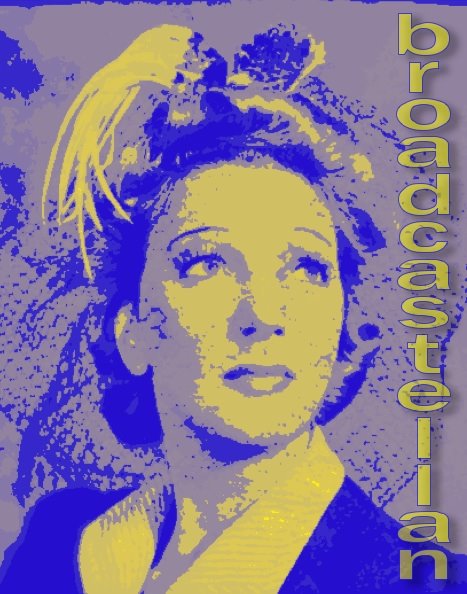
However much it tickled me to watch the redoubtable Margaret Rutherford (captured above in an ethereal fade) as she throws herself into the role of Madame Arcati, the Theater Guild adaptation brought the wit of Coward’s lines home to me like no coating of Technicolor ever could.