The Life of Radio: Norman Corwin Turns 97

Well, I just cast my two votes in the National Election here in Wales. It is the first time I’ve been given such a voice in a country not my own, and the first I am asserting my right to raise it since leaving Germany for New York City back in 1990. It is an important election, too, considering that, beginning this month, the National Assembly for Wales is enjoying new legislative powers and can henceforth pass laws (or assembly measures) affecting everyday living in the principality. Now, I won’t divulge just where I placed that X on the ballot sheets; but—caveat: creaky transition—I am going to tell you who gets my vote for “Most Underrated and Ignored American Poet of the 20th Century.” That would be Norman Corwin, who on this 3 May 2007 celebrates his ninety-seventh birthday.

He has been called the “poet laureate” of American radio, even though that title was never officially bestowed. As writer, director, and producer, he created some of the most eloquent, witty and stirring plays ever conceived for listening. He was the life of the medium at a time when it was alive (if not always well) as an artistic forum, and is ready to reach out to those, including myself, who refuse to turn a deaf ear to it. As The Easy Ace reminds us, he had a profound influence on the lives and careers of creative minds (like the aforementioned Robert Altman) who turned on the radio and turned on to his works.

What is the life of radio? Is it the voice, the word made sound, or sound itself? Are the airwaves the domain of the bard who writes for recital or the journalist who listens and records? When asked (by Douglas Bell, in a published interview titled Years of the Electric Ear) whether he thought of himself as a “creative, imaginative writer or as a sociologist or documentarian,” Corwin declared himself to be “definitely” the former. Perhaps, he was rather too accepting of the dichotomy. After all, many of his most compelling pieces for radio are at once reportage and poetry.

It was not by choice that he assumed the role of a radio documentarian, that he achieved fame for commemorative specials like “On a Note of Triumph” and “We Hold These Truths” or acclaim for series like An American in England and One World Flight). He enjoyed being witty and whimsical, writing satires and fantasies in verse disclosing “The Plot to Overthrow Christmas” or opening the case of “The Undecided Molecule”; but, once his powers of engaging the mind became known, he was being “importuned by radio entities” to speak on behalf of the American people in moments of sorrow, cheer, and sheer confusion.

The height of Corwin’s radio career—the heyday of the medium—coincides with the period of the Second World War; indeed, radio’s influence and status during those years was largely due to that global conflict, as the airwaves connected the home front to the theaters of war, however careful the filtration. For purposes of propaganda, radio recruited a great many authors who otherwise would have had little to do with the commerce-corrupted mass medium. In Corwin, broadcasters and government officials found an artist who not only knew the medium but loved and respected it, who could exploit it (rather than its listeners) while exploring its potentialities.

Corwin never turned his back on broadcasting, even when commercial radio in the US began to abandon the production of dramatic programming, already rendered largely inconsequential during the 1950s as a result of anti-Communist hysteria. Unlike many former radio playwrights, Corwin did not consider the airwaves to be a path to ostensibly bigger and better projects in other media. And if his writings are not nearly as well known today as they once were and deserve to be now, we should fault neither the topicality nor the transient nature of his work in sound, but cite the neglect of the stage on which it had been brought into existence.

"Round and Round Hitler’s Grave"

It took a while before the news got around the world; but on this day, 30 April, in 1945, Adolf Hitler got around facing trial and execution by committing suicide in his bunker. It would take another six decades until that hideout was opened for public inspection, when, in 2004, the Führer’s final days became the subject of a German film Der Untergang (2004). The Great Dictator had often been the subject of caricatures and crude character sketches, which are so much easier to accomplish than a life-size portrait. They are so much easier to take, as well, considering that a realistic image forces us to acknowledge that, far from being super- (or sub-) human, Hitler was one of us.

Throughout the Second World War, parodies and revenge fantasies boosted the morale of the Allies, comforted by way of comic deflation or enraged through violent melodrama. Radio popularized songs like Spike Jones’s previously mentioned “Der Führer’s Face” and Pete Seeger’s “Round and Round Hitler’s Grave.” If he could not be assassinated, potshots had to do:

I’m-a going to Berlin
To Mister Hitler’s town
I’m gonna take my forty-four
And blow his playhouse down.

This is how, a few days after the Führer’s death, the Almanac Singers modified those lines of Seeger’s original song when they performed it for a live broadcast of Norman Corwin’s celebrated VE-Day tribute “On a Note of Triumph,” the highest-rated American radio play of all time:

We’re gonna tell the postman,
Next time he comes ’round,
That Mr. Hitler’s new address
Is the Berlin buryin’ ground.

The Führer was dead, all right. Some eager radio writers had already killed him off, in fantasies like the aforementioned “Death Comes for Adolf Hitler.”  And yet, did that “playhouse” of his ever shut down only because its director, its producers, sponsors, and select members of staff were found dead, along with an audience of millions or, as discussed here, tried and executed in the spectacle of Nürnberg?

Corwin cautioned the American public, asking listeners to “fix [their] eyes on the horizons” and swing [their] ears about.” The old regime did not simply expire, no matter how many rounds had been shot to silence the enemy or how loudly one went “Round and Round” the problem of facing the aftermath.

Lately, I have been watching a number of German post-war films that dealt with the recent past of the fallen Reich and were less than sanguine about the Wunder of the nation’s reinvention as a republic. That is, they dealt with the inconvenient truth that the Nazis were not all below ground. Some had gone underground. They went on to make it big during the US-financed Wirtschaftswunder (or economic boom). Both Wir Wunderkinder (1958) and Rosen für den Staatsanwalt (1959) comment on the big fascist business and bureaucracy behind Germany’s capitalist society and its corruption by Nazi big shots who, rehabilitated without remorse, managed to get high up by keeping a low political profile.

It is this sense of a hidden presence, of an unresolved, let alone conquered past, that, many decades after Germany’s surrender, made it difficult for me to face life in that country, a country where fascists old and new still dance round and round Hitler’s grave as if in hopes of a resurrection; where those in denial of the past or in support of its policies still trample on the graves of millions; and where the radical left not only opened wounds, but fire, perpetrating acts of extremist terror.

I have not been back these seventeen years. We all have our baggage, you might say. Sometimes it weighs so heavily on our souls, it keeps us from dancing . . .

Pride of the Luftwaffe: Guernica at 70

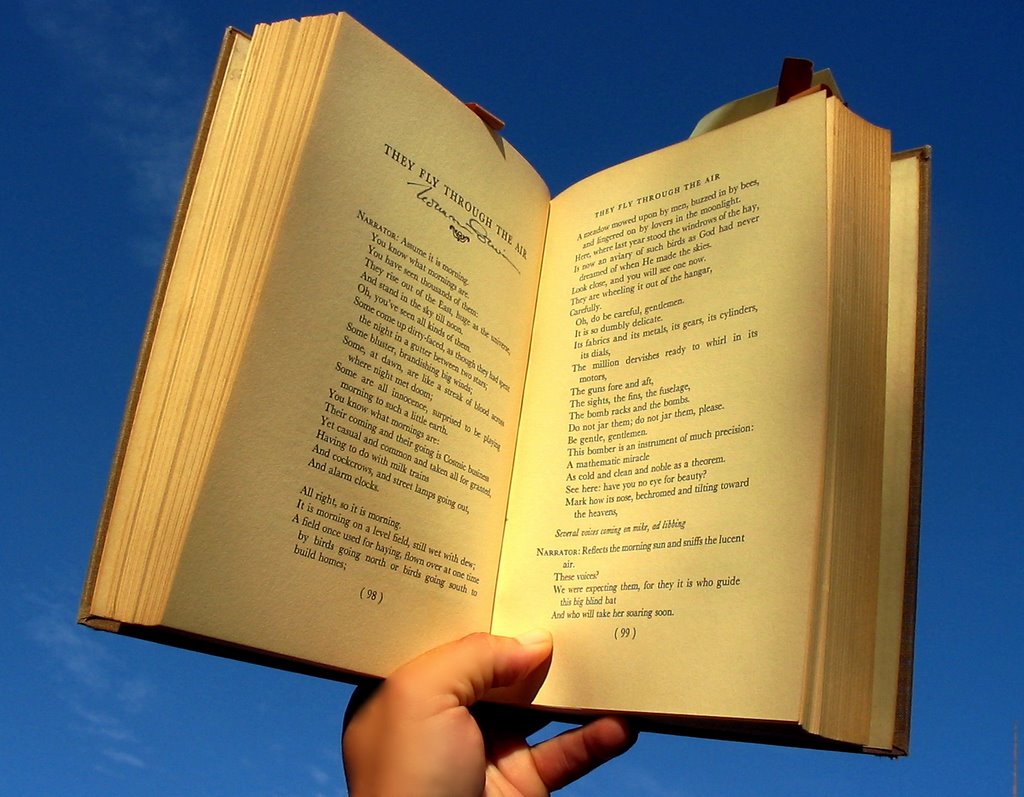
“Well, gentlemen, let’s get aboard,” says the pilot in Norman Corwin’s “They Fly Through the Air.” What a “peach” of a morning. “You couldn’t ask for a better day” . . . to blow up a few hundred civilians. The verse play (discussed here previously), was written in commemoration of the air raid on the village of Gernika-Lumo, perpetrated on this day, 26 April, in 1937. In what words, in which ways can one approach such a monstrosity, reproach such a murderous marvel as modern warfare? How to make sense of it? How to keep from becoming numb, insensitive to the atrocities of war that are being committed even today, when our gardens are peaceful and the pavements busy with people consumed with their own cares or the pleasures of consuming? These are the questions poet-journalist Corwin, who will turn 97 in a few days, tackles in his response to the raid. Picasso’s Guernica, which I got to see at last on a visit to Madrid, is a lament for the dead and wounded; Corwin’s “They Fly” is an attack on the machinery of war and the minds that get it running.

“Gee, that’s fascinating,” exclaims the pilot as he looks down upon the havoc and horror he has wrought by dutifully carrying out his mission, which is merely to test the what is hot from the runways of Germany, the latest line of the Luftwaffe: “What a spread! Looks just like a budding rose, unfolding.” That precious simile is an echo of a remark attributed to Mussolini, who is said to have found floral beauty in mass destruction.

“How can we justly celebrate the odysseys / Of demigods who finger destinies upon their trigger tips?” Corwin’s narrator considers. He has a few suggestions, all of which he rejects as unworthy of the deed:

With wreaths of laurel?
Laurel withers fast.
By sculpturing in bronze?
Too cold; too passive;
Also, in emergencies, it may be melted to make other things;
Rechristen with you names a public square?
That’s vulgar.
Furthermore, no single square is big enough.

A poem, perhaps?
Aha, that’s it! A poem!
A verse or two that will contract no rust,
A bombproof ode, whose strophes will stand stout
Against all flood and famine, epidemic war,
And pox and plague and general decay.
Yes, poetry’s the thing.

Is it? The narrator tries to escape the noise of the motors (“Our meter will be influenced”), but is dissatisfied with his lines:

What words can compass glories such as we have seen today?
Our language beats against its limitations.

How do we commemorate Guernica? Perhaps by listening for and to those engines running, the war machinery that is at work today. The past is often conveniently looked at as if from above, from which vantage point it appears distant, clearly patterned, even negligible or quaint. Perhaps it is best to resist the temptations of flight . . .

What Those Who Remembered Forgot: Robert Altman (1925-2006) on the Air

Well, news is spreading fast these days; and by now anyone within reach of a computer will have learned that film director Robert Altman has died on Monday, 20 November 2006, at the age of 81. Since my own web journal can do little to propagate this message, it will provide instead an addendum to the small number of long-prepared and oft-copied obituaries currently circulating in the blogosphere. I have attempted as much on previous occasions by sharing a lesser known aspect of the careers of Don Knotts, Shelley Winters, and composer Cy Feuer, all of whom had connections to the world of radio to which broadcastellan is largely dedicated. As it turns out, Robert Altman is no exception. Indeed, his debt to the medium was far more profound than that of the other artists aforementioned.

To be sure, Altman’s name is already being closely linked to the so-called golden age of radio by virtue of what would be his last film, A Prairie Home Companion (2006), a filmic realization of a world evoked by radio romancer Garrison Keillor. Altman was greatly influenced by 1940s radio. He revealed as much in a National Public Radio documentary broadcast in May 1995 (a recording of which you may find here). In a tribute to Corwin’s “On a Note of Triumph,” Altman made the following statement:

“Anything I know about drama today comes more from Norman Corwin than anybody. If I had to list my mentors, I would say Norman Corwin, David Lean, Fellini, Bergman, Kurosawa, and then a countless number of people whose names I forget where I learned what not do.”

Now, what could Altman have learned “about drama” from Corwin, America’s foremost radio playwright (whose first letter to me I cheered recently)? As a film director, Altman did not fare well on the stage. His production of Arthur Miller’s Resurrection Blues earlier this year was widely panned; indeed, the reviews were so unfavorable that, while in London at the time, I decided to pass on it, despite my interest in the career of Miller, a former radio writer (one of whose works I discuss here). Perhaps, what Altman did take from Corwin—and what he could do on film more readily than on a stage—was the idea of an ensemble piece comprised of a large cast, a sprawling drama of many voices (such as The Player and Gosford Park). Everybody‘s in it, you think, when you look at the cast for an Altman production.

The same can be said for the signature pieces written and directed by Norman Corwin—plays with a vast number of characters, their stories intersecting, their voices adding up to something, to an idea, a statement, about Hollywood, for instance, about politics, about the state of American society. Corwin’s seminal On a Note of Triumph was such a piece, a play for voices; not a choir, mind you, but a cacophony; not a traditional drama of linear storytelling, but a fictionalized documentary, a record of a moment. Of this play, Altman said, some fifty years after its initial broadcast: “I can recite 40% of On a Note of Triumph from memory,” having listened to it “time and time again.”

I had not been aware of Altman’s admiration of Corwin’s work, until today. Come to think of it, both Corwin and Altman were belatedly honored at the Academy Awards this year, Altman receiving a lifetime achievement award, and Corwin being the subject of an Oscar-winning documentary about the making of “On a Note of Triumph.” Now, when I watch Altman’s films, I will look for Corwin and “Anything” he might have brought to the craft of the late director.

Budd Hulick, the "Man With a Platform"

Well, this would be a perfect day to kick the proverbial bucket, especially one of those in which it has been coming down all day. Most of us seem capable of resisting the impulse, and some wretched creatures are rewarded for their restraint by having to slosh through the muck of life toward senility, whether or not they care to prolong the journey, until they are too fragile to kick at all and waste away ingloriously like an abandoned experiment in resilience. If the Internet Movie Database got it right—and did not merely neglect to keep up with the subject*—one such mortality-resisting mortal might be Budd Hulick, an American radio comedian once known as one of a couple of “gloomchasers.” He was born on this day, 14 November, in 1905.

Hulick was an announcer at station WMAK in Buffalo, New York, where he met his comedy partner, writer-announcer-utility man F. Chase Taylor. Together they became known as Stoopnagle and Budd, an act that sounded fresh and unconventional because the two tossed caution to the wind and did what was generally discouraged on the add-littered airwaves: they ad-libbed.

Indeed, or according to legend, that is just how they got started one October evening in 1930 after a hurricane had caused the network to collapse and CBS affiliates, bereft of their regular transmissions, were temporarily left to send for themselves. Hulick and Budd filled a quarter hour with music and banter, to which impromptu performance the audience responded so favorably that WMAK gave them a regular spot.

While slow to attract a national sponsor, the team proved a popular success on radio in the early to mid-1930s with their show. Together with the big names of vaudeville, wireless and motion pictures, the voices of Stoopnagle and Budd answered the public’s curiosity by appearing alongside W. C. Fields, Rudy Vallée, Burns and Allen, Bela Lugosi, Cab Calloway, and Baby Rose Marie in the Paramount comedy revue International House (1933).

After Stoopnagle and Budd split in 1937, Hulick carried on as a radio quiz show host. It was another unforeseen advent—always dreaded in the big business of unseen entertainment—that turned Hulick into “A Man With a Platform,” the title character of a “musicomedy” by America’s foremost radio playwright, Norman Corwin. Corwin had written this piece “expressly” for Henry Morgan, a caustic radio wit who apparently got his dates mixed up, as the author-director reasoned in his notes on the play, which was broadcast on 2 November 1941. Corwin “quickly revamped the show to accommodate the sly and ingratiating comedy of Budd Hulick.”

As “A Man With a Platform,” Hulick played a know-it-all of the kind we all know: some nobody who thinks that “things should be done about things.” The character sounds familiar today, considering that most people who keep a blog such as this step on the old soap box once in a while (or frequently, even) to advocate and accuse, to bemoan and belittle. We all grab this virtual microphone to voice what we feel passionate about, even though we may be opining without sound argument, in the face of facts we dare others to face.

Mounting his platform, Hulick gets to go on about the inanity of baby talk (as if responding to the phenomenon of the “mommy blogs”) and the need for changes in public education, however questionable his suggestions. Not in favor of “singing the praise of unsung heroes,” the “Man” proposes a “dishonor system,” singling out those “whose annoyance to the public takes the form of chronic overeager optimism” (as if speaking of those who maintain that the war on terror is going well). He even gets to meddle with established broadcasting practices (something that web journalists are wont to do, simply by insisting on doing things their way).

I was glad to have learned about Hulick’s 101st birthday when, rather listless and unsure whether to write anything at all today, I sauntered over to the IMDb, and, after consulting the invaluable GOLDINdex, dug out a recording of Corwin’s play. The “Man” was just the kind of gloomchaser I needed on this miserable November afternoon; indeed, it made me rethink my remarks about kicking the bucket, being that Corwin is still kicking at 96.

*The date of Hulick’s departure has since then been added to the IMDb entry

As Nazis Hang in Nuremberg, a Playwright Points at an "Empty Noose"

Imagine tuning in to one of your favorite mystery programs and being greeted instead by the following message:

“Columbia and its affiliated stations present a special broadcast for Wednesday, October 16, 1946, a day that will long be remembered at Nuremberg and throughout the world.”

It was a reminder that criminals greater than those generally found in detective fiction had been brought to justice; yet the broadcast that followed was far from celebratory.

The play was “The Empty Noose,” heard on the evening of that memorable day on which eleven masterminds of Nazi Germany’s crimes against humanity were being executed. The verdict had been announced two weeks prior to the date set for the hanging, giving writer Arnold Perl time to construct with care this provocative memorial, a document in sound that opens with the naming of the sentenced: “Goering, Ribbentrop, Keitel, Kaltenbrunner, Rosenberg, Frank, Frick, Sauckel, Jodl, Streicher and Seyss-Inquart.” Of course, only ten were actually hanged that day, leaving the eleventh noose empty.

“You should have seen them die,” the play’s “Eyewitness” addresses the listener,

seen all but one who arranged it by his own schedule [that is, Goering, who committed suicide] walk in the early morning of a gray cold day while most of Europe slept; seen them hanged one by one in the gymnasium under the electric lights. The ghastly ten who were left behind to where the hangman waited. Like those who watched, he knew, there was no payment large enough for what they had done.

Does the violent end of such violent men constitute the end of an era of violence? Or is this hanging little more than a gesture? Is it a time chiefly to rejoice and hope, or to reflect and doubt? These are the questions raised by Perl’s commemorative docudrama whose action unfolds in the eyewitness reports of those who had experienced life under fascist rule and were now attending the trial and executions.

“The Empty Noose,” like Norman Corwin’s “On a Note of Triumph,” refuses to cheer at the apparent victory for democracy, resists uttering or encouraging as much as a sigh of relief. After all, it was not Goering’s noose to which the title of Perl’s piece refers. His “Noose” was reserved for all those fascists who survived, living beyond remorse or reform, those denying the holocaust while harbouring thoughts of genocide, including those active in present-day Germany’s re-emerging Nationalist movement and those, elsewhere, tearing down liberties under cover of democracy.

“What didn’t we do at Nuremberg?” Perl’s play dares to ask, confronting listeners weary of conflict and eager to move on:

Well, that empty noose is still swinging, and it’s still empty. Until it’s used, until it’s choked the life out of Fascism—so far as I’m concerned this is no time, no place—there is no reason—to sit back relieved and calm. Tonight at Nuremberg—and tomorrow—there will still be one round coil of rope ready to be used. It’s going to take a lot of self-examining, a lot of faith in what we believe in, a lot of willingness to fight for it, a lot of speaking out, for all of us, here and everywhere, before that empty noose is filled, and we can stand up and say we have won, we have conquered.

In short—a message the play suggests rather than states plainly lest it promote fatalistic passivity—never.

Non-visual theater is the theater of ideas. While it has rarely been permitted to do so, it can dispense with traditional storytelling, with the Aristotelean dictum that there must be a beginning, middle, and end to any drama. It can raise questions, doubts, and awareness by raising voices and leaving interstices of ambiguous silence. It can resist dramatized exemplars and deal instead with ideological concepts simply by giving them utterance. And it can dangle an empty noose in the mind of its audience, a looming question mark in one’s own head more forceful and than the image of a rope around the neck of another. That image, after all, is a reminder of a time supposedly bygone, a reminder that, once again, someone else was made to stick his neck out to pay for our complacency and complicity.

The living breath of the voices on the air create no such conclusive image; instead, they caution us to be mindful, mindful of a present in which, around and within us, freedom and fascism run neck and neck for our future.

On This Day in 1945: An "Undecided Molecule" Becomes a Matter of Radio Activity

Well, if I said it once, I’ve said it a thousand times. Maybe I should say it a thousand times more and keep on saying it. Recently, the British equivalent of the destructive piece of ill equipment now installed at the White House managed to revive what might very well put an end to civilization: nuclear energy. As I looked across the fields at the green hills of Wales, some of which vistas are spoiled by clusters of wind farms, I thought what I would do if an atomic power station were to rise there. I don’t suppose leaving behind the deceptive serenity that is our garden (pictured above) would be forceful enough a statement, since moving would not bring about any change for the environment that is going to suffer at the greedy hands of narrow minds who think that today’s economy is more important than the ecology of tomorrow.

I can and will get passionate about nuclear energy, and, in this one matter, I accept neither counter-argument nor levity. That is why I fail to get much of enjoyment out of “The Undecided Molecule,” a “rhymed fantasy concerning dangerous developments among the elements” that was presented on US radio on this day, 17 July, in 1945. With a cast including Groucho Marx, Vincent Price, and Sylvia Sidney, it was given a lavish production by Columbia Presents Corwin under the direction of its author, Norman Corwin—the very man who just a few days ago offered me further advice regarding my writings about old-time radio.

“The Undecided Molecule” is a courtroom drama, of sorts. At the center of it is X, the titular molecule charged with endangering the universe by failing to find its place in the animal, vegetable, or mineral kingdoms. At the suggestion of the Defense, the representatives of each kingdom are called forward to assist X in making up its mind.

Now, the play is a charming piece of nonsense, nonsense of the kind made meaningful and literarily respectable by Victorian poet Edward Lear. To call it utter “nonsense,” in short, does not in any way belittle such joyful wordplay. And yet, I feel that Corwin’s play is belittling a matter of life and death. To do so was not his intention, as he assures readers of one of his anthologies of radio plays, in which the script of “The Undecided Molecule” was published.

“The atomic bomb was several weeks east of Hiroshima when this was first broadcast,” Corwin pointed out; “so it wasn’t that which got me writing about Mr. X.” Yet the testing of such nuclear might in New Mexico was already a thing of the past when the play went on the radioactive air. However they were conceived or intended, these cheerful lines are burdened by a history of destruction:

Oh, dear! Oh, dear!
The cosmic alarm!
Which means, I fear,
Some woeful harm
Is afoot or awing
In the universe.
Some deplorable thing,
Some active curse
Like a falling sky
Or a new star-cluster,
Been banged up by
A cluster-buster.

Thus cries Corwin’s Vice President in Charge of Physiochemistry when the alarm is sounded that the order of the universe has been disturbed. It is a wake-up call that might be suggesting

[. . .] a dried-up sea
Or another Ice Age for a spell,
Or maybe it’s only a freezing hell.
On the other hand it might possibly be
That Hitler is alive and well.

Hitler, of course, was good and dead. Two months earlier, Corwin had invited Americans to dance around his grave. It was in this atmosphere of relief that the Atomic Age was welcomed and the trifle of Uranium comically exploited. Soon after, this new instrument of horror and psycho-terror would inaugurate the cold war with a blast some believed could end all wars. How disillusioned many who fought the Second World War must have felt when they realized that there was no end to destruction, the preparation, prevention and clean up of which is such lucrative business. I was reminded of this last night, watching the post-war drama The Best Years of Our Lives. I am reminded of it now, as I look out into the fields, in awe of molested molecules that might decide our future or what there is of it.

In “The Undecided Molecule,” things turn out all right for the kingdoms of nature; but the matter is rather too heavy to be made light of in this way. With nuclear trouble mounting, it seems dangerous to make a molehill out of a molecule.

A Letter to Make a Day

Well, he deserved better than being barked at. For once, he had something of interest in his inky, pamphlet-sorting hands. The mailman, I mean. Among the bills and flyers I tossed aside, there was that rare specimen of posted correspondences: a personal letter. A missive that did not include the dismissive “sorry” or “unfortunately,” words frequently uttered by the publishers I approach regarding Etherized, my dissertation on American radio drama. Instead, it contained words like “remarkable” and “wonderful”—both, “remarkable” indeed, referring to just that study, of which this webjournal is an unacademic extension. And none now living is more qualified to make such an assessment (or pronounce such flattery) than the greatest of all American radio playwrights: the Old-time Radio Primer inspiring subject of a 2006 Academy Award winning documentary, Norman Corwin.

Researching about so-called , I never contacted any of the people whose performances are discussed in my work. As I expressed it to Mr. Corwin, I was “desirous to let the words they had intended for publication and broadcasting—words so rarely heard—speak for themselves at last. It was a listener’s respect” for such words, I declared, “not a critic’s arrogance.” I treat radio plays as art, not artifacts. I approach them as such, rather than as occasions to wax nostalgic or opportunities to get at a factual past, however important it is to keep their historical context in mind.

When I write about listening to radio plays, I avoid phrases like “the author believed” or “the writer was trying to…..” I am not a biographer; I don’t presume to know what anyone believes. Instead, I pay attention to an artist’s public utterances to discover what they can make me believe, what they convince me of—to express how their works stimulate my emotional or intellectual responses.

Recently, someone perusing this journal disagreed with my reading of a radio play by modernist poet Archibald MacLeish, arguing that I “misunderstood” the author’s “intent.” I appreciate any alternate interpretation of the works I discuss; indeed, I encourage and long for such dialogue, debates I generally have with myself. I just don’t believe that an author is the ultimate authority, that the creator of any work, once that work has been released to the public, can lay claim to any single, definitive interpretation. The brainchild has been given up for adoption, set free to dwell and flourish in the mind of foster parents the existence of which the one giving birth cannot conceive. Writing about literature and art means to adopt a reading, rather than return the presumably lost child to its cradle.

When a parent like Norman Corwin, curious to find out whatever happened to his child and how it fared in the world, finds traces of it in the adoptee’s home, there can occur a get-together of sorts, a reunion by proxy. I am pleased Mr. Corwin recognized his child and did not find me wanting in my care or amiss in my rearing of it. How elated I am to be commended for having produced, in turn, a response to radio that Mr. Corwin argues to be “leagues ahead of anything ever written on the subject in this country” (meaning, the USA). Perhaps, I ought not to have repeated it here; but, as in any such reunion, there is that moment in which pride, like the hot air in a much-damaged balloon, inflates the ego of the one privileged to have given rise to such a joyful occasion.

It is a moment to celebrate the life of a piece of writing, a life continual as long as there are eyes to read, ears to hear, and minds to create it anew. It is the hope I hear in this opening of “Daybreak,” one of Corwin’s many remarkable performances, which was brought to life again in a CBS production broadcast on this day, 10 July, in 1945:

A day grows older only when you stand and watch it coming at you. Otherwise it is continuous. If you could keep a half degree ahead of sunup on the world’s horizons, you’d see new light always breaking on some slope of ocean or some patch of land. A morning can be paced by trailing night. This we shall do, where we begin we shall return to, circling the earth meanwhile.

My mind has been going in circles today; and, for once, it still feels like morning.

On This Day in 1944: A Travelogue Introduces Americans to Tel Aviv

Well, it seems that the power lines are beginning to rot. The electric lights went out just after the sun had set, a sun, mind you, that had been hidden for days behind a wind-blown, tattered curtain of clouds. I was rather relieved to find my none-too-successful experimentations in podcasting cut short by this momentary outage, lit a large candle, and began to read a few pages of Mervyn Peake’s epic Gormenghast. In doing so, I was readying myself for a dramatization of this dreadful story—a study in dread—that I am going to attend tomorrow evening.

My reading aloud soon sent my audience (of one) to sleep, just as I have often dozed off listening to recordings of old-time radio programs—a sonically induced somnolence largely responsible for the delay in the completion of my doctoral study. In the image empire of the west, closing one’s eyes is generally associated with rest, rather than heightened attention.

Most of us are too visually trained, weaned on and preoccupied by the ocular, to become fully audile—that is, capable of learning through hearing. It was a challenge that radio producers had to meet when education—or indoctrination—by radio became an essential aspect of mobilizing the masses during the Second World War.

There are a number of radiodramatic techniques that assist listeners in taking in whatever needs to be conveyed; but rather than sharing information—factual specifics or intricate data—radio drama was most successful at creating impressions, stirring sensations, and instilling beliefs. One such belief, slow to take root, was that Americans were not fighting by themselves or for themselves alone, that it was not simply a war against an identifiable enemy, but a struggle for democratic ideals and their realization elsewhere.

In 1943, journalist, poet, and radio dramatist Norman Corwin was asked to create a series that would tell Americans at the home front something about their nation’s gobal allies. Passport for Adams was a sonic travelogue relating the impressions of a small-town newspaper editor assigned to report on the impact of the war on the world’s civilian population; weekly broadcasts transported listeners to Moscow and Marrakesh, to Monrovia and Belem.

As Corwin explains it in his notes on the play “Tel Aviv”—a second production of which was soundstaged by Columbia Presents Corwin on this day, 23 May, in 1944—the “idea was to pull for unity and victory.” The “omission of ugly details was quite beside the point. To have dwelt upon them would have been to play exactly the same tune as Goebbels, who was constantly reminding the world that the British, in their time, were dreadful imperialists.”

To counter the ignorance of his fellow citizens, Corwin created a comic sidekick more naïve than they—a culturally insensitive if good-natured news photographer who greets with wisecracks his colleague’s advice that he prepare for his assignment by “striking up an acquaintance” with Hebrew: “I know plennya Hebrew: aleph, baze, vaze, gimbel, dullard, kibitz, schlemiel, guniff, kosher, gefilte fish, Yehudi Menuhin. . . .”

Poet-journalist Corwin, who, pressed for time, gleaned most of his facts about life in Tel Aviv from a single interview with a former correspondent in Palestine—approached his subject linguistically by making a foreign tongue sound friendly and familiar—a language expressing the ideals known to and embraced by all who fought fascism.

During their tour of the city, Adams and his colleague gather information like pieces of vocabulary, from the shouts of a newsboy (“Davar Iton Erev”) to street signs such as “Rechow Umot Hameuchadot” (Street of the United Nations). Along the way, the ignorant photographer—a man dealing in images rather than words—is set right about the Hora, which he thought of as some “kind of a Jewish jitterbug dance,” while Adams talks to the people of Tel Aviv, among them a construction worker who, once a lawyer in Germany, is proud of having helped laying the bricks of the “Bet-Haam” (House of the People).

The broadcast ends with the word “shalom,” which Adams hopes will gain in a “future not too distant” a “new meaning and a more lasting one than we have ever known.” While “shalom”—or “peace”—is a dream that has yet to be translated into a global reality, radio, as a disseminator of sentiments, kept alive an ideal that kept home front Americans from abandoning the war as a means of achieving it.

Old-time Radio Primer: A Stands for Audience

Well, we all crave it. An audience, I mean. Not that “audience” is the most precise term for visitors, readers, or spectators. Audiences are people who come to audit—to hear and judge—a performance as sound; and to no medium does the experience of aural appreciation seem more germane than to radio, the only forum in which a single recital has been known to have come, instantaneously, to the ears of nearly half the US population. So, I am opening my “Old-time Radio Primer,” as announced yesterday (and as inspired by Norman Corwin’s 1941 play “Radio Primer”) with just that word: “audience.”

Is “audience” a synonym of “radio listeners”? “Audience” generally implies membership, partaking of something or taking something in, whether singly or jointly, as an individual belonging to a certain group—be it a group of theatregoers or Roman Catholics. Radio listening, however, requires no such membership; nor is it a group experience.

The so-called members of the radio audience are separated, often tuning in alone. They are not unlike the anonymous websurfer in their isolation; but, back in the pre-TV era of the 1930s and ’40s, tuners-in were even more remote and less interactive than today’s rovers of the blogosphere. Radio listeners might talk to friends about a certain broadcast; they might even call in or write letters to a station or sponsor; but the interactivity of what has been called “yesterday’s internet” was nonetheless limited.

It was a removal from the public eye that was rather daunting to many performers, especially those coming to radio from the defunct vaudeville circuit. Actors standing behind the microphone in an empty, austere studio might have thought something like this (you’ve got to have some rhyme in a Corwin inspired primer):

An audience before you
Is easy to assess:
Folks sneer, snore or adore you,
Respond as you address.

It’s not so for the speaker
Behind the microphone;
The limelight sure seems bleaker
Faced millionfold alone.

This sense of isolation from the public made stage-trained performers reluctant to step into the theater of the mind. A notable exception was the great Alla Nazimova, an actress who very much embraced the opportunity to dis-appear on the air. “Always,” she confessed to the delight of a decidedly catty reviewer of one of her radio performances, “I have hated audiences. Always!”

Producers and sponsors of radio entertainment were concerned about the medium’s missing group dynamic. What would induce listeners at home to sit still during commercials, let alone purchase the articles advertised? To create this sense of a shared experience, broadcasters resorted to some aural trickery that has shaped television and influences it to this day.

I am referring, of course, to the “live studio audience.” In the 1930s and ’40s, most radio broadcasting was live; and it was widely believed that radio plays would sound even more like live entertainment, or at any rate more lively and interactive, if spectators were to come to the studio to howl and clap on cue.

There was considerable dispute over this definition of “live audience” as referring to studio visitors who could testify—through laughter and applause—that a certain performer truly was there, appearing in the flesh for some to see while dematerializing as sound for all to hear.

As I discuss it in Etherized Victorians, my study on old-time radio, those who believed in the autonomy of radio drama as an art very much resented this spectacle approach to soundstaging, which gave listeners at home the impression that they were not witnessing the real thing because they never got to see the stars performing for them.

In a statement read at the close of the Campbell Playhouse presentation of Liliom (22 October 1939), Helen Hayes reminded listeners that a program barring spectators was

a real radio show, produced for the air, without a stage, without a curtain, without an audience in the studio. It allows the producer to produce and the actors to act for their real radio audience, for those millions of listeners sitting at their radio sets in their own homes all over the country.

Today, of course, “live studio audiences” in the age of time-delayed transmission and laughtrack accompaniment are neither truly live nor, for the most part, present in the studio. Given such progress, could I be hearing a chorus of disapproval?