
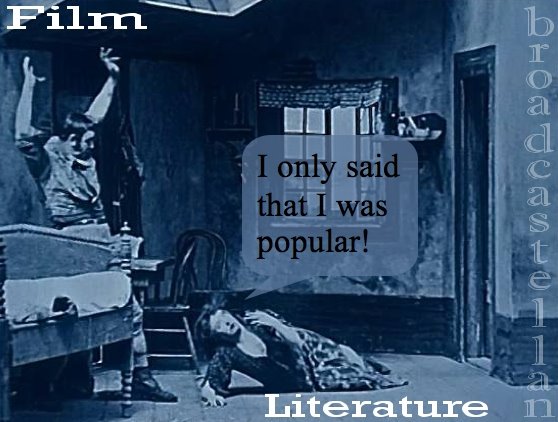
 The Oxford English Dictionary devotes an astonishing number of pages to the definition and history of the word “old.” Thus far, I have not been entered as an example. To be sure, whether or not something or someone is “old” depends largely on the age and attitude of the beholder; but it also depends on the history and evolution of what is being beheld and judged. Based on the history of film alone, one can safely describe Vitagraph’s “Oliver Twist” as “old” without incurring many objections as to the subjectiveness of the chosen adjective. After all, “Oliver Twist” was released back in 1909. At the time, some of the first readers of Dickens’s serial novel still numbered among the living. They might have looked upon those images in motion as a novel approach to an old favorite, while we, who have come to realize that technology dates faster than art, look at it as a creaky and inadequate translation.
The thought of film as a bridge between us and the early Victorian age is awe-inspiring; not that extant constructions rising above that gap are particularly trustworthy, considering the cardboard sets and threadbare production values of films like “Oliver Twist.” Directed by Englishman J. Stuart Blackton, it is all but nine minutes long; and as such, it is more or less a synopsis of the novel.
Indeed, it is rather less. Here we have the richly descriptive words of Dickens, a master of penning indelible if none-too-intricately sketched word-portraits, translated into the moving images that are, to this date, the competitors of moving English. Intertitles are sparse, an economy of words that turns the spectacle into a set of tableaux in the service of a moral whose statement even a sentimentalist like Dickens might well reject as rather too obvious and prosaic.
Owing to the film industry’s raiding of the Dickens canon, the author’s original illustrator, Cruikshank, appears to have run away with the show. In film, now and then, the word is largely an adjunct to the image, reversing the precedent set by the illustrated novel, itself the product of modern printing technology. Without any close-ups and a style of emoting that makes Lana Turner’s acting look like the epitome of realism, “Oliver Twist,” unlike Dickens’s Oliver Twist, can no longer engross us as anything but a curio to be marveled at and studied. Unless, of course, one thinks of those sitting in the auditorium back then, finding their books to be projected onto a screen in the most peculiar form of translation, with authors and actors alike removed from the scene.
What a comfort it might have been to pick up the novel anew and give it life in one’s own breath, to learn that Oliver’s story was the story of modern, industrial society in which even the living things of our imaginings are reduced to commodities. Nancy is literature, I kept thinking, and the thieving Bill Sikes is film. It will require a screening of Frank Lloyd’s 1922 version, starring Lon Chaney and Jackie Coogan, to adjust this image; I am very much looking forward to the latter, being that our friend, the aforementioned silent film composer and (radio) dramatist Neil Brand, showed me his studio as he was in the process of scoring the film.
Both versions, along with a lantern show of “Gabriel Grub” (from an episode in Pickwick Papers), are included in the collection Dickens Before Sound, compiled and preserved by the British Film Institute. At the sight of this feast in small doses, nutritiously dubious as some may be, I can hardly refrain from echoing Oliver’s familiar plea for “more.”
 Moving from Manhattan to Mid-Wales was bound to lower my chances of taking in some live theater now and then (not that Broadway ticket prices had allowed me to keep the intervals between “now” and “then” quite as short as I’d like them to be). I expected there’d be the odd staging of Hamlet with an all-chicken cast or a revival of “Hey, That’s My Tractor” (to borrow some St. Olaf stories from The Golden Girls). Luckily, I’m not one to embrace the newfangled and my tastes in theatrical entertainments are, well, conservative. I say luckily because even if you’’re living west of England rather than the West End of its capital, chances are that there’s a touring company coming your way, eventually.
 Harry Heuser