
The Home Folks Are Moving In

Well, sir, it’s a few minutes or so past six o’clock in the evening as our scene opens now, and here in the garden of the small house halfway up in the Welsh hills we discover Dr. Harry Heuser setting the table for a barbecue dinner. Sorting the flatware, he still keeps an eye on Montague, his Jack Russell terrier. Meanwhile, the side dishes are being prepared in the kitchen and the telephone is ringing. Listen.

That is how my evening dinner preparations might have sounded if they had been fictionalized by Paul Rhymer, creator of radio’s Vic and Sade, a series of sketches (previously mentioned here) that had its debut on this day, 29 June, in 1932. Some sixty years before Seinfeld renovated the television sitcom, Rhymer constructed a fictive world whose four main characters could truly go on about nothing like nobody else—without as much as a situation. Like this, for instance:

UNCLE FLETCHER. [. . .] Don’t s’pose you ever knew Arnie Gupples, Vic? 

VIC. Name’s not familiar. 

UNCLE FLETCHER. Sadie? 

SADE. Uh-uh. 

UNCLE FLETCHER. Arnie Gupples worked in a shoe store there in Belvidere years ago. I’ve bought shoes off’n Arnie. Far as that goes, I could name you off a dozen parties that bought shoes off’n Arnie. Hey, Sadie, your cousin Albert Feeber bought shoes off’n Arnie Gupples. 

SADE. Really? 

UNCLE FLETCHER. (Stoutly) Your cousin Albert Feeber bought shoes off’n Arnie Gupples. 

SADE. Um.

Don’t expect the other shoe to drop any time soon. This is as much a rumination about birthday presents as it is an occasion for one of Uncle Fletcher’s stories, yarns that became tangled as soon as he set out to spin them. For all their lazy folksiness, Rhymer’s wireless tappings of the small house have been likened to the Theater of the Absurd. In the estimation of noted storyteller Ray Bradbury, these “conversations” are “more brilliant in their pointlessness, circling around nothing, than anything written since by Pinter or Beckett.” Radio raconteur Jean Shepherd followed up this assessment by calling Rhymer’s series an “authentic picture of American life” while arguing them to be “far closer to Ionesco in spirit than [. . .] to Thornton Wilder.”

That Rhymer inspires such name dropping is due in part to his radiogenic use of the unseen and non-speaking character—the “phantom” of Mrs. Harris. In Dickens’s Martin Chuzzlewit, Mrs. Gamp appeared to be in “constant communication” with a woman whose existence remained a “fearful mystery” and stirred “conflicting rumours,” since none had “ever seen her.”

Giving voices to only four of his creations, Rhymer managed to introduce hundreds of such talked-about “phantoms” into the small house—an imaginary dwelling fit for anyone dwelling on and dwelling in imaginings. Its architecture never changed, despite undergoing countless extensions. Like our memories, it became cluttered and crowded, familiar and bewildering, age-worn yet ever new. Here, conjured up again for our amusement, is the aforementioned Arnie Gupples.

UNCLE FLETCHER. Arnie Gupples give Gwendolyn Yowtch this fancy shoe scraper for her birthday. They were engaged to be married at the time. Well, sir, first shot outa the box Gwendolyn went to scrape some mud off her shoes with that shoe scraper, twisted her ankle, had to have the doctor, got mad, an’ give Arnie the mitten. Two months afterwards she married Art Hungle an’ moved to North Dakota. Arnie felt so bad he quit is job at the shoe store. I heard afterwards he finally married a rich woman that made him learn to play on the cornet. 

VIC, SADE, and RUSH. Uh. 

UNCLE FLETCHER (thoughtfully) Way the world goes, I guess. 

VIC, SADE, and RUSH. Um.

Which concludes another missive from the small house halfway up in the Welsh hills.

On This Day in 1951: A Radio Sitcom Is Cited by the Chamber of Commerce

Well, I can’t say that I have been, lately. Well, I mean. My digestive system is on the fritz, and my mood is verging on the dyspeptic. So, if I am to begin this entry in the broadcastellan journal with “Well”—as I have so often done these past six or seven months—it must be a brusque and slightly contentious one, for once. My jovial, welcoming “Well,” by the way, was inspired by Paul Rhymer’s Vic and Sade, a long-running radio series whose listeners were greeted by an announcer who, as if opening the door to the imaginary home of the Gook family, ushered in each of Rhymer’s dialogues with expositions like this one:
Well, sir, it’s a few minutes or so past eleven o’clock in the morning as our scene opens now, and here in the kitchen of the small house half-way up in the next block we discover Mrs. Victor Gook industriously bending over her ironing-board. Tuesday is the time usually given over to this task, but the holidays have more or less thrown Sade off schedule. And so she irons. But there’s a newcomer approaching apparently . . . because the back door is opening. Listen.

Writing my introductions, I chose to omit the gendered address; but I hope to have retained the friendly, casual tone of the interjection.

Now, Vic and Sade was one of those shows that did not successfully transition to the radio format that became such a staple of television entertainment: the situation comedy or sitcom. Rhymer was a raconteur, not a dramatist; he allowed his characters to reveal something about themselves through their words, rather than their actions. If you, like me, enjoy the Golden Girls, imagine Rose, Blanche, Dorothy and Sophia sitting around the kitchen table, telling stories about St. Olaf, the old South, Brooklyn and Sicily—without the dramatized flashbacks. The situation comedy became popular in the mid-1940s; and it did away with the old vaudeville routines, the minstrel shows, and the quietly funny Americana in which Rhymer excelled.

On this day, 2 May, in 1951, one of the finest American radio sitcoms was being honored in Washington, where the cast performed before members of the Chamber of Commerce. The program, which had just received the prestigious Peabody Award, was the aforementioned Halls of Ivy, and the cast was led by Ronald Colman (as William Todhunter Hall, the president of an imaginary American college) and his wife, Benita Hume (as the academic’s refreshingly non-academic spouse, a former stage actress). What made The Halls of Ivy worthy of such accolades was writer-creator Don Quinn’s ability—and the sponsor’s willingness—to tackle a number of social problems, whether topical or universal.

In the spring of 1951, that problem was the Korean War and the resentment with which the draft was greeted by college students who believed to have had their future mapped out for them and now found their careers derailed, their very lives in danger. On Halls of Ivy, the resulting campus unrests were dealt with in a rather tentative and sentimental manner; but Quinn’s sophisticated prose—peppered with smart puns, metaphors, and literary allusions no other radio or television sitcom can hope to rival—make this a worthwhile entry in the annals of Ivy.

Asked to speak before the members of the Chamber of Commerce, Colman had this to say about his radio role (which he later performed on television):

I want to thank you for being such an appreciative audience and for accepting me as a college professor. Come to think of it, I can’t be too bad at that because, I believe, I am probably the only college professor in the country that can take a difficult problem and solve it in exactly half an hour. More that this, I can do it every week.

Highlighting the strength of the program, Colman was also pointing out its weakness. Today, in the post-Seinfeldian era of social irresponsibility in entertainment, the problem sitcom strikes many as simplistic and hypocritical. Of course, most of us fail to express our cynicism and anti-social rants nearly as eloquently as any of the makeshift wisdom shared by The Halls of Ivy.

Realism may lie well beyond the scope of witticisms and sentiments—but the monosyllabic insult and the actions-speak-louder-than-words approach to problem solving contribute even less in the shaping of a better reality for us all.

Wireless Women, Clueless Men: Bernadine Flynn, "Small House" Keeper

ANNOUNCER: Well, sir, it is the middle of the afternoon as we enter the small house half-way up in the Welsh hills. In the conservatory we find our friend Dr. Harry Heuser in less than scholarly pursuits as he stares out of the windows to witness the birth of the first lamb of the season. He has taken a few pictures and now picks up the phone to relate the news to his pal in the old country. Listen!

Okay, you won’t get to listen. As you may have gathered from the above imitation, I was determined to keep the old-time radio comedy Vic and Sade—but especially Sade—in my ear and on my mind this afternoon when I got distracted by the opening of an outdoors birthing center just beyond the hedge.

Being an old urbanite, the opportunity of witnessing the spectacle of a lamb being born in full view is something too fascinating to pass up. I seem to be averting my eyes too often as it is, you might think, as I rarely mention the headlines of the day, be it the rise of cartoon riots or the spread of avian flu, Holocaust denier trials or Winter Olympics scandals. Indeed, I generally have such strong opinions that it is not always easy to refrain from speaking up. Ish!

The privilege of this online journal, as I see it, is not so much to go on indiscriminately about anything, but to show the restraint that is the requisite of all artistic expression. Rather than the illusion of being altogether ungoverned, art is the reality of adhering chiefly to our own rules. So, let’s go visit Mrs. Victor Gook, shall we?

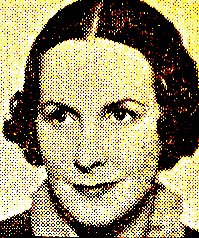
As imagined by radio writer Paul Rhymer and brought to life by former stage actress Bernadine Flynn (pictured), Sade Gook was neither a desperate housewife nor a dainty one. She was her husband’s equal, and sometimes his superior. She got along well with her adopted son, Rush, but did not always find it easy to keep her cool when confronted with the antics and outrageous anecdotes of her visiting Uncle Fletcher.

Rhymer’s imaginary small house was only occupied by those four characters; and sometimes Sade was left all to herself (something she relished, rather than dreaded). Through their exchanges and their one-sided telephone chats with others, however, listeners got to hear about a lot of different folks. Indeed, these talked-about or talked-to personages are so frequently mentioned and vividly described by Sade, Vic, Rush, and Uncle Fletcher that you might sense having heard them after all.

When the men of the menage are gone, Sade Gook enjoys settling down at last to one of her telephonic exchanges with confidante Ruthie Stembottom; never heard, always there. Unlike Uncle Fletcher’s outlandish acquaintances, recalled from the past or made up for the sole purpose of yarnspinning, Mrs. Stembottom is decidedly real.

Rhymer’s writing and Flynn’s well-timed monologue make it so. Yet, by not being imaged forth through voice, she becomes, by extension, our imaginary friend. We know her because we are her genetrix, giving birth to her in our minds.

The noisy men in Sade’s life are about to leave now. Once again we are being teased with a bit of intimacy; but, as in this conclusion to one of Rhymer’s scripts, little more than Sade’s satisfaction is conveyed. Let’s listen in as she cherishes the momentary stillness—by talking, of course:

VIC and RUSH. Telephone is ringing, telephone is ringing. 

SADE. I’ll get it. 

FLETCHER. (off a ways) Good-bye. 

SADE. Good-bye, Uncle Fletcher. So long, fellas. 

VIC. (moving off) So long, kiddo. 

RUSH. (moving off) So long, Mom. 

SADE. [into the imaginary telephone receiver] Hello? (warmly) Oh, yes, lady. Why, bless your old sweet heart, you did call back. (giggles affectionately) Gee, lady, I still haven’t got anything to say. It was just such a still quiet lonesome afternoon I felt like I had to talk to somebody. Isn’t it quiet though. Person runs into quiet afternoons like this every so often. Yes. (giggles) Well . . . quietness is nice sometimes. Gollies . . . I don’t think I’ve spoken to a soul all day. No. (and then briskly) Who had an operation, Ruthie? Mis’ McFreemer? Which Mis’ McFreemer? The one on South Morris Avenue or the one on West Monroe Street?

ANNOUNCER. Which concludes another interlude . . . at the small house half-way up in the Welsh hills.