
 Well, I’ll probably laugh about it—eventually. Not a day in my life passes without mishaps, some major, some trivial, all vexing. Sure, I could blame it now on Montague, our new canine companion. After all, dogs are expected to be inept, to be indifferent to our technological comforts and headaches; but a few remaining bristles on that scouring brush called conscience go against the grain of my indolence and continue to tickle until I make a clean breast of it. The “it,” this time around, is a cordless phone plunged into the watery grave of a bathtub. The rest, as they say (in Hamlet) is silence.
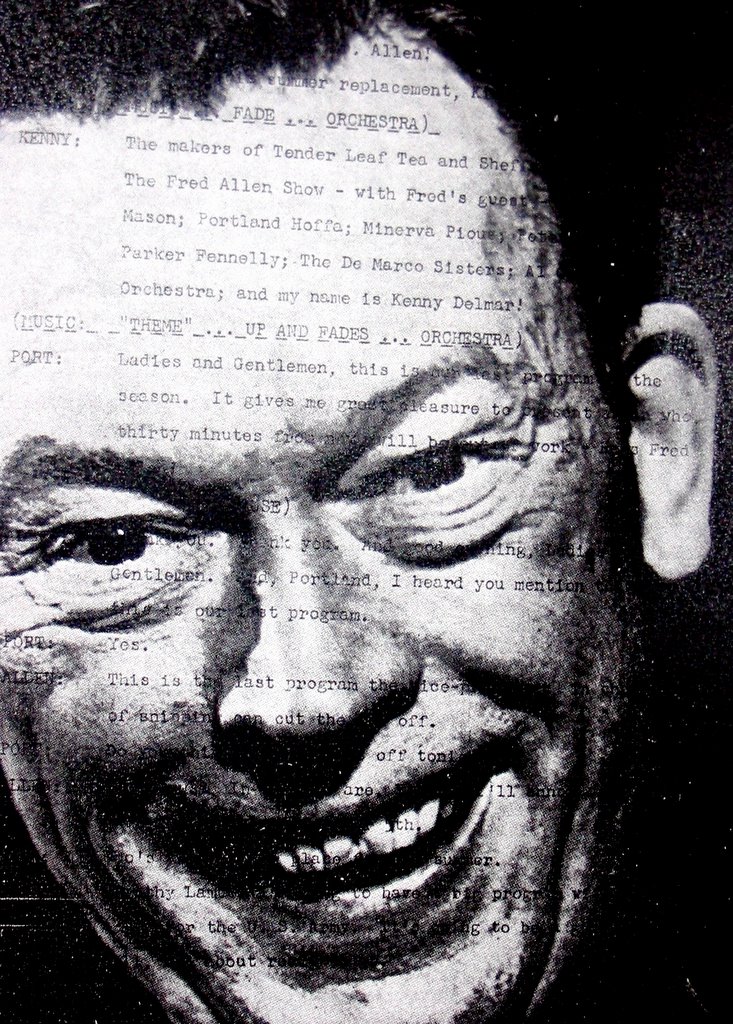
I won’t be silent about the quietus of one of the great American radio comedians whose program left the air on this day, 26 June, in 1949. The comedian in question is Fred Allen, a mediocre juggler who discovered that playing with words attracted a larger audience. That is, until the quiz and giveaway craze of the late 1940s revealed the greed and idiocy of a public that was eager to leave radio behind for the promises of a few bucks, some gifts, and a little flickering picture in a box of tubes and wires.
Fred Allen was a satirist. Whereas Jack Benny relied on situational humor, Allen relished in timely wit. Benny got people to laugh by making a fool of himself on our behalf. His age, his musical shortcomings, his vanity and tightfistedness—they were as hilarious as they were endearing. Rival Allen, on the other hand, made fun of all and sundry. He was the court jester in the living room, sending up what got listeners down: New Deal bureaucracy, wartime rationing, postwar housing shortage—anything fit for banter in Allen’s Alley.
That Alley was Allen’s finest piece of airwaves architecture. It was just the airway to vent anger and open up debate. How unfortunate that, in his final months on the air, Allen stooped to driving around that lane—a broader and less angular Alley called Main Street—in a Ford vehicle, in keeping with the demands of his new sponsor and the greed rampant after years of sacrifice. It wasn’t television that ended Allen’s career, even though, as critics insisted, he had no face for it. That he had no voice for radio did not prevent him from excelling in that medium. It was commerce, plain and simple.
The sponsors kept giving him a tough time, demanding cuts or cutting him off. The giveaway programs cut him to the quick; he was smarting from the audience’s lack of loyalty. It was just a phase; but Allen, plagued by poor health, did not wait for it to end. On the final program, Portland Hoffa started things off “with a laugh” by telling a few intentionally corny jokes and supplying the laughter herself. “If I can keep up this pace, I’ll end up with my own program,” Hoffa declared. “The way radio is going, that is quite possible,” her husband retorted. It was Allen having the last laugh at the age of canned cheer. It was the gallows humor of a man at wit’s end.
There were jokes, too, about Milton Berle, the epitome of television humor, comedy that translated sharp lines into slips and gaffes, allusions into grimaces, and travesty into cross dressing. True, television could deliver verbal jokes—but it had to justify the image, however grainy or ghostly at first. An old vaudevillian who learned to tell jokes when his juggling hands failed to do the trick, Allen was not a lad of Berlesque. He made some attempts, as Alan Havig noted, but none succeeded, just as his film career had flopped while Benny and Hope stayed afloat.
On his last program, Allen confronted wit and humor by pairing fellow satirist Henry Morgan with humor triumphant—none other than Benny, the fall guy who would be back in the fall. Having overspent by buying into the installment plan scheme, Morgan, “flatter than something that has been stepped on,” is forced to go to a pawnshop. There, he is greeted by Benny, the broker, proudly showing off his cool, green vault and counting whatever money was coming his way. As it turns out, Benny was also the shyster whose loan got Morgan still deeper into his financial fix.
It paid to adjust, this final sketch suggested; and pinning your hopes on a medium that was being abandoned, as Allen put it in Treadmill to Oblivion, like the “bones at a barbecue” was no picnic. It’s no good to be good at something if it’s something the many no longer cares about. It’s the death sentence under the law of supply and demand. I know. I’ve been staring at that noose for years.
 Harry Heuser