
I have never heard J. B. Priestley deliver his famous Postscripts, a series of morale-boosting talks broadcast to the British public during those early, uncertain and hence no doubt most terrifying days of the Second World War. Many decades later, actor Patrick Stewart returned Priestley’s lines to the airwaves that had once carried them into the homes of millions; but somehow I could not get excited about those recreations. For, no matter how delayed an originally live broadcast, its recording yet retains the immediacy of a first-hand experience that no re-enactment can approach.
Recently, I came across the published Postscripts (1940). Unlike Stewart’s voiceovers, the printed speeches are unabridged and, their author insists, “exactly as they were, without a speck of retouching.” These are “wireless talks and not essays,” Priestley cautions the reader:
If I had my way they would never have re-appeared in this form, to be examined at leisure instead of being caught on the wing every Sunday at nine-fifteen, but the requests for a volume of them have come in so thick and fast during these last three months, that I felt it would be churlish to refuse. So here they are, and please don’t blame them now, for they have already done the work they were intended to do.
Indeed, reading those scripts aloud now, I can, even in my own indifferent, untrained voice, hear them doing their work. Priestley indulges in none of the hysterics and hyperboles that so often render alienating what is meant to be persuasive speech. They are sentimental, these talks, and they are sane.
As Priestley puts it in the Preface, the
tricks of the writing trade and some fortunate accidents of voice and manner are all very well, but what really holds the attention of most decent folk is a genuine sharing of feelings and views on the part of the broadcaster. He must talk as if he were among serious friends….
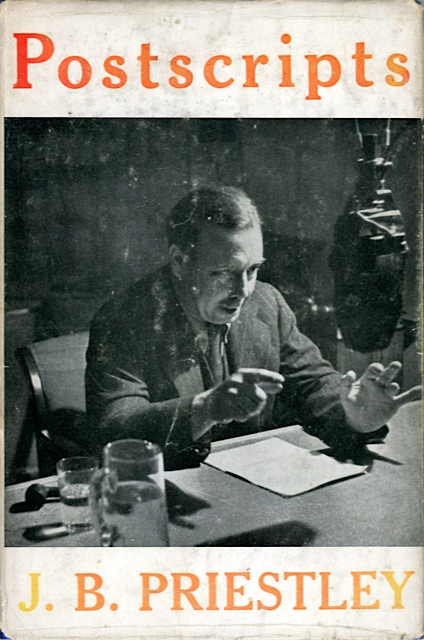
Priestley’s Postscripts are simply words of encouragement, gentle reminders that much of our seemingly inconsequential everyday is worth holding on to as it defines who we are, that the loss of even the slightest thing may be keenly felt as a threat to our identity. Take a piece of pie, for instance—and make it a fake one.
That is just what Priestley did, on this day, 29 September, in 1940, when he talked about returning home to Bradford, the “solid real place” of his childhood. The seemingly random devastation caused by a recent air raid, though far less grand in scale than the attacks on London, “made a far deeper impression” on Priestley “because it somehow brought together two entirely different worlds; the safe and shining world of my childhood, and this insecure and lunatic world of to-day.”
The local bakery, too, had suffered during the raid; but there, in the broken, half boarded up window, could still be glimpsed at the giant pie that had fascinated Priestley when, as a child, he saw emanating from it a steady flow of “fine rich appetising steam.” A wondrous, awe-inspiring sight it was to Priestley, the boy—and a wonder it was now to Priestley, the man, that, after all those years and after all those hours of bombing, the pie was still in its place, still in one piece, and still steaming away.
Mindful of the prosaic souls who needed to have their lessons spelled out for them, and who may well have resented as this “yapping about . . . pies and nonsense” at a time of acute crisis, Priestley added the reminder to “keep burnished the bright little thread of our common humanity,” a world in which that particular pie had “its own proper place.”
If only we had heard a voice like that during the dark days after 9/11, an opportunity seized by warmongers and profiteers. If only there had been that sane and gentle voice, the raising of which in a time of terror is as difficult as pie.
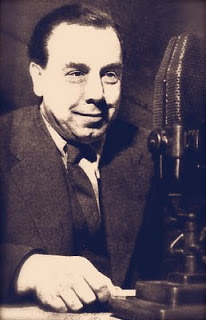 Both BBC Radio 4 and 7 are in the thick of a J. B. Priestley festival, a spate of programs ranging from serial dramatizations of early novels (The Good Companions and Bright Day) and adaptations of key plays (Time and the Conways and An Inspector Calls), to readings from his travelogue English Journey and a documentary about the writer’s troubled radio days. Now, I don’t know just what might be the occasion for such a retrospective, since nothing on the calendar coincides with the dates of Priestley’s birth or death. Perhaps, it is the connection with the 70th anniversary of the evacuation of Dunkirk,
  Harry Heuser