Theater of the Mime

There is something magical about it. The idea that an old mirror might show us a reflection of our past, with you and me on the other side to make sense of it all. I don’t believe there is such a thing as old news, unless you are averse to or incapable of examining it in the light of your own reflections. I am still flicking through the August 1949 issue of Radio and Television Mirror, as I have been all this week, if only to test my own maxim (which, I admit, sounds rather like the slogan with which NBC once tried to vindicate its reruns).

Earlier this week, an article in the Hollywood Reporter suggested that television is on its way out (except in Australia), that people turn to their computer instead to snatch out of the web whatever they want whenever they want it rather than rely on the old TiVo, let alone simply stay put when something of interest comes on. Back in 1949, television, though practically dating back to the age when radio became the medium of the moment, was still in its commercial infancy, “commercial” being redundant, considering that its growth and maturity were determined by the medium’s viability as a promotional tool.

According to the Mirror, there were just over 1.3 million TV sets in the US that spring, half of them in New York City. Radio was still tops; but those who did not have a TV set were beginning to think of radio as something inferior, as something that would never allow them to keep up with the Joneses.

Few people defended radio those days, in part because programming had gotten worse (instead of more diverse) with the advent of tape recording, used largely for the sake of economy, rather than reportorial or artistic experimentation. Shows were no longer produced live, which gave audiences the impression that they listened to a reproduction rather than a once-in-a-lifetime theatrical event and, as summer reruns became common, the sense that one had heard it all before. Radio was losing its edge, and listeners were only too ready to find that edge and push their old receivers over it. In other words, they were pushovers for television.

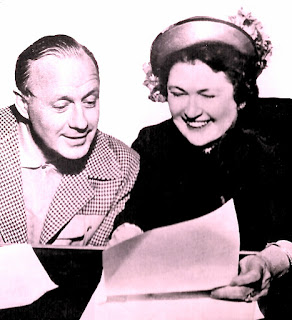
So, just what could television do that was not possible on the old wireless? Not much, really, considering the picture quality was still so poor as to give you a headache finding the difference and the production techniques were so inferior as to give rise to the adage that, in radio, the pictures are better. The theater of the mind, it is true, could not recreate the enjoyment of an old-fashioned charade, as demonstrated above by Vincent Price. Pantomime. Now there’s a concept with which to silence the old wireless (even though silent movies could hardly have staged such a comeback against the talkies).

Mr. Price, who appeared on KTTV’s Pantomime Quiz, along with Lon McAllister (also pictured in the foreground), seems to have leaped at the opportunity of saying “boo” to shake up the public on behalf of the television industry. Pity, he was so much more sophisticated as the Saint of the airwaves.

"Life with[out] Mother": Anna and Eleanor Roosevelt on the Air

Leave it to Will and Grace. That is what I used to say when that show was still on the air. Sarcasm, I mean. The kind of at-someone-else’s-expense humor those most likely to be subject to bias attacks are so quick to dispense. Sometimes, though, even I cannot hold back. While flicking through the August 1949 issue of Radio and Television Mirror, something I decided on doing all this week here at broadcastellan, I came across an essay by Anna Roosevelt, commenting on her life with former First Lady Eleanor.

Back in 1949, the two had a radio program, broadcast Monday through Friday afternoon over ABC stations. Now, imagine soon-if-not-soon-enough-to-be former First Lady Laura Bush and one of her daughters going on the air five days a week to discuss politics and social matters. Who would tune in, let alone without a smirk or the fingers-crossed anticipation of a delicious gaffe?

Now, I do have doubts that the Bush women could handle such an assignment; but that is almost beside my point. Take Hillary and Chelsea, if you must. I mean, would anyone tune in, unless Hillary were having a giant tumor removed or Chelsea defended herself after being caught driving naked under the influence?

We chuckle at the so-called “good old days” with an air of superciliousness or else wax nostalgic. The very thought of sitting still while two of the western hemisphere’s most famous mother and daughter talk without any scandal or sensational element in sight! Preposterous, right? To me, this is neither cause for ridicule nor romance. It is simply a fact that we have become more callous and shallow and than we have ever been in the best and worst of times, even in the face of what might be, according to some scientists, the worst yet to come.

I do go on a bit; but I am not one to attach as of course the adjective “cheap” to the much-abused noun “sentiment.” At any rate, here is Anna Roosevelt talking about her mother and their joint radio venture, recordings of which, I regret, do not appear to have survived for appraisal:

Life with Mother always has been rich with her inspiration. Her aim never was to mold me in her image, but to guide me along lines of intellectual independence, social awareness and understanding. If I am able to bring any of these qualities to our radio program, I recognize how deeply indebted I am to Mother—even when I have the temerity to take issue with her on a subject. 

Neither Mother nor Father ever courted sycophants among their children. And if I have learned to speak up, I can trace my assertiveness to the family hearth. Although the family has arrived at broadly the same general philosophy, it would be an error to suppose that we agreed automatically on every social and economic question of public interest. 

Certainly there was nothing to support such a notion at our spirited family gatherings where everyone was free to express opinions, where sometimes even Father would have to shout to get the floor. The dictum that children should be seen and not heard was sharply modified in our household [. . .]. 

Our silence [in front of company] was not mere obeisance to good manners, but a credit to Mother’s good sense. For she took great pains to impress upon us that we should learn by listening to others[. . .]. 

It was second nature for us to hear Mother—from the time I was a child—discuss settlement work in New York, and to hear her connect individual cases to broad social problems affecting hundreds and thousands of others in any large city in the United States [. . .] 

Whether at the White House or elsewhere, life with Mother is unfailingly eventful—and always has been. It was especially eventful recently when Mother—the very epitome of punctuality—did not arrive on time for our first broadcast together at the ABC studios in New York City. 

I couldn’t understand it. Mother had planed in the night before from the United Nations meeting in Paris. We had worked out a few questions I was to ask concerning the Human Rights Committee, and were to meet at 10:30 the following morning at the ABC studios in Radio City. 

I had thought how easy our first program at the same microphone would be. I didn’t become alarmed until I noticed that Mother still was among the missing—and it was just two minutes before air time. 

Suddenly I found myself on the air—and utterly alone. I gazed entreatingly at the door. I was certain Mother would burst in at any moment. But there was no sign of her. I ad libbed for ten and one half minutes, without a page of script or a note to guide me. I filled in two more minutes by playing a recording Mother had made in Paris. I discussed New York traffic. Christmas shopping and anything else that came to mind. 

Then Mother arrived—in time to answer just one question. I knew Mother must have had a good alibi. She did. She had forgotten about the congestion of New York City traffic. She had thought—with incredible naiveté—that she could travel from Washington Square to 50th Street in ten minutes. 

Quite a miscalculation for so adept a world traveller as Mother. It made her realize just how completely engrossing the United Nations sessions had been.

Mrs. Roosevelt, who was taking a break from broadcasting during August, kept turning to the radio for news from Korea. On this day, 22 August, in 1949, she expressed herself concerned about the use of the Atomic bomb to resolve the conflict, hoping that the weapon would never be used (and she does not write “again”) since it would create a deadly chain of retaliation that might prove the end of the civilized world. In light of the current state of broadcasting here and stateside, I have a feeling it takes less than a nuclear weapon to accomplish just about that.

A Week with Radio and Television Mirror (August 1949)

This being the 100th birthday of Lurene Tuttle, former “First Lady of Radio” (previously celebrated here), it behoves me to return to my favorite subject. So, all week I am going to flick through the August 1949 issue of Radio and Television Mirror to dig up what I hope to be noteworthy or just plain curious items.

My copy of the old Mirror is getting a bit tatty, having been cherished more for its content than for its potential trade value. The issue contains a short article about Ms. Tuttle, an Indiana native gone Hollywood: “There’s scarcely a radio program on which Lurene hasn’t been heard,” it says, “but she’s no radio Cinderella. She came to radio as a stage actress seasoned by seven years of trouping in stock.”

Cover of Radio and Television Mirror, August 1949

There is an article by Anna Roosevelt, writing about her mother, another former First Lady, wife of the President who first took such great advantage of the new medium of radio; at the time, Anna and Eleanor were heard Monday through Friday afternoon on ABC. Singer Kate Smith, broadcasting daily at noon over the Mutual network, shares recipes and shows readers around her summer residence, Camp Sunshine.

Louella Parsons, the “First Lady of Hollywood,” describes her experience in broadcasting (as illustrated here). She gossiped each Sunday, 9:15 pm over ABC, but was on her summer vacation that August. Kit Trout describes “tag[ging] along” with her husband, NBC reporter Bob Trout (whose Who Said That? was both heard and seen each Saturday at 9 pm); and Jo Stafford, heard Thursday evenings at 9:30 pm over ABC stations, relates what happened during her first audition.

Mary Jane Higby, in character as Joan Davis (the heroine of daytime serial When a Girl Marries) answers reader mail concerning marital problems, while the aforementioned Terry Burton, heard daily in The Second Mrs. Burton continues her own column in the role of “Family Counselor.”

And then there is Blondie (or, rather, Ann Rutherford), telling readers how she relates to her famous radio and movie character:

Radio’s Blondie on a page from Radio and Television Mirror

The letters we get from people who listen to the show often say that the Bumsteads help them to laugh at their own troubles.  When they laugh at the Bumsteads the laughter carries over to their own lives.  It works for us too. In fact it’s often one of us who furnishes the incident from real life. 

The Bumsteads are not only the couple next door to us on the show, we are the Bumsteads, and yes, Blondie is real to me.

In radio and on television, as in its Mirror, fact and fiction merge, making it difficult to tell one from the other. Reading this monthly is like stepping through the looking glass into a reality show, anno 1949. Sanctioned, streamlined or sanitized, what kind of story is history anyway?

Wireless Women, Clueless Men: Louella Parsons, Dirt Dispenser

Today, I am closing my series of tributes to women in American radio by devoting this final edition to one of the biggest names in Tinseltown hearsay: Hearstian columnist Louella Parsons. I leave it to Ms. Parsons to dish a little dirt about her on-air scandalmongering, even though that dirt is no more messy than a dusting of confectionary sugar on a well turned cuff. “Well,” Parsons told readers of Radio and Television Mirror Magazine (from an issue of which this picture has been taken), “I can safely say that no one else in the business can boast that her program was almost a radio casualty because of a toothache, a can of soup, and Audie Murphy’s cold! Likewise, I’m the only woman in these parts who’d had the dubious distinction of being almost ‘stood-up’ by Clark Gable. . . .”

Now, she does say “almost.” As it turns out, Gable was scheduled to appear on Parsons’s Hollywood Hotel when he got “snarled up” in a traffic accident. Shortly before the broadcast, he showed up with assorted bruises, welts, and a torn coat; but, according to Parsons, he insisted on going ahead with the live broadcast as scheduled, since, as the enterprising secret sharer put it, “he knew the program was very important to me, and didn’t want to disappoint me.”

He also knew better than to stand up this formidable career ender. So, Parsons’s wounded pride was mended—and Gable’s stardom secure. “Since that day,” Parsons added, “he has had a very special place in my book of friends.” Merely pencilled in, no doubt. This lady dealt in muck, after all, which in her profession is more precious than friendship.

I’ve mentioned Joan Crawford’s mike fright before in this journal. It was a well-known fact the first lady of gossip enjoyed repeating, claiming that the star “ran like a startled faun” every time a microphone was as much as “mentioned” to her. Eventually, the actress’s fear of bad press must have been more pronounced than her microphonophobia, as Parsons got her to go on the air talking about “what an advantage it was to be born on the wrong side of the tracks.”

Carole Lombard, on the other hand, was “completely unruffled when she lost two whole pages of her script. She merely ad libbed her way through, without a pause, and you’d never have known the difference.” Abbott and Costello, in turn, “turned the tables” on Parsons by reading her lines instead of their own. So, the chat hostess obliged by reading theirs, and, “as mad as it may sound,” she discovered that “the program had some semblance of sense to it.” These recollections are not exactly an endorsement of Parsons’s writing; but, by her own admission, “lack of talent has never dimmed [her] enthusiasm.”

Her first program, Hollywood Hotel, was off to a shaky start back in 1934: “My show was probably the worst in existence—I wrote, produced, and directed it all by myself.” Perhaps, it was not so much the writing and directing that were most amiss. Unlike rival columnist Hedda Hopper, Parsons did not have a trained voice, let alone a pleasing one; but she “knew too that is wasn’t how [she] said anything that mattered, because people were interested in what [she] was talking about.”

Sure, she couldn’t “close [her] eyes to television indefinitely,” she concluded. “But until better make-up and lighting are developed,” she vowed to “stick with [her] Hooper” (Hollywood jargon for radio audience).  And stick she did, for better and worse.