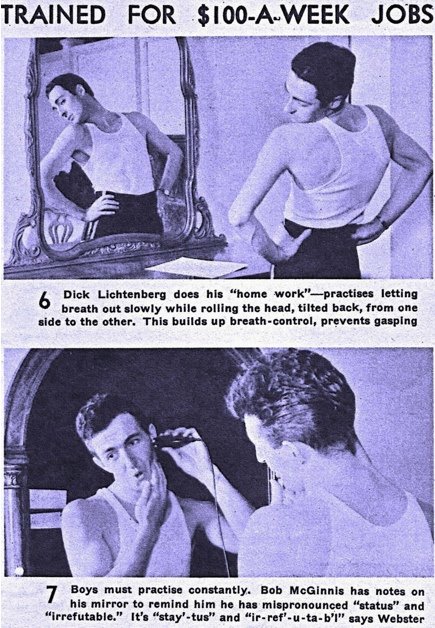
Manus Manum . . . Love It: Lever Brothers Get Their Hands on Those Nine Out of Ten

“Ladies and gentlemen. We have grand news for you tonight, for the Lux Radio Theater has moved to Hollywood. And here we are in a theater of our very own. The Lux Radio Theater, Hollywood Boulevard, in the motion picture capital of the world. The curtain rises.โ€

Going up with great fanfare on this day, 1 June, in 1936, that curtain, made of words and music for the listening multitude in homes across the United States, revealed more than a stage.  It showed how an established if stuffy venue for the recycling of Broadway plays could be transformed into a spectacular new showcase for the allied talents at work in motion pictures, network radio, and advertisement.
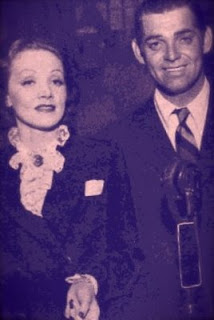
Marlene Dietrich and Clark Gable at the premiere of the revamped Lux Radio Theater program

โ€œFrankly, I was skeptical when the announcement first reached this office,โ€ Radio Guideโ€™s executive vice-president and general manager Curtis Mitchell declared not long after the Hollywood premiere. The program was โ€œan old production as radio shows go,โ€ Mitchell remarked, one that was โ€œrich with the respect and honorsโ€ it had garnered during its first two years on the air. Why meddle with an established formula?

Mitchellโ€™s misgivings were soon allayed. The newly refurbished Lux Radio Theater had not been on the air for more than two weeks; and Radio Guide already rewarded it with a โ€œMedal of Meritโ€โ€”given, so the magazine argued, โ€œbecause its sponsors had the courage to make a daring moveโ€ that, in turn, had โ€œincreased the enjoyment of radio listeners.โ€ Thereโ€™s nothing like a new wrinkle to shake the impression of starchiness.

โ€œI cannot help but feel,โ€ Mitchell continued, that the “two recent performances emanating from Hollywood have lifted it in a new elevation in public esteem. Personally, listening to these famous actors under the direction of Cecil De Mille, all of them broadcasting almost from their own front yards, gave me a new thrill.”

That DeMille had, in fact, no hand in the production did little to diminish the thrill. An open secret rather than a bald lie, the phony title was part of an elaborate illusion. The veteran producer-director brought prestige to the format, attracted an audience with promises of behind-the-scenes tidbits, and sold a lot of soap flakes throughout his tenure; and even if the act wouldnโ€™t wash, he could always rely on the continuity writers to supply the hogwash.

As DeMille reminded listeners on that inaugural broadcast (and as I mentioned on a previous occasion), Lux had โ€œbeen a household word in the DeMille family for 870 years,โ€ his family crest bearing the motto โ€œLux tua vita mea.โ€ Oh, Lever Brother!

Perhaps the motto should have been โ€œManus manum lavat.โ€ After all, that is what the Lux Radio Theater demonstrated most forcibly. In the Lux Radio Theater, one hand washed the other, with a bar of toilet soap always within reach. As I put it in Etherised Victorians, my doctoral study on the subject of radio plays, it

was in its mediation between the ordinary and the supreme that a middlebrow program like Lux served to promote network programming as a commercially effective and culturally sophisticated hub for consumers, sponsors, and related entertainment industries.

With DeMille as nominal producer and Academy Award-winner Louis Silver as musical director, the new productions came at a considerable cost for the sponsor: some $300 a minute, as reported in another issue of Radio Guide for the week ending 1 August 1937. Of the $17,500 spent on โ€œThe Legionnaire and the Lady,โ€ the first Hollywood production, $5000 went to Marlene Dietrich, while co-star Clark Gable received $3,500. Those were tidy sums back the, especially considering that the two leads had not even shown up for rehearsals.

The investment paid off; a single Monday night broadcast reportedly attracted as many listeners as flocked to Americaโ€™s movie theaters on the remaining days of the week. As DeMille put it in his introduction to the first Hollywood broadcast, the audience of the Lux Radio Theater was โ€œgreater than any four walls could encompass.โ€ Besides, the auditorium from which the broadcasts emanated was already crowded with luminaries.

โ€œI see a lot of familiar faces,โ€ DeMille was expected to convince those sitting at home: โ€œThereโ€™s Joan Blondell, Gary Cooper (he stars in my next picture, The Plainsman), Stuart Erwin and his lovely wife June Collier.โ€

Also present were Al Jolson, Ruby Keeler, and Franchot Tone. โ€œAnd I, I think I see Freddie March,โ€ DeMille added in a rather unsuccessful attempt at faking an ad lib. While there is ample room for doubt that any “nine out of ten” of those stars named actually used Lux, as the slogan alleged, they sure made use of theย Lux Radio Theater. It was an excellent promotional platform, a soapbox of giant proportions.
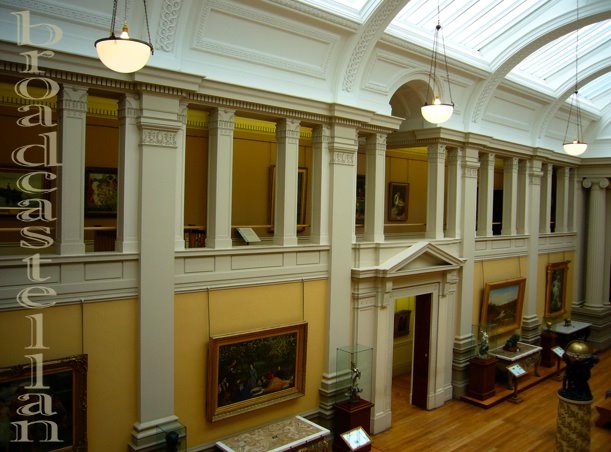
A visit to the Lever Art Gallery in Port Sunlight

As I was reminded on a trip to the Lady Lever Art Gallery in Port Sunlight last year, Lever Brothers had always been adroit at mixing their business with other peopleโ€™s pleasure. Long before the Leverhulmes went west to hitch their wagon on one Hollywood star or another, they had disproved the Wildean maxim that the greatest art is to conceal art and that art, for artโ€™s sake, must be useless.

It is owing to the advertising agents in charge of the Lever account that even the long frowned upon โ€œcommercialโ€ did no longer seem quite such a dirty word.


Related recording

“The Legionnaire and the Lady,โ€ Lux Radio Theater (1 June 1936)

Related blog entries

“Cleaning Up Her Act: Dietrich, Hollywood, and Lola Lolaโ€™s Laundryโ€

Tyrone Power Slips Out to War on a Bar of Soapโ€

โ€œAfter Twenty Years of Pushing Stars and Peddling Soap, a Hollywood Institution Closes Downโ€

The Dionne Quintuplets: The Catโ€™s Pajamas . . . or Katzenjammer?

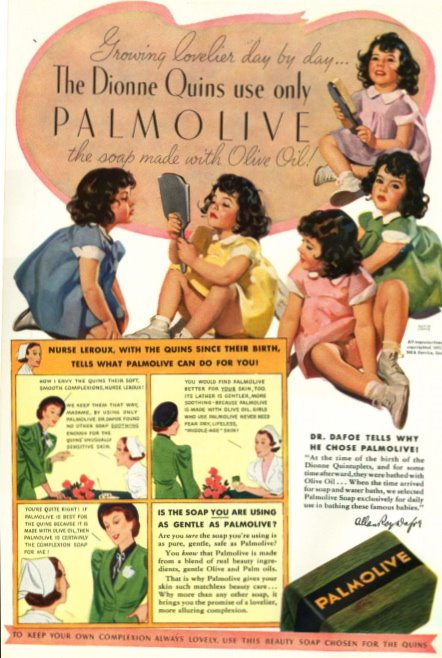
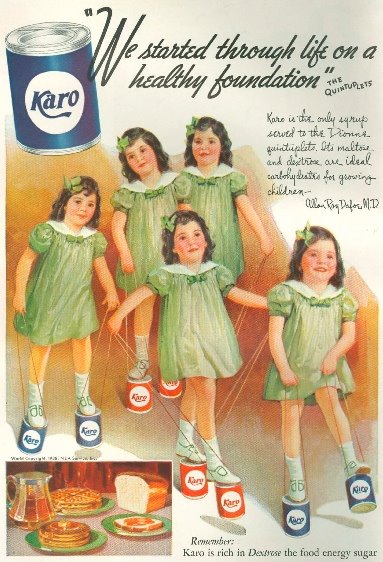
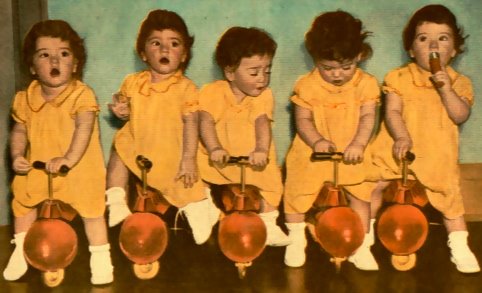
โ€œName your favorite radio star of 1950!โ€ an article in Radio Guide for the week ending 18 April 1936 appealed to its readership (reputedly some 400,000 strong). It wasnโ€™t a challenge to the clairvoyant or a call for votes in one of the magazineโ€™s popularity polls, as the implied answer stared you right in the face, a promise with five sets of peepers. โ€œThe chances are you wonโ€™t be far wrong if your list includes Cecile Dionne, or Yvonne or Annette or Emile or Marie.โ€ย  The famous Dionne Quintuplets, born on this day, 28 May, in 1934, were not yet two years old. No quintuplets before them had ever lived even that long; but their future in show business was already well mapped out for them, in contracts amounting to over half a million dollars.ย  Opposite screen veteran Jean Hersholtโ€”the quintessence of Hippocratic fidelityโ€”those essential quints had already starred in The Country Doctor, released in March 1936, to be followed up by Reunion later that year.

Quite a life for carpetful of rug rats once described as โ€œbluish-black in color, with bulging foreheads, small faces, wrinkled skin, soft and enlarged tummies, flaccid muscles and spider-like limbs!โ€ However fortunate to escape life as a sideshow attraction, the medical history makers could โ€œhardly avoid” being turned into celebrities and groomed for stardom.

“Whether they like it or not,” as the Radio Guide put it, “whether their guardians decree it, whether their parents give their permission, those five famous tots in Callander, Ontario, are the little princesses of the entire world. As such, they are already in and must remain in the public eye as long as the world demands them.”

Sure, the โ€œpublic eyeโ€ tears up at the sight of babies, bouncing or otherwiseโ€”but the public ear? Would audiences tune in to hear a quintet of babbling, bawling infants? And what of all those other noises, the blue notes producers did not dare to mention, let alone set free into the FCC-conditioned air? Publications like Radio Guide paid fifty bucks for a single photograph of the famous handful (even though various if not always authentic pieces of memorabilia could be had considerably more cheaply), and that at a time when you could get your hands on the Presidentโ€™s likeness for a mere five; but would a sponsor risk investing thousands in an act that could not hold a tune or stick to a script? As yet, there was no evidence that the media darlings could blossom into a veritable Baby Rose Marie garden.

Defending Radio Guideโ€™s continued attention to the Dionnes, editor Curtis Mitchell declared that, while the phenomenon โ€œhad little to do with radio,โ€ โ€œall the great personalities of every walk of life and every continentโ€ eventually stepped up to the microphone: “As entertainers they may not have the expertness of Eddie Cantor or Jack Benny but their gurgling and cooing will surely remind us of what a magnificent instrument for participating in the life about us young Guglielmo Marconi provided when he invented radio.”

Sure enough, radio kept the multitudes abreast of the Dionnes while gag writers worked their name into many an old routine. Baby Snooks could stay snug, though. The infantas of Quintland would not baby talk themselves into the hearts of American radio listeners. According to legend (as perpetuated by Simon Callow), it was Orson Welles whom producers called upon to supply the โ€œgurgling and cooingโ€ when the babies were featured on a March of Time broadcast.

Accompanied by their physician, guardian and manager, Dr. Dafoe, the Dionne girls would be paraded before the listening public on several occasions in the early 1940s, and were even heard singing on the air; but they never became the ultimate sister act that readers of Radio Guide, anno 1936, had been encouraged to anticipate. Seen rather than heard, they nonetheless remained a prominent feature on the advertising pages of the Guide and other radio-related publications. All those endorsement deals and money-making schemes make you wonder what the Million Dollar Babies might have said if only they had been permitted to get a word in . . .

NBC, CBS, and Abe

On the eve of the 200th anniversary of Abraham Lincolnโ€™s birth, I am once again lending an ear to the Great Emancipator. Franklin Delano Roosevelt may have been Americaโ€™s โ€œradio presidentโ€; but in the theater of the mind none among the heads of the States was heard talking more often than Honest Abe. On Friday, 12 February 1937, for instance, at least six nationwide broadcasts were dedicated to Lincoln and his legacy. NBC aired the Radio Guild‘s premiere of a biographical play titled โ€œThis Was a Man,โ€ featuring four characters and a โ€œnegro chorus.โ€ Heard over the same network was โ€œLincoln Goes to College,โ€ a recreation of an 1858 debate between Lincoln and Democratic senator Stephen A. Douglas. Try pitching that piece of prime-time drama to network executives nowadays.

Following the Lincoln-Douglas debate was a speech by 1936 presidential candidate Alf Landon, live from the Annual Lincoln Day dinner of the National Republican Club in New York. Meanwhile, CBS was offering talks by Lincoln biographer Ida Tarbell and Glenn Frank, former president of the University of Wisconsin. From Lincolnโ€™s tomb in Springfield, Illinois, the Gettysburg Address was being recited by a war veteran who was privileged to have heard the original speech back in 1863. Not only live and current, the Whitmanesque wireless also kept listeners alive to the past.

Most closely associated with portrayals of Lincoln on American radio is the voice of Raymond Massey, who thrice took on the role in Cavalcade of America presentations of Carl Sandburgโ€™s Abraham Lincoln: The War Years; but more frequently cast was character actor Frank McGlynn.

According to the 14 June 1941 issue of Radio Guide, Lincoln โ€œpop[ped] upโ€ in Lux Radio Theater productions โ€œon the average of seven times each yearโ€; and, in order to โ€œkeep the martyred Presidentโ€™s voice sounding the same,โ€ producers always assigned McGlynn the part he had inhabited in numerous motion pictures ever since the silent era. In the CBS serial Honest Abe, it was Ray Middleton who addressed the audience with the words: “My name is Abraham Lincoln, usually shortened to just Abe Lincoln.” The program ran for an entire year (1940-41).

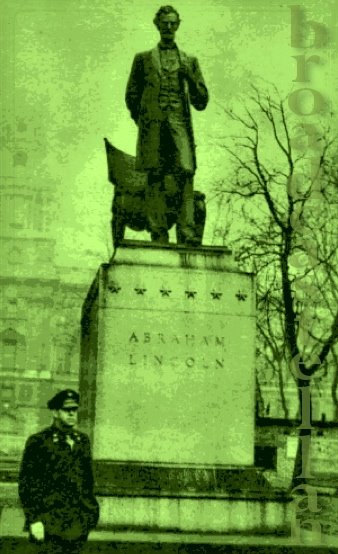
The long and short of it is that, be it in eulogies, musical variety, or drama, Lincoln was given plenty of airtime on national radio, an institution whose personalities paid homage by visiting memorials erected in his honor (like the London one, next to which singer Morton Downey poses above). Nor were the producers of weekly programs whose broadcast dates did not coincide with the anniversary amiss in acknowledging the nationโ€™s debt to the โ€œCaptain.โ€ On Sunday, 11 February 1945โ€”celebrated as โ€œRace Relations Sundayโ€โ€”Canada Lee was heard in a New World A-Coming adaptation of John Washingtonโ€™s They Knew Lincoln, โ€œTheyโ€ being the black contemporaries who made an impression on young Abe and influenced his politics. Among them, William de Fleurville.

โ€œYes,โ€ Lee related,

in Billyโ€™s barbershop, Lincoln learned all about Haiti. ย And one of the things he did when he got to the White House was to have a bill passed recognizing the independence of Haiti. ย And he did more than that, too. ย Lincoln received the first colored ambassador to the United States, the ambassador from the island home of Billy the Barber. ย And he was accorded all the honors given to any great diplomat in the Capitol of the United States. ย Yes, the people of Harmony have no doubt that Billyโ€™s friendship with ole Abe had more than a lot to do with it.

Six years later, in 1951, Tallulah Bankhead concluded the frivolities of her weekly Big Show broadcast on NBC with a moving recital of Lincolnโ€™s letter to Mrs. Bixby. That same day, The Eternal Light, which aired on NBC under the auspices of the Jewish Theological Seminary of America, presented “The Lincoln Highway.” Drawing on poet-biographer Sandburg’s “complete” works, it created in words and music the โ€œliving arterial highway moving across state lines from coast to coast to the murmur โ€˜Be good to each other, sisters. Donโ€™t fight, brothers.โ€™โ€

Once, the American networks were an extension of that โ€œHighway,โ€ however scarce the minority voices in what they carried. Four score and seven years ago broadcasting got underway in earnest when one of the oldest stations, WGY, Schenectady, went on the air; but what remains now of the venerable institution of radio is in a serious state of neglect. An expanse of billboards, a field of battles lost, the landscape through which it winds is a vast dust bowl of deregulation uniformity.

Related recording
“They Knew Lincoln,” New World A-Coming (11 Feb. 1945)
Toward the close of this Big Show broadcast, Bankhead recites Lincoln’s letter to Mrs. Bixby (11 Feb. 1951)
“Lincoln Highway,” The Eternal Light (11 February 1951)
My Tallulah salute

Related writings
โ€œSpotting ‘The Mole on Lincolnโ€™s Cheek'”
โ€Langston Hughes, Destination Freedom, . . .”
A Mind for Biography: Norman Corwin, ‘Ann Rutledge,’ and . . .”
โ€Carl Sandburg Talks (to) the Peopleโ€
โ€œThe Wannsee Konferenz Maps Out the Final Solutionโ€ (on theย Eternal Lightproduction of โ€œBattle of the Warsaw Ghetto”)

Biggest Announcement Ever

No, I am not referring to todayโ€™s publication of the Academyโ€™s chosen nominees for this yearโ€™s Oscars; nor am I going to circulate information about some future event of alleged significance. The kind of announcement of which I speak was made seventy years ago, to the day, back when announcing was both a business and an art. Whether they served as barkers or featured as sidekicks, whether they peddled toilet soap or introduced those nine out of ten stars who condescended to claim they used it, announcers heard on network radio were respected and highly-paid professionals. Celebrities in their own right, they had come to prominence in the 1920s, well before they had many big names to drop.

Beginning in the mid-1930s, NBCโ€™s Chicago headquarters even ran an announcer school. According to the 16 April 1938 issue of Radio Guide, the school offered classes in โ€œpronunciation, writing and reading script, speaking extemporaneously, reading three-minute announcements in town and four minutes, and other tests designed to simulate an announcerโ€™s actual experience.โ€

About those actual experiences: as I perused the radio listings for Sunday, 22 January 1939 (which, along with hundreds of such published broadcast schedules, have been made available at this invaluable site), I became rather wistful about the printed announcements of so many fine or worthwhile programs I may never get to hear. Claudette Colbertโ€™s visit with Charlie McCarthy, for instance, or Jane Cowlโ€™s performance in an adaptation of Schillerโ€™s Maria Stuart. And how about Mayor La Guardia in a โ€œTwo-Way Transoceanic Talkโ€ with the Lord Mayor of Londonโ€”from a police car no less!

Rather than getting carried away in an ode to faded echoes, I studied the listings to verify the broadcast dates for some of the recordings that are in my library. Of Carole Lombard’s Presidential prediction and Cary Grant’s singing in The Circle presided over by Ronald Colman I have found occasion to write previously; but the really big announcement was made on a March of Dimes spectacular (shared here), an announcement even greater than the cast assembled in the fight against infantile paralysis.

And what a cast! It isnโ€™t often that you get to hear Eddie Cantor, Jack Benny, Bob Hope, Rudy Vallee, George Burns, Gracie Allen, Frances Langford, Bob Burns, and Fanny Brice in a single broadcast, and find them joined to boot by film stars Norma Shearer and Tyrone Power, recording artist Maxine Sullivan and tenor Frank Parker, as well as teenaged Mickey Rooney performing one of his own compositions, โ€œHave a Heart.โ€

Not that what they had to say or sing was all drivel, either. Eddie Cantor, who was an outspoken anti-fascist when it was not yet de rigueur or prudent to be one, had the best line of the evening when, commenting on the popularity of swing music, he remarked:

A lot of people say that maybe these children shouldnโ€™t be worshipping at the shrine of Tommy Dorsey and Benny Goodman. And I tell you, ladies and gentlemen, as a father and as a citizen, Iโ€™d much prefer to have these children hailing band leaders than heil-ing bund leaders.

Still, what, above all, distinguishes this March of Dimes broadcast from any such extravaganzas is its opening announcement:

The thirty-seven voices to which you are now listening represent the combined personnel of announcers employed by Mutual, Columbia, and National Broadcasting Networks in Hollywood. Tonight, we speak as one voice, a voice which reflects the sentiment of an entire nation when it says: infantile paralysis must go.

On the air, nothing could bespeak radioโ€™s commitment to a cause more forcefully. I wonder whether the NBC announcer school prepared its students for choric recitals.


Related recording
The Circle (22 January 1939)

Related writings and images
My album of radio stars, featuring Eddie Cantor and Frank Parker
Carole Lombard and Cary Grant on The Circle
Mickey Rooney live, December 2008
Mayor La Guardia’s response to Pearl Harbor