

When Radio Times magazine announced a few weeks ago that its 10-16 November issue would celebrate the ninetieth anniversary of the Corporation largely in charge of the medium to which the pages of said venerable British weekly are nominally dedicated, I was very nearly all ears. That I wasn’t ears entirely is owing to the skepticism I have developed when it comes to the wireless and its status in today’s mass-mediated society. Sure enough, the Radio Times celebration fell as flat as my introductory sentence. The promised “Anniversary Special” amounted to little more than a few pages of pictures designed to demonstrate that radio—or, strictly speaking, BBC radio—is very much alive.
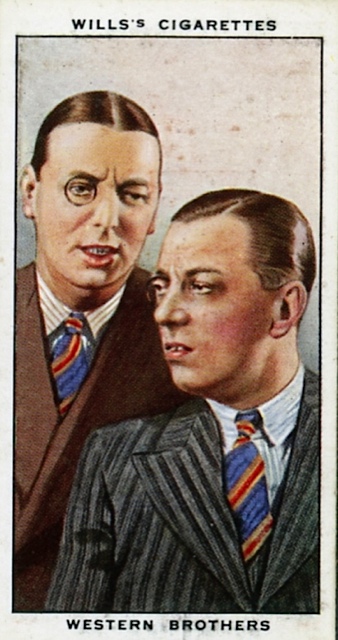
Clearly, I haven’t kept my ear to the ground, as most of the personalities depicted on the pages of the Radio Times anniversary issue are no more familiar to me in appearance or voice than the radio stars of yesterday whose images I put on display here to suggest that commemoration and oblivion are not mutually exclusive, and that what is being marked by the “Anniversary Special” is not so much the birth, infancy or longevity of radio as is its presence and relevance today.
“Print, they say, is dying,” news presenter Eddie Mair opens his commemorative Radio Times article, and television programs nowadays are “watched by a fraction of the numbers who used to tune in.” The wireless, on the other hand on the proverbial dial, he argues to be in “rude health,” ninety years after the BBCs mics first went live” on 14 November in 1922.
No doubt, those words are meant to be eulogistically reassuring, albeit less so to the publishers of an ailing print magazine, in deference to whom Mair distances himself from his opening statement by injecting “they say.” I might add—and shall—that if “they say” radio is thriving, then why isn’t there a radio on the cover of that ‘anniversary’ issue?
It isn’t radio’s age, surely, that made editors decide against a shot of an historic wireless set, a glistening microphone, or any number of radio personalities, living or dead. After all, the editors chose Sir David Attenborough as their cover boy—and he, at 86, is nearly as old as the BBC.
Why Attenborough? Well, he, too, has a broadcasting anniversary worth celebrating; and, apparently, his sixty years of television are worth more to the BBC than its own ninety years of radio broadcasting, marked in the pages of Radio Times with a slim timeline of scant microphone highlights so miniscule that it, like the fine print in advertising, makes you feel what is really wanting is a microscope.
Could it be that the Corporation toned down its self-glorification in light of the scandal surrounding desanctified saint Jimmy Savile and the efforts to cover up or deal with his posthumously emerging history of pedophilia? While this may not be the time for airs and graces, it does not follow that any self-reflexive, critical history the BBC airs disgraces.

Sure if your face is red, you are not inclined to parade it in public; but that does not quite explain, let alone justify, the way in which the wireless anniversary is scheduled to unfold sonically this afternoon. At 5:33 PM precisely—the exact time of the first BBC radio broadcast back in 1922—all BBC stations jointly air a newly commissioned composition of music and sound bites, the latter to be contributed by listeners. However thrilling and noteworthy, the whole rather self-defacing event lasts about three minutes, less time by far than commercial television sets aside for a single block of advertising.
Not quite believing my eyes at the sound of that announcement, I flicked through the pages of Radio Times in search of further commemorative programming. Alas, it is, for the most part, business as usual. And even though the “usual” is usually quite satisfactory, the extraordinary sure has a deflated air about it.
 Well, it is supposed to be busting out all over tomorrow. June, that is—the month during which television entertainment goes bust. In the US, at least, a generally enforced leave-taking from your favorites is a programming pattern that predates television. Looking through my radio files, I came across an article in the June 1932 issue of The Forum, discussing what Americans could expect to find “On the Summer Air.” It is an interesting piece, especially since it serves as a reminder that, during the early years of broadcasting, the summer hiatus was a response to technical difficulties. The shutting down of broadcast studios, like the closing of Broadway theaters, was directly related to the rising mercury, to the heat that made the asphalt buckle and urbanites escape to their vernal retreats.
 Harry Heuser