Mighty Joe Young and I: A Curator’s Statement

Installation view, Recapturing Mighty Joe Young: The Movie! The Memory!! The Make-believe!!!, School of Art, Aberystwyth University, 20 Nov. 2017 to 2 Feb. 2018 

Put on display like a corpse in a glass coffin, the album in the centre of our gallery at Aberystwyth University is a relic of a bygone era of moviemaking.  It features documentarian photographs, production stills, concept drawings and watercolour storyboards.  

These images showcase ingenuity, commemorate teamwork, and highlight the efforts of the many artists involved in creating make-believe. They are shown alongside each other in the album to demonstrate how ideas were realised.
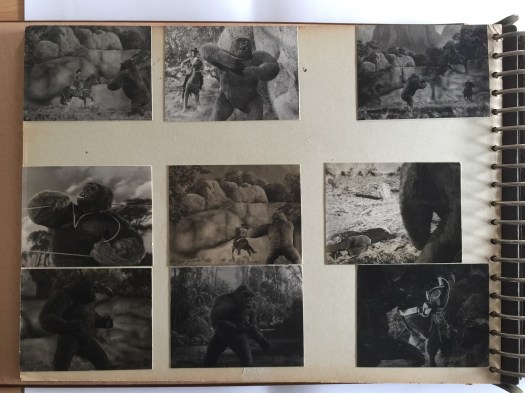
A page from the album in the Aberystwyth University School of Art collection

Why showcase this album here? Why now? Why bother commemorating the production of a relative commercial failure that, by now, is technically outmoded?

My motivation for staging this exhibition is rooted in a queer identity and a sense of belatedness.  Mighty Joe Young – the story of a captured primate exploited for profit and sentenced to death for revolting – affects me with its pathos and its promise of xenophilia triumphant. By accommodating its memorialization in our gallery, I seek to contest notions of cultural relevance and the trivialisation of nostalgic longing as ahistoric sentimentality.

The album defies history by unfolding Joe’s story in fictional time. It captures the film’s production in the sequential order of its narrative, not in the chronological order of its planning and shoot.

Conceived in 1945, filmed over a period of fourteen months, and released in 1949, Mighty Joe Young did not keep up with the times. Its compassion for the outsider and its indictment of consumer culture is an expression of early post-war idealism. Was the right to consume equal to the pursuit of happiness for which GI Joes and Jills had risked their lives? Mighty Joe Young’s climactic orphanage fire suggests otherwise.

‘Mr. Joe Young,’ as the giant yet gentle gorilla is announced in the credits, stands apart from the Atomic Age monsters of the Cold War era in whose destruction we are encouraged to relish. The menace in Mighty Joe Young is not its title character. Mighty Joe poses no threat to the Average Joe. The enduring, transcontinental friendship of Jill and Joe is proposed as an alternative to the fears and desires that tear us apart. 

Lego sculpture by Richard Boalch

Perhaps, this is why Mighty Joe Young was not a commercial success. By the time of the film’s release, red-menaced consumers had been conditioned to accept as the new normal what the film fantastically surmounts. The contemporary press called Mighty Joe Young‘incredible corn.’ 

A banana peel of discarded values, a throwback like Mighty Joe Young– and an album devoted to its making – can make us mindful of lost chances, and of the biases and restraints operative to this day.
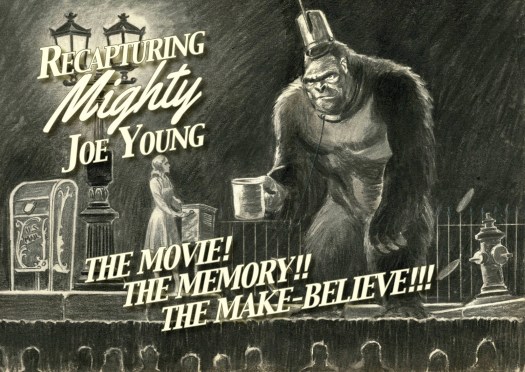
Recapturing Mighty Joe Young: The Movie! The Memory!! The Make-believe!!!

Preliminary poster design by Neil Holland
using a 1940s concept drawing for Mighty Joe Young

This fall, I am curating an exhibition featuring a unique album commemorating the production of the 1949 Hollywood fantasy movie Mighty Joe Young.  The brainchild of the creative team responsible for King Kong (1933), Mighty Joe Young earned an Academy Award for Special Effects. 

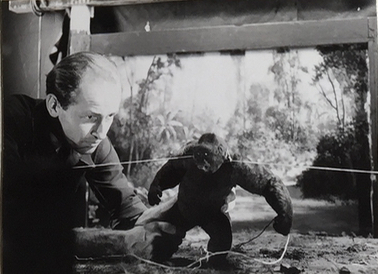
The album contains over 100 stills from the film as well as documentarian photographs, drawings and watercolour paintings.  It provides insights into the production of Hollywood movies, and in pre-CGI visual effects and the work of the celebrated stop motion animator Ray Harryhausen (1920–2013) in particular.

The album has never been on public display before, and little is known about its origins or provenance.  Along with hundreds of books and journals, it was bequeathed to Aberystwyth University by the film historian Raymond Durgnat (1939–2002).

Ray Harryhausen and Mighty Joe Young

As a curator, I am keen to recover and display objects of visual culture that encourage us to explore connections between the arts as well as the creative industries and academic disciplines devoted to them. The Mighty Joe Young album tells stories of ingenuity and collaboration, of artistic influences and commercial enterprise.  The film, meanwhile, is a story of friendship, a friendship that triumphs over greed and the exploitation of innocence.

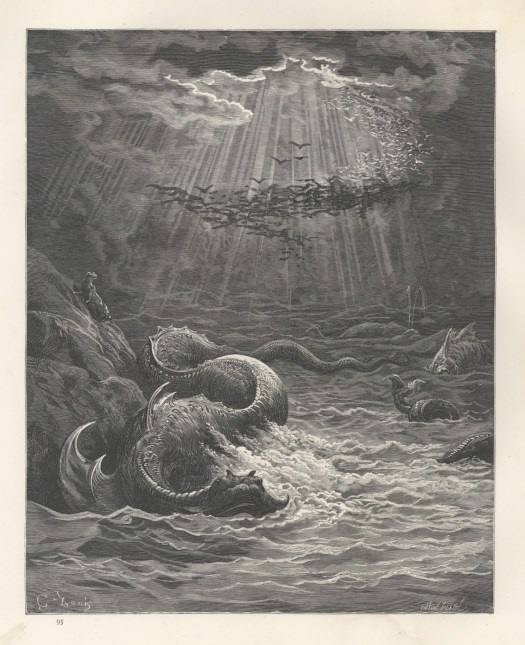
Gustave Doré, Leviathan
for an 1866 edition of Milton’s Paradise Lost

The work of Ray Harryhausen has long attracted enthusiasts of fantasy and science fiction. Now, there is renewed interest in his artistry.  Leading up to the centenary of Harryhausen’s birth, major institutions, including Tate Britain in London, have been staging exhibitions of his drawings and sculptures.

Our album has attracted the attention of the Ray and Diana Harryhausen Foundation, who will be giving a presentation in the School of Art galleries on 22 November.  We will also hold animation workshops during the run of the exhibition, and the videos created as part of those workshops will be shown in our galleries.

The album will be displayed alongside film posters and promotional materials, as well as production drawings for animated movies of the 1940s.  Also on show are prints by Gustave Doré whose sublime and fantastic imagery was a precursor to Hollywood magic and served as an inspiration to Harryhausen.

Recapturing ‘Mighty Joe Young’: The Movie! The Memory!! The Make-Believe!!! 
is on display at the School of Art from 20 November 2017 to 2 February 2018.