
”Whatever your own political views in the matter may be. . . .”

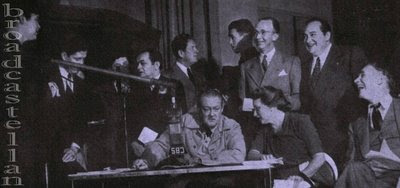
Diplomatic, cautious and propitiatory, those are hardly words you would expect to hear coming from the close-miked mouth of crooner Rudy Vallee, one of the 1930s most popular—and insipid—radio personalities. After all, Vallee was not emceeing America’s Town Meeting of the Air; his chief ambassadorial function was to promote middlebrow culture and represent the makers of a certain leavening agent. Yet that is just the preamble with which the old Vagabond Lover segued into the dramatic portion of the Fleischmann’s Yeast Hour, which, on this day, 25 June, in 1936 presented what sounded very much like an endorsement of one of the Roosevelt administration’s latest projects, notwithstanding Vallee’s assurance that the views of the program’s producers and sponsors—in contrast to the debates from the Democratic Convention broadcast elsewhere that evening—were “strictly neutral.”
The calculatedly catholic Fleischmann’s Yeast Hour took variety to the extreme that evening, featuring vaudeville song-and-dance duo Alan Cross and Henry Dunn, “Gags and Gals” cartoonist Jefferson Machamer (who would have liked to talk “sex” but was told that the subject was “never mentioned” on the air), comedian Bert Lahr (whom Vallee’s writers sent to the dentist), swing vocalist Midge Williams (referred to as a “small bundle of dark dynamite”) . . . and T. S. Eliot’s Murder in the Cathedral. Natch . . .
Murder had come to Broadway some three months earlier, in March 1936. As stated by contemporary critics Ernest Sutherland Bates and Alan Williams in their book American Hurly-Burly (1937), Eliot’s play “as offered by the WPA was finer than anything produced during the season at any price.”
Yet rather than merely extracting scenes from the celebrated drama, Vallee’s program offered a dramatization of a “true story” that had “happened only a little while ago,” namely the behind-the-scenes story of how the Broadway production was cast.
As Vallee’s writers have it, an aging stage actor enters the offices of the WPA, declaring: “I’m looking for a job.” He claims to have been in the acting profession for thirty-three years; but lately he has only been pounding the pavement in hopes of treading the boards again. He is referred to the Federal Theatre Project, where, by the kind of miracle that smacks of Victorian melodrama, he is greeted by producer-manager George Vivian, an old friend of his from his days in London’s West End.
Soon, the actor is given the chance, however slight, of auditioning for Broadway director Edward T. Goodman, who is still trying to cast the role of the Archbishop. As many listeners tuning in to the Fleischmann’s Yeast Hour would have known, the old actor got the part—and, as Bates and Williams summed it up,
gave a magnificent performance in the role of Becket. When Murder closed he re-appeared with another splendid characterization in Class of ’29, but at the end of the season he was promptly reclaimed by the commercial theater.
That actor—playing himself in the broadcast version of his story—was Harry Irvine, who, aside from Murder and Class of ‘29, went on to appear on Broadway in several dramas by Maxwell Anderson, including Joan of Lorraine starring Ingrid Bergman and Anne of the Thousand Days starring Rex Harrison.
Vallee commented that “the sequel” to this story was “yet to be written,” by which he was not referring to any attempts to follow up Murder with Resurrection. “The name of Harry Irvine appears again,” Vallee predicted. “He is very much in demand now. You’ll see him in pictures before long. Hollywood is taking care of that.”
Irvine responded to these not entirely fulfilled prophesies and commented on his good fortunes by reciting one of his speeches from Eliot’s play:
We do not know very much of the future
Except that from generation to generation
The same things happen again and again.
Men learn little from others’ experience.
But in the life of one man, never
The same time returns. Sever
The cord, shed the scale. Only
The fool, fixed in his folly, may think
He can turn the wheel on which he turns.
As much as he was in the center of the Fleischmann’s Yeast Hour playlet telling his story, Irvine was little more than a cog in the wheel, an example of the “true story” extolling the wonders of the “relief project” that gave “the actor out of work” a “helping hand.”
“In the larger cities all over the country these past few months,” Vallee reminded his audience,
dark theaters have been opening, idle actors have been finding work. Reason: The Federal Theatre Project, a branch of the Works Progress Administration in Washington.
So why, radio having benefitted most from the Depression and the closing of popular playhouses, did an ersatz revue like Vallee’s program now celebrate the policies through which actors returned to newly reopened stages? Well, considering that the Fleischmann’s Yeast Hour was an East Coast production—whereas Lux Radio Theater had just left New York for Hollywood and abandoned its Broadway format—it stood only to gain from the renewed activity along the Great White Way.
Given that the performers who appeared on variety programs of that period were deemed somebodies largely owing to the name they had made for themselves in other media, Fleischmann’s, far from being neutral, depended on its theatrical ties—and stage actors like Harry Irvine—to fill its weekly roster of acts.
Listening to slickly commercial variety programs such as the Fleischmann’s Yeast Hour, I realize that escapism is not so much a matter of production as it is a manner of consumption, a way of tuning out rather than tuning in. No form of entertainment, however trifling or shallow, can entirely escape the role an alert listener may assign to it—the role of telling us about the time in which it was created.
 Well, I am mad about music this weekend, or something remotely resembling it. After fifteen years of going without while living in the Eurotrash-resisting US, I finally got another hit of it last spring. The Eurovision Song Contest, I mean, the spectacle (or cultural war) in whose battles have fought the likes of Celine Dion, Olivia Newton-John, Abba, Lulu, Cliff Richards, Katrina and the Waves, and whoever it was first to belt out “Volare.” Thursday night’s semi-finals in Athens were predictably vulgar—short on fabric and long on fanfare, feuds and fanaticism.
 I was inclined to put the “wireless women” on hold for today. I have been feeling rather poorly as a result of an exposure to noxious fumes emanating from a fresh coat of paint in our conservatory. My evening with Claudette Colbert, starred in the rarely screened melodrama The Man from Yesterday (1932) was utterly spoiled. I also missed the BAFTAs, the new Marple (controversially, not a mystery in which the old sleuth was placed by her creator), and found little enjoyment in Crack Up (1946), a noirish thriller directed by radio dramatist Irving Reis, which aired on BBC Two early last Saturday. Dizziness, mood swings, fatigue and nausea are my mental and bodily responses to a thankfully small number of chemical solutions including household cleaners, varnishes, and insecticides.
 Harry Heuser