
Pitch-Hitting; or, When Dietrich’s Not Herself

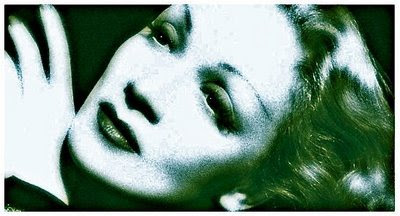
My grandmother refused to listen. She would walk out of the room whenever Marlene Dietrich appeared on the small screen. “She betrayed our country,” Oma would say, referring to Dietrich’s departure for Hollywood about the time the fascists came into power. Actually, Dietrich left a few years earlier; but the Nazis sure failed to lure her back. What a loss it is to turn a deaf ear to what aforementioned radio actor Joe Julian called “an exotic accent” and a “strong voice-presence.” Working with her in Dietrich’s lost radio series Café Istanbul (1952), Julian got a “glimpse behind the public image” and discovered

a woman of strength, warmth, and intelligence, yet so spontaneous that when, during a rehearsal, she overheard one of the actors express doubt that the rest of her body [she was in her early fifties by then] was as youthful as her famous legs, she ripped open her blouse to prove him wrong.

On this day, 8 October, in 1939, Dietrich could provide no such proof of her health and vitality. Scheduled to appear on the Screen Guild program that night, she was forced to call in sick due to a severe cold that, according to Roger Prior, host of the show, had halted the shooting of Dietrich’s comeback feature Destry Rides Again. The star had tried to honor her commitment, but had lost her voice entirely during rehearsals. In what must be one of the most inept voice-overs in Hollywood history, the Screen Guild producers replaced her with . . . Zasu Pitts.

It was all for laughs, of course. After all, Pitts’s voice had about as much sex appeal as fingernails being painstakingly filed . . . with a blackboard. And by casting Pitts opposite the less-than-expressive Gary Cooper, the Guild made the most of this emergency situation. “Is that Marlene Dietrich?” Cooper inquired. The affirmative only produced a terse “Well, so long.” Trying to explain the situation, Prior informed Cooper that “Zasu has Marlene Dietrich’s lines.” “Not from where I’m standing,” Cooper retorted. Together with Bob Hope and the actress billed as “Marlene Zasu Dietrich Pitts”, he nonetheless condescended to co-star in the sketch “The Girl of the Woolly West; or, She Was Wearing Slacks, So She Died Like a Man.” It sure made audience’s anxious for Dietrich’s return.

Nine years later to the day, on 8 October 1948, Dietrich was once again sick—and scheduled to appear on the air. This time, though, she was able to perform her role, cast as she was as the ailing Madame Bovary in the Ford Theater presentation of the novel as adapted by NBC staff writers Emerson Crocker and Brainerd Duffield . Sure, you’ve got to take Madame Bovary with “a pinch of power”; but you won’t be sorry to hear Dietrich breathe her last on the occasion. Besides, who could expect fidelity in the case of Emma Bovary?

“If some of Flaubert’s delicate delineation of character was missing from ‘Bovary’-on-the-air,” critic Saul Carson remarked, “Marlene Dietrich more than made up for this loss in literary flavor by her superb acting in the lead role.” Hardly carrying the chief burden, Dietrich was supported that night by Van Heflin and Claude Rains. “Too often, film stars rely on their screen reputations to cover slipshod work in radio,” Carson conceded; “but these people performed as artists who respected the medium as well as the vehicle.”

If Dietrich’s in it, just about any vehicle will do for me. Unfortunately, the extant recording does about as much justice to her timbre as Zasu Pitts. As for you, grandma, who saw trains depart for the concentration camps without making a noise, I’m just sorry that fascist propaganda robbed you of your senses . . .

Ham and Accents

“Good evening, ladies and gentlemen. The Lady Astor Screen Guild Players have a surprise for you tonight.” Such a promise may well have sounded hollow to many of those tuning in to the Guild program broadcast on this day, 27 March, back in 1944. That it was grandiloquently voiced by the avuncular-verging-on-the-oleaginous Truman Bradley, whom American radio listeners knew as a voice of commerce, hardly imbued such a potential ruse with sincerity. And yet, the program is indeed a surprise, and a welcome one at that. The broadcast is a rarity in scripted radio comedy: one of those occasions when ham is not only sliced generously but consumed with gusto. Granted, I may be somewhat of a hypergelast, the kind of fellow Victorian poet-novelist George Meredith denounced as a fool who laughs excessively. Still, believe me when I say in a voice that has nothing to advertise but its own taste, poor or otherwise: this is one is a riot.

Affable character actor Jean Hersholt, then President of the Motion Picture Relief Fund and star of his own sentimental radio series (Doctor Christian), takes over from the announcer to introduce the players for the evening. You can buy a line from a man like Hersholt. His is a thick, honest-to-goodness accent that sounds trustworthy compared to whatever slips from the trained tongues of promotion.

Tonight, he tells us, “we have Barbara Stanwyck, Basil Rathbone, and director Michael Curtiz, three of filmdom’s outstanding personalities who will offer. . . .” At this moment, Hersholt is cut short by the one who generally occupies that spot, the man entrusted with the dearly paid-for delivery of cheap assurances.

“Uh, just a minute, Jean,” Bradley interjects, “I thought that Jack Benny was supposed to be one of the guests here tonight.” This exchange sets up the slight comedy known as “Ham for Sale,” a fine vehicle for Jack Benny, the master of comic deflation, the jokester known for his largely unfulfilled aspirations as a thespian and classical musician.

According to Hersholt, Benny got “a little temperamental”; so he will not be heard on the program. Hersholt’s recollections give way to a dramatized account of Benny’s response to the proposed broadcast. “I haven’t got anything against you, Jack. But you’re a comedian; and, frankly, I don’t think you have enough dramatic ability to play the lead opposite Miss Stanwyck.” Upon which the slighted comedian sets out to win the part.

The hilarity generated by “Ham for Sale” is not so much scripted than delivered. Greatly responsible for the kicks you’ll get out of this broadcast is the highly regarded, Oscar-winning director of Casablanca, whose Hungarian accent is so pronounced and to radio listeners’ surprising, that it causes Benny to ad-lib and Stanwyck to scream with utterly infectious laughter.

According to Herbert Spencer’s “The Physiology of Laughter” (1860), mankind (or, homo ridens) response in this way when expectations are suddenly disappointed and an excess of energy in our nervous system is discharged in the muscular reflex of laughing. It seems that, as an actress, Stanwyck expected Curtiz to have a great, controlling presence; instead, while to some extent in on it all, he became the hapless brunt of Benny’s jokes: “Between Hersholt and you, I don’t understand anything.” Perhaps, it is the kind of “sudden glory” Thomas Hobbes denounced as a “sign of pusillanimity.” But it sure feels good to salt this “Ham” with your own tears.

It wasn’t exactly a fresh cut. The sketch had already been presented once before (on 20 October 1940), with Benny trying the patience of Edward Arnold, Ernst Lubitsch, and Claudette Colbert. Yet Colbert appeared to have been too controlled an actress to let anything interfere with her live performance that evening; nor did Lubitsch’s accent trigger as many not altogether intentional laughs as that of his fellow director. It is Stanwyck’s reaction to Curtiz’s line readings (just hear him exclaim “stop interrupting”) and Benny’s extemporising to the occasion that makes “Ham for Sale” such an irreverent piece of Schadenfreude.

Relentless and immoderate, laughter here is a response to the “mechanical” (in Bergson’s sense), to the orderly and overly rehearsed—the minutely timed, predictable fare that so frequently went for on-air refreshment.

". . . between the zodiac and Orson Welles": A Play Scheduled for Pearl Harbor

Well, it wasn’t exactly business as usual on this day, 7 December, back in 1941. Mind you, lucre-minded broadcasters tried hard to keep the well-oiled machinery of commercial radio running. There were soap operas and there was popular music, interrupted in a fashion rehearsed by “The War of the Worlds,” by updates about the developments of the attack on Pearl Harbor (previously commemorated here). Unlike on the day now known as 9/11, when advertising came to an immediate standstill to make way for propaganda and regular (that is, commercial) programming ceased for hours and days to come, radio back then was slow to adapt. There was no precedent; and, having ignored the signs of the time, not much preparation.

Minding the business of its sponsors, broadcasters had no master plan for a response to the masterminds behind the plans for the master race and its allies. It was, however briefly, overmastered; or flummoxed, at least. For an industry relying on minute timing, the attack and subsequent declaration of war were most inopportune. Big business was, for the most part, not behind a war that would translate into major financial losses.

Until that day, broadcasters had counted on being inconsequential; it was the commerce stimulated by the sales talk punctuating the chatter and musical interludes proffered “in the public interest,” that mattered.

The Screen Guild was fortunate. After previous crowd pleasers like “Penny Serenade” and “If You Could Only Cook,” the Gulf Motor Oil sponsored Hollywood-rehash factory had scheduled a play that just fit the bill. For that fateful night it had prepared a live production of Norman Corwin’s “Between Americans,” previously staged in June 1941. “By one of those mystic and infallible arrangements between the zodiac and Orson Welles,” the playwright would recall, this broadcast was the

first uninterrupted half-hour on the CBS network after the bombing of Pearl Harbor. All afternoon the news had come pounding in—comment, short-wave pickups, rumors, analyses, flashes, bulletins. Programs of all kinds were either brushed aside or so riddled by special announcements that they made no sense. But by 7:30 PM EST all available news on the situation was exhausted, and the Screen Guild, which had long ago scheduled “Between Americans” and Welles for this date, was given clear air.

According to Corwin, the greatest living American radio dramatist, indeed the greatest radio playwright of any time anywhere (whose 97th birthday I celebrated here), the “staggering news of the previous hours made the show far more exciting than it had any right to be.” The studio audience reacted enthusiastically, a response the playwright attributed to the moment, rather than to anything of moment in his play.

A war only four hours old is an emotion, an intoxication, a bewilderment [. . .]. People felt reassured by it. They heard the piece as a statement of faith. They were moved; they laughed extra loud; they applauded like mad when the show was over. I am certain it was Pearl Harbor that made the show so electric that night, and not so much the work of Welles, Corwin, or Harry Ackerman, who directed it.

“Between Americans” had not been prepared for the day; indeed, it had been produced five months earlier, with actor Ray Collins (whose voice Welles regarded as the best in the business) as narrator. According to Corwin, who is none too fond of the play, there were some 22,000 requests for scripts and rebroadcasts. No wonder, with lines like these:

You ever asked yourself what America means to you? Does it mean 1776? “Columbia, the Gem of the Ocean”? Big business? The Bill of Rights? Uncle Sam? Chances are it means none of these things. Chances are it means something very personal to each of you. Something close to your heart, which you’d miss like the very blazes if you were stranded abroad. It might have nothing to do with quotes from Madison or Acts of Congress. It might be just the feeling of crisp autumns in New England and the smell of burning leaves. It might be the memory of the way they smooth off the infield between the games of a double-header. It might be a thing as small as your little finger [that is, a cigarette].

“Big business” and personal memories. They merge at the moment of listening. Big business counted on that.

The 7 December 1941 program is a fascinating record of an industry coming to terms with the role it was called upon to play. The commercial structure remained remarkably intact; but the play was being shrewdly exploited as “one of the most timely programs ever heard on the Gulf Screen Guild Theater:

Broadcast at any time, we believe this program would make every American’s heart beat a little faster, make him hold his head just a little higher. But since the tragic and foreboding news that came today, this program, “Between Americans,” now becomes an American Odyssey. In just a moment, our story will begin.

“But first,” listeners had to hear the words from the sponsor, who had this topical message prepared for the occasion:

Right. And here is an easy way to change from a pessimist into an optimist. If you are wondering now how long you may have to keep your present car, and wondering too if it will last, if it will stay in good condition, just look on the bright side of the picture. Remember, when you give the wearing parts of your car good protection that helps it stay young and act young a long, long time. So, give your automobile the modern method of lubrication . . .

Yes, radio was a well-oiled machine . . . until the rationing of its parts set in.