
.jpg) Well, if prices had plummeted as rapidly as city temperatures, I’d be enjoying some terrific bargains today. Yesterday, I went downtown to my favorite electronics store and went hunting for a few old movies. I am not prepared to pay $25 or more for a copy of, say, Queen Kelly; nor am I eager to get my hands on $5 DVDs that turn Hollywood entertainment into headache-inducing eyestrainers. I always keep abreast of what’s in the stores by reading the notes and reviews posted by fellow bloggers like Brent McKee and Ivan Shreve; so I pretty much knew what to look our for while in town.
Well, if prices had plummeted as rapidly as city temperatures, I’d be enjoying some terrific bargains today. Yesterday, I went downtown to my favorite electronics store and went hunting for a few old movies. I am not prepared to pay $25 or more for a copy of, say, Queen Kelly; nor am I eager to get my hands on $5 DVDs that turn Hollywood entertainment into headache-inducing eyestrainers. I always keep abreast of what’s in the stores by reading the notes and reviews posted by fellow bloggers like Brent McKee and Ivan Shreve; so I pretty much knew what to look our for while in town.
I had my eye on The Doris Day Show and the Ann Sothern sitcom Private Secretary, both of which I turned down for the reasons just stated. This time, I walked away with The Harold Lloyd Comedy Collection, a set of seven DVDs containing most of Lloyd’s best films, some shorts, stills, as well as episodes from his Old Gold radio program. With prices for this anthology as high as $100, I was pleased to have snatched it up for the relative bargain of $63. Today I will head downtown again to have a browse at the best second-hand bookstore in town (you know, the one featured in Absolutely Fabulous). Now, on with the show . . . I Love a Mystery that is.
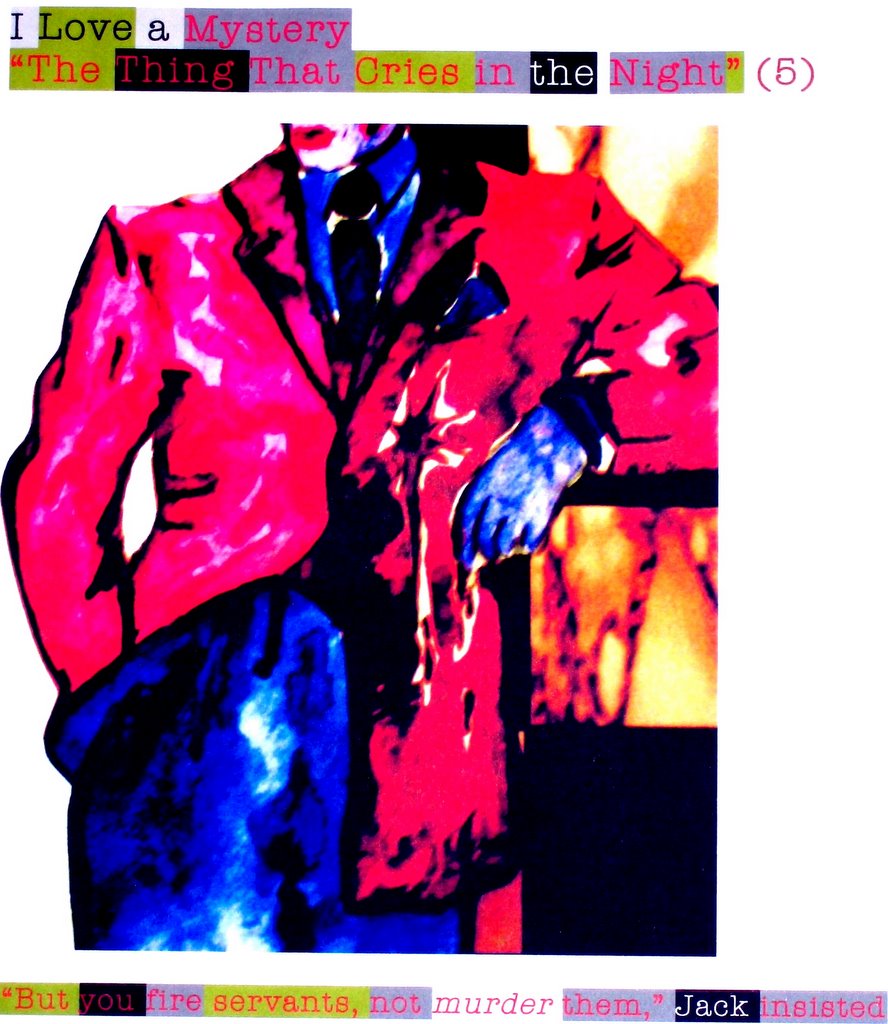
On this day, 17 November, in 1949, creator-writer-director Carlton E. Morse opened the penultimate chapter of “The Thing That Cries in the Night,” the fifteen-part radio thriller I have been following for nearly three weeks now. Compared to the previous installment, today’s 10-minute segment is a decidedly noisy affair. It is the equivalent of a car chase sequence in an otherwise not uninspired detective story. For all its excitement, it is something of a cop-out.
Only yesterday, Morse was demonstrating how terrifying and mysterious a voiceless presence can be when the ambiguities of silence are introduced to challenge the sound-equals-life dynamics of radio drama. Silence, however, was dreaded by none more than the broadcasters, who filled the air with words, noise, and music to prevent listeners from twisting the dial or questioning the soundness of their receivers.
In Jack’s dialogue with death, Morse had found an ingenious way of giving silence a voice. Now, in a desperate attempt to crank up the thrills, his storytelling is in danger of being reduced to a frantic mess of juvenile tumult and shouting, a nocturnal free-for-all during which the stuffy air of the Martin mansion is filled with much mindless clamor and sense-numbing chloroform (the weapon of choice for Morse’s unseen and supposedly ethereal adversaries).
I Love a Mystery was always introduced as an “adventure-thriller”; and in episode fourteen, it is adventure that prevails. If silence is the stuff of mystery, adventure plays itself out in loud noise and boisterous speech. Will “The Thing” shut up when the mystery concludes tomorrow? Time for me to take a break from blogging and signal-hunting. The town beckons.
.jpg)


 Well, the scheduled power outage has been postponed due to regional flooding. I ought to be thankful, I guess, for one of the dreariest, wettest, and stormiest autumns ever to be weathered by the umbrella of a smile. Last night I was tolerably amused watching You’ll Find Out (1940), one of those star-studded Hollywood efforts whose chief purpose was to exploit and ostensibly promote the burgeoning radio industry by supplying listeners with images the mind’s eye could have very well done without. While the headliner of the movie, bandleader Kay Kyser, made my head ache with his bargain basement Harold Lloyd antics, the lavishly produced horror-comedy—co-starring Bela Lugosi, Peter Lorre, and Boris Karloff—nonetheless kept me in my seat.
.jpg)
.jpg)

 Harry Heuser