
โ€Uneasy Thresholdโ€:ย Sherlock Holmes Faces Deathย (1943) and the Demise of the Gothic

Just what is โ€˜gothicโ€™? And how useful is the term when loosely applied to products of visual culture, be it paintings, graphic novels, movies or the posters advertising them? Aside from denoting a literary genre and a style of architecture, in which usages I recommend setting it aside by making the โ€˜gโ€™ upper case, the term ‘gothic,’ understood as a mode, can be demonstrated to take many shapes, transcend styles, media, cultures and periods.  It can also be demonstrated not make sense at all as a grab bag for too many contradictory and spurious notions many academics, to this day, would not want to be caught undead espousing.  Those are the views I take on and the potentialities I test out with students of my module Gothic Imagination at the School of Art, Aberystwyth University.

As the gothic cannot thrive being crammed into a series of seminars, let alone been exsanguinated or talked to death in academic lectures, I created an extracurricular festival of film screenings to explore the boundaries of the visual gothic beyond genre and style.  The fourth film in the chronologically arranged series, Sherlock Holmes Faces Death (1943), demonstrates that the gothic struggles to thrive as well when its sublime powers are expended in a game of wartime chess.

The fourth entry in a series of Universal B-movies that began in 1939, prior to the end of US isolationism, as feature films, Sherlock Holmes Faces Death is a formulaic whodunit in which the gothic is an accessory to crime fiction, and in which suspects, some more usual than others, are lined up like cardboard grotesques for deployment in a mock-Gothic extravaganza executed on a budget.

Now, as a lover of whodunits and epigrams, I do not object to formula or economics.  I can appreciate budget-regard even when I long for that rara avis.  For the gothic, however, a cocktail consisting in measures equal or otherwise of solvable mystery and final-solution mastery is a cup of hemlock. Granted, the attempt to serve it and make it palatable to the public creates a tension of intentions that may well give motion picture executives and censors nightmares.

I discuss such messaging mixers in the context of radio plays in a chapter of Immaterial Culture I titled “‘Until I know the thing I want to know’: Puzzles and Propaganda,” in which Holmes and Watson also feature.

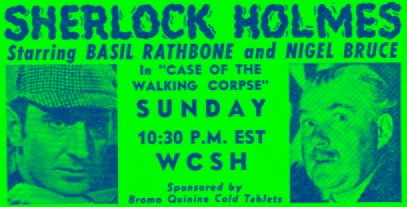
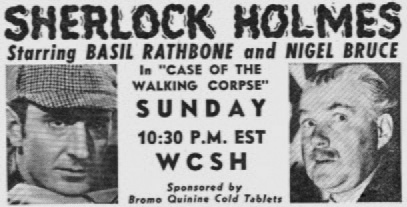
After all, at the same time the pair set the world aright in twentieth-century wartime scenarios, Holmes and Watson continued to solve crime in the gaslit alleyways of late-Victorian and Edwardian London, or suitably caliginous settings elsewhere in the British Isles, in pastiches in which Basil Rathbone and Nigel Bruce were heard on the New Adventures of Sherlock Holmes radio program that aired in the US at the same time:

Asย Sherlock Holmesย director Glenhall Taylor recalled, the series was one of several sponsored programs whose โ€œservices were requested by the War Department.โ€ ย The charms of an imagined past were to yield to visible demonstrations of the responsibilities broadcasters and audiences shared in the shaping of the future. ย To promote the sale of defense bonds during the War Loan Drives, Bruce and co-star Basil Rathbone appeared in โ€œspecial theatrical performances,โ€ live broadcasts to which โ€œadmission was gained solely through the purchase of bonds.โ€ ย (Heuser,ย Immaterial Cultureย 189)

To be sure, Sherlock Holmes Faces Death is less overtly propagandist than the previous three entries in Universal’s film series, all of which are anti-fascist spy thrillers.  Adapted, albeit freely, from a story by their creator, Sir Arthur Conan Doyle, the case they took on subsequently recalled the titular detective and his faithful sidekick from Washington, DC, and released them back into their fog-shrouded habitat in and for which they had been conceived.

And yet, whatever the setting, in motion pictures Holmes and Watson continued to face adversaries that were recognisably anti-democratic โ€“ stand-ins for the leaders of the Axis.  The villain of Sherlock Holmes Faces Death, diagnosed as egomaniacal by Holmes, is no exception. 

Much of the action of Sherlock Holmes Faces Death takes place in an ancestral pile that has been temporarily converted into a convalescent home for wounded soldiers.  Those inmates may have their idiosyncrasies, as all flat characters do, but, to serve their purpose in a piece of propaganda, they cannot truly be plotting murder, unless there are exposed as phoneys, in which case the reassurances of wartime service honored and government assistance rendered would be called into question.  

The unequivocal messages the Sherlock Holmes films were expected to spread in wartime did not allow for such murky developments.  A post-war noir thriller might sink its teeth into corruption; but the Sherlock Holmes series did not exhibit such fangs.

Variety thought this entry ‘obvious stuff.’ Less obvious to me, reading Variety, was
how much Ella Fitzgerald contributed to the success of the film at the box office.

Nor could the recovering soldiers be shown to be so mentally unstable as to kill without motive; according to the convention of whodunits, even serial killers like Christie’s Mr. ABC follow a certain logic that can be ascertained.  The heiress of Musgrave Manor may be momentarily distraught, the butler may be exposed as an unstable drunkard โ€“ but the soldiers, whatever horrors and shocks they endured on the battlefield, can only be moderately muddled.

Most of the recovering servicemen โ€“ in their fear of unwrapped parcels or their fancy for knitting โ€“ are called upon to provide comic relief, bathos being a key strategy of the domesticated gothic. In the Sherlock Holmes series, that is a part generally allotted to Dr. Watson, a role he performs even in this particular installment, in which his expertise as a man of medicine is put to use for the war effort. Inspector Lestrade serves a similar purpose, which is probably what made the ridiculing of military personnel seem less objectionable to sponsors, as it made them look fairly inconsequential to the crime caper unfolding. Aligning those men with Watson and Lestrade assists in eliminating them from the start as potential suspects.

While missing legal documents and cryptic messages are certifiably Gothic tropes, the gothic atmosphere in Sherlock Holmes Faces Death is fairly grafted on the proceedings with the aid of visuals. There are genre Gothic trimmings aplenty in โ€“ secret passages, a bolt of lightning striking a hollow suit of armor, and pet raven assuming the role of harbinger of death โ€“ but there is no real sense of menace as, guided by the infallibly capable hands of Sherlock Holmes, we negotiate with relative ease the potentially treacherous territory of a mansion as makeshift asylum and contested castle.

The climax, which tries to cast doubt as to Holmes’s perspicacity, plays out in a dimly lit cellar. It is here that the gothic could potentially take hold if the plot had not preemptively diffused the dangerous situation hinted at in the film’s title. The trap for the killer below has already been laid above-ground on the newly polished surface of a giant chessboard, in a display of strategy choreographed by Holmes himself. By the time the game moves underground, it is no longer afoot; rather, it is fairly limping along.

Gothic and propaganda can mix; genre Gothic fiction often served political purposes. Gothic and whodunit are less readily reconciled. Although John Dickson Carr tried hard to make that happen, often in an antiquarian sort of way, the Victorian Sensation novelists and the had-I-but-known school of crime writers come closer to achieving that.ย ย But the handling of all three of those form or raisons d’รชtre for writing โ€“ Gothic, whodunit and propaganda โ€“ by the jugglers employed here, at least, is not a formula designed to make the most of mystery and suspense. As I concluded in my discussion of the “identity crisis” of the wartime radio thriller, “propagandist work was complicated by the challenge of puzzling and prompting the audience, of distracting and instructing at once.”

Sherlock Holmes faces death, all right, but the demise he encounters is that of the gothic spirit.
” . . . the way of all flesh, material or imaginary”: Conan Doyle at 150

โ€œHad Holmes never existed I could not have done more, though he may perhaps have stood a little in the way of the recognition of my more serious literary work.โ€ That is how Arthur Conan Doyle, not long before his own death in 1930, announced to his readers that he would put an end to his most robust brainchild, the by now all but immortal Sherlock Holmes. Indeed, the figure continues to overshadow every aspect of Dr. Doyleโ€™s career, literary or otherwise. Perhaps, โ€œupstageโ€ is a more precise way of putting it, considering that the venerable sleuth was to enjoy such success in American and British radio drama from the early 1930s to the present day.

โ€œOne likes to think that there is some fantastic limbo for the children of imagination,โ€ Doyle assuaged those among his readers who found it difficult to accept that Holmesโ€™s departure was merely โ€œthe way of all flesh.โ€

To be sure, the earlier incident at the Reichenbach Falls suggested that Holmes was impervious to threats of character assassination, that he could reappear, time and again, in the reminiscences of Doctor Watson. Still, Doyleโ€™s intention to do away with Holmes so early in the detectiveโ€™s literary career had been no mere publicity stunt. Rather than feeling obliged to supply the public with the puzzles they craved, the author felt that his โ€œenergies should not be directed too much into one channel.โ€

One of the lesser-known alternative channels considered by Doyle has just been reopened for inspection. Today, 22 May, on the 150th anniversary of Doyleโ€™s birth in 1859, BBC Radio Scotland aired โ€œVote for Conan Doyle!โ€ a biographical sketch โ€œspecially commissionedโ€ to mark the occasion. In it, writer and Holmes expert Bert Coules relates how, in 1900, Doyle embarked on a career in politics. He decided to stand for parliament; but the devotees of Sherlock Holmes would not stand for it.

Coulesโ€™s play opens right where Doyle had first intended to wash his hands of Holmesโ€”at the Reichenbach Falls. No matter how sincere Doyle was in improving the Empireโ€™s image and the plight of the Britishโ€™s troops during the Second Boer War, the push hardly met with the approval of the reading public. โ€œHow could you!โ€ โ€œHow dare you!โ€ โ€œYou brute!โ€ the public protested.

Although it was not this perceived case of filicide that did him in, Doyle proved unsuccessful in his campaignโ€”and that despite support from Dr. Bell, who served as an inspiration for Holmes. After his defeat, Doyle โ€œbowed to the inevitableโ€”and back the man came.โ€

When the The Case-Book of Sherlock Holmes was published in 1927, Doyle dropped the man once more, albeit in a gentler fashion. To assuage loyal followers, he fancied Holmes and Watson in some โ€œhumble cornerโ€ of the โ€œValhallaโ€ of British literature. Little did he know that the โ€œfantastic limboโ€ in which the two were to linger would be that in-between realm of radio, a sphere removed from both stage and pageโ€”but nearer than either to the infinite โ€œOโ€ between our ears.

It hardly surprises that, Radio Scotlandโ€™s efforts to get out the โ€œVote forโ€ and let us walk โ€œIn the Footsteps of Conan Doyleโ€ aside, most of the programs presumably devoted to Doyle are concerned instead with โ€œThe Voice of Sherlock Holmesโ€ and the โ€œGameโ€ that is โ€œAfootโ€ when thespians like Cedric Hardwicke, John Gielgud, Carleton Hobbs and Clive Merrison approach the original. It is not Doyleโ€™s life that is celebrated in these broadcasts, but Holmesโ€™s afterlife.

True, to the aficionados of Doyle’s fiction, Sherlock Holmes has never been in need of resuscitation. Yet, as Jeffrey Richards remarked in “The Voice” (first aired in 1998),

[r]adio has always been a particularly effective medium for evoking the world of Holmes and Watson. The clatter of horses hoofs on cobbled streets, the howl of the wind on lonely moors, and the sinister creaks and groans of ancient manor houses steeped in history and crime.

The game may be afoot once more when Holmes returns to the screen this year; but, outside the pages that could never quite contain him, it is the โ€œfantastic limboโ€ of radio that kept the Reichenbach Falls survivor afloat. It is for the aural mediumโ€”the Scotland yardstick for fidelity in literary adaptationโ€”that all of his cases have been dramatized and that, in splendid pastiches like โ€œThe Abergavenny Murder,โ€ the figure of Sherlock Holmes has remained within earshot all these years.


Related writings
“โ€˜What monstrous place is this?โ€™: Hardy, Holmes, and the Secrets of Stonehengeโ€
โ€œRadio Rambles: Cornwall, Marconi, and the โ€˜Devil’s Footโ€™โ€
Old Sleuth Re-emerges in New Medium for American Ho(l)mes

. . . for the Memories?

Well, I am not sure which state of oblivion is more tolerable: to forget or to be forgotten. I tend to commute between the two, as most folks do. Yet I am far more troubled by the defects of my own memory than by any failure on my part to leave an indelible imprint of me on the minds of others. The latter might injure my pride from time to time; but the former damages the very core of my self as a being in space and time. Is this why I am attracted to pop-cultural ephemera, to the once famous and half forgotten, to the fading sounds of radio and the passing fame of its personalities? Am I, by trying to keep up with the out-of-date, rehearsing my own struggle of keeping anything in mind and preventing it from fading?
At present, I am catching up with the cases of Sherlock Holmes as chronicled by Doctor Watson, who, on this day, 25 July, in 1936, regaled American radio listeners with the “Adventure of the Noble Bachelor.” No recording of that particular broadcast seems to have survived; and few, if any, are alive today to remember hearing it. Arthur Conan Doyle’s original stories, of course, are still being discovered today by readers who, like me, come to them with moving images in mind, a mind crowded with dubious celluloid tributes that bear little resemblance to Doyle’s creations. As I recently found out, the first sound film version of A Study in Scarlet has, its title apart, nothing in common with the novel, borrowing dialogue and plot elements from The Valley of Fear instead.

Those who choose to enter Doyle’s Study are likely to be struck by what his unforgettable if frequently misremembered detective had to say about memory:

“You see,” he explained, “I consider that a man’s brain originally is like a little empty attic, and you have to stock it with such furniture as you choose. ย A fool takes in all the lumber of every sort that he comes across, so that the knowledge which might be useful to him gets crowded out, or at best is jumbled up with a lot of other things so that he has a difficulty in laying his hands upon it. ย Now the skilful workman is very careful indeed as to what he takes into his brain-attic. ย He will have nothing but the tools which may help him in doing his work, but of these he has a large assortment, and all in the most perfect order. ย It is a mistake to think that that little room has elastic walls and can distend to any extent. ย Depend upon it there comes a time when for every addition of knowledge you forget something that you knew before. ย It is of the highest importance, therefore, not to have useless facts elbowing out the useful ones.”

I find little comfort in those words. Memory is not simply a matter of selecting what one wishes to recall or neglect; nor is forgetting, however convenient in many cases, merely a means of keeping the cabinets of our internal storage space organized or of keeping from us certain memoranda about events and personages whose presence we do not care to face.

What I fail to retrieve is often just what I need to have present. I make indices of my activities, such as the list (to the right of this) of films I have seen this year, well aware that the titles alone do little to trigger memories. My pocket diary and online calendars are filled with reminders; not of things to do, but of things done and places seen, jotted down so as to bring them back to mind: a combination of letters and numbers with which to gain access to an otherwise inaccessible past.

Resorting to the outsourcing of memory, I updated my homepage today, adding an album set aside for portraits of largely forgotten entertainers, photographs given to me by a friend whose mother wrote in for and held on to them. The above picture of Bill Johnson, for instance, that “Thanks”-giving fellow with the pipe (a prop likely to endear him to Mr. Holmes, but liable to bar him or anyone, for that matter, from being featured in a Disney family movie). I do not recall hearing of him or hearing him entertain me; but I made up my mind to remember him publicly, to become an aide to someone else’s memory, the mental faculty on which I cannot depend.

It is only after such clean-up efforts that I allow myself to contemplate how I might be remembered should ever the winds of change or the sweeping gesture of an officious feather duster wipe away what I chose to leave behind on the web . . .

On This Day in 1930: Old Sleuth Re-emerges in New Medium

Well, before taking a moment to give my page a bit of a makeover and getting all gimmicky by setting up a poll to encourage reader participation (despite my own difficulties with such surveys), I tuned in again to BBC 4 last night and watched another fine British thriller: Edward Dmytryk’s Obsession (1949). Sufficiently motivated by the experience, I promptly cast my vote at IMDb, which is something I am just getting into the habit of doing.

Obsession is told mainly from the perspective of the criminal, a jealous husband determined to do away with his wife’s lover; eventually, Scotland Yard is on his case, and the storytelling loses some of its focus as the inspector keeps calling and occasionally takes the camera along with him. Still, with its emphasis on the execution and prevention rather than the detection of a crime, Obsession is a psychological thriller as opposed to a whodunit, the genre revolutionized in the 1880s by Conan Doyle and his famed Sherlock Holmes stories.

I have always enjoyed a solid whodunit, even though I prefer them in print instead of visualized on the screen or dramatized for radio, as I explained previously. I nonetheless put aside my copy of Agatha Christie’s Poirot puzzler The Clocks to commemorate a milestone in radio mystery drama. It was on this day, 20 October, in 1930, that master detective Holmes and his sidekick-chronicler, the logic-deficient Dr. Watson solved their first mystery on the air.

The mystery, “The Speckled Band,” was a familiar one, to be sure, as was the actor who assumed the role of the brilliant if conceited armchair detective. The performer before the microphone that night was none other than William Gillette, who had not only played Holmes more than a thousand times before but had rewritten some of his adventures to create a stage melodrama that was to serve as his star vehicle for over three decades.

As a Theatre Magazine critic pointed out, Gillette “himself cut the radio score, arranged by Edith Meiser [. . .], directed his cast, and spoke into the microphone from the special glass-curtained stage of the National Broadcasting Company’s Times Square studio” atop the theater that had been โ€œthe scene of Gilletteโ€™s farewell return to the footlightsโ€ earlier that year.

Gillette was already in his late 70s and did not return to the microphone for subsequent episodes; but, being described by a New York Times reviewer as standing “erect and unbending” and as having a “clear, precise, vibrant” voice, the aged thespian was lured out of retirement now and again to play the part for several years longer, returning to the airwaves once more for the 18 November 1935 Lux Radio Theatre production of his stage success.

Holmes survived Gillette’s death in 1937 and continued for another decade to solve mysteries on US radio, even though he had to face plenty of competition on the blood-speckled bandwidths. Like the motion picture series starring Basil Rathbone and Nigel Bruce, the Holmes adventures on the air also played an important role in home front motivation, endearing Americans to their at times veddy peculiar and snobby sounding allies in Britain. After the war, the British reclaimed Holmes and continued to dramatize his adventures on BBC radio.

Although I was not immediately taken by such pastiche, the American dramatizations eventually won me over with their charm. Retaining Watson as the narrator added much to the cozy atmosphere of these miniature mysteries; the banter between Holmes and his friend supplied the wit; and the thrills were not wanting either, as aforementioned writer-adaptor Meiser managed to keep the guessing game going despite the challenge of making the short plays intelligible by reducing the number of suspects and dropping fairly conspicuous hints.

So, as the sun is setting earlier or refuses to appear altogether on these gray autumn days, I will sit back more often to join Dr. Watson at his fireside, listening attentively to his tales of intrigue and murder. Just don’t call it an obsession . . .