I’m fighting them any which way I can. Headaches! This time, though, nothing seems to work. And all the while, during a very nearly sleepless night, I’ve been torturing myself, thinking of the old Bromo-Seltzer train and its insistence that listeners to those Bromo-Seltzer sponsored programs “fight . . . headache . . . three . . . ways.” That meant taking care of stomach upset and jangled nerves into the bargain. Jangled nerves? I don’t know, but somehow that train whistle is the last thing you want to hear when you are under the weather (or whatever is firing up that blasted steam engine in my cranium these days).
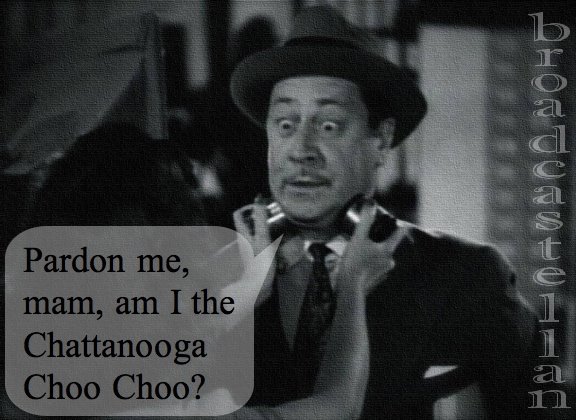
The Bromo-Seltzer train was a menace, if you ask me; but it was also a marvel. It came to life through the magic of Sonovox, one of those fabulous if artistically insufficiently explored sound effects devices used in 1940s film and radio, where it was largely relegated to commercial duties. Its potential becomes no more apparent than in those insinuating drops of water dripping on A Letter to Three Wives (discussed here). As Time magazine described the invention in its 24 July 1939 issue, a recorded sound is “fed through wires to two little biscuit-shaped gadgets which are placed on each side of the throat against the larynx. These gadgets transmit the sound vibrations to the larynx, so that the sound comes out of the throat as if produced there.”
For comic effect, the novelty was used in the comedy-thriller You’ll Find Out (1940; mentioned here) and Disney’s Dumbo (1941). The Sonovox was also heard in The Falcon and the Co-eds (1943), and, rather more hauntingly, in the Joan Crawford-starring melodrama Possessed (1947; mentioned here). The swan song for the Sonovox appears to have been The Good Humor Man (1950), as a fellow web journalist shares it here, with a clip from the film.
The other day, I caught another glimpse of the Sonovox in operation while watching the The Reluctant Dragon (1941), a promotional tour of the Disney Studios filmed during the making of Dumbo, which was released early the following year. The proxy visitor taking the tour on our behalf is Algonquin Round Table wit Robert Benchley (pictured).
Tonight, though, it had better be a silent movie. Why not a stroll in Hitchcock’s Pleasure Garden, (1925)? After all, it is Alma Reville’s birthday.
“Then heaven help the masses!” That’s what English teacher George Phipps exclaims in A Letter to Three Wives (1949) when confronted with the notion that soap operas were the “literature” of his fiercely commercial, communists fearing day. Alerted to this mock prayer by Leonard Maltin’s Great American Broadcast, I began to wonder what radio executives, whose business it was to take note when their line of business was threatened or questioned, would do with such a line if ever A Letter were to be read on the air.
To begin with, Joseph L. Mankiewicz’s Oscar-winning screenplay would have to be reduced to a memo, given the tight, commercials-cluttered slots allotted for post-World War II broadcast drama; but the Letter had already been severely edited, two of what had once been five wives receiving the pink slip in an economic downsizing of a property initially spread out on the pages of Cosmopolitan back in 1945. It was too prominent a missive not to be bottled anew and tossed into the airwaves.
The Lux producers were not generally concerned with aesthetics; but, Phipps’s disparaging remarks notwithstanding, the screenplay for A Letter is most radiogenic. After all, it depends on voice-over narration by an unseen character (played by Celeste Holm in the film version), a storytelling convention suited to—and appropriated from—radio drama, whose publicly confidential talks transported audiences straight into the mind of the speaker.
The film version also makes excellent use of the aforementioned Sonovox, a device that could turn any sound into speech. In A Letter, it gets droplets of water to seep insinuations into receptive ears. What speaks volumes in the Lux production is that the Sonovox, largely relegated to advertising duty on radio, was being scrapped altogether. Its innovative props disposed of, its potentialities ignored, radio theater was frequently reduced to borrowing its material from the movies it had assisted in furnishing and shaping.
However impoverished, Sandy Barnett’s radio adaptation does take on the challenge posed by George Phipps, even though the teacher’s arguments have little bearing on the plot involving the two leads of the Lux production. And rather than being turned into a hausfrau, George’s spouse Rita is the soap opera writer she was on the screen.
The scene for the assault on radio is set: Rita (played by Joan Banks) has invited one of “those radio people” to dinner. “You know what I like about your program?” her maid tells her, “Even when I’m running the vacuum I can understand it.” Besides, it keeps her “mind off [her] feet. George (Stephen Dunne) is not pleased having to entertain the entertainers; he is unwilling to serve them expensive liquor to make them feel at home:
Rita. People in show business, well you know what I mean. Those kind always drink scotch.
George. I know what you mean, dear, but I wish you wouldn’t say it in radio English. That kind, not “those kind.”
Rita. There are men who say “those kind” who earn a hundred thousand dollars a year.
George. There are men who say “Stick ‘em up” who earn even more.
Not surprisingly, given her husband’s attitude, Rita is concerned about the evening’s entertainment.
Rita. George, just one thing, please. No jokes about radio.
George. Oh, the time for joking about it is past. Radio has become a very serious problem now, like juvenile delinquency.
Rita. That’s just what I mean. Cracks like that.
The get-together does not go as smoothly as planned by Rita, who would like her self-consciously impecunious husband to quit teaching in favor of writing for the soaps. A debate about radio’s cultural offerings and the lure of the big money behind them ensues:
George. Look, Rita, let’s put aside my personal likes and dislikes. They’re not important. I am willing to admit that to a majority of my fellow citizens I’m a slightly comic figure: an educated man.
Rita. But nobody’s asking you not to be. Think of the good you could do. Maybe raise the standards.
George. And what’s even worse than being an intellectual, I am a schoolteacher. Schoolteachers are not only comic, they’re often cold and hungry in this richest land on Earth.
Rita. And thousands are quitting every year to take jobs that pay them a decent living.
George. That is unhappily true.
Rita. Then why not you?
George. Because I can’t think of myself doing anything else. What would happen, do you think, if we all quit? Who’d teach the kids? Who’d open their minds and hearts to the real glories of the human spirit, past and present? Who’d help them along to the future?
I suppose the impressionables of 1940s America have, for the most part, survived those radio days unscathed. Besides, the lessees of the airwaves awash with suds had learned to respond to the dirt on radio offered by its detractors by giving such criticism a good rinse and a clever spin. Sure, it got Fred Allen and fellow satirist Henry Morgan into trouble during the ’40s; but The Hucksters (shown here) had proven how profitable rants against radio could be.
When “A Letter” was sent off by the renowned toilet soap promoters (having been delivered previously by the Camel-sponsored Screen Guild, without any references to the evil influences of radio), such attacks were as old hat as the consoles from which they occasionally sputtered.
By 1950, there was little need to suppress a memo critiquing what was becoming immaterial as its subject matter was being yanked from the broadcast schedules. Everyone was making eyes at television; and while Hollywood stars still flocked to the microphone to make a quick buck, the radio theater audience dwindled as Americans scraped together their savings for the set that would define our everyday in the second half of the 20th century.
In a 21st-century update of the Letter, Rita Phipps would probably be designing interactive games or reality shows—the literature of today?
Well, I had this particular spot reserved for two; but, as you will see, it got considerably more crowded here. Watching the Joan Crawford melodrama Possessed (1947) last night, I noticed in the opening credits that the screenplay was an adaptation written by playwrights once well known for their work in radio: Ranald McDougall and Silvia Richards. I had come across McDougall’s name only yesterday, when his propaganda piece “The Boise” reached me by mail (between the covers of Erik Barnouw’s 1945 radio play anthology Radio Drama in Action).
McDougall’s plays for the series The Man Behind the Gun are notable for their effective use of second-person narration, an addressing of the listener as a character in the drama to follow:
You’re a chief bosun’s mate aboard the “Boise”—a gun pointer—the guy that points and fires the fifteen big guns of the cruiser. Right now you’re standing by for action [. . .]. You’ve sighted the enemy, and your eye is jammed into the telescopic gun sight, searching for a target. [And] now, very dimly, you see a light-gray spot on the lens . . . then another . . . and another—five of them. It’s them! You can see them plainly.
As those listening to old-time radio shows know, the technique was later used to announce each upcoming episode of Escape). McDougall’s collaborator writing the screenplay for Possessed was Silvia Richards. I assume that is the Sylvia Richards who wrote scripts for the thriller anthology Suspense. At any rate, I was going to discuss the influence of radio writing and technique on the structure of Possessed, a film noir that also makes use of radio’s voice-altering Sonovox, readers interested in which Google occasionally refers to broadcastellan.
The second topic on my mind was the narrative genre of soap opera, which occurred to me after misreading the date marking the demise of four long-running radio serials back in 1959, the anniversary of their silencing having been 2 January, not 1 February. I occasionally contribute a definition to Waking Ambrose and was interested in redefining “soap opera” for myself. It is a word that has become rather too loosely used, but might actually fit certain commercial blogs.
So, this is what I had planned to write about today; but technorati made me reconsider all that. After posting my essays here, I often go in search of other online journals discussing subjects similar to mine. Not infrequently, this leads to some follow up on my part. The other day, for instance, having written about the radio promotion for Cecil B. DeMille’s Four Frightened People, I searched for recent mentions of that title elsewhere. And what did I learn? That the film is going to be released as part of a DeMille DVD anthology. Both the Alternative Film Guide and Trouble in Paradise will tell you as much. That’s another product of popular culture recalled from obscurity. Unfortunately, my similarly obscure journal had little to do with it; but bloggers are doing their share by spreading the word and signalling interest in or demand for such films.
Yesterday, having just mocked the “relevance” of the Academy Awards, I came across an entry in the Popsurfing blog, shared by someone who, unlike me, took time to look at the entire list of nominees. And what is nominated in the documentary (short subject) category? A Note of Triumph: The Golden Age of Norman Corwin, a film honoring the foremost exponent of American radio dramatics. How relevant (to me, the broadcastellan blog, and readers in popular culture) can an Oscar nomination get? The next question on my mind was not a rhetorical one: how can I get my hands on a copy of this film?
By sharing all this I meant to comment on the enriching interactivity of the blogosphere, on the flow of information (correct, false, relevant or not) that can sweep past, engulf, or uplift you, if only you bother to keep surfing. “There will be time later” (to quote a line from Corwin) to retreat into that world between my ears. Right now, I’m eager to look around and partake . . .

 I’m fighting them any which way I can. Headaches! This time, though, nothing seems to work. And all the while, during a very nearly sleepless night, I’ve been torturing myself, thinking of the old Bromo-Seltzer train and its insistence that listeners to those Bromo-Seltzer sponsored programs “fight . . . headache . . . three . . . ways.” That meant taking care of stomach upset and jangled nerves into the bargain. Jangled nerves? I don’t know, but somehow that train whistle is the last thing you want to hear when you are under the weather (or whatever is firing up that blasted steam engine in my cranium these days).

 Harry Heuser