
“Jumping Niagara Falls”; or, She’s Pushy, for a Corpse

Among the fifty-eight movies I added to our video library while shopping in New York City is the 1948 film adaptation of Lucille Fletcher’s radio play Sorry, Wrong Number. Fletcher penned the adaptation as well, despite her previous remarks about the merits of her original script. “I wrote ‘Sorry, Wrong Number,’” she was quoted in a 1948 anthology of Plays from Radio, “because I wanted to write a show that was ‘pure medium,’ something that could be performed only on the air.” And yet, “Sorry” has been reworked for stage and television and turned into both film and novel. If the original play is “pure medium,” Anatole Litvak’s melodrama is a Sorry adulteration. Just how much of a narrative muddle it is becomes clear when the screenplay was returned to the airwaves as a presentation by the Lux Radio Theater on 9 January 1950.

The thrill of the original lies in what Matthew Solomon refers to as its “narrative isochrony,” that is, the congruence of elapsed airtime and the clock ticking away the last minutes in the life of the central character. Instead, Sorry is marred by too many flashbacks and too much background story for what is essentially our witnessing of the inevitable death of someone we cannot wait to shut up.

Fletcher invites us to rethink Mrs. Stevenson’s role of a victim and permits us to enjoy tuning in to the well-scheduled execution of a perfect monster. In her screenplay, however, the playwright attempted to elicit feelings for a woman we’d much rather strangle, to make us waver between sympathy and condemnation. Mrs. Stevenson now has a first name and presumably a heart, however weak.

Alfred Hitchcock might have agreed with this revision, considering that the audience experiences suspense more keenly if the character is sympathetic. Fletcher also adds a moment of doubt as to Mrs. Stevenson’s fate by suggesting that her executioner might also become her rescuer.

At the same time, though, the film, unlike the radio play, compromises its point of view, letting the camera glide through Mrs. Stevenson’s room and giving us eyes to see the world beyond instead of keeping us close to the invalid who is being given a pair of wobbly legs just strong enough to make us wonder about her condition and chances of survival. Film insists on showing, even if the most compelling sight is the emotional state as written in the face of a person reduced to being all ears.

At any rate, Mrs. Stevenson died, eventually and unsurprisingly. Or did she? While on our trip upstate, recalled in the current entries into this journal, I was reminded of “Jumping Niagara Falls,” the unlikely sequel to Fletcher’s rather conclusive thriller. In it, Mrs. Stevenson is out for revenge—from the grave as her husband Elbert goes off to the Falls with a woman young enough to be his granddaughter. What’s left of Mrs. Stevenson is nothing more than what we get when we first encounter her—a voice, which insists on making itself heard on the telephone, the radio, and (or perhaps solely in) the mind of the man who masterminded her murder.

That voice, in the 1999 sequel (by Brian Smith and George Zarr) is Claire Bloom’s. To me, though, as to anyone loving radio, the voice of Mrs. Stevenson belongs to none other than the aforementioned “First Lady of Suspense.” Equipped with Moorehead’s larynx, Fletcher’s celebrated harridan might have us all over in a barrel.

“Long Distance” Caller Sounds “Sorry”

My students never knew it, but I can be a right pushover when it comes to sentiment. I weep, publicly and almost unabashedly, at the sight of a Landseer painting like “His Only Friend.” I enjoy being manipulated that way and am pleased to find my senses receptive to the melodramatic, the dubious arts some denounce as kitsch and others approach only as camp. Nor do I mind being aware of being taken in—unless the trick doesn’t quite come off and I am left disappointed, unmoved, or get downright cross. Disappointed because I was promised a chance to exercise my passions in the relative safety of the controlled environment that is an aesthetic experience. Cold because the passions could not be provoked, despite appreciable effort; and hostile because my intellect rebukes me for having been put on hold for something clearly not worth the shutting down of reason.
To be sure, there’s much to be done with art even if an emotional engagement is lacking; but I am generally distrustful of critics who deny themselves such personal responses or who, worse still, are entirely incapable of experiencing them; commentators who are eager to speak before having listened to the work they subject to the mental appropriation that is critical study.

A long time ago, I told myself never to write anything I don’t feel; and I don’t enjoy writing about matters that do not matter to me emotionally. Granted, that list of subjects is quite short, since I cannot but feel angry at not feeling anything else. Here, then, is what I feel about “Long Distance,” a radio thriller that premiered on this day, 3 July, in 1948.

To begin with, “Long Distance” sounds an awful lot like “Sorry, Wrong Number” (previously mentioned here) It invited the comparison, considering that it aired on and inaugurated NBC’s Radio City Playhouse within weeks of the film premiere of Sorry, Wrong Number, the vastly inferior adaptation of Lucille Fletcher’s famous radio thriller. Vastly inferior because the film resorted to flashbacks and thus diminished the sensation of experiencing a crime in progress, a crime whose victim will die within the time allotted for the play—the sensation of being alone with this person as she sits by the telephone, fighting for her life.

What makes “Sorry” such a guilty pleasure is that we don’t feel altogether sorry that the number’s up for the ostensibly innocent victim, who reveals herself to be a mean and selfish individual. The distraught woman trying to call “Long Distance” (portrayed by future Palmolive spokesperson Jan Miner) is fighting for survival as well; but it is not her own existence she cares about; it is the survival of her husband. Convicted of murder, he is schedule to be executed within the next twenty minutes. Mrs. Jacks, the desperate woman on the telephone, claims to have found the missing piece of evidence that would prove her husband’s innocence. For the duration of the play, she is heard trying to get hold of the judge who can stay the execution.

Like Mrs. Stevenson, the anti-heroine of “Sorry, Wrong Number,” Mrs. Jacks is frustrated by a maze of wires; the telephone, her only means of taking action, is acting against her. It is only when the clock strikes the hour of death that she finally manages to talk to the only person who can keep her husband alive. She is urged to hang up and await his return call. The deadline passed, dramatic time stands still. A brief musical bridge rips apart the real time unity of the play—perhaps shredding its realism altogether to pieces. Then, the telephone rings once more. Reluctantly, the despairing woman picks up the receiver. She begins to laugh hysterically, shouting her husband’s name.

Unlike the conclusion of “Sorry, Wrong Number,” which leaves no doubt as to the deadly failure of its central character, the epilogue of “Long Distance” permits alternate readings. The voice to which the woman on the phone responds so euphorically is the only one in the play not rendered audible. It is for the audience to determine whether her husband has been saved or whether she lost both him and her mind during the ordeal of this long distance rescue mission.

It is only in this moment of doubt that I can find merit in Harry W. Junkin’s overwrought and derivative melodrama that, were it not for this little breach of trust, leaves me disappointed, cold, and nearly as hostile as Agnes Moorehead must have felt being passed over for Barbara Stanwyck in the film version of the play that had earned Moorehead the title “First Lady of Suspense.”

Another “Wrong Number,” a False Start for Marilyn, and the Right Answer at Last

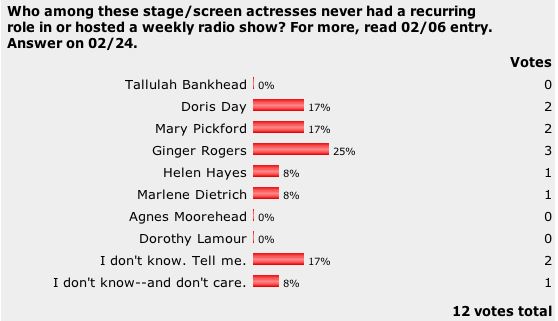
For the past three weeks I have been commemorating the dames, gals, and ladies of the airwaves; but now, the correct answer to the question posed in first broadcastellan quiz can finally be revealed. Thanks to all those who guessed or knew or couldn’t care less—and told me so. Tallulah Bankhead, Doris Day, Mary Pickford, Helen Hayes, Marlene Dietrich, Agnes Moorehead, and Dorothy Lamour—they were all radio regulars at some point in their careers, whereas others, including Ginger Rogers, the lady in question (as guessed by three readers), limited their air time to occasional guest appearances on dramatic programs like the Lux Radio Theatre. And others still, Marilyn Monroe among them, started out in commercials.

On this day, 24 February, in 1947, more than five years before she became a major star, a noticeably nervous Monroe, having waited months for her first movie role while already under contract at Fox, was pushed before the microphone to appear in a commercial break for the Lux production of “Kitty.” Within the few seconds allotted for her radio debut, Monroe was faced with the task of initiating her career (by mentioning her first Technicolor screen test), plugging Betty Grable’s The Shocking Miss Pilgrim (whose costume she got to wear during the test shoot), and peddling Lux “flakes” (which ostensibly kept those costumes fresh and colourful). However alluring her timbre, Monroe fumbled. She could not even get the name of the announcer straight; her voice was rarely broadcast thereafter, even as her film roles remained scarce and undistinguished.

A pleasant voice, while an asset, was not a radio requisite. As I mentioned previously, Louella Parsons did quite well without one, notwithstanding her consternation when being told she had to do without the larynx of Ms. Rogers, who allegedly insisted on getting paid to be interviewed. The giggles and high-pitched screechings of comedy actresses aside, the most celebrated woman’s voice on American radio was the less than pleasing one emanating from Agnes Moorehead. Her virago vocals, by which Joseph Cotton’s character in Since You Went Away claims to have been haunted across the Atlantic, was ideally suited to the role of irate Mrs. Stevenson in that most famous of original old-time radio plays, Lucille Fletcher’s “Sorry, Wrong Number.”

On this day in 1944, Moorehead, shown left during a performance of “Sorry,” once again starred in the role she had originated on the radio thriller anthology Suspense in May 1943. The part was subsequently translated for motion picture audiences and television viewers (by Barbara Stanwyck, Mildred Natwick, Ida Lupino, and Shelley Winters); but, however bitter Moorehead might have been losing the role to Stanwyck on the big screen, no actress would snatch the original from the “First Lady of Suspense.”

It was not until long after Moorehead’s death that Claire Bloom (recently seen on UK television in the last of the second season of Marple), made an attempt at superseding the “First Lady,” not only by recreating the role for radio in 1999, but by starring in a sequel of sorts.

While she had nothing to do with that sequel, radio dramatist Lucille Fletcher was responsible for the 1948 film adaptation. Her involvement did not, however, assure the aesthetic success of the latter, which, for all its high melodrama, has little of the tension generated by the original play. With its numerous flashbacks, the film destroys the intensity of a drama unfolding in real time. Like Allan Ullman’s novelization of Fletcher’s screenplay, it fails to approximate, let alone recreate, the excitement of eavesdropping on someone in mortal danger, someone whose life, like the live broadcast during which it plays out—runs on a decidedly tight schedule beyond our control and influence.

“I wanted to write a show that was ‘pure medium,'” Fletcher remarked about “Sorry, Wrong Number.” She succeeded so well that any adaptation would amount to nothing short of mediocre impurity.