Murder in the Backroom; or, No Place for a Lady

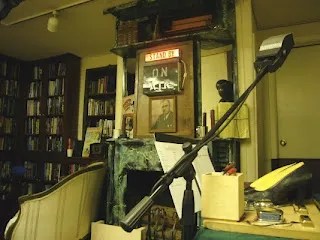
Well, they are still at it. Slamming doors, screaming bloody murder, getting into fisticuffs—all in a perfectly orderly manner, standing upright, their eyes focused on the sheets of paper in their hands. The W-WOW! players, I mean, who meet on the first Saturday of each month, from September to June, to step into the “broadcasting” studio in the (pictured) backroom of the aforementioned Partners & Crime bookstore on Greenwich Avenue in downtown Manhattan

Last night, for their final performance before going on summer hiatus, the W-WOW! troupe recreated episodes from Broadway Is My Beat (“Francesca Brown,” originally broadcast on 2 June 1951) and Richard Diamond, Private Detective (“The Carnival Case,” from 16 August 1950). Capably delivering their lines, the two leading men—Steven Viola as Danny Clover in Broadway Is My Beat and Michael H. Johnson as Richard Diamond—were more than amply supported by the four ladies of the fancifully titled Cranston & Spade Theatre Company. Indeed, they were upstaged by them, and that despite the fact that the titular character of the evening’s first offering was dead before the action got under way.

Sheila York brought sex appeal to the role of a carnival gypsy who beckons Diamond into “the inner sanctum,” which gives the leading man a chance to quip: “Haven’t I heard you on the radio?” As a former DJ, the woman who played her sure has experience in broadcasting. And aside from being a competent voice artist, York is also a published novelist who draws inspiration from the medium in which she worked. Her latest thriller, A Good Knife’s Work, takes readers inside the business of radio drama in the 1940s—with a female detective as a guide.

Voice-over artist and teacher Karla Hendrick has a voice most likely to succeed in that business, standing out even in parts no larger than that of a gum-chewing waitress cracking wise with the gumshoe. In charge of musical transcription and accompaniment was Heather Edwards, while DeLisa M. White handled the sound effects, delivering blows and popping balloons according to the cues in the script.

For now, the ladies of W-WOW! are adjuncts to the dramas presented by the players, deliver commercials, play sidekicks, sirens, or servants. Sure, Diamond’s girlfriend Helen knows how to handle a gun (as is demonstrated in one of the script’s sly takes on traditional gender roles); but maybe the company should take on some of the radio thrillers featured in Jack French’s Private Eyelashes and revive that rare breed of crime-solving radio heroines. So, how about it, Messrs. Cranston & Spade?

Chalk Circuits: Brecht, the Stage, and the Radio

Well, it rolled into town last night . . . and carted me right back to high school (in Germany, anno never-mind), where I was exposed to it first. The National Theatre’s “education mobile,” I mean, whose production of Brecht’s Caucasian Chalk Circle I went to see at the local Arts Centre. Despite the publicly staged custody battle at the Circle‘s center, I did not once think of the circus that has become the life and legacy of Anna Nicole Smith. Brecht’s parables of the filthy rich and dirt poor are hardly without tabloid appeal; but instead of drawing parallels between this story and history, I felt encouraged by the production’s interpretation of Brecht’s theory of Epic Theater to contrast the techniques of the theatrical stage with the potentialities of the sound stage, radio being a medium of which Brecht was suspicious at first (given its exploitation in Fascist Germany), but for which he was to write a number of plays.

Communism has always been big business in capitalist societies, both as fuel for wars, cold or otherwise, and as an artistic construct. A carnivalesque appreciation of his anti-capitalist allegories from the comfort of a loge might run counter to anything Brecht envisioned in his organon, but I suspect that such is the spirit in which most audiences take in his works for the stage. They are didactic, all right, but that does not mean theatergoers are ready, willing, or able to be instructed.

Instead, audiences might take in, take on or leave Brecht’s Epic theatricals, only to return to their shopping, to the latest installment of an American television serial featuring the works of Hollywood’s highest-paid plastic surgeons, or to their various modes of right-winging it in style. Episches Theater struggles against the complacency induced by the convenience and relative comforts of a reserved seat in a handsome theater. Theatergoing, after all, is little more than a costly interlude these days, a getting-away-from the everyday rather than a forum in which to face it.

Besides, Brecht’s apparatus seems by now more creaky than a well-oiled Victorian spectacle. Its stage was not the proscenium arch of melodrama, plays of sentiment and sensation that draw you in and, once the curtain is drawn, absolve you from any responsibility to engage further with whatever you had the privilege of witnessing. Never mind that The Caucasian Chalk Circle draws to a close with the potentially high-tension climax of two women called upon to tear at a child rightfully belonging to one of them (the verdict depending on the judge’s—and our—definition of “rightful”). Much lies outside this circle that invites onlookers to stray from the center.

The main principle of Epic Theater is not to let anyone watching get emotionally absorbed in the action. Brechtian drama challenges audiences to observe behavior, action and circumstance, however stylized, in order to assess and draw conclusions from it. Conceived as a theater of estrangement (or Verfremdung), it is meant to provoke thought rather than pity. The play (and the play within) remain an artifice rather than becoming—or assuming the guise of—reality.

In order to create this sense of estrangement, the National Theatre production lets the audience in on the stagecraft involved in the manufacture of realist theater, especially the motion picture variety whose special effects trickery has long surpassed traditional stagecraft. The stage was both scene and soundstage, a set peopled with foley (or sound effects) artists at work in the background and, to highten the effect of alienation, interacting with the performers or taking part in the drama they help to mount. Not since I last attended a production of a radio drama have I seen so many tricks of the trade displayed, from the production of a crackling fire to the imitation of a bawling infant.

I’m not sure whether Brecht would have approved of this interpretation of his theory, which results in a spectacle that was amusing rather than authoritative, a Marx Brother’s production during Karl’s night off, a staging that turned Verfremdungseffekt into an elaborate running joke. This Chalk Circle, replete with a narrator addressing the audience with a microphone in his hand, was a radio melodrama turned “epic” by virtue of being both played and displayed.

On the air, with its techniques obscured from view, it would have come across like the very stuff against which Brecht rebelled with his theory. The eye and the ear were pitted against each other, an “epic” battle of the senses whose enemy is realism but whose victim is engagement. For once, my ears were the channels of realism, while my eyes were instructed to see and disbelieve. Sure, I learned how to set a palace on fire; but Revolution had nothing to do with it.

"Endangered Sounds"?

Well, let’s see. No, wait. Let’s listen instead. “Now I will do nothing but listen, / To accrue what I hear into this song, to let sounds contribute / toward it.” Walt Whitman wrote these lines. What are the notes to the song of my self? What are the echoes of my everyday? What do these sounds have to do with me?

When I moved to Wales, far from the hubbub of Manhattan, I had to get used to a whole new soundscape. I haven’t quite gotten used to it yet; particularly not to the howling of the wind. These days, there is a new sound in the living room. Yet it is so old, Whitman might have heard it. It is not a Welsh sound, but one made in Brooklyn. It is the sound of our Ansonia clock, anno 1881 (pictured above), which is now part of the ambiance in which I breathe and move.

I have been listening to the BBC Radio 4 documentary “Endangered Sounds.” What might that be, an endangered sound? In my adolescence, I began to wonder about the perishable fabric of my sonic everday. I began to record noises and voices in an attempt to capture where—and who—I was. I did not trust my archival mind as a storehouse of sonic markers of place and time. We tend to make records of our lives in words and images rather than sound. The image seems to be more desirable as a keepsake—more reliable and persuasive. It dominates our senses. Is it any wonder we feel out of touch with the past if we insist on turning it into graphic objects.

I remember sitting in Central Park one afternoon, thinking how serene my environs were. I recorded the sounds of that afternoon and played them back at home, only to realize how noisy that spot had been. The images were so powerful, they drowned out the sounds of the metropolis—the cars rushing by just behind the trees, the buzz of commerce puncuated by sirens. I took no notice of what was out of sight (though hardly out of earshot); I did not hear what the eye fooled me into believing absent. I listen for them now that I am gone. I miss them more than the sights, stored in my mind, preserved on paper, and displayed in this journal.

“Endangered Sounds” provokes thoughts about our changing environment, about noise pollution, about the loss and luxury of silence: the nostalgia for our silenced past, the awareness that, as technology advances, we lose ourselves soundscapes whose sameness is robbing us of our identity—an alienating, Kmartian sub-urbia, a generic soundtrack as mind-numbing as Muzak. For all this, “Endangered Sounds” frustrates as much as it intrigues, especially since it does not resound with many of the authentic sounds it declares to be on the brink of extinction, some of which were recreated in stock recordings, others crushed in musical beats.

Rather than preserving sound, the program serves as a reminder of loss; it is a memorial service for our silenced past. It suggests that, in the near future, technology will permit us to deaden what we do not wish to hear, to create bubbles of choice sound and tranquility distilled from the din of civilization. Manufacturers of sound are hard at work to sell us back what commerce and progress has robbed us of.

Do we really need highly sophisticated computer technology to create our individual sound spheres? When I lived in Germany and dreamed of New York City, I would listen to the sounds of streets and avenues I had recorded while away from what was not truly home. The sirens, the footsteps on the sidewalks, the babble of the passers-by—they provided more comfort than the electronic tunes I merely consumed. Unlike the artifice of those purchased sounds—a sonic anywhere to take the place of the here and now—the metropolitan noises I had recorded were real and concrete. My feet had touched those steps, my shoulders had brushed against those voices, my nose had taken in the fuel with whose burning the traffic resounded. That was somewhere—a there I felt—and I knew I had to go back there to stay.

These days (owing to the electronic blasts of the past, no doubt) I am somewhat hard of hearing; but instead of deadening my everyday in specious phonics or phoney silences—some New Age orchestrations of an assembly-lined existence—I seek and find comfort in sounds whose source I can identify and take in with my other senses—the fire I feel against my skin, the yawning of our none-too-pleasant smelling dog on the carpet, and the clock on the mantelpiece (which, in the picture above, reflects both me and the dog on its surface); and instead of losing myself in the folds of a custom-made soundcarpet, I wrap myself in this resonant quilt and know myself to be . . . at home.

Racket Science: Two Coconut Shells, a Blowlamp, and a Raspberry"

Well, what does it sound like? Home, I mean. The everyday we inhabit. Perhaps, home is a space in which we no longer pay much attention to what our ears can pick up because we are so accustomed to and at ease with our surrounding soundscape. Or perhaps it is that private environment within whose confines we can drown out what is strange with a soundcarpet of our own weaving. Today, my sonic rug received another sound beating, and I guess this is some of the dust that fell off.

There was an awful lot of howling and rattling, produced by the fierce winds that, while no longer unfamiliar to me after two years of living here in Wales, still suggest the foreign, the uncanny, the inhospitable. I guess I could have countered it by turning on the radio or by playing some of my favorite tunes; but I rarely listen to music these days, at least not as a means of muffling the world or creating an alternate one. I am trying to remember past places I called home and the sounds that might have made them such.

Do you recall sounds as easily as images? We tend to take pictures of our friends and surroundings; but, unless we take moving images with our digital cameras, we rarely record our lives in sound. Right now, I am not even sure about my father’s voice, for instance. He died some ten years ago; but I hadn’t talked to him for some time before that. My family was just about as functional as the clan in Little Miss Sunshine, with which I finally caught up this evening at a local cinema.

I was the teenager in that picture—moody, aloof, and not inclined to share my thoughts with the family to which I scarcely belonged. I might have a photograph of the man somewhere. I’m not sure; but I could get my hands on one should I require such supplemental image for the mental ones still vivid. Now, I could not produce a sound portrait of my father; at least not one featuring his own voice. He breathed his last . . . and the “rest is silence.”

Our voice excepting, what sounds might best represent us? That is a challenge few radio artists had to meet: to create a life in non-verbal, non-musical sound. Generally, aural effects were thought of as a crutch to the spoken word. They might create atmosphere, aid in setting scenes or in visualizing a body moving in space. Footsteps and doorslams, that sort of thing. Instead of supplementing or complementing, sounds may also counter the image the word creates. We are told one thing, but hear another, wonder and chuckle at the irreconcilable differences.

There was a little of that in the BBC 4 documentary “Two Coconut Shells, a Blowlamp and a Raspberry”, which is once again available online for a couple of days. However cursory, it tells the story of the BBC sound effects department and the uses of noisemaking in 1940s comedy programs like ITMA (It’s That Man Again). As in the US, the low humor of bodily sounds was frowned upon by the BBC; but there were a few amusing substitutes of the “raspberry” kind to suggest forcefully what escapes all of us from time to time. It rendered as over-the-top what was generally off limits.

Comedy is exempt from the realism often expected of radio drama, the realism for which the medium was famous—and infamous. Last night I watched the MGM musical Hullabaloo, which feebly sends up the panic created by the Mercury Players’s production of “The War of the Worlds.” Some of the humor, such as there was, derived from the sounds coming out of lip-synching Frank Morgan’s mouth, unexpected voices including those of stars like Spencer Tracy, Clark Gable, Hedy Lamarr and Claudette Colbert.

Closing your eyes, you’d see a scene from Boom Town, the box-office hit that Hullabaloo promoted by way of promising, conjuring, and withholding. Sounds can contradict both words and visuals in a way Magritte’s “Ceci n’est pas un pipe” does; but they can also confront each other so as to shatter the mental images we create while listening.

Perhaps I would resort to this sort of playful surrealism in a sonic portrait of my jovial if booze-wrecked father, who, when I created my first audio plays with my tape recorder, advised me not to use a narrative voice but let noises and dialogue speak for themselves. Now, we are well past dialogue, my father and I; but in rendering him, I might use sounds that speak against the revisionist and fragmented image I’ve made up, sham yet real—the mental picture that has become as much of a crutch as the old doorslam.

Now, I was all prepared to review “Two Coconut Shells”; but my mind was unruly tonight and wandered off into the cloud-shrouded sunset like . . . two coconut shells in a gravel box; carried away by the autumnal fury of sound, it decided not to return home in time for today’s post. Instead, it’s that man again, knocking on my windblown mind like the proverbial skeleton in the family closet. He insists on revisiting from time to time, as much as I’d like to send him off with an old-fashioned raspberry.

Old-time Radio Primer: G Stands for Gravel Box and Glass Crasher

Well, where to begin? Picture this, if you will. You decided to write a play that will never be seen; a play that will be imagined rather than staged; a play that will be taken in as sound alone. In short, something—some immaterial thing—that used to be called radio drama. Audio drama will suffice as a name for it, even though other, more grandiose terms have been suggested. Having studied the history of such performances for years, I might as well try my hands, my ears, and my mind at them. The question remains; where to begin?

This is what I am pondering as I sit here in the relative still of our garden, where life plays itself out in a display of colors, a cool breeze and the rays of the sun stroking my bare skin, and (to borrow from Tennyson) the air stirring to the “murmur of innumerable bees.” Now, audio plays can conjure any number of concrete images and intimate sensations; they may trigger memories of feelings—or desires for them—and thus bring them about. Audio drama. It is certainly not all sound.

Yet sound is the non-matter with which to do the conjuring. And to me, audio play has to be about sound and of sound, rather than a verbal exchange place, sequences of lines uttered and interrupted or augmented by non-verbal noise and moments of silence. I don’t hold with those critics who think of radio drama primarily as an oral medium. It is, more inclusively, aural.

Too often sounds have been relegated to the business of supporting a drama unfolding as dialogue or narration—of setting scenes, creating backdrops, or, at best, enhancing its atmosphere. The sounds of opening or closing doors, for instance, create the space in which characters are heard to move, as do those steps on rocks-strewn earth produced by sound(wo)man playing in the “gravel box.”

A gravel box, you see, is a container filled with pebbles, a box which used to simulate the ground on which the dramatis personae of the air were heard to tread. Are bodies immaterial without such sandbox sounds? Or does it suffice, after all, to rely on the voice box alone.

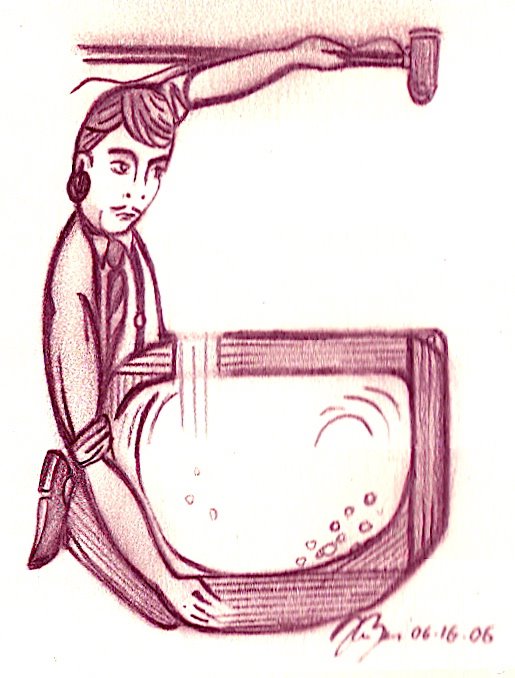
Then there are in radio dramatics those stirring noises of shots and sirens, crashing waves or smashed windows. There is the glass crasher, for example, which, as the name suggests, is a device used for creating the sound of breaking glass. G, in this entry in my old-time radio primer, does not stand for gadget or gimmick.

Sounds have a life beyond live support, beyond adding color or concrete markers of space, which merely enhance what is often already expressed in words: “Don’t you just love the ocean?” (biz: sound of waves); “Isn’t it romantic out here in under the stars?” (cue the crickets); “What are you pointing that gun at me for, you thug?” (insert shots here).

To appropriate another line of poetry (from Pope, this time), must sound seem an “echo to the sense”? Must it make sense? Must it be echoing something else? Does it always suggest a body, some certain corporeal entity responsible for such noise? Must sound be a relationship, a communicating passageway between one hearing and one sounding, traceable to an originating source which gives it meaning, as footsteps getting louder might mean “danger” if tracked down to the body of an approaching adversary or “the promise of pleasure” if traced to the form of a lover?

In other word, is sound an echo of the reverberating body producing it? The question, to be sure, is older than the wireless; it is as ancient as the atmosphere and the dark of night begetting such thoughts. Consider this exchange from Thomas Love Peacock’s Nightmare Abbey (1818), which investigates the relationship between (re)sonance and reception, between sounding and sounding out:

“Nonsense, sir,” interrupted Mr. Glowry. “That is not at all like the sound I heard.” 

“But, sir,” said Scythrop, “a key-hole may be so constructed as to act like an acoustic tube, and an acoustic tube, sir, will modify sound in a very remarkable manner. Consider the construction of the ear, and the nature and causes of sound. The external part of the ear is a cartilaginous funnel.” 

“It wo’n’t do, Scythrop. There is a girl concealed in this tower, and find her I will.”

Should I lead the ear to that concealed someone? Or will my play be all architecture, tower and bells, without a body in sight? We shall hear . . .

Listening to “The Thing That Cries in the Night”; (Chapter Nine): Destiny Is an Assigned Seat

Well, the scheduled power outage has been postponed due to regional flooding. I ought to be thankful, I guess, for one of the dreariest, wettest, and stormiest autumns ever to be weathered by the umbrella of a smile. Last night I was tolerably amused watching You’ll Find Out (1940), one of those star-studded Hollywood efforts whose chief purpose was to exploit and ostensibly promote the burgeoning radio industry by supplying listeners with images the mind’s eye could have very well done without. While the headliner of the movie, bandleader Kay Kyser, made my head ache with his bargain basement Harold Lloyd antics, the lavishly produced horror-comedy—co-starring Bela Lugosi, Peter Lorre, and Boris Karloff—nonetheless kept me in my seat.

You’ll Find Out makes much use of one of radio’s most intriguing technological novelties: the Sonovox. A patented sound effects device, the Sonovox could invest a trombone, a locomotive, or even a few raindrops (in short, anything capable of producing sound) with the power of human speech. Now, if only that deuced infant would speak up and let us know what it’s all about.

I am referring, of course, to the mysterious “Thing” in Carlton E. Morse’s I Love a Mystery serial “The Thing That Cries in the Night,” an old-time radio thriller I have been following for nearly two weeks now. On this day, 10 November, in 1949, the “Thing” made itself heard once again, announcing imminent death. When the Martin household’s peculiar baby alarm goes off tonight, another life is being claimed . . . the life of the prime suspect.

It is a thrilling twist in a story that, for two chapters, assumed the guise of a whodunit. In the previous installment, Job Martin, the heretofore good-natured drunk, was exposed as an ill-tempered cynic who showed little affection for his three tormented siblings. His youngest sister, Charity, promises to get a confession out of him, claiming that he was responsible for the murder of the Martin’s chauffeur. She urges Jack Packard, the man hired to investigate the mysterious goings-on, to round up all members of the household in the dining room.

Once they are assembled, Grandmother Martin insists on the observance of the family’s traditional seating arrangements. When the conference is just about to commence, the lights go out; yet no one has been within ten feet of the switch. The “Thing” begins to cry. It is not until the light is being turned on again that a gun goes off and Job is shot through the head.

This is the first murder committed in our presence. We are in the thick of it and, like the three members of the A-1 Detective Agency, left very much in the dark, despite the fact that the Martins and two of their hired investigators were standing right there in a brightly lit room when the shot was fired.

New questions arise: Was Job indeed the murderer of the Martin’s blackmailing hoodlum of a chauffeur? If so, he dodged the electric chair by taking that seat. Was he being silenced by one of his accomplices? If so, he must have been harboring a secret whose revelation is dangerous to another. Or is the “Thing” an otherwordly avenger of the sins committed in the house of Martin, a house doomed to fall?

Say, where were you when the lights went out?

A Soundscape of Britain?

Princess Diana Memorial Fountain,
Hyde Park, London

A few days ago I went to the Tate Gallery in London to see A Picture of Britain. This exhibition of paintings, coinciding with a BBC television series, did not exactly get rave reviews. Critics complained that the real Britain was, for the most part, left out of the picture. The works on display mainly feature idyllic representations of what Britain could be or ought to be, according to followers of the Picturesque or romantically inclined artists. In short, plenty of nature, little naturalism. I wonder how A Soundscape of Britain would turn out, if ever there were such a showcase devoted to national noise. What would be the representative sounds of Britain?

In the US, during radio’s so-called golden age, the Columbia Workshop and the later CBS Radio Workshop offered listeners aural snapshots and panoramas of New York, London, and Paris. “A Portrait of London,” for instance, which aired over CBS on 20 July 1956, took listeners to Big Ben, the city zoo, and Buckingham Palace, with Sarah Churchill (daughter of the former Prime Minister) serving as tour guide.

A few weeks earlier (7 July 1956), the Workshop had taken tuners-in to Paris, while “The Sounds of a Nation” (18 November 1956) sonically evoked the history of the United States. Some twenty years earlier, the Columbia Workshop had presented a “Broadway Evening” (25 July 1936), a noisy report from the bustling Big Apple. Other such programs include “Crosstown Manhattan” (8 December 1938) and Norman Corwin’s “New York: A Tapestry for Radio” (14 May 1944).

While more concerned with the spoken word than with the creation of collages in sound, Corwin conducted frequent experiments in bringing faraway places home to the radio audience with travelogue series like An American in England (1942) and Passport for Adams (1943), as well as the ambitious documentary One World Flight (1947), which consisted of interviews and recorded sounds from actual locations in Italy, India, and Australia.

Corwin’s travelogues did not simply revel in sound qua spectacle; they were propagandistic or didactic in nature, designed to glean messages from or impose meaning on bits and bites of sound. As Alexander Pope once put it, the “sound must seem an echo to the sense.” How, then, could one make sense of Britain through sound? What, besides the tolling of Big Ben, or the water gurgling in the Diana, Princess of Wales Memorial Fountain (pictured above), or the chirping of robins, or the roaring North Sea, or raindrops falling on hedgerows, might be A Soundscape of Britain?

Many years ago, visiting New York City for the first time, I walked through the streets of Manhattan to capture the sounds of the sirens, the pedestrians on the pavement, the honking of cars and the hollering of cabbies during rush hour. It gave me immense pleasure listening to these recordings back in the misery that was my home across the Atlantic. I could drown out the silence and loneliness in ways that a few pictures in my photo album could not accomplish. I have always loved wrapping myself in sound’s cape, escaping in sound . . .