
“… a companionable thing”: Catching up with Stanley Anderson

A “companionable thing.”  That is how the English painter-printmaker Stanley Anderson (1884 – 1966) summed up what “art” should be.  His work reflects this sentiment, even though much of it was produced in solitude – slowly and studiously.  Staging the exhibition, Unmaking the Modern: The Work of Stanley Anderson, I was glad to have had another chance of giving my contemporaries an opportunity to get acquainted with Anderson, who died on this day fifty years ago, and to have a conversation with him as he, through his work, continues to communicate his beliefs.
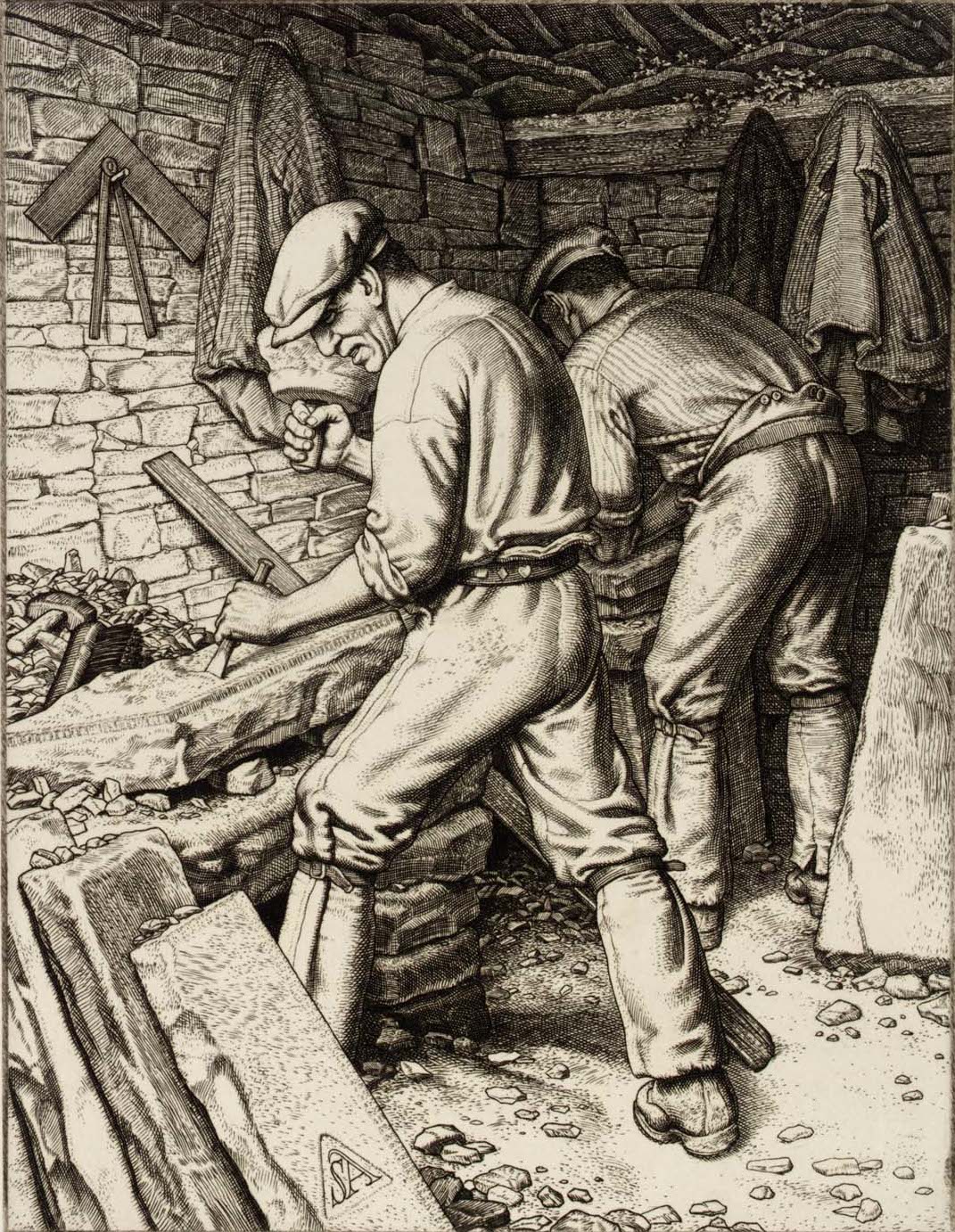
Stanley Anderson, Purbeck Quarrymen (1936), engraving

I say “another chance,” as I had previously co-curated an exhibition of Anderson’s prints at the Royal Academy in 2015 and, getting to know Anderson through his prints and correspondences, written about him with my better half, Robert Meyrick, a book that was released to coincide with that show.  Staging this second exhibition, Unmaking the Modern, a year later, I concentrated on Anderson’s efforts to bring about the conversation he hoped for – a conversation about the disregard for a generation of men like him who saw their lifetime commitment to traditions threatened by so-called progress.

Much of what Anderson chose to engage with and bring to our attention has disappeared: traditions gone and skills abandoned, rural communities destroyed and urban neighborhoods demolished, lives lost and often forgotten.  This may well evoke a sense of nostalgia.  But that nostalgia is ours, not Anderson’s.

Anderson did not refer to himself as an “artist” and rejected the idea that makers of cultural products should create such works for art’s sake or as a means of self-expression.  Making art, like doing any other meaningful work, was to him a social act – a “companionable thing.”

Anderson observed those changes as they took place: the demolition of buildings, the erection of shrines to profit and temples devoted to the exchange of money.  He responded concretely and in no uncertain terms to what he saw going on in his lifetime.  His works are not so much a lament as they are public outcries and displays of solidarity with those who, like him, where threatened by a demand for speed and expediency.

Objects of visual culture, especially prints, are a way of reaching out and fostering connections among individuals who share the values that are made manifest in arts and crafts.  Anderson’s works are the products and tokens of fellowship.  He took careful note of how others around him carried out their jobs of creating furniture, of working the land, and of serving the community.  He understood their labor and honored it with the work of his own hands.  Each print bespeaks a communion, a faithful, generous and sustained engagement with his subjects.

Anderson also looked at – and insisted on making us see – the forgotten men of his day: the homeless, the destitute and the aged.  He cast a light on individuals that society had turned into outcasts, misfits that could not or would not conform to the dramatic changes that progress demanded.
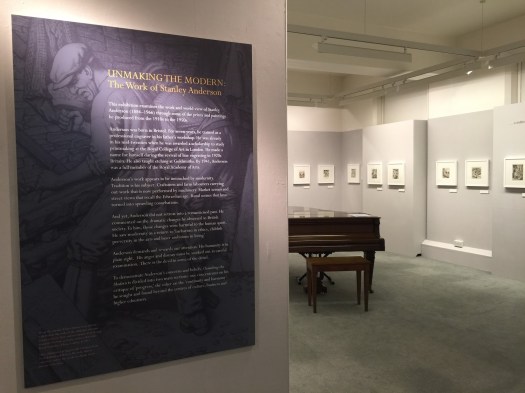
Installation view of the exhibition at the School of Art Museum & Galleries, Aberystwyth University

Anderson was not opposed to commerce; indeed, market scenes were among his favorite subjects.  Born in Bristol, he had trained for seven years as a professional engraver in his father’s workshop.  He was already in his mid-twenties when he was awarded a scholarship to study printmaking at the Royal College of Art in London.  Art – and the teaching of printmaking – were jobs to him.  Being a Royal Academician, meanwhile, was a privilege to him that came with the responsibility of making or promoting art that was not removed from the everyday but that brought people together and that got them looking at each other.

Long before Pop Art, Anderson bridged the divide between high and low culture that modernism had created.  He united what modernity insisted on separating: the heart and the hand.  This was a conscious decision, as his correspondence bears out, not a lack of awareness of Modernism.  After years of studying and using a variety of printmaking techniques, he returned to engraving, which he had long associated with trade. 

With those later engravings, he devoted himself to documenting the workaday activities of others – be they craftsmen or farmhands – who, like him, made a living from performing manual work for the benefit of others.  Making art, like performing any other meaningful work, was to Anderson a social act – a ‘companionable thing.’

Unmaking the Modern: The Work of Stanley Anderson was on show at the School of Art galleries, Aberystwyth University, Wales, from 1 February to 11 March 2016.  An online version is currently under construction.

The catalogue raisonné Stanley Anderson: Prints by Robert Meyrick and Harry Heuser was published in 2015.  Still online are a couple of short videos, produced for the Royal Academy exhibition An Abiding Standard, in which my husband and I talk about Anderson’s works and views.

For a comprehensive archive of Anderson’s prints, visit www.stanleyanderson.co.uk.

Stanley Anderson: An Abiding Standard

This is a speech I prepared for the private view of “Stanley Anderson: An Abiding Standard” at the Royal Academy of Arts in London on 24 February 2015. Mindful of the assembled party ready to mingle and enjoy the evening, I decided to cut my talk short. Here it is in its entirety.

Stanley Anderson’s move from London to Oxfordshire coincides with – and made happen – a body of work for which he is now best known: a series of thirty or so prints on the subject of traditional farming methods and rural trades. They are on view in the Council Room.

Anderson’s move to the countryside was not a retreat. Despite their nostalgic appeal, his works are not escapist. Like his London scenes, they engage with the here and now. His here and now.

Anderson’s prints do not glorify England’s past or gloss over what he perceived to be its problems. It took me a while to appreciate that. As someone interested in the 1930s and 1940s and the impact the Second World War had on civilian life, I was disappointed not to find any overt references to the conflict, any depictions of the homefront, or images of disabled soldiers. After all, Anderson himself lost his London studio during the Blitz.

But they are there, those references. Or at least, Anderson’s commentaries on the human condition are there.

It is telling that so many of the men whose activities – or inactivities – he portrays are old. Anderson himself was in his 50s and 60s when he created these line engravings. The young had gone to war or else were working in the factories. It was war that turned men into machines and that, like other crises before it, had thrown the fragility – or the speciousness – of modern civilization into relief.

Anderson said that, when he moved to the country, his ‘mind and feelings became clearer, more definite in their reactions.’ In the countryside, alive to the seasons, he ‘seemed immersed in a sense of stability’ that was ‘not static. He called it ‘a sort of ordered growth’. Ordered growth in the face of chaos. And what he set out to do in his prints was to remind others of what they were in danger of losing or forgetting: the traditions that, he feared, would die with the men – the friends, neighbours and fellow craftsmen – whose work he commemorated in his prints.

Anderson did not want to be called an “artist.” He did not consider self-expression to be the highest achievement or chief aim of visual culture. He saw himself as a craftsman in the medieval tradition.

He aligned himself with anyone who derived his living – and his satisfaction – from the work produced with his or her own hands, just as Anderson did (with the support of his wife Lilian, a trained nurse).

Trade was not a dirty word for Anderson; nor did he mind getting his hands dirty. He not only related to his working men subjects – menial labourers and skilled craftsmen alike –he befriended these men, at a time when England turned its back on their traditions and forced the hand of many who were pushed into assembly line work or else were made to operate the machinery of war.

Moving to the countryside was not a getting away from mankind but a getting closer to his fellow man. Anderson called fellowship the ‘only currency’ that truly mattered. The ‘pleasure and interest’ of others in his work was what he deemed ‘ample repayment for all [his] labours.’

The hours he spent creating these prints were a time of contemplation; he abhorred speed and distrusted work produced quickly and, he believed, thoughtlessly. His works are spiritual, and the Zeitgeist they capture is that of an age in which spirituality was fast disappearing.

Anderson did not work or live fast. As [co-curator Robert [Meyrick] said, he spent seven years as an apprentice in his father’s engraving workshop, an experience on which he would draw and which he would not regret. His career is a continuum that anyone banking on instant fame might find hard to comprehend. His aim was to live by an abiding standard and his career was the reward of biding his time.

‘My life has been a quiet, studious one,’ the sixty-year-old Stanley Anderson told an American friend who wanted to write a biographical essay on him. There had been ‘no exciting experiences immorally, no amazing lights and shades, no boisterous contretemps; just a steady, sustained effort to express clearly and as well as my ability will allow, that note, in the main, I feel so deeply in life and nature – the plaintive note […].’

‘I often wonder, Anderson added, ‘if this is the reason I crave the friendship of sympathetic folk; why I feel that the arts are a social, or sociable act; why I abhor the bigotry, the insufficiency of self, and fear the exclusiveness of ‘success.’

Before we continue enjoying the ‘sociable act’ of this private view, I would like to express my gratitude to the man to whom everyone seeing this exhibition is indebted: to Stanley Anderson himself.

Anderson reminded me, again and again, how rewarding – how necessary – it is to keep at it, to keep looking, beyond the first glance in the search for novelty or the reassuring instance of recognition.

“In all matters of execution his work is highly disciplined,” a 1932 review in the London Times declared “and, if he seldom thrills you, he never lets you down.” If by thrill we mean the quickening pulse in response to the flashy and sensational, then the reviewer was certainly right. But there are thrills in Anderson’s work that are the rewards of anyone who keeps looking: discoveries of social commentaries – cultural references and sly observations – in which Anderson’s prints are rich.

We have not provided object labels for each of the 90 or so works on display here because we want to encourage you to look for yourselves without being told what to see. Anderson will tell you much about his attitudes toward modernity – and toward modernism – in these prints. These are not works that are open to a myriad of individual interpretations. His intentions become clear, his message, which often appears in fine print – in signs, fictional newspaper headlines and literary allusions – is consistent. His prints are essays on modern life and traditional labour, for the appreciation of which every line counts. So, stay a while …. and keep on looking.

“Stanley Anderson: An Abiding Standard” is on at the Royal Academy of Arts, London, from 25 February to 24 May 2015.