
“By the magic of the radio.” Suitably charming if by then well-worn, the phrase served as the opening of a public address by the thirty-first president of the United States, Herbert Hoover. Broadcast from the White House on this day, 12 February, in 1931, and occasioned by the birthday of Abraham Lincoln, the message conveyed in the speech that followed was decidedly less magical than the purported medium of enchantment by way of which it was delivered.
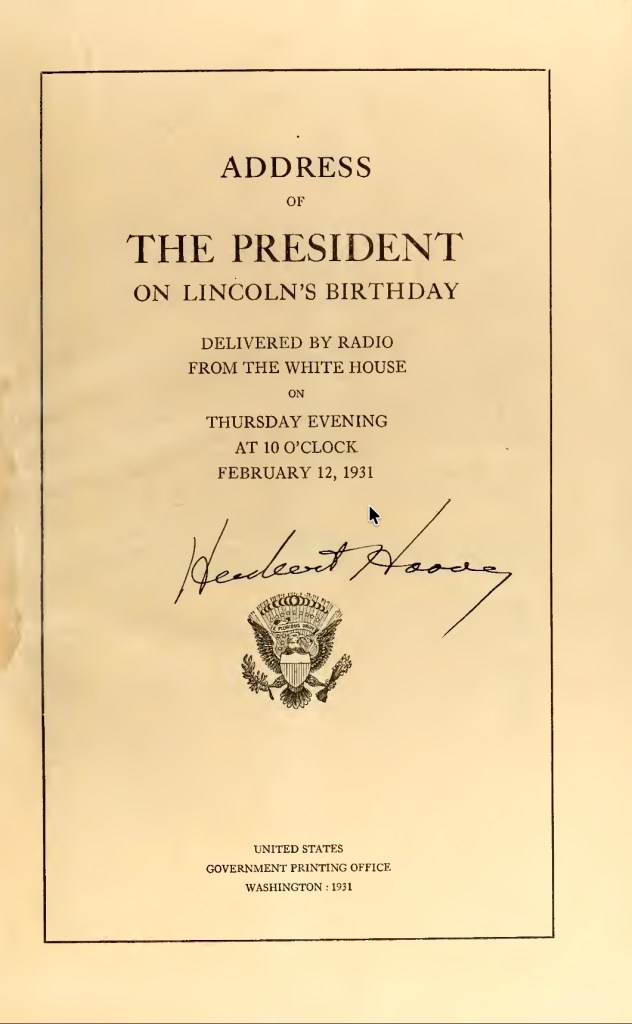
In lieu of a recording, the script published by US Government Printing Office serves as a reminder of Hoover’s inability to respond with understanding to the needs—and the mood—of the multitudes who tuned in to hear his words. And while its initial reception is now difficult to gauge, the broadcast no doubt contributed to Hoover’s defeat the following year, on 8 November, when Franklin D. Roosevelt won the popular and electoral vote, carrying forty-two states.
FDR came to be known as “the radio president.” His predecessor, however, had already made ample use of the medium, especially after the establishment of national chains—NBC in 1926 and CBS in 1927—significantly increased the possibility of reaching millions of US Americans instantly and simultaneously in their homes.
Just days after Hoover’s radio address on Lincoln’s Birthday in 1931, for instance, his administration launched a “drive against illiteracy in the United States” in cooperation with the Columbia Broadcasting System.
There was little evidence of Hoover’s ability to read the room, however, as his voice passed through the four walls in which so-called members of the far from homogenous public sat alone or in intimate circles to learn about his response to the economic crisis that had left so many of them floundering.
Continue reading “Live from the Lincoln Bedroom: Herbert Hoover Cautions Depression-Stricken Radio Listeners Against the “opiates of government charity”” Harry Heuser