
NBC, CBS, and Abe

On the eve of the 200th anniversary of Abraham Lincoln’s birth, I am once again lending an ear to the Great Emancipator. Franklin Delano Roosevelt may have been America’s “radio president”; but in the theater of the mind none among the heads of the States was heard talking more often than Honest Abe. On Friday, 12 February 1937, for instance, at least six nationwide broadcasts were dedicated to Lincoln and his legacy. NBC aired the Radio Guild‘s premiere of a biographical play titled “This Was a Man,” featuring four characters and a “negro chorus.” Heard over the same network was “Lincoln Goes to College,” a recreation of an 1858 debate between Lincoln and Democratic senator Stephen A. Douglas. Try pitching that piece of prime-time drama to network executives nowadays.

Following the Lincoln-Douglas debate was a speech by 1936 presidential candidate Alf Landon, live from the Annual Lincoln Day dinner of the National Republican Club in New York. Meanwhile, CBS was offering talks by Lincoln biographer Ida Tarbell and Glenn Frank, former president of the University of Wisconsin. From Lincoln’s tomb in Springfield, Illinois, the Gettysburg Address was being recited by a war veteran who was privileged to have heard the original speech back in 1863. Not only live and current, the Whitmanesque wireless also kept listeners alive to the past.

Most closely associated with portrayals of Lincoln on American radio is the voice of Raymond Massey, who thrice took on the role in Cavalcade of America presentations of Carl Sandburg’s Abraham Lincoln: The War Years; but more frequently cast was character actor Frank McGlynn.

According to the 14 June 1941 issue of Radio Guide, Lincoln “pop[ped] up” in Lux Radio Theater productions “on the average of seven times each year”; and, in order to “keep the martyred President’s voice sounding the same,” producers always assigned McGlynn the part he had inhabited in numerous motion pictures ever since the silent era. In the CBS serial Honest Abe, it was Ray Middleton who addressed the audience with the words: “My name is Abraham Lincoln, usually shortened to just Abe Lincoln.” The program ran for an entire year (1940-41).

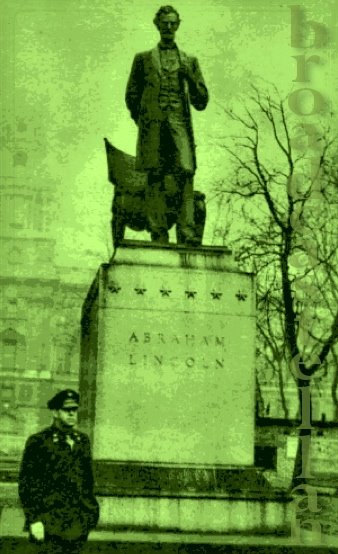
The long and short of it is that, be it in eulogies, musical variety, or drama, Lincoln was given plenty of airtime on national radio, an institution whose personalities paid homage by visiting memorials erected in his honor (like the London one, next to which singer Morton Downey poses above). Nor were the producers of weekly programs whose broadcast dates did not coincide with the anniversary amiss in acknowledging the nation’s debt to the “Captain.” On Sunday, 11 February 1945—celebrated as “Race Relations Sunday”—Canada Lee was heard in a New World A-Coming adaptation of John Washington’s They Knew Lincoln, “They” being the black contemporaries who made an impression on young Abe and influenced his politics. Among them, William de Fleurville.

“Yes,” Lee related,

in Billy’s barbershop, Lincoln learned all about Haiti.  And one of the things he did when he got to the White House was to have a bill passed recognizing the independence of Haiti.  And he did more than that, too.  Lincoln received the first colored ambassador to the United States, the ambassador from the island home of Billy the Barber.  And he was accorded all the honors given to any great diplomat in the Capitol of the United States.  Yes, the people of Harmony have no doubt that Billy’s friendship with ole Abe had more than a lot to do with it.

Six years later, in 1951, Tallulah Bankhead concluded the frivolities of her weekly Big Show broadcast on NBC with a moving recital of Lincoln’s letter to Mrs. Bixby. That same day, The Eternal Light, which aired on NBC under the auspices of the Jewish Theological Seminary of America, presented “The Lincoln Highway.” Drawing on poet-biographer Sandburg’s “complete” works, it created in words and music the “living arterial highway moving across state lines from coast to coast to the murmur ‘Be good to each other, sisters. Don’t fight, brothers.’”

Once, the American networks were an extension of that “Highway,” however scarce the minority voices in what they carried. Four score and seven years ago broadcasting got underway in earnest when one of the oldest stations, WGY, Schenectady, went on the air; but what remains now of the venerable institution of radio is in a serious state of neglect. An expanse of billboards, a field of battles lost, the landscape through which it winds is a vast dust bowl of deregulation uniformity.

Related recording
“They Knew Lincoln,” New World A-Coming (11 Feb. 1945)
Toward the close of this Big Show broadcast, Bankhead recites Lincoln’s letter to Mrs. Bixby (11 Feb. 1951)
“Lincoln Highway,” The Eternal Light (11 February 1951)
My Tallulah salute

Related writings
“Spotting ‘The Mole on Lincoln’s Cheek'”
”Langston Hughes, Destination Freedom, . . .”
A Mind for Biography: Norman Corwin, ‘Ann Rutledge,’ and . . .”
”Carl Sandburg Talks (to) the People”
“The Wannsee Konferenz Maps Out the Final Solution” (on the Eternal Lightproduction of “Battle of the Warsaw Ghetto”)

I Was a Communist for Tallulah Bankhead

Memento Park, Budapest

Radio has always promoted other media, despite the competition it faced from print and screen. To some degree, this led to its decline as a dramatic medium. Producers made eyes at the pictures, neglecting to develop techniques that would ensure radio’s future as a viable alternative to visual storytelling. Television had been around the corner virtually from the beginnings of broadcasting; even in the 1920s, radio insiders were expecting its advent. So, the old wireless was often seen as little more than a placeholder for television, an interim tool for advertisers eagerly awaiting the day on which they no longer had to spell out what they could show to the crowd.

One of the last big hurrahs of radio during the early 1950s was The Big Show, a variety program hosted by actress Tallulah Bankhead (last revisited here). Sure, Bankhead promoted the movies—but on this day, 29 April, in 1951, she doubtlessly had something else in mind when she expressed herself “privileged to hear a portion of a truly great new Warner Bros. picture, starring Frank Lovejoy.”

According to Joel Lobenthal’s biography of the actress, Bankhead had a “phobia about communism,” largely owing to her Catholic upbringing. Yet, as George Baxt, a theatrical agent involved in booking talent for the program, tells it in The Tallulah Bankhead Murder Case, a mystery set during those Big Show nights, her show struggled as a result of this anxiety and the forms it took.

Not Bankhead’s anxieties—the measures taken by fierce anti-Communists to blacklist (or at least graylist) allegedly subversive players. By the early 1950s, even comedienne Judy Holliday was considered suspicious, which did not stop Bankhead from welcoming her on the Big Show on several occasions.

By playing a scene from a soon-to-be-released spy thriller titled I Was a Communist for the FBI, Bankhead fought for the life of the Big Show, now that even she, the fierce anti-Communist, had come under attack. As Bankhead pointed out, I Was a Communist was a dramatization of the Saturday Evening Post stories based on experience of counterspy Matt Cvetic, whom Lovejoy “deem[ed] it an honor” to portray.

“It certainly brought home to me the patriotic devotion and the sheer guts that Matt needed to take that nine-year beating.” At this point, a voice is heard, off-mike, telling Lovejoy that “someone had to do it.” That someone, speaking to the listening audience, was none other than Matt Cvetic:

Well, Frank, maybe we’d better wait until the job is done before we start taking bows.  The job is far from finished.  We’re just beginning to fight back against the deadly, ruthless, highly organized Soviet-controlled conspiracy.  So, we’ve got a lot of fighting yet to do before we can rid ourselves of this greatest threat to the world of free men.  We’ve got to fight.  All of us.  All the time.

“Amen to that,” Bankhead responded enthusiastically as the crowd in the studio applauded. Threatened by the blacklisters and the menace of television, Ms. Bankhead knew she had to fight—for the good of the country and the good of her show. The Big Show went off the air a year later, just as the aforementioned radio version of I Was a Communist began its syndicated run . . .

Songs, Lies, and Audiotape: Margaret Truman Daniel (1924-2008) on the Air

Having just learned of the passing of Margaret Truman Daniel, the former US President’s only daughter, I am going to conjure up her voice by listening to some of the radio programs on which she was featured. Truman made her broadcasting debut in Detroit, back in 1947; she started out as a pianist, then turned to singing.

Fade to black: Margaret Truman Daniel

To most Americans, of course, she was, first and foremost, the First Daughter. Could she pull off a career on the strength of her vocal chords, people wondered, or was it all a matter of pulled strings? Fully aware of this debate, Truman was often in on the joke, an act that made her a welcome guest on what, in the early 1950s, was the biggest show on radio. Tallulah Bankhead’s Big Show.

On 3 December 1950, Truman faced the acerbic Bankhead for the first time. “I suppose you’re all a-wondering how we were able to get such a prominent personage as Miss Truman to be guest on our program,” quipped the celebrated hostess. “Well, really, all it took was a telephone call. I called a certain party, and that party called another party, who in turn called another party. Uh, naturally, these were all democratic parties.”

On the same broadcast, Truman was also confronted with Fred Allen. Sharing the microphone with the seasoned if semi-retired radio wit proved quite a challenge for the still inexperienced Truman.

Truman. How do you do, Mr. Allen?

Allen. Well, how do you do? It’s certainly a pleasure. But, please, don’t call me Mr. Allen. Call me by my given name.

Truman (imitating Bankhead). All right, Daaahling!

Bankhead. This girl has the makings of a Milton Berle.

Truman. Fred, I’ve been an admirer of your radio program for a long time.

Allen. Well, thank you. But where were you when my option came up back there in 1948?

Truman. In 1948, we were busy with an option problem ourselves.

Allen. Yes, but that option was renewed for another four years. You were lucky you didn’t have a quiz show running against you. And, by the way, Miss Truman, I’m surprised you don’t have a radio program of your own.

Truman. Oh, I can’t do anything well enough to have my own program.

Allen. Oh, on radio that’s no handicap.

When Allen insists that Truman ought to have her own variety program, Bankhead feels threatened:

Allen. Say, uh, this might be an idea, Margaret. Now, how about doing a big variety show, about an hour and a half program, and get the biggest names in show business. Why, you could be the mistress of ceremonies.

Bankhead. Just a moment! That’s my program. I don’t mind standing here without any lines, but I simply refuse to stand here without a program.

Truman. Oh, don’t worry, Tallulah. I wouldn’t dream of doing a program like that.

Bankhead (at her huskiest). And why not, Daaahling?

Truman. Well, I don’t think I’m old enough.

Bankhead. Whaaaaaaat!

Three months later, on 4 March 1951, recent Time magazine cover girl Truman was back on the Big Show. “Aren’t you Charlie’s Aunt,” Allen’s wife and sidekick Portland Hoffa inquired, mistaking Truman for the sister of Britain’s reigning monarch. “Love Is Where You Find It,” Truman trills after a confrontation with Ethel Merman, then learns about the harmonica from Herb Shriner.

“I’m an actress now,” Truman declared upon her return to the Big Show on 6 May 1951. A week earlier, she had played opposite James Stewart in a Screen Directors Playhouse production of Jackpot (26 April 1951), a satire on the excesses of commercial radio. Bankhead condescended to give Truman the title role in “Advice to the Little Peyton Girl,” a dramatic sketch based on a story by Dorothy Parker. Yet the emphasis was decidedly on the “Advice” and the one proffering it, not on the “Girl”; as the young woman’s “older, wiser, and oh-so-understanding confidante,” Bankhead devoured the scene.

Sharing the microphone with experienced performers, Truman was not so much propped up as shown up by them. The following year, for instance, the successful recording artist was called upon to sing opposite Gordon MacRae on the Railroad Hour in the operetta “Sari” (17 March 1952), an adaptation of Noel Coward’s Bitter Sweet. The words “Pretty boys, witty boys, you may sneer” come to mind. Perhaps, Truman, or Bankhead’s script writers, had been right. She did not quite have it in her to be a radio personality. Guesting five times on the Big Show, however, she proved herself a genial team player.

Being shown up by your hostess is bad enough; worse still is when you are the hostess and the guests don’t show up. This misfortune befell Truman on the premiere of her next radio venture. Along with Mike Wallace, the gal from Missouri was to host Weekday, a six-hour, five-day-a-week daytime variety program also starring Martha Scott and Walter Kiernan. Imitating the successful Monitor, Weekday promised drama, music, and chat.

On the opening program, back in 1955, Truman announced Eddie Fisher, her “star companion” for the day. “Hi Eddie!” she opened; but Fisher did not respond. As Slate and Cook recall in It Sounds Impossible (1963), the chats were partially recorded. That is, Truman did not get to talk to her guests, but was expected to simulate her scripted interviews, with the control room feeding her a recorded voice, an experimental technique called “‘stop-start’ taping.” Eddie was not stuck up; he was just a tape getting stuck.

Such difficulties notwithstanding, Truman stuck with the show until 1956, picking up a regular television assignment nearly a decade later. She may not have hit the Jackpot, but she maintained her media presence long after her father and his party had been voted out of office.

Anything They Can Do . . . to Make You Feel Better

Well, leave it to a couple of old troupers to make me feel a little less sorry for myself. This New Year’s cold is making me feel miserable, cranky, and just about as fresh as a Jackie Mason standup routine. As those subjected to my groanings and whinings will only be too glad to corroborate, I am not one to suffer in silence. Mind you, I groan and whine even without an audience, of which I was deprived this afternoon (save for our terrier, Montague, who showed no signs of interest, let alone compassion). I reckon those noises serve chiefly as a reminder to myself that I am still numbering among the living.

On days like this, when the food tastes stale, I resort to a few extra doses of comfort culture. I seem to derive the greatest pleasure watching or listening to the old. Exposure to youth, in those moments of premature decrepitude, seems rather too cruel to endure.

After a reassuring hour or so with The Golden Girls, I needed to give my burning peepers a rest; so, I quickly went through my old-time radio log and came across this episode of the Big Show, originally aired on this day, 7 January, in 1951. Among Ms. Bankhead’s guests were Fred Allen, joking about his retirement and health problems, Edward G. Robinson, who was heard in a digest of Cornell Woolrich’s After Dinner Story and lamenting years of typecasting, as well as the fabulous Marlene Dietrich, with whose Scarlet Empress I caught up last month at the Museum of Modern Art in New York (a few days ago, I reencountered her in Stage Fright). Now, Dietrich was even older than the hostess of the Big Show—and Bankhead and her team of writers did not let her forget it for a minute.

Marlene, in turn, was permitted to mock Tallulah’s age-imposed invisibility (“I hear so little about you since you have hidden yourself away in radio”) while rubbing it in that she had just been interviewed by the Woman’s Home Companion. “Are they changing the name to Old Woman’s Home Companion?” Bankhead retorted. “Now let’s face it, darling,” she went on to tear at Dietrich’s glamorous persona, “false eyelashes, mascara, powder, rouge, lipstick . . .” “Yes, darling,” Dietrich purred, “but the rest of it is all me.”

“Let’s stop pretending and tell the truth,” Dietrich declared.

There’s no use denying it. I am not quite as young as I used to be. Everybody knows that I am a mother, and now I’m a grandmother. The silly idea women have that they must lie about their age is ridiculous. I don’t care if everybody knows how old I am.

Upon which Dietrich admits to 32 and Bankhead to 31. That cleared up, Dietrich (who performs such “miracles in numbers”) is invited to sing “Falling in Love Again” . . . “just the way [she] sang it 35 years ago,” before she was born.

Culminating in a rendition of “Anything You Can Do,” the Bankhead-Dietrich face-off is another exercise in self-effacement, which quickly became the trademark of The Big Show. Just the kind of kick in the old pants I needed . . .

All About Tallulah! (Never Mind “Wardrobe, make-up, or hair”)

Well, Tallulah Hallelujah! How could I pass up the chance to pass on this anniversary double treat? On this day, 16 November, in 1950, Tallulah Bankhead grabbed the microphone to entertain the multitude, first in a recreation of her role in Alfred Hitchcock’s Lifeboat. Two year later, she was heard in the part that might have gone to Claudette Colbert (had she not given her all to make sure that Three Came Home) but is now almost exclusively thought of as belonging to Bette Davis: All About Eve (previously discussed here in its pre-filmic radio version). When I featured clips from these performances in first adventure in podcasting, I was unaware that both “Lifeboat” and “All About Eve” were broadcast on the same day, two years apart.

Now, la Bankhead is more often thought of as a legend than an actress; that is, she is foremost a star, and only secondarily a performer. We generally do not have access to the stage appearances of Hollywood stars of the studio era, a couple of stills and reviews aside. Radio theatricals, however, can give us an inkling of those ephemeral performances. So, once again, I am conjuring up the Tallulah spirit, as I did when last I placed her image on my Quija board.

Bankhead’s performance in the Screen Directors Playhouse production of “Lifeboat,” broadcast on this day, 16 November, in 1950, serves to remind us how good an actress an icon can be. As an uncommonly humble Alfred Hitchcock tells the audience in the introduction to the play,

. . . I think you should know that Lifeboat is not what we call a director’s picture.  There are no trick sets, no camera tricks, in fact, no tricks at all.  When the director approaches such a picture, he offers up a little prayer and delivers himself wholly into the hands of his actors.  Since they are very good actors, the result is just as you should hear it now.

Indeed, the production is very fine, with Bankhead serving as narratrix of her character’s experience aboard that ill-fated vessel. That time around, there were no calls for “Wardrobe, make-up, or hair,” no matter how many times the eccentric star uncrossed her legs.

The Theater Guild adaptation of “All About Eve” was more in keeping with the Bankhead persona in those Big Show days. “Thank you, Mr. Brokenshire,” Bankhead seizes the microphone from her announcer,

and good evening, darlings.  The play we are performing for you this evening on Theater Guild on the Air is called—and I never could understand why— All About Eve.  All About Eve.  True, there is an Eve in it, and what a part that is.  There is also a glamorous and brilliant leading lady of the theatre whose true identity has been kept a secret too long.  Tonight, darlings, tonight baby intends to do something about that.

What a bumpy night it turned out to be. Those two years sure made a difference. You might say, that the campy “Eve” is an extension of or promotional vehicle for the Big Show and the Tallulah image in general. Character had given way for caricature.

How odd it is that such camp is so personal to me; and yet, when I think of Bankhead, I am inevitably reminded of my years in New York City. Sitting in my favorite local park by the East River while preparing for my dissertation on radio drama by listening to a few programs (oh, the hardship a doctoral candidate has to endure), I got to talk to a fellow sun worshipper who, learning about my uncommon soundtrack, asked whether I had come across the name of Florence Robinson, who was an old friend of his. No, I could not say I had; but I soon discovered that Robinson had been Tallulah’s co-star in “All About Eve.”

Just about that time, in those early days of the 21st century, I got to see the Tallulah Hallelujah! starring Tovah Feldshuh in the title role (no, not Hallelujah). A few years later I became friends with the “producing associate” of the show. So, listening to Bankhead, however outré or larger than life she might sound, triggers many a personal memory.

Then again, listening is always personal, as sounds pass the threshold of my ears, entering my body in a way images never could, and keep reverberating in my mind. While no longer surprised, I am still disappointed when I flick through biographies like the one by Joel Lobenthal I am clutching above, accounts of an actor’s life that make so little of their roles on radio and the role radio played during the 1930s, ’40s, and ’50s.

Sure, the The Big Show was not being ignored (even though George Baxt, who novelized Bankhead’s broadcasting experience in the volume shown here, barely gets a mention). Beyond that, though, Bankhead’s “many radio appearances” are summed up as involving “acting in sketches or trading patter with Hildegarde, Fred Allen, Kate Smith, and others.”

Given that recordings are now so readily available, the general disregard for the medium, expressing itself in a line like “[r]adio was Tallulah’s only medium for the next six months,” becomes an intolerable distortion of American popular culture. I wish more attention was being paid to the cultural force of the old wireless, a wish that, aside from all the nonsense and dross you might expect here, is the raison d’être of broadcastellan.

“Isn’t she nice?”: Laraine Day (1913-2007) on the Air

Well, the first thing I thought of when I heard about the passing of screen actress Laraine Day on 10 November 2007 was this remark by Alfred Hitchcock, who directed her in Foreign Correspondent (1940): “I would have liked to have a bigger star.” He could not have been faced with a brighter one. Best known in the 1940s for her recurring role of nurse Mary Lamont in a series of Dr. Kildare movies, Day (seen left in a picture taken from my copy of the 3-9 January 1942 issue of Movie-Radio Guide) was as bright as her name suggested. There seemed to be no edge from which to push to her into more ambitious performances. She was just so darn nice . . . at least until she was forced to give back that pretty Locket.

In The Locket (1946), Day’s cheerful personality is being cleverly exploited to make audiences wonder whether her character, Nancy, is really as charming and uncomplicated as she seems. “She is nice,” a woman attending Nancy’s wedding observes. “She’s lucky,” another guest replies. “If you’re nice, you have to be lucky,” the first one counters, only to be dealt with the riposte that “[i]f you’re lucky, you can afford to be nice.”

Nancy can afford to be nice, however little happiness being a good girl managed to get her as a child; but is she just Mrs. Lucky to have landed such a well-to-do husband, or has her not being quite so nice something to do with it? The Locket, in which Day stars opposite Robert Mitchum, Brian Aherne, and Gene Raymond, is Hitchcock’s Marnie without the sex angle. It is a dark, labyrinthine thriller that casts welcome shadows on the brightness of Ms. Day.

Before making her frequent US television appearances, hosting her own program, Daydreaming with Laraine (1951), and starring in a number of Lux Video Theater productions, Day was heard on the Lux Radio Theater in recreations of her screen roles in Mr. Lucky (1943) and Bride by Mistake (1944). She was also cast in a number of original radio plays produced by the Cavalcade of America (such as in “The Camels Are Coming,” opposite her Foreign Correspondent co-star Joel McCrea).

On Biography in Sound, Day let listeners in on the home life of her husband, Brooklyn Dodgers manager Leo Durocher, with whom she also appeared on Tallulah Bankhead’s Big Show (4 February 1951), in which Day’s clean image was contrasted with that of her irascible husband:

Bankhead: Well, I must say, Laraine, that being the wife of a stormy baseball manager doesn’t seem to have changed you very much.  You still have that fresh, lovely, scrubbed look.

Day: Why shouldn’t I look scrubbed? Every time we have an argument, Leo sends me to the showers.

Considering that Day’s projected identity resembles an ad for toilet soap, it is not surprising that she made several return visits to the Lux Radio Theater. Introduced as “ever lovely” by Mr. DeMille, Day enjoyed a rather more interesting vehicle than her own comedies in the mystery “The Unguarded Hour” (4 December 1944).

In that adaptation for radio (of a movie based on a stage drama that itself was an adaptation), Day plays a valiant wife who tries to protect her husband from a scandal of which he is unaware. His words, uttered by co-star Robert Montgomery, capture what is the Laraine Day persona:

How do you think I came to worship you? Because you’re so pretty? Because you win large silver cups jumping horses or play good bridge? No, darling.  You have what’s called quality.  It’s kindness, it’s generosity, that makes all the rest of us feel just a little shoddy.

On This Day in 1950: Chain-smoking Belle Gives Radio Mouth-to-Mouth

Well, let’s get out the matches. It’s time for some festive display of pyrotechnics. No, I am not responding to the news that Saddam Hussein has been sentenced to death for crimes against humanity. It is Guy Fawkes Day here in Britain, celebrated with rockets and bonfires lit in commemoration of a rather more decisive victory against terrorism than could be claimed in the Middle East: the foiling of a plot to blow up the Houses of Parliament in London back in 1605. “Remember, remember, the Fifth of November”:

Burn him in a tub of tar.
Burn him like a blazing star.
Burn his body from his head.
Then we’ll say ol’ Pope is dead.

As such inflammatory (and subsequently watered-down) rhymes suggest, this all occurred long before Islam came to define what many now so closely associate with terrorism. Then again, organized religion is never far from terror—and often the foundation or instrument, the cinder heap and match of it.

While no radical symbolism was intended, Guy Fawkes Day also marks the second anniversary of my move from the United States to Wales, which, in a symbolic act fully premeditated, was scheduled to coincide with the 2004 presidential election in the US: a leave-taking on a note of triumph or, as it turned out, a sorrowful singeing of bridges. But these political and personal anniversaries are rather beyond the scope of the broadcastellan journal, which breaks its never-on-a-Sunday tradition to salute a firecracker of a Southern Belle who knew how to make a display of herself, simply by lighting another Craven A, her cigarette of choice.

I have already cheered the tar-pitched voice of Tallulah Bankhead in my first podcast, a salute that was promptly answered by what struck me as a nod from the lady herself (as shared in the concluding paragraph of this entry); but another toast is quite in order, since it was on this day in 1950 that Ms. Bankhead made radio history with her debut as mistress of ceremonies for The Big Show, an unseen spectacular of unheard of proportions.

NBC’s Big Show was US broadcasting’s last major investment in aural entertainment. It was also an admission and a compromise: an admission that Americans did no longer take radio seriously enough to sit down for a longer piece of audio theater, and a compromise in the form of a ninety-minute variety program delivering songs, gags, and snippets of drama.

The inaugural broadcast featured old pros like Jimmy Durante and Ethel Merman, as well as newcomers including Danny Thomas and Jose Ferrer (in a scene from Cyrano de Bergerac). Also on mike for this premiere were semi-retired radio comedian Fred Allen, character actor Paul Lukas, and recording artist Frankie Laine. It was musical-variety gone hit-parading: a quick succession of acts introduced by an engaging and radiogenic personality.

This Sunday Night Live spectacular was well received by critic and audiences alike, even though it proved ultimately too extravagant to be at once effective in cost and consistent in quality in an age when money and talent were being siphoned into television, the new everyman’s home theater.

Short-sidedness aside, I don’t see why a variety program like The Big Show could not work on radio nowadays as something you tune in on a long journey or a dull evening to be turned on by contemporary singers, stand-up comedians, and a gaggle of celebrities promoting their latest movies, albums, or books.

Of course, there is no one to take the place of the hot-tempered Ms. Bankhead, a seasoned siren who, aware of the futility, the profligate waste of starting over—Tallulah rasa, as it were—managed to make use of an outmoded medium that allowed her to draw on a life in the limelight while keeping her out of it in prominent invisibility; to send her image up in smoke while firing barbs at the luminaries around her; and to become a breath of fresh air while all along indulging in the excesses of a malignant and much maligned habit.

So, if you got a match to spare, why not dim the lights, listen to the fabulous Tallulah, and spark up a candle (or a cigarette) in her honor!

Wireless Women, Clueless Men: Mary Margaret McBride, Commercial Correspondent

There is a plaque at last on Weymouth House, erstwhile London residence of Edward R. Murrow. I’m not sure how much it is owing to Good Night, and Good Luck. (which I have not yet seen); but this recognition was long overdue. They are all over London, those blue signs, telling passers-by of the notables who once lived, worked and made history behind otherwise nondescript façades. Looking up at them makes me feel that I am walking among those who made a name for themselves—or, if the name fails to ring a bell, plain ignorant. What’s in a name? Well, you could look it up, for starters.

Being that I am in the middle of a series devoted to “Wireless Women,” I shall let that plaque speak for itself and switch from the celebrated Ed “This . . . is London” Murrow to one of his most popular if now less well remembered female colleagues: Mary Margaret McBride (seen above in a picture that appeared in the premier issue of Tune In magazine, March 1943).

Born in Missouri (and her voice will tell you as much), McBride began her broadcasting career at station WOR, New York, in 1934, playing the fictitious “Martha Deane,” dispenser of household hints. A few years later, she signed a contract with CBS and was heard thrice weekly interviewing noted contemporaries, writers, actors, and politicians. While few recordings of McBride’s talks are available online, a tantalizing clip from one of her programs is interspersed in this NPR interview with McBride biographer Susan Ware.

McBride is chatting with brazen Tallulah Bankhead, who manages to break a broadcasting rule while politely inquiring about it:

Bankhead: “I can’t say, uh, ‘hell’ on radio, can I?”
McBride: “No.”
Bankhead: “Well, excuse me.”

Not that interviewer McBride was starchy or self-conscious. Indeed, she succeeded in making acceptable what, to the ears of many, listeners and journalists alike, was radio’s dirtiest kind of talk: commercials. Shrewdly enterprising, she was not above promoting the wares of the sponsors. She even turned her audience into advertisers, reading letters she received from loyal tuners-in who had tried the products she endorsed during her talks.

Apart from reaching millions of Americans with her broadcasts, McBride also exerted influence on the younger generation with proto-feminist novels like Tune In for Elizabeth (1945). Subtitled “Career Story of a Radio Interviewer,” Tune In is McBride’s commentary on—and vindication of—her own profession, packaged as a piece of juvenile fiction.

Within the framework of her story, McBride offers advice and encouragement to those who, like everyday heroine Elizabeth Cary, are trying to break into radio without having to churn out serial romances (a career suggested to her by a female colleague): “World War II, it seemed, had cracked completely the walls of the Fourth Estate where women were concerned.”

The title character is one of those aspiring young women who pushed her way through the temporarily loosened patriarchal brickwork at a time when executive doors were still reserved for her male counterparts, too few of whom had gotten, let alone accepted, McBride’s message.

Elizabeth moves from Glendale, Illinois, to New York City in order to pursue a career in journalism. Family connections in the newspaper business notwithstanding, she finds herself drawn to the world of broadcasting; her inspiration is radio interviewer Janet Adams, a fictional stand-in for McBride. Rather than imitating her idol, who started out writing for the papers, Elizabeth is eager to venture straight into radio:

The times—and especially radio—are moving too fast for that. I think a new technique is developing in radio itself. I think that people like Janet Adams are its pioneers

Working for Adams, Elizabeth is impressed how seriously the interviewer is taking her job; she becomes convinced that broadcasting can be an honest business, run with dignity and integrity—despite the commercials that Adams is contractually obligated to read on the air:

[Elizabeth] had thought of commercials as necessary evils, watching the announcer check off the list of products, everything from tea to toffee, as Miss Adams said a few words about each in the course of her broadcast. She had heard from her mother and other sources that housewives all over America trusted Janet Adams, took her advice without hesitation. But she had assumed that the product part of the program was arranged in advance with the sponsors, on the understanding that Miss Adams would feed it into the program as occasion offered. Elizabeth felt a glow of satisfaction. Granted that radio, as it was organized today, could not live without advertising, it was invigorating to learn that one program spoke its mind boldly, even where sponsors were concerned.

In addition to McBride’s justification of her part in radio advertising and the role of commercials in broadcast journalism, the novel emphasizes radio’s respect for the audience. Reading listener mail,

Elizabeth resolved never again to think of people as the public, to be dealt with on the basis of polls and surveys and experts who glibly listed the things ‘They’ liked or told you what they were able to understand. Why, they understood the whole wide world, these men and women from everywhere who tuned you in—or out, as you deserved—and who, if you were wise enough to keep close to them, would guard you from the awful conceit and self-satisfaction that would swiftly wreck both your job and you.

This is how McBride wanted to be perceived by her listeners. Expressing her ideals in uplifting fictions, she improved on—embroidered and enriched—this cherished relationship. In fiction, at least, she could generate fan mail without becoming the mouthpiece of corporations.