
I could not have faulted anyone for brushing me off with a terse “none of your lip,” considering that my kisser had taken on the appearance of an over-boiled frankfurter abandoned during a picnic invaded by flesh-eating ants.
Luckily, sight at the time mattered less than sound, and the painkillers had not entirely divested me of whatever powers of articulating my ideas I yet possess. Yesterday morning, during a meeting with administrators at the local university, interest was once again expressed in a course I had proposed a few years earlier. I fancifully titled it “Writing for the Ear,” which was meant to distinguish the module from more traditional classes in radio writing as they are still being taught here in Britain.
I had previously turned down an offer to teach a course in writing for the medium, as I have no experience in developing scripts aimed at those in charge of productions at the BBC.
Besides, today’s technology makes it possible for anyone to have a voice in the forum, to podcast talks and engage in sonic experimentation. With these opportunities in mind, I outlined a course exploring the relationship between the spoken and the written that would make those who express themselves typographically alive of the value of sounds and the potentialities of silences.
Too much of the most eloquent prose and sonorous poetry is being silenced. Words written hundreds of years ago are still being pored over, but they are far less frequently voiced and heard. In classroom and study, printed words are scrutinized, paraphrased, underlined, crossed out, and annotated; they are dissected like so many toads in the imaginary garden, well before they get a chance to let out a single distinctive croak.
Lending your own voice to written lines is an act of resuscitation—of breathing life into the thoughts of those who came before you, of triggering a startling echo in what was assumed to be a soundproof vault. Silences, too, speak volumes, especially when they enter into a dialogue with the spoken and the sounded.
Someone who had a lot to say on the subject of the word made sound was Archibald MacLeish, the Pulitzer Prize winning poet who, from 1939 to 1944 served as Librarian of Congress. Before being appointed Assistant Secretary of State for Public and Cultural Relations, MacLeish brought to radio a series of lectures titled The American Story. At a time of global conflict, the program was designed to emphasize
the experience in common of the American peoples, the story set down in the accounts of those who knew the American experience at first hand or were part of it. Whatever their race may have been, or their faith, or their language.
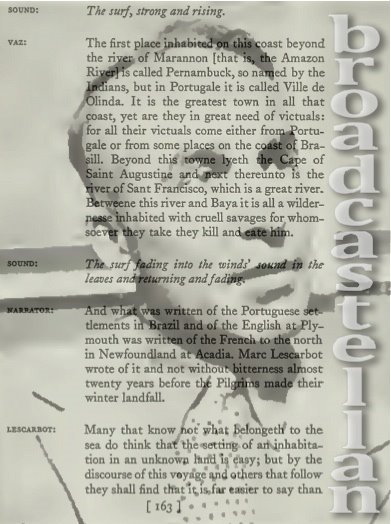
In other words, it took a scholarly approach to what Carmen Miranda accomplished in the conga line of duty. On this day, 18 March 1944, NBC presented “Between the Silence and the Surf,” the eighth broadcast in the series. It related the settlement of the Americas, from Plymouth (as recorded by William Bradford in the 17th century) to Brazil (as documented by Lopez Vaz in the 1580s). I recently rediscovered the program while digitizing my collection of audio tapes; the published scripts, meanwhile, have been shared online. The printed words bespeak the poet’s mission of giving voice to the lost and long unsounded, to lives shelved and shut away in our repositories of knowledge:
SOUND. A slow surf, the hush of the waves withdrawing.
NARRATOR. And the wind’s sound in the grass or in the brush or in the forests where they still must go.
SOUND. The wind in the coarse grass and the solemn trees.
NARRATOR. The world of the first settlements was the narrow world between the silence and the surf, between the water and the wilderness—between the past cut off by water and the future closed by distance and by danger—but not closed.
According to the April 1944 issue of Radio Age, MacLeish “poured an immense amount of painstaking research,” into this series; and in “addition to the laborious research and authentication,” he included the
most important fillip—his own brilliant style of the prose poem, a style which has won for him the accolades of the literary world. Each line read on the broadcast is a part of this poetic narrative style, giving each program a dramatic sweep so necessary in producing the effect desired.
Yet while the poet claimed to have aimed at creating “new forms of radio expression,” rather than adhering to the formats of “conventional radio drama,” critics were not uniformly enthusiastic, arguing the productions to be “overloaded with conversation” and “self-denyingly austere.” Such gainsayings are representative of the bias toward dramatization and dialogue as opposed to lecture or oratory, no matter how many individual speakers were employed to deliver it.
In the foreword to the published scripts for the series, MacLeish defended his minimalist approach by reasoning that “radio’s unique function and unique opportunity” was simply to convey speech instead of presenting words, “artfully blended” by means of “[s]killful devices,” to “produce dramatic effects”:
Because radio is limited mechanically to sound, and particularly to the sound of speech, radio is capable of a concentration of speech itself, the text itself, which can give words a life and a significance they rarely achieve outside the printed pages—and which they achieve there only for the most gifted and fortunate readers.
The word, to MacLeish, was the beginning and the end. As a documentarian and poet, he inhabited that “world between two sounds,” listening, recording, and readying himself to speak with force and deliberation. His American Story is the story of humanity’s struggles for survival, for voice and representation.
Our daily existence, like that of the first settlers, is this “narrow world between the silence and the surf,” between the calm and the roar, between tumult and tranquility. Our lives are a string of moments waiting to be seized for having our say, periods of stillness, voluntary or imposed. We may chronicle our times and leave behind piles of documents to be poured over or neglected by future generations; but it is the sound we make now and the space we leave for listening that define the present we must fill with meaning as we rage against the silence to which we are ultimately condemned . . .

 Harry Heuser