
Sweetness and The Eternal Light

My bookshelf, like my corporeal shell, has gotten heavier over the years.  The display, like my waist, betrays a diet of nutritionally questionable comfort food—of sugar and spice and everything nice.   Now, I won’t take this as an opportunity to ponder just what it is that I am made of; but those books sure speak volumes about the quality of my food for thought.  There is All About Amos ‘n’ Andy (1929), The Story of Cheerio (1937), and Tony Wons’s Scrap Book (1930).   There is Tune in Tomorrow (1968), the reminiscences of a daytime serial actress.  There’s Laughter in the Air (1945) and Death at Broadcasting House (1934).  There are a dozen or so anthologies of scripts for radio programs ranging from The Lone Ranger to Ma Perkins, from Duffy’s Tavern to The Shadow.

My excuse for my preoccupation with such post-popular culture, if justification were needed, has always been that there is nothing so light not to warrant reflection or reverie, that dismissing flavors and decrying a lack of taste is the routine operation of the insipid mind.  That said, I am glad to have added—thanks to my better half, who also looks after my dietary needs—a book that makes my shelf figuratively weightier rather than merely literally so.

The book in question is The Eternal Light (1947), an anthology of twenty-six plays aired on that long-running program.  It is a significant addition, indeed—historically, culturally, and radio dramatically speaking.

In the words of Louis Finkelstein, President of the Jewish Theological Seminary of America, under whose auspices the series was produced, The Eternal Light was a synthesis of scholarship and artistry, designed to “translate ancient, abstract ideas into effective modern dramatics.”

In his introductory essay “Radio as a Medium of Drama,” Morton Wishengrad, the playwright of the series, defended broadcasting as a valuable if often misused “tool.” He did so at a time when, in the disconcerting newness of postwar opportunity and responsibility, radio was increasingly—and indiscriminately—dismissed as the playground of Hucksters, to name a bestselling novel of 1946 whose subject, like Herman Wouk’s Aurora Dawn (1947), was the prosperity and self-importance of the broadcasting industry in light of the perceived vacuity of its product. 

“An automobile does not manufacture bank-robbers,” Wishengrad reasoned, “it transports them.  It also transports clergymen.  It is neither blameworthy because it does the first nor is it an instrument of piety because it does the latter.  It is merely an automobile, a tool.

 What the medium needed—and what the times required—were writers who had “something to say about the culture.”

According to Wishengrad, there was “nothing wrong” with the techniques of radio writing.  He noted that serial drama, derided and reviled by “demonstrably incompetent” reviewers, had great storytelling potential: “Here are quarter-hour segments in the lives of people which could transfigure a part of each day with dramatic truth and an intimation of humanity instead of presenting as they now do a lolly-pop on the instalment plan.”

A  “lolly-pop on the instalment plan”! To paraphrase Huckster author Frederic Wakeman’s parody of radio commercials: love that phrase. Wishengrad is one of a small number of American radio dramatists whose scripts remain memorable and compelling even in the absence of the actors and sound effects artist who interpreted them.  Of the latter’s métier Wishengrad wrote: “Sound is like salt.  A very little suffices.”  He cautioned writers, in their “infatuation with its possibilities,” not to “drown” their scripts in aural effects.

Wishengrad’s advice to radio dramatists is as sound as his prose.  “Good radio dialogue,” he held, should come across “like a pair of boxers trading blows, short, swift, muscular, monosyllabic.”  Speeches, he cautioned, ought not to “be long because the ear does not remember.  There is quick forgetfulness of everything except the last phrase or the last word spoken.”

While Wishengrad made no use of serialization in The Eternal Light—as much as the title suggests the continuation and open-endedness of the form—his scripts bear out what he imparts about style and live up to his insistence on substance. 

Take “The Day of the Shadow,” for instance.  Produced and broadcast over NBC stations on 18 November 1945, the play opens: “Listen.  Listen to the silence.  I have come from the land of the day of the shadow.  I have seen the naked cities and the dead lips.  Someone must speak of this.  Someone must speak of the memory of things destroyed.”

The abstract gives way to the concrete, as the speaker introduces himself as the “Chaplain who stood before the crematorium of Belsen.”

I have buried 23,000 Jews.  I have a right to speak.   I stood the last month in Cracow when “Liberated” Jews were murdered.  I have no pretty things to tell you.  But I must tell you.

The “plain, and written down, and true” figures—appropriated from the “adding machines of the statisticians”—tell of the silenced.  But, the Chaplain protests, “[l]et the adding machines be still,” and let the survivors—the yet dying—speak; not of the past but of the continuum of their plight, of the aftermath that comes after math has accounted for the eighty percent of Europe’s Jewish population who were denied outright the chance to make their lives count.

At the time The Eternal Light was published, radio drama, too, was dying; at least the drama with a purpose and a faith in the medium.  To this date, it is a body unresuscitated; and what is remembered of it most is what is comforting rather than demanding, common rather than extraordinary.  Shelving the candy, resisting the impulse to reach for the sweet and the obvious—the lolly-popular—I realize anew just what has been lost to us, what we have given up, what we have forgotten to demand or even to long for . . .
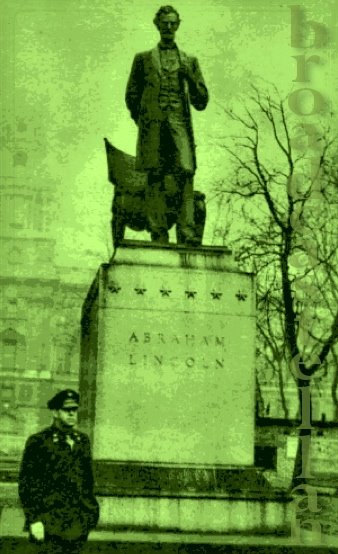
NBC, CBS, and Abe

On the eve of the 200th anniversary of Abraham Lincoln’s birth, I am once again lending an ear to the Great Emancipator. Franklin Delano Roosevelt may have been America’s “radio president”; but in the theater of the mind none among the heads of the States was heard talking more often than Honest Abe. On Friday, 12 February 1937, for instance, at least six nationwide broadcasts were dedicated to Lincoln and his legacy. NBC aired the Radio Guild‘s premiere of a biographical play titled “This Was a Man,” featuring four characters and a “negro chorus.” Heard over the same network was “Lincoln Goes to College,” a recreation of an 1858 debate between Lincoln and Democratic senator Stephen A. Douglas. Try pitching that piece of prime-time drama to network executives nowadays.

Following the Lincoln-Douglas debate was a speech by 1936 presidential candidate Alf Landon, live from the Annual Lincoln Day dinner of the National Republican Club in New York. Meanwhile, CBS was offering talks by Lincoln biographer Ida Tarbell and Glenn Frank, former president of the University of Wisconsin. From Lincoln’s tomb in Springfield, Illinois, the Gettysburg Address was being recited by a war veteran who was privileged to have heard the original speech back in 1863. Not only live and current, the Whitmanesque wireless also kept listeners alive to the past.

Most closely associated with portrayals of Lincoln on American radio is the voice of Raymond Massey, who thrice took on the role in Cavalcade of America presentations of Carl Sandburg’s Abraham Lincoln: The War Years; but more frequently cast was character actor Frank McGlynn.

According to the 14 June 1941 issue of Radio Guide, Lincoln “pop[ped] up” in Lux Radio Theater productions “on the average of seven times each year”; and, in order to “keep the martyred President’s voice sounding the same,” producers always assigned McGlynn the part he had inhabited in numerous motion pictures ever since the silent era. In the CBS serial Honest Abe, it was Ray Middleton who addressed the audience with the words: “My name is Abraham Lincoln, usually shortened to just Abe Lincoln.” The program ran for an entire year (1940-41).

The long and short of it is that, be it in eulogies, musical variety, or drama, Lincoln was given plenty of airtime on national radio, an institution whose personalities paid homage by visiting memorials erected in his honor (like the London one, next to which singer Morton Downey poses above). Nor were the producers of weekly programs whose broadcast dates did not coincide with the anniversary amiss in acknowledging the nation’s debt to the “Captain.” On Sunday, 11 February 1945—celebrated as “Race Relations Sunday”—Canada Lee was heard in a New World A-Coming adaptation of John Washington’s They Knew Lincoln, “They” being the black contemporaries who made an impression on young Abe and influenced his politics. Among them, William de Fleurville.

“Yes,” Lee related,

in Billy’s barbershop, Lincoln learned all about Haiti.  And one of the things he did when he got to the White House was to have a bill passed recognizing the independence of Haiti.  And he did more than that, too.  Lincoln received the first colored ambassador to the United States, the ambassador from the island home of Billy the Barber.  And he was accorded all the honors given to any great diplomat in the Capitol of the United States.  Yes, the people of Harmony have no doubt that Billy’s friendship with ole Abe had more than a lot to do with it.

Six years later, in 1951, Tallulah Bankhead concluded the frivolities of her weekly Big Show broadcast on NBC with a moving recital of Lincoln’s letter to Mrs. Bixby. That same day, The Eternal Light, which aired on NBC under the auspices of the Jewish Theological Seminary of America, presented “The Lincoln Highway.” Drawing on poet-biographer Sandburg’s “complete” works, it created in words and music the “living arterial highway moving across state lines from coast to coast to the murmur ‘Be good to each other, sisters. Don’t fight, brothers.’”

Once, the American networks were an extension of that “Highway,” however scarce the minority voices in what they carried. Four score and seven years ago broadcasting got underway in earnest when one of the oldest stations, WGY, Schenectady, went on the air; but what remains now of the venerable institution of radio is in a serious state of neglect. An expanse of billboards, a field of battles lost, the landscape through which it winds is a vast dust bowl of deregulation uniformity.

Related recording
“They Knew Lincoln,” New World A-Coming (11 Feb. 1945)
Toward the close of this Big Show broadcast, Bankhead recites Lincoln’s letter to Mrs. Bixby (11 Feb. 1951)
“Lincoln Highway,” The Eternal Light (11 February 1951)
My Tallulah salute

Related writings
“Spotting ‘The Mole on Lincoln’s Cheek'”
”Langston Hughes, Destination Freedom, . . .”
A Mind for Biography: Norman Corwin, ‘Ann Rutledge,’ and . . .”
”Carl Sandburg Talks (to) the People”
“The Wannsee Konferenz Maps Out the Final Solution” (on the Eternal Lightproduction of “Battle of the Warsaw Ghetto”)

On This Day in 1942: The Wannsee Konferenz Maps Out the Final Solution

An engagement with old-time radio need not be an escape from the world; it can be a return to the very realities we may have been desirous to avoid or void altogether. Listening to recordings of historical broadcasts can become a confrontation with the past, its representation, and, in the act of relating, with the present itself. Today, for instance, marks the anniversary of the Wannsee Conference at which, on 20 January 1942, the fate of eleven million European Jews was being debated and decided upon with the matter-of-factness and statistical precision known as the “final solution” (the minutes of which genocidal get-together can be found here). Few radio playwrights were as committed to representing the Jewish experience as Morton Wishengrad, whose 1942 play “The Battle of the Warsaw Ghetto” is as chilling and relentless as the calculated cruelty of the master(race)minding behind the massacre on which it comments.

Wishengrad, a prolific and politically engaged playwright whom noted radio actor Joseph Julian once called the only writer beside Corwin to have created a “body of radio literature that deserves a perennial life,” lets the record speak for itself in his chilling echo of fascist calculating and cataloguing—of a nation’s counting, counting down, and accounting of murder millionfold. In “The Battle of the Warsaw Ghetto,” first heard on NBC on the eve of Yom Kippur in 1943, the personal story of a holocaust victim, related from the grave, is reinforced by the sound of “black trucks” rolling out of the Ghetto to the concentration camps, by the three voices of fate (the three fates?) calling up the facts with a statistical precision that echoes the calculated ruthlessness of the acts planned and committed:

VOICE I. July 22, 1942.
VOICE II. Six thousand two hundred and eighty-nine.
VOICE III. Destination . . . Tremblinka.
VOICE I. July 23rd.
VOICE II. Seven thousand eight hundred and twenty.
VOICE III. Destination . . . Oswiantzem.
VOICE I. July 24th.
VOICE II. Seven thousand four hundred and forty-four.
VOICE III. Destination . . . Belzec. 

(Biz: Voices and truck sounds hold under narrator.) 

NARRATOR. Done with method, precise, efficient, recorded.  To Tremblinka, Oswiantzem, Belzec, Sobibor, Majdany—a lethal gas chamber, an electric furnace, a poison pit, an execution field, a cemetery.  And add also ten thousand brave, hopeless, tragic men who seized sticks and stones and knives and bare fists and charged the tanks and tried to halt the trucks.  Add their bodies to the list for the ten days of June, 1942. Make your total and then add two precise, methodical, documented months in August and September, 1942.  Reckon it.  Do it carefully.  You cannot do it on your fingers.  No! Let me give you the sum.  Listen, 275,954 fewer bread cards in the Ghetto! Swift, accurate, final.  Quicker than typhus, surer than hunger.

The records of the Wannsee Konferenz became instrumental in the gathering of evidence for the Nuremberg Nazi trials, another somber occasion dramatized on 16 October 1946 by playwright Arnold Perl, whose docudrama “The Empty Noose” suggested that, while the masterminds of the Third Reich had been hanged, the thoughts behind their actions were still very much alive, both in America and abroad. The regularly scheduled whodunit The Adventures of Ellery Queen was not heard that night.

“The medium needs writers who have something to say about the culture,” Wishengrad remarked in his foreword to The Eternal Light, an anthology of scripts from the series. Old-time radio drama also deserves listeners who take in and respond with their ears and minds open.