
Cranky Doodle Dandy: George M. Cohan Feels So Free

Jumping Jehosophat! It sure feels good to rant about our elected government—some force that, at times, appears to us (or is conveniently conceived of) as an entity we don’t have much to do with, after the fact or fiction of election, besides the imposition of carrying the burden of enduring it, albeit not without whingeing. Back on this day, 4 May, in 1941, the Columbia Broadcasting System allotted time to remind listeners of the Free Company just what it means to have such a right—the liberty to voice one’s views, the “freedom from police persecution.” The play was “Above Suspicion.” The dramatist was to be the renowned author Sherwood Anderson, who had died a few weeks before completing the script. In lieu of the finished work, The Free Company, for its tenth and final broadcast, presented its version of “Above Suspicion” as a tribute to the author.

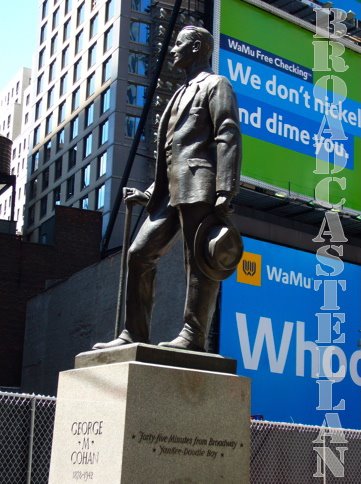
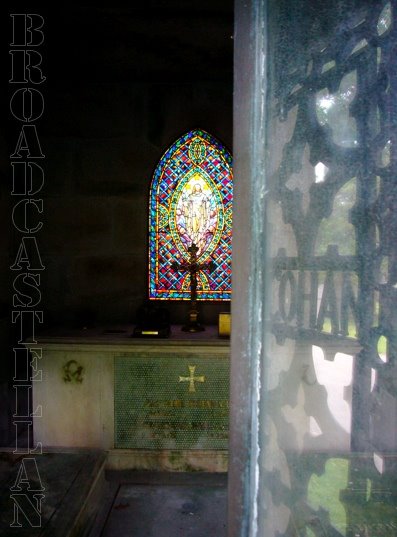
Starred on the program, in one of his rare radio broadcasts—and perhaps his only dramatic role on the air—was the legendary George M. Cohan (whose statue in Times Square, New York City, and tomb in Woodlawn Cemetery, The Bronx, are pictured here). Cohan, who had portrayed Franklin D. Roosevelt in I’d Rather Be Right was playing a character who fondly recalls Grover Cleveland’s second term, but is more to the right when it comes to big government.

The Free Company’s didactic play, set in New York City in the mid-1930s, deals with a complicated family reunion as the German-American wife of one Joe Smith (Cohan) welcomes her teenage nephew, Fritz (natch!), from the old country. Fritz’s American cousin, for one, is excited about the visit. Trudy tells as much to Mary, the young woman her mother hired to prepare for the big day:

Trudy.  Mary, I have a cousin.

MARY.  Yeah, I know, this Fritz.

TRUDY.  Have you a cousin?

MARY.  Sure, ten of ‘em.

TRUDY.  What are they like?

MARY.  All kinds.  One’s a bank cashier and one’s in jail.

TRUDY.  In jail! What did he do?

MARY.  He was a bank cashier, too [. . .].

Make that “executive” and it almost sounds contemporary. In “Above Suspicion,” the American characters are not exactly what the title suggests. That is, they aren’t perfect; yet they are not about to conceal either their past or their positions.

Trudy’s father is critical of the government, much to the perturbation of Fritz, who has been conditioned to obey the State unconditionally:

SMITH.  Jumping Jehosophat [chuckles].  Listen, the State’s got nothing to do with folks’s private affairs.  Nothing.

FRITZ. Please, Uncle Joe, with all respect.  If the State doesn’t control private affairs, how can the State become strong?

SMITH.  Oh, it will become strong, all right.  You know, sorry, it might become too darn strong, I’ll say.  And I also say, let the government mind its own dod-blasted business and I’ll mind mine.
To Fritz, such “radical” talk is “dangerous”; after all, his education is limited to “English, running in gas masks, and the history of [his] country.” He assumes that Mary is a spy and that anyone around him is at risk of persecution. To that, his uncle replies: “Dangerous? Well, I wish it was. The trouble is, nobody pays any attention. By gad, all I hope is that the people wake up before the country is stolen right out from under us, that’s what I hope.”

“Above Suspicion” is a fairly naïve celebration of civil liberties threatened by the ascent of a foreign, hostile nation (rather than by forces from within). Still, it is a worthwhile reminder of what is at stake today. Now that the technology is in place to eavesdrop on private conversations (the British government, most aggressive among the so-called free nations when it comes to spying on the electorate, is set to monitor all online exchanges), we can least afford to be complaisant about any change of government that would exploit the uses of such data to suppress the individual.

“Dictaphones,” Smith laughs off Fritz’s persecution anxieties.

I wish they would some of those dictaphones here.  I’d pay all the expenses to have the records sent right straight to the White House.  That’s what I’d do.  Then they’d know what was going on then.  [laughs]  They’d get some results then, hey, momma?

These days, no one is “Above Suspicion.” Just don’t blame it on Fritz.
Spotting “The Mole on Lincoln’s Cheek”; or, The Free Company We Didn’t Keep

My headphones have been buried so deeply in the sands of time that I have only recently begun to pay attention to the mission of Cindy Sheehan, to the anti-war movement she seems to have reinvigorated, and to the controversy she is stirring by insisting on talking to the US president at his ranch down in Texas. The American home front is showing signs of battle fatigue. Well, perhaps the phrase “home front,” so commonly used during World War II, is inappropriate these days, considering the lack of universal support the Iraq-centered war on terror has been receiving.

Expressions of frustration, confusion, and anger seem to become more forceful and frequent as, after years of fighting, both the end of the war and the ends of it remain uncertain. Is it illusory or perhaps even misguided to hope for a voice of reason to unite the masses, a voice not strident yet unequivocal, not irate but assertive, not jingoistic but inspirational? Radio once seemed to have given nations such a voice, but was often in danger of becoming the medium of fascism.

Unlike those who go indifferently about their business while being mute beneficiaries of democratic freedoms, few protesters would deny that American ideals are worth fighting for in words and actions; indeed, people like Sheehan, a mother who lost her son in combat, are fighting for the realization of such ideals by insisting on publicly voicing their concerns, concerns that by now are shared even by many of those responsible for the reelection of the US president in 2004.

The question on the minds of many Americans and their allies today is, of course, whether the war in Iraq has in any constructive way contribute to the defense of their freedoms or whether it might not have further endangered them either directly (through increasing acts of global terrorism) or indirectly (through anti-terrorist measures curtailing civil liberties).

It is a mistake to assume, however, that, in 1942, US citizens were any more united about going to war then they are now, or that they had a clearer understanding of the stakes and aims of such an enterprise. As I learned from Gerd Horten’s book Radio Goes to War, a government survey revealed that half of those questioned just months after the attack on Pearl Harbor were not even sure what the war was about. Many had been convinced to embrace an isolationist position. Media tycoon Randolph Hearst was one of the most influential figures to warn Americans that war was bad because it was not good for business. And radio was big business.

Back then, noted American playwrights, journalists, and novelists spoke up against isolationist—that is anti-war—propaganda, reminding citizens that inertia could mean surrender to fascism, that there are nearly as many wrong reasons for not going to war than they are for engaging in it.

One such group of artists who set out to inspire the American public in the months prior to Pearl Harbor was the Free Company, a “group of leading writers, actors and radio workers who had “come together voluntarily to express their faith in American democracy.” They were “unpaid, unsponsored and uncontrolled. Just a group of Americans saying what they [thought] about [America] and about freedom.” And they chose a commerce-driven medium like radio to bring their point across.

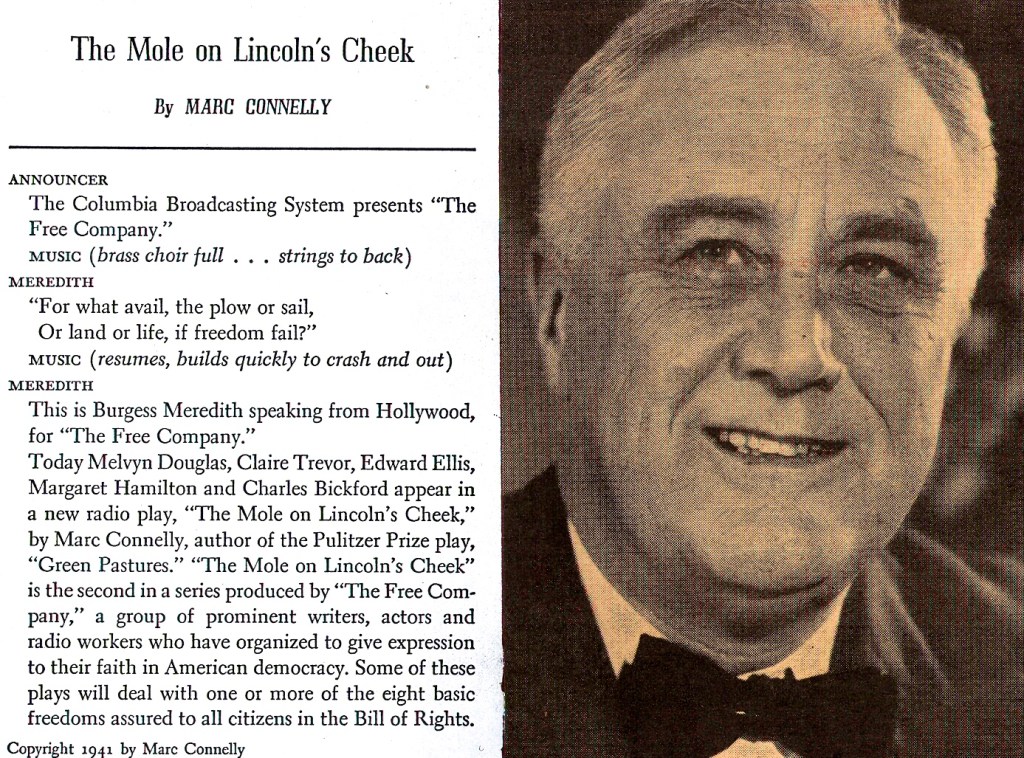
As Burgess Meredith told the radio audience of Marc Connelly’s play “The Mole on Lincoln’s Cheek”: “Our freedom [ . . . ] has this meaning . . . that here, in our land, the truth may be taught, always.” He urged Americans to “resist all attempt to suppress truth or to distort it. Let us consider again,” he continued,

the most powerful words ever spoken against the enemies of man—the lightning-charged words of Lincoln at Gettysburg. And let us renew, in this threatening hour, his high resolve that the government of the people, by the people and for the people shall not perish from the earth.

Could a group like the Free Company—which consisted of Pulitzer Prize winners including Maxwell Anderson, Archibald MacLeish, Stephen Vincent Benét, Marc Connelly, and Paul Green—unite for a series of radio (or television) broadcasts today to unite a largely disillusioned people divided by confusion and cynicism, a people more eager to expose the mole on Lincoln’s cheek than to conceal it?

Would they deem a continuation of the present war unjustifiable or argue a withdrawal from Iraq to be a surrender to terrorism? And just how open would a skeptical public be to any effort to “resist all attempts to suppress truth or to distort it,” how willing to accept any attempts to achieve a consensus?