 Just a little while ago, I was following Jack Benny and Mary Livingstone into a Beverly Hills department store, where, on this day, 18 December, in 1949, they found themselves in a stampede of bargain hunters. As the doors of the emporium opened, the valued customers were greeted with a whip and shouts of “mule train, mule train”—a regular muletide treat.
Accounts of penny-pinching Mr. Benny as a latter-day Scrooge tasked with the challenge of Christmas shopping were a seasonal feature on US network radio. Having had a few chuckles, but not enough material for this online journal, I continued to raid my library of scripts and recordings and came across a play I hadn’t read or heard in a while. It’s a play for all seasons, but one conveying a message particularly well received toward the end of the year: the promise—and the reality—of peace.
The play is “The Undefended Border” by Pulitzer Prize winning poet Stephen Vincent Benét. Written especially for radio, it was first heard on the Cavalcade of America program on 18 December 1940—about a year before the US entered into war with Japan and Germany. As I discuss it in Etherized Victorians, my doctoral study on old-time radio, both networks and sponsors were squeamish about any overt commentary on the war then being waged in Europe. Broadcasters were not permitted to play “advocate,” to endorse an anti-isolationist position, or any other political position, for that matter.
Engaged in a comprehensive campaign to adjust its corporate image in the wake of a report about the company’s profiteering during World War I, the DuPont company commissioned an advertising agency to design a series of historical dramas dedicated to telling American stories of peace and progress. A well-respected writer of historical and patriotic verse, an author whose death in 1943 was argued by one contemporary critic to be “an even greater loss to radio than to poetry,” Benét was just the man to deliver such a message—but not without indirectly signalling his support for Britain in the war against fascism.
“The Undefended Border” celebrates the peace between the United States and Canada. Both countries were at war in 1812; but there existed friendships between those living along the border. Benét tells of such a friendship and how it encouraged an American citizen to go on mission to Washington to urge the Acting Secretary of State, Richard Rush, and the representative of the British crown, Sir Charles Bagot, to create a border that would foster rather than endanger friendly relations between the neighboring countries.
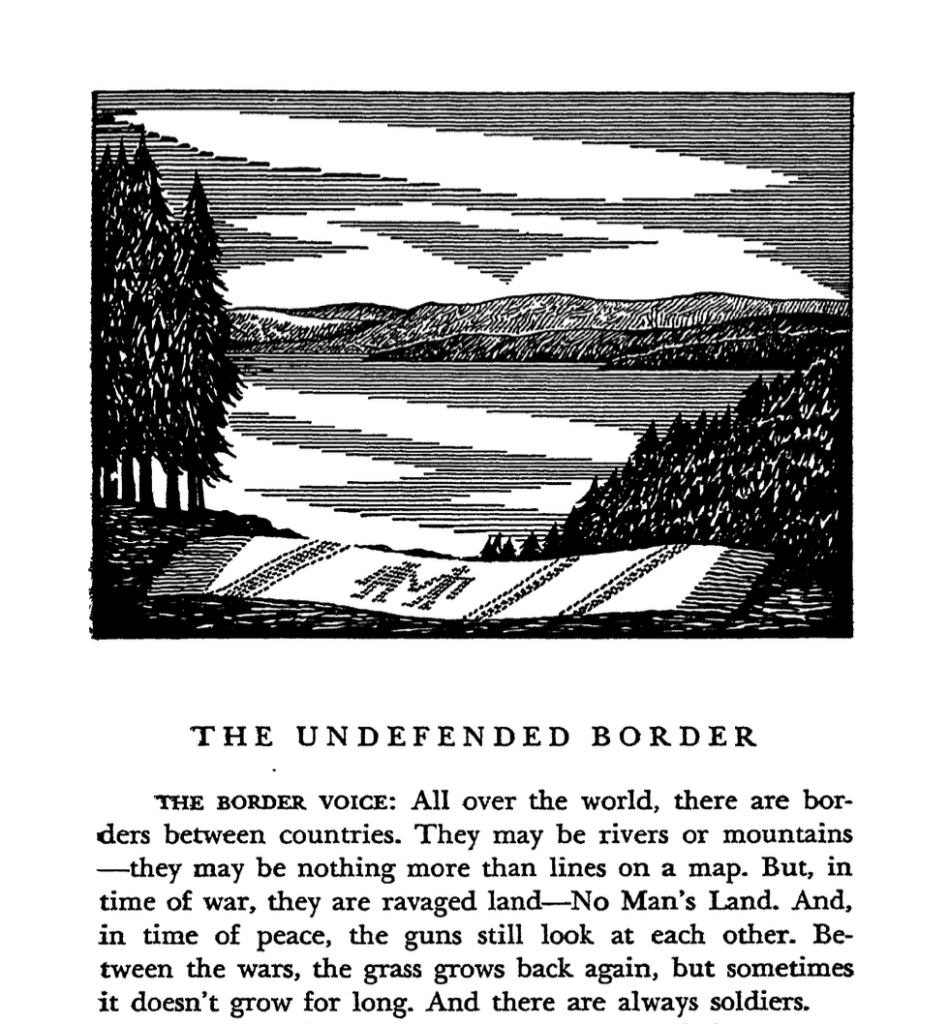
“All over the world, there are borders between countries,” Benét begins his play, narrated by character actor Raymond Massey:
They may be rivers or mountains—they may be nothing more than lines on a map. But, in time of war, they are ravaged land—No Man’s Land. And, in time of peace, the guns still look at each other. Between the wars, the grass grows back again, but sometimes it doesn’t grow for long. And there are always soldiers.
But from New Brunswick to Puget Sound there runs a border between two great nations of proud people, individual people, people with their own customs and beliefs and ways, and that border has not one fort, not one ship of battle, not one hidden or usable gun. There is a lone cannon. And they point it out to tourists as a memory of the past.
The Rush-Bagot Agreement was signed in April 1817, and the two countries went on to create a “great house of freedom.” Was it the doing of that one farmer who travelled on foot to Washington to have his say?
Can the spirit of Benét’s play endure? Or will it be the doing of today’s anxious politicians to tear down our freedoms by putting up new fences? Love Thy Neighbor, I say. Just don’t ask for assistance from stubbornly feuding misers like Mr. Benny.

 Harry Heuser