
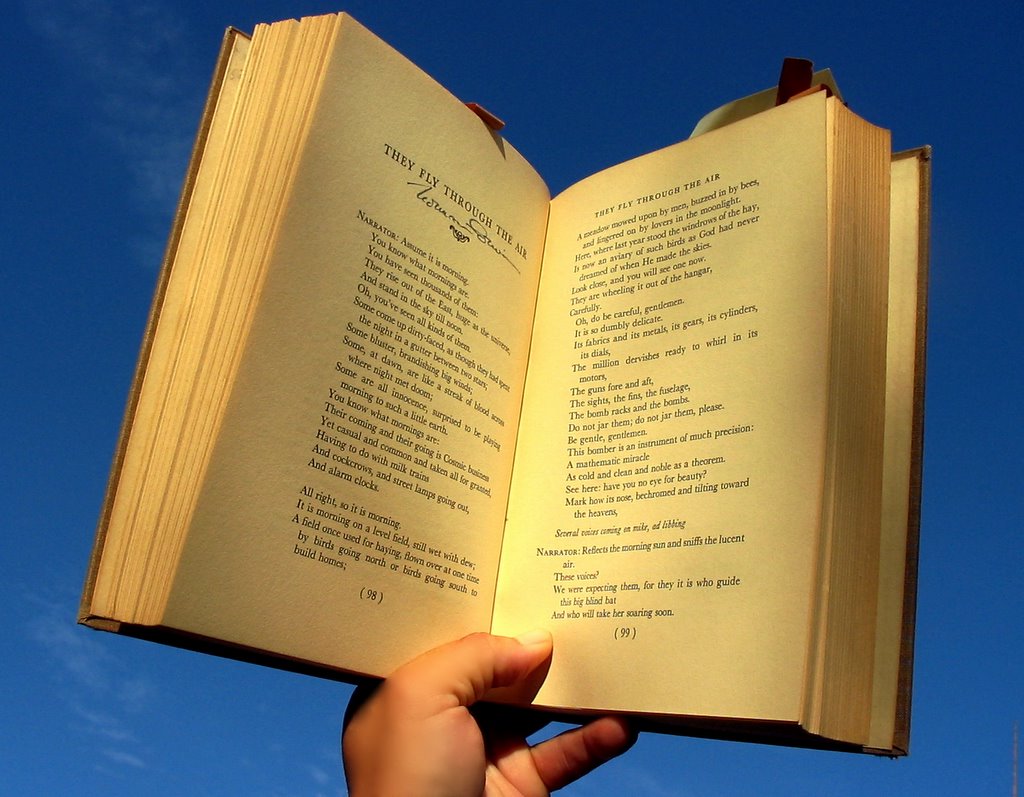
 “Well, gentlemen, let’s get aboard,” says the pilot in Norman Corwin’s “They Fly Through the Air.” What a “peach” of a morning. “You couldn’t ask for a better day” . . . to blow up a few hundred civilians. The verse play (discussed here previously), was written in commemoration of the air raid on the village of Gernika-Lumo, perpetrated on this day, 26 April, in 1937. In what words, in which ways can one approach such a monstrosity, reproach such a murderous marvel as modern warfare? How to make sense of it? How to keep from becoming numb, insensitive to the atrocities of war that are being committed even today, when our gardens are peaceful and the pavements busy with people consumed with their own cares or the pleasures of consuming? These are the questions poet-journalist Corwin, who will turn 97 in a few days, tackles in his response to the raid. Picasso’s Guernica, which I got to see at last on a visit to Madrid, is a lament for the dead and wounded; Corwin’s “They Fly” is an attack on the machinery of war and the minds that get it running.
“Gee, that’s fascinating,” exclaims the pilot as he looks down upon the havoc and horror he has wrought by dutifully carrying out his mission, which is merely to test the what is hot from the runways of Germany, the latest line of the Luftwaffe: “What a spread! Looks just like a budding rose, unfolding.” That precious simile is an echo of a remark attributed to Mussolini, who is said to have found floral beauty in mass destruction.
“How can we justly celebrate the odysseys / Of demigods who finger destinies upon their trigger tips?” Corwin’s narrator considers. He has a few suggestions, all of which he rejects as unworthy of the deed:
With wreaths of laurel?
Laurel withers fast.
By sculpturing in bronze?
Too cold; too passive;
Also, in emergencies, it may be melted to make other things;
Rechristen with you names a public square?
That’s vulgar.
Furthermore, no single square is big enough.
A poem, perhaps?
Aha, that’s it! A poem!
A verse or two that will contract no rust,
A bombproof ode, whose strophes will stand stout
Against all flood and famine, epidemic war,
And pox and plague and general decay.
Yes, poetry’s the thing.
Is it? The narrator tries to escape the noise of the motors (“Our meter will be influenced”), but is dissatisfied with his lines:
What words can compass glories such as we have seen today?
Our language beats against its limitations.
How do we commemorate Guernica? Perhaps by listening for and to those engines running, the war machinery that is at work today. The past is often conveniently looked at as if from above, from which vantage point it appears distant, clearly patterned, even negligible or quaint. Perhaps it is best to resist the temptations of flight . . .
 Harry Heuser