
Good News: Seeing Judy Garland at El Capitan
Compared to seeing, listening is a solitary experience. What is going on in your head while you take in sounds is between you and your ears—a private world removed from the public place where noise, music, and talk are produced. True, you may be overhearing what those around you are saying while a performance is in progress; yet, unlike that frown you may want to bestow on those who won’t shut up, you cannot make ear-contact.
The sense of isolation—the remoteness against which producers of radio programs fought by placing live audiences in the studio to create an approximation of a shared experience for those tuning in at home—is especially pronounced when you put on your earphones to take in a recording of an old radio program, seventy years after those watching it have vacated the studio. So, it is good news when you, feeling quite apart, hear the voice of someone who has been there, a fellow in the audience whose response you are invited to share. Good News is the name of the show; and so is having an expert in the business of radio entertainment right there with you, eager to report.
On this day, 14 April, the Maxwell House Coffee-sponsored Good News of 1938 featured Judy Garland, who had yet to star in The Wizard of Oz, child actor Freddie Bartholomew, as well as veteran comedians Frank Morgan and Fannie Brice (whom you may hear in this recording of the program, retrieved from the indispensable Old Time Radio Catalog).
The word “show” a rather unsatisfying when applied to performances designed to be heard, not seen; but in this case I imagined BBC radio drama department head Val Gielgud watching the broadcast spectacle. As Gielgud noted in his diary (excerpted in his Years of the Locust, aforementioned), Gielgud went to the “El Capitan to see the Maxwell Coffee Hour broadcast with the Metro stars.” Comparing it to British radio entertainment, he called the program a “slicker, more gilt-edged version of our shows from St. George’s Hall.”
Not surprisingly, the “advertising inserts” seemed “silly beyond belief” to the visitor from Britain when, particularly when “read out by an announcer in front of a vast audience.” He was not immune, though, to Robert Taylor, who “comperèd with much charm,” and pointed out that “young Bartholomew stood up well to an interview with some aged editor [Bernarr McFadden] who was presenting him with a gold medal [for his performance in Captain Courageous, and fluffing horribly on his script.”
Gielgud marvelled how “all these stars” remained so
surprisingly amiable in their attitude to perfect strangers, who must as a rule bore them no end. It may be part of “the act,” but they seem quite without pretentiousness, while their manners are quiet and charming: Fannie Brice . . . Florence Rice . . . Judy Garland . . . and that amiable actor Frank Morgan.
Completing his radio day, Gielgud went to the Cocoanut Grove to see broadcast favorites Edgar Bergen and Charlie McCarthy (“in terrific form”). So, Gielgud barely took note of Garland, who sings the duet “Why? Because” with Baby Snooks. Nor did he mention designer Adrian, who was interviewed on the program. Most surprisingly, perhaps, no mention was made of the play heard on he broadcast—“The Hebrides” by noted radio dramatist turned Hollywood director Irving Reis, with whom Gielgud would soon work on a production of the Columbia Workshop.
To be sure Gielgud was on somewhat of a whirlwind tour of Hollywood, and rather impressed by a certain leading lady. Once again in the company of Anna May Wong, Gielgud may very well have forgotten the birthday of his famous brother, John Gielgud, who was born on this day in 1904. At least, he was too distracted to make any mention of it.
Enter Clemence Dane
Okay, so I got momentarily distracted tonight watching American Idol. It’s the only television show I am following these days; but immediately after the twelve anxious men have sung their way into or out of the finals (we are about two days late here in Britain), I am going to lower the blind to screen Hitchcock’s Murder! The arrival of the Gracie Fields DVD set earlier this week has let to a change in my movie diet, with Hollywood fare being put on ice for the duration. Not that Fields’s Love, Life and Laughter was such a gem; it struck me as a poor, distant cousin of The Smiling Lieutenant (recently released on DVD in the US). Last night, I screened Alfred Hitchcock’s peculiar romance Rich and Strange (1931). So, when I noticed that today marks the anniversary of the birth of Clemence Dane, co-author of Enter Sir John, the novel upon which Hitchcock’s Murder! is based, I knew what we would be watching tonight.
Born in England on this day, 21 February, in 1888, the woman who called herself Clemence Dane was a prolific and highly popular novelist-playwright whose works were adapted for screen and radio. The Campbell Playhouse, for instance, presented a dramatization of Dane’s 1931 novel Broome Stages, starring Helen Hayes. Dane’s best-known work, A Bill of Divorcement (which you may read here), was produced by the Theater Guild (1 December 1946) and adapted for Studio One (29 July 1947).
Dane’s screenplays were reworked for broadcasting as well; the Lux Radio Theater soundstaged both “The Sidewalks of London” (12 February 1940) and ”Vacation from Marriage” (26 May 1947).
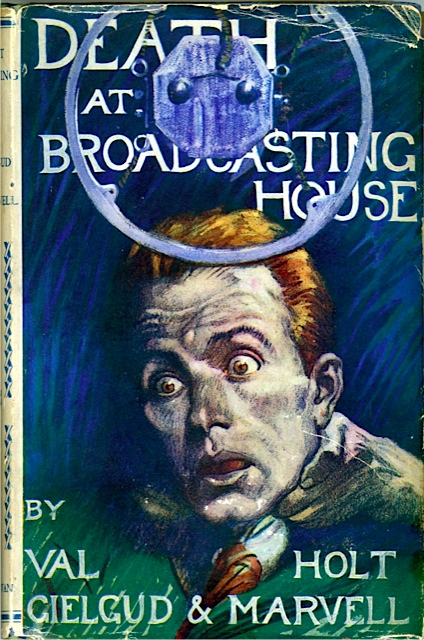
What I did not know until today is that, like W. H. Auden (to acknowledge the birthday of another, far more enduring writer), Dane also conceived plays especially designed for listening. Did they “do” radio? is a question invariably on my mind when I consider the cultural contributions of 20th-century writers and actors who made a name for themselves in other branches of the performing arts. The answer, in Dane’s case, came to me from this latest addition to my bookshelves, British Radio Drama, 1922-1956 (1957) by BBC radio drama department head Val Gielgud (last featured here).
According to Gielgud, Dane’s The Saviours, was “without doubt” the “most distinguished contribution to Radio Drama during 1941.” Why these plays are no longer presented by the BBC is a mystery to me. Despite the continued popularity of radio drama in Britain, recordings of classic broadcasts are far more difficult to come by, whereas copies of the published scripts for The Saviours, a series of seven propaganda plays on the theme stated in the title, are readily available in second-hand bookstores online. Published radio plays, of course, are always second hand.
So, I resort to an irreverent account by playwright-actor Emlyn Williams (aforementioned) of his experience being cast by Gielgud in one of Dane’s earlier play, Will Shakespeare: An Invention in Four Acts (1921), broadcast in 1937 on the anniversary of the Bard’s birth (23 April). “In spite of the talkies,” Williams remarks in his autobiography Emlyn, “British radio was still a momentous force.” The thought of going “live” before an unseen audience of three million people was “paralysing.” Worse still was the atmosphere in the soundproof studio, a “dungeon” filled with microphones resembling a “regiment of robots,” each ded eye turnd bright red and stared at its victims.”
Present in the studio was Clemence Dane, whom Williams describes as an
outsize author with a handsome generous face topped by hair as overflowing as her talent. It had been scooped hastily back into a bun and seemed about to come tumbling down and be sat on.
In a cascade of black to the floor, with a corsage of big happy flowers which accentuated her size, she looked as if, were the world not larger than she was, she would cradle it in her lap. A photographer advanced to arrange the cast round her chair, just as she was handed a vast bouquet which she embraced with a beautiful smile. She was a mother at a prize-giving where all her children had ended up First.
After all, this formidable woman is rumored to be the model for Madame Arcati, the delightfully eccentric psychic in Noel Coward’s Blithe Spirit (discussed here). Thanks to Williams’s first-hand account, I can picture Clemence Dane in the studio, even if I am not likely ever to hear her plays for radio. To think that the world is dead to the theatrical events of the air, that these offerings are being kept out of earshot. It’s enough to make a body scream bloody Murder!
Lance Sieveking, “The Man with the Flower in His Mouth”
Let me be the first to admit my ignorance. The world being largely ignorant of me, I simply cannot depend on anyone else to do so. That said, I might as well turn the keeping of this journal (complicated as it was today by internet-disrupting hailstorms) into occasions to pick up a little something rather than disperse whatever scraps of knowledge I may already lay claim to after years of study (or intellectual loafing).
One such occasion might be the birthday of British radio and television pioneer Lancelot Sieveking, born, as the Internet Movie Database informed me, on this day, 19 March, back in 1896. Sure, I had come across his name during my research for Etherized Victorians; but, concentrating my efforts on American radio dramatics, I had conveniently overlooked Sieveking’s accomplishments. Even the folks over at the Database have yet to catch up with this man of all media; at least, his death (back in 1972) has thus far escaped them.
It is no overstatement to say that the author of The Stuff of Radio (1934) is a neglected figure today; his name has most recently been dropped in connection to Disney’s first entry in the Chronicles of Narnia series. Narnia author C. S. Lewis had approved of Sieveking’s radio dramatization but dismissed the idea of a film adaptation. During the first season of BBC2 television’s Oxford English Dictionary challenge Balderdash and Piffle, there was some debate about the origin of the phrase “back to square one,” which was argued to lie in an eight-squared drawing meant to assist BBC radio’s football commentators back in 1927. That design, as it turns out, was Sieveking’s.
Fellow BBC radio drama producer Val Gielgud had this to say about the “not altogether fortunate” Sieveking: “He was perhaps over much influenced during his most impressionable years by G. K. Chesterton, and by the theory of that master of paradox that because some things were better looked at inside out or upside down such a viewpoint should invariably be adopted. Talented and imaginative beyond the ordinary, his eyes gazing towards distant horizons, he was liable to neglect what lay immediately before his feet.”
In other words, Sieveking was an audio-visionary, a trier of radiogenic techniques at whom actors and colleagues would “gaze with a certain dumb bewilderment” as he “exhorted them to play ‘in a deep-green mood,’ or spoke with fluent enthusiasm of ‘playing the dramatic-control panel, as one plays an organ.'” There was not much use for such an one in radio. As Gielgud put it, even British radio broadcasting, “provided him with no laboratory in which experiments could be carried out.”
In 1930, when radio drama was still in its protracted infancy (despite earlier trials-by-air like the aforementioned “Comedy of Danger”), Sieveking found a “laboratory” in the still newer medium of television. He collaborated with Gielgud in bringing to British television “The Man with the Flower in His Mouth.” An adaptation of Luigi Pirandello’s short play L’uomo dal fiore in bocca (1923), it aired on 14 July 1930.
Little remains today of Sieveking’s work in sound and images, aside from its blueprints—long-out-of-print scripts and theories. Now, I live in a town with a five-million-volume copyright library (which celebrated its 100th anniversary today); but for a snippet of sound, you might as well saunter over to tvdawn, where you may hear Sieveking’s spoken introduction to “The Man.”
Wouldn’t You Rather Have . . . “picked up Anna May Wong at the Park Wilshire”?
There are days when you are in desperate need of vicarious living. While the world marvels at the latest solar eclipse, you wonder whether there’ll be any sun at all his spring, the prospects for your upcoming trip to Cornwall looking decidedly grim. So, you grab a book from your shelves and, presto, you assume the identity of some personage whose existence strikes you as being rather more colorful than your own present self. I wouldn’t have minded trading places with a certain Val Gielgud, who, on this day, 29 March, in 1938, “as nearly as possible passed out over the soup!” I should add that the soup was served at the home of Isabel Jeans, Hollywood actress, and that Mr. Gielgud, brother of distinguished thespian John Gielgud (whom I heard only last night in a 1951 radio production of Hamlet) and a noted radio writer-director in his own right, was on a month-long tour of Tinseltown.
Now, I’ve never been much of a namedropper, being that the only vintage Hollywood notable I’ve been around for any longer period of time was stage and screen actress Viveca Lindfors, whose dog Willie I used to walk during my college days in New York City. I’ve got pictures of the dog, but no mementos of his owner, save for a few messages she left on my answering machine. Gielgud, on the other hand, found himself surrounded by luminaries and duly recorded each encounter in his 1938 diary, excerpts of which he later shared publicly in his biography Years of the Locust. When he was not nearly passing out in a bowl of soup, he was dining or gambling or drinking among the late greats of the motion picture industry.
“So this is Hollywood!” Gielgud exclaimed upon his arrival in Beverly Hills on 26 March 1938. He was visiting his friend, Eric Maschwitz, a novelist-playwright then at work on an adaptation of Goodbye, Mr. Chips. “One’s first impression,” Gielgud noted,
is of a place without form and void, sprawling, unfinished; a forest of oil-derricks; wide roads and fast cars; low houses; far more lights than Budapest, infinitely less effective. Whirled up to Beverly Hills, where Eric has a charming little house that belongs to [screenwriter] John Balderstone. Our nearest ‘stellar’ neighbour in Rodeo Drive—nomenclature perfect—is Rosalind Russell, who has a big house about two blocks away, marked by a police patrol. Fears of Kidnapping or just Publicity?
In this manner the diary continues. On 17 March, Gielgud recorded having had lunch “at a tennis club, where Cesar Romero, looking regrettably unshaven, was playing backgammon with a concentration that seemed [. . .] excessively gloomy.” He then went on to dine at “‘La Maze,’ where among other people were Greer Garson and Tilly Losch.” Tilly Losch? Okay, I had to look that one up. Turns out, she was a Viennese-born actress-ballerina who played Lotus in The Good Earth. From there Gielgud sauntered over to the “Clover Club—dancing and gambling—which reminded [him] of a cross between a Corner House and one of the minor circles of hell. Charles Bennett and his wife, and [Henry] Wilcoxon among others. Dolores Costello, looking tragically passee, Claire Trevor, and various large-size executives with remarkable names represented the Studios. Most people were quite simple and normally drunk.”
On 28 March, Gielgud lunched at the Brown Derby, where he met director Lewis Milestone. In the evening, Eric “collected a party [ . . ] of people whom [Gielgud] had at one time or another known in London: Isobel Jeans [is it Isobel or Isabel, now?], looking as always just out of a band-box; Reggie Gardiner, of train-imitation fame; Heather Thatcher; Greer Garson, very decorative in a pink hat and green gloves.”
In the days to follow, he also spent some time on the MGM lot, where, as he put it, “[o]ne expected to run into Garbo or Shearer or Tracy any moment—and had to be contented with a sight of Robert Young.” Sure, he was less than impressed when being “introduced to John Barrymore, who looked pathetically old and flabby,” but he also got to shake hands with the “certainly most decorative” Dorothy Lamour, “that admirable actor Lloyd Nolan,” and “Una Merkel, who turned out to be as amusing in real life as on the screen, with the most charming manners to boot.”
Within a few weeks, the visitor from Britain got to drive around town alongside glamorous Anna May Wong, with whom he is pictured above. The lucky devil! I’d sure have risked conking out in a bowl of wontons for a few afternoons with Ms. Wong.
On 21 April 1938, Gielgud left Hollywood for New York City, where, on 30 April, he directed his play “Fours into Seven Won’t Go” for the Columbia Workshop. I don’t always agree with Gielgud’s view of American radio, or America in general. In fact, I find his attitude rather haughty and his dismissals too sweeping; but I sure envy his Hollywood excursion, of which I might have more to write anon, should I find myself in need of another dose of hobnobbing by proxy . . .
Sailor Duval Did Not Go Out Into That Big Sleep Last Night
Well, I just got back from a weekend up in Lancaster, a town in the north of England not far from that hotbed of Romanticism known as the Lake District. Perhaps I imbibed rather too copiously from the well of romance, which might account for the strange dreams I had while there. Few things are more tiresome, I know, than someone else’s dreams, unless they are recalled by a poet, a painter, or a psychoanalyst. Being none of the above, I ought to know better than to dabble in such recollections; but this tidbit of mental television so closely relates to my general musings as recorded in this journal—and the plans I have for it—that I deem it worth sharing.
Being removed from a wireless network and the up-to-dateness it affords, I had plenty of time to linger in and dwell on the past, a return trip that began at the Ruskin Library. Exhibited there were sketches and daguerrotypes by the noted Victorian art critic (whom I had just mentioned in my discussion of Quiet Please).
At a second-hand bookstore in Carnforth, I happened on a fine copy of One Year of Grace (1950), a small volume of travel impressions by BBC radio drama producer Val Gielgud, composed while he visited the United States in the late 1940s. A brother of noted stage and screen actor John Gielgud, the author frequently commented on American radio acting and production techniques, deploring commercially sponsored broadcast dramatics and their wastefulness. So, I am looking forward to reading and contradicting his remarks, responses I might share in a future instalment of this journal.
While in Carnforth, I also got to look at the town’s train station. It was here that the location shots were taken for my favorite British film melodrama, the previously discussed Brief Encounter. Unfortunately, I did not recognize the scene as such, even though I arrived at it on a suitably bleak and misty day. Nor does the town seem particularly interested in advertising its landmark.
After visiting a gallery in the town of Kendal, where quite a few painting by erstwhile resident George Romney are on display (though few truly outstanding ones), I was on my way to Lake Windermere, picturesquely shrouded in a haze the feeble winter sun was not able to dispel. My camera refused its services; but I did manage to take the photograph featured in the collage above.
Wordsworth found much to dream and write about on this lake:
There, while through half an afternoon we played
On the smooth platform, whether skill prevailed
Or happy blunder triumphed, bursts of glee
Made all the mountains ring. But ere night-fall,
When in our pinnace we returned, at leisure
Over the shadowy Lake, and to the beach
Of some small Island steered our course with one,
The Minstrel of our Troop, and left him there,
And rowed off gently, while he blew his flute
Alone upon the rock,—Oh then the calm
And dead still water lay upon my mind
Even with a weight of pleasure, and the sky,
Never before so beautiful, sank down
Into my heart, and held me like a dream!
I went to bed early that night, set my ears for a while on “Library Book,” a Suspense play starring the none-too-phonogenic Myrna Loy, but soon drifted beyond earshot and reason. I was not beyond gossip, however, and awoke with the feeling—the knowledge—that Hollywood had lost someone far grander than good old Grandpa of The Munsters—and someone rather more formidable at that.
Upon my return home, I opened to my laptop and eagerly checked the Internet Movie Database for facts, only to realize that I had merely imagined it all: imagined that I had read a headline pronouncing the death of Ms. Lauren Bacall. As of today, 5 February 2006, Ms. Bacall is alive and, I trust, well. Exhale in relief, and marvel at my murderous revision. “You know how to whistle, don’t you?”
In the murkier recesses of my mind, I had somehow made up this story of her passing and believed it, too, mainly because I saw it all in print, however fictive. Sad to say, my immediate response was that I saw in this imaginary headline ample material for a new journal entry, as well as occasion for some exciting listening. I was prepared to write about Sailor Duval and the Bold Venture, the boat on which Bacall (as “Sailor”) and her husband, Humphrey Bogart (as Slate Shannon, her guardian), took off for some tropical adventure each week in their 1950s radio series of the same name. . . .
Not that I require an obituary to revisit the ladies, dames, and gals of the air, the heroines of old-time radio whom I had planned all along to feature over the next couple of weeks, and to whom my first quiz is dedicated. For now, I am going to close the creaking door on this day (and that vision) like Raymond shutting up the Inner Sanctum: “Good night. Pleasant dreams, hmmmmmmmmm?”


