“Alone Together”: A Portrait of the Artist as an Artist’s Spouse

“So, here he is. My father. In a churchyard in the furthest tip of Llŷn. Eighty years old. Wild hair blowing in the wind. Overcoat that could belong to a tramp. Face like something hewn out of stone, staring into the distance.” The man observing is Gwydion, the middle-aged son of R. S. Thomas (1913-2000)—“Poet. Priest. Birdwatcher. Scourge of the English. The Ogre of Wales.” With this terse description opens Neil McKay’s “Alone Together,” a radio play first aired last Sunday on BBC Radio 3 (and available online until 28 March).

The voice of the Nobel Prize nominated poet (as portrayed by Jonathan Pryce) is heard reading lines from his works, the words that are, to us, a stand-in for the man. None of them escape the commentary of his estranged son: “Yes, you could tell yourself this is him, the real R. S. Thomas,” the observer, filial yet unloving, remarks. “But you’d be entirely wrong.” As his father’s old voice keeps on reciting, he adds: “Oh, he’d be happy enough for you to fall for it . . . and to fall for the version he tells of his own life.”

What compels the son to revise this “version” of a life is the life of another, a figure that, to his mind, is concealed or mispresented in the autobiography of the father. The figure is Elsi, the Welsh poet’s English wife (1909-1991), whose fifty-year-relationship with R. S. was compressed by him in these lines:

She was young;
I kissed with my eyes
closed and opened
them on her wrinkles.

Speaking of their first encounter, R. S. introduces Elsi as “a girl who was lodging fairly close by,” the kind of icy understatement with which Thomas, writing about himself in the third person, kept his distance from his readers, just as the people he knew and wrote about were turned into abstracts on a page. “He doesn’t even give her a name,” the son comments, “and that’s where it starts to unravel.”

The churchyard in which we are introduced to the father is Elsi’s burial place; it is Gwydion’s ambition and quest to bring her to life for us, to let us see her in something other than the austere words of an introverted, discontented, and tormented man—an Anglican rector who sought isolation in the remote west of “the real Wales,” who, advocating Welsh independence and separation from England, was consumed by what the Welsh call “Hiraeth”: a longing for home. In how far did this longing, this radical yet futile attempt at forging an identity alien to him, prevent R. S. from making a home for the two, the three, of them?

Searing, severe, yet profoundly moving, “Alone Together” is a compelling play at biography; listening to it, I was reminded of the above self-portrait of Elsi, who, as an artist, was known as Mildred Eldridge, respected and sought-after long before R. S. published a line of poetry. Until now, whenever I looked at it, hanging there on a wall of our home, I have never considered it as an autobiographical act.

Both their approaches to rendering the self seem indirect, his being the third person singular, hers a reflection. Eldridge does not assume the center of the frame; nor does she give us a close-up of the face in the looking-glass; and yet, her self-portrait, tentative as it may be, allows us a glimpse at her perception. The distant self in her husband’s performance, by comparison, seems a construct, the artifice of an entire controlled performance. Unlike her husband, Eldridge appears before us the first person singular, letting us see her as only she sees herself: a mirror image.

In how far are written or spoken words a path to—or a vessel for—the essence of the one writing or speaking? Is anyone knowable through the vocables that are a locum for self and experience? Cautioned not to take a father’s word for whatever “it” amounts to verity, can we now trust the estranged son in his voice-over, his over-writing of the words he claims to be false or misleading?

“Alone Together” suggests that, for all his accomplishments as a writer, R. S. Thomas—who yearned to be Welsh but could not speak it, who, as Elsi puts it, “adopted the vowels of an Oxford Don” to hide the shame of being, as he puts it, an “ignorant Taff from Cardiff”—envied the ease with which his accomplished artist wife communicated in a language beyond words, expressed herself freely on a blank canvas . . . and felt at home there.

"Everybody talks too much": Dylan Thomas and the Long-Lost "Art of Conversation"

“To begin at the beginning.” Thus opens what is undoubtedly the most famous of all plays written for radio: Under Milk Wood, by Welsh poet Dylan Thomas. BBC radio first produced the play in January 1954, with fellow Welshman Richard Burton in the role of the narrator. It had been previously performed in New York, shortly before Thomas’s death in November 1953 (which is the subject of a new book, Fatal Neglect by David N. Thomas, whose previous biography was the source for the motion picture The Edge of Love. Thomas’s poetry is still widely read today; but little is known generally about his other works for the wireless, about which there is generally little talk these days.

Thomas’s most popular story, “A Child’s Christmas in Wales” (published posthumously in 1955) was originally written for radio, as may be deduced from the attention Thomas’s pays to descriptions of sounds and voices, from the “most unducklike sound, a mewing moo that an ambitious cat might make who wished to be a cow” to that “small, dry voice, like the voice of someone who has not spoken for a long time,” a “small, dry, eggshell voice from the other side of the door: a small dry voice through the keyhole.”

Indeed, as I learned from Douglas Cleverdon’s introduction to the Folio edition of Under Milk Wood, Thomas had been on the air, whether as poet, critic, or actor, since 1939. Among his broadcast features is “Return Journey” (1947), a precursor to “Mad Town” (as Under Milk Wood was initially titled); it has been published in the anthology Wales on the Wireless (1988). Earlier this year, another play for voices by Dylan Thomas has been discovered and is now being given its first production on the air. Titled “The Art of Conversation,” it is available online until 9 December.

The title is somewhat misleading, since the play is really about shutting up. It is a Second World War propaganda piece, commissioned as part of a “Loose Lips Sink Ships” campaign, the sort of cautionary talk on the virtue of silence exemplified in the US by mystery writer Mignon Eberhart’s “The Enemy Is Listening” (Cavalcade of America, 7 June 1943). In it, a sinister voice (Everett Sloane’s) replies to remark that no “real American intends to give information to the enemy,” that

sometimes, sometimes someone forgets.  A word overheard and repeated. A small fact passed on to someone else may mean little to you.  It may mean nothing to the person to whom you repeat it.  But the third or the fourth person or the tenth or the twentieth may be your enemy. Your enemy.

Thomas’s “The Art of Conversation” is a rather more subtle performance. It permits us to indulge in the excesses of talk by Britain’s most celebrated conversationalists, only to remind us that there are times when—and subjects about which—the word should be “mum.” “I don’t think you’ll find Mr. Hitler with a little notebook under our table, do you?” one careless talker quips; but, just to be on the safe side, the idle talk that ensures is being censored.

Like Eberhart, Thomas weaves a web of compromising voices; yet he dispenses with melodrama and, indeed, as is typical of his compositions, with plot altogether. Instead, he opts for an informal lecture (replete with audience) punctuated by “the lantern slides of sound”: a multitude of voices, some distinct, others choric. All are preliminaries and subject to shushing:

Hundreds of odds and ends of hundreds of hearsays and rumours may, and can, be brought together into such a pattern that a whole Allied enterprise is thwarted or destroyed. A wagging tongue may sink a ship; a stray word over a mild-and-bitter may help to murder children.

However chatty and playful, “The Art of Conversation” eventually gets down to business and brings its message across; at least, it might have done, had it not disappeared for decades—apparently before it was ever broadcast. According to the current issue of the Radio Times, there is no evidence that the play was intended for radio; but you need only to listen to know that it could have hardly been written with any other medium in mind.

Alison Hindell’s belated production slightly condenses the original script (available here in its entirety), but otherwise takes few liberties with Thomas’s prose and directions; a 1920s “nigger” is turned into “negro,” a concession to our politically corrected sensibilities. Few US radio dramatists were treated with such respect.

The single exception is the rather pointless addition of an opening line that is not part of Thomas’s “Art,” but the famous introduction to Under Milk Wood, quoted above. No doubt, the presenters intended to draw the famous poet into his forgotten “Conversation,” so as to validate this lesser performance; but, instead of indulging in such self-conscious reverberations, they should have left themselves out of it, especially since there is enough of Thomas in it to make the lecture worth our while.

If only a discovery like this could get us talking again about radio . . .

Let George Say It

I penned my first autobiography at the age of sixteen. With the bombast befitting an insecure teenager eager for validation, I called it a “memoir.” It was a short, handwritten volume I passed around to fellow students, a performance designed at once to justify, expose, and invent myself. Like so many pieces of juvenilia, those “memoirs” were destroyed in an act of reinvention, or, not to be fanciful, embarrassment. I fear that many of the instances I recorded, however embellished, edited or carefully selected my memories, may be far more difficult to recreate, faded as my recollections have during all those intervening years that have made me a stranger to my former selves. I seem to have made forgetting a virtue by looking at it as the ability to move on and start over as if from scratch.

Perhaps, one reason for my dwelling in and on the presumably out-of-date in a journal reflective of my readings, viewings, and listening experiences is that it allows me to discover myself in a researchable past other than that which is chronologically and biologically my own: movies, radio programs, books that precede my past and inform my present. To research my story, I must rely on a memory I dare not trust. When it comes to my early life, I have little to go on, other than flashes of dreamlike recollections.

One of the problems involving the autobiographical act is to arrive at a narrative frame that fits the picture without distorting, let alone creating, it. It is difficult to determine where an autobiography ought to end, considering that, as its writer, one is still in engaged in the creation of memories. One is alive and, apparently, compelled to prove it. A future event might call for an entirely new arrangement of facts—a life-changing event may lie ahead, rendering negligible much that seems important at present.

Not quite as problematic, but troublesome nonetheless, is the beginning. Does one begin with one’s family, with one’s ancestors, with a description of the birthplace that, presumably, shaped our early life? Should an autobiography start with an explanation, an apology for the hubris of taking oneself serious enough to warrant such a performance, or an acknowledgement of whomever we construe as our audience? Dear reader, is this my life? Should, as in James Joyce’s Portrait of the Artist, the voice reflect the age, mind and intellect of the subject, the self turned object, in various stages of existence?

One man who knew how to begin was the aforementioned Emlyn Williams, born on this day, 26 November, in 1905; he grew up in a remote town in Wales, his parents hardly proficient in English, to become a well-known actor and playwright (a production of whose Night Must Fall I briefly discussed here), personae or roles that no doubt influenced his performance and may well have created the impetus to for it. He could count on an audience, a public that presumed and demanded to know him.

Williams’s lyrical introduction to George: An Early Autobiography (1961) is one that compels me both to read on and revisit the idea of writing my own life. Aware of the task at hand, of the challenges of starting, of devising a beginning reflective of one’s own start in life and the impossibilities of doing so ab ovo, it is disarmingly reflective:

The world was waiting. Waiting for me, to whisper my incantations. “I am George Emlyn Williams and . . .” I was lying with my head on my fist on morning grass, dry of dew and warm with the first heat of the year. All was still, even the stalks clutched in my hot fingers. I had come up into the fields to gather shaking-grass, a week with a hundred beads tremulous to the touch, which my mother would inter in two vases where it would frugally desiccate and gather dust forever. Spring smells and earth feelings crept into my seven-year-old boy; nine-tenths innocent, one-tenth conscient, it responded. I rolled one cheek up till it closed an eye, and squinted down at the sunlit village. A dog lay asleep in the road. Mrs. Jones South Africa was hanging washing, and quavering a hymn. Cassie hung on their gate and called for Ifor. “Time to go to the well!” The bleat of a sheep. A bird called, careless, mindless. Eighteen inches from my eye, a tawny baby frog was about to leap. It waited.

Everything waited: the hymn had ceased, the bird was dumb and suspended. “I was born November the 26th 1905 and the world was completed at midnight on Saturday July the 10th 4004—our Bible stated the year at the top of page one, the rest I felt free to add—“and has been going ever since, through Genesis Revelation the six wives of Henry the Eighth the Guillotine and the Diamond Jubilee right until this minute 10 AM. Sunday April the 14th 1912, when the world has stopped. The sun will not set tonight, or ever again, and I am the only one who knows.”

No sound: the spool of time has run down, the century is nipped in the bud. I shall never grow up, or old, but shall lie on the grass forever, a mummy of a boy with nestling in the middle of it a nameless warmth like the slow heat inside straw. This is the eternal morning.

The frog jumped. Cassie called again. I scrambled up, brushed my best knickerbockers, pulled the black stockings up inside them, raced down and hopped between my water buckets into the wooden square which kept them well apart so as not to splash. The sun did set, and by the time it rose next morning the Titanic had been sunk. If the world had stopped, they would not have drowned; I thought about it for a day.

The century, un-nipped, has crept forward, and the knickerbockers are no more. They encased one brother till he burst out of them, then another till they fell exhausted away from him, turned into floor rags and at last were decently burned. But I am still here, not yet decently burned or a floor rag or even exhausted, George Emlyn Williams, born November the 26th, 1905.

Autobiographies are performances, to be sure; but the audience, however large, also includes the one in the scrutinizing self in the mirror. Staring at it, it gives me no hints as to how, or whether, to write one. Regardless of all the personal reflections I have offered in this journal, I no longer have the confidence, or the illusions, of a sixteen year old who presumes that his life matters; nor is mine the life of a man like Emlyn Williams, who did.

Day for Bonfire Night; or, On a Bum Note of Triumph

However disheartening California’s majority rule in favor of amending the state constitution so as to protect an institution for which millions of divorced Americans have shown little respect, 5 November 2008 is still a day to inspire confidence in a democracy’s ability to refine and redefine itself, to let go of old prejudices so often upheld as time-honored traditions. To update and appropriate On a Note of Triumph, Norman Corwin’s cautiously optimistic radio play in commemoration of VE Day: “Seems like free men [and women] have done it again!” Perhaps, it seems even more of a victory to those living in Europe and elsewhere around the world.

Like many non-Americans anxious for change in Washington, I stayed up all night to keep track of the election results. Watching the BBC coverage, I was struck by the enthusiastic response to the outcome, even though it should come as no surprise that most people around the world are relieved to see the Republican rule of proud indifference come to an end.

I was tickled by David Dimbleby’s hilariously awkward interview with the cantankerous Gore Vidal, who refused to explain his enthusiasm about the Obama victory to an audience he assumed to be ignorant of America’s civil rights movement and the Republican mindset that impeded it. Perhaps, the world does not understand what it means to be an American; but now, for the first time since 11 September 2001, the world is once again eager to learn and willing to empathize.

Here in Britain, 5 November marks the anniversary known as Guy Fawkes Day, or Bonfire Night, when the threats of extremism and self-righteousness go up in smoke. Generally, it is the figure of Gunpowder Plotter Guido Fawkes that is burned in effigy. Tonight, though it may well be the Republican legacy that the British are eager to consign to the flames. Change, after all, is only a dirty word to those incapable of coming clean about a past that is far from spotless. And, given the state of our global economy and, more importantly, our globe, mend our ways we must.

Today, 5 November, also marks a personal anniversary. It was on this day, four years ago, that, after nearly fifteen years of living, working and studying in the US, I left Manhattan to impose myself on the Welsh and the British at large. I intended the departure date to coincide with the previous election, thinking that the result might either be so decisively against my kind as to eclipse any misgivings about moving and—allowing me to wash my hands of a country whose people were reckless enough to re-elect George W. Bush—or so encouraging and propitious as to send me off into uncharted territory with a sense of hope and a feeling of elation.

It turned out to be the former, of course; but that did not keep me from visiting to Manhattan and from feeling very much at home there. You may not read the anxiety into the above picture, one of the first photographs taken of me after my move to Wales, a Principality theretofore unknown to me.

Before moving, I had shed nearly twenty percent of my body weight, as if resolved to let go of my past or determined to leave behind what could not be retrieved, as if I were trying to convince myself that I needed to regain weight on British soil in order to make it British. If you look at the image of me posted in the previous entry into this journal, you will notice that I did regain the weight, largely owing to Welsh meat and home cooking.

I owe it to my partner, with whom I am yet barred from forming a legally recognized union amounting to matrimony, that I am feeling at home in our remote cottage halfway up in the Welsh hills, a place that, the wilds of the rain forest or the Congo notwithstanding, could hardly be more different from life in Manhattan. How wonderful it is to be celebrating this historic moment of harmony as a very intimate part of my own journey . . .

The Earl Next Door

Montague, our Jack Russell terrier, had a visitor this morning. A sheepdog from the neighboring farm took time off from her daily chores and made her way up the lane to our cottage. A mere quarter of a mile—but what a giant leap into the lap of relative luxury. I wonder about the old lass. You can tell by her coat that she isn’t a pet; she’s strictly the below-stairs kind of gal. And that would be the front steps. No lounging around in the conservatory at all hours of the day, no ball games in the garden, no treats from the table, no trips to the beach. If she weren’t dead tired from doing her work, she might be daydreaming about how the other half lives. Perhaps, that is what did in the last dog who held the job. The poor thing was run over by the tractor under whose wheels it rested. Shades of Thomas Hardy.

I was reminded, too, of Norman Corwin’s “association” with Nick, an English setter who “lived down the hill,” but, having had a “falling out with his owners,” insisted on being taken care of and paid attention to elsewhere. That same “Grand Hotel of fleas” achieved the next best thing to immortality in Corwin’s radio play “The Odyssey of Runyon Jones.” Our neighbor’s sheepdog, on the other paw, was rather less demanding. After an hour’s visit, she went dutifully back down the hill. Now it is Montague’s turn to dream about that life beyond the fence. . . .

Entire industries are devoted to reminding us that the grass is greener elsewhere, to sowing the seeds of discontent and to suggesting we’d settle for a pair of binoculars and a box of weed killer to improve our lot. In this racket of showing us the other half and telling us that, with some slight and low-priced adjustments, our own ain’t half bad, the quarter-hours known as soap operas take the booby prize. Some fifty, sixty years ago—but at just about the time of day that Montague was entertaining his not-a-lady friend—a string of tangled yarns like Our Gal Sunday would roll into America’s kitchens and living rooms, or wherever radio sets were positioned and tuned in for that chance at a ready-made getaway.

“Sunday,” as James Thurber put it, “started life as a foundling dumped in the laps of two old Western miners” but managed to move on up to become the “proud and daggered wife” of “England’s wealthiest and handsomest young nobleman.” Was it safe on the other side? Was it wise to make that leap? According to Thurber, that was a question asked by most of the so-called washboard weepers:

Can a good, clean Iowa girl find happiness as the wife of New York’s most famous matinee idol? Can a beautiful young stepmother, can a widow with two children, can a restless woman married to a preoccupied doctor, can a mountain girl in love with a millionaire, can a woman married to a hopeless cripple, can a girl who married an amnesia case—can they find soap-opera happiness and the good, soap-opera way of life?

The answer, of course, was a resounding “no.” The denizens of “Soapland” remained “up to their ears in inner struggle, soul searching, and everlasting frustration.”

Sure, we’ve all got those. I’m never sure, though, just what the other half might be for me. It’s not that I know my place; I just came to know a lot of places. What is the use of an elusive realm of otherness to a squarely queer working-class boy with a PhD, a cottage in the country, and a suitcase that is always half full (or half empty)? I am either here or there, and the elsewhere is neither here nor there to me. I guess I’m just not prone to nostalgia.

Meanwhile, on this partly cloudy afternoon, my better half and I are off to spend a night at Powis Castle. We won’t flop in the recently restored state bedroom, mind you, but in the timbered cottage to the right of the Welsh fortress once known as “Y Castell Coch” (“The Red Castle”). Further to the right is where the present Earl of Powis resides. So, I am spending the night between the riches amassed by the aforementioned Clive of India and the home of a demoted nobleman. Our Gal Sunday and her kind can take a half-day . . .

"By [David], she’s got it"; or, To Be Fair About the Lady

Having spent a week traveling through Wales and the north of England—up a castle, down a gold mine, and over to Port Sunlight, where Lux has its origins—I finally got to sit down again to take in an old-fashioned show. That show was My Fair Lady, a production of which opened last night at the Aberystwyth Arts Centre, where each summer a musical is put on for the amusement of the locals and the visitors to the seaside town a few miles east of which I now reside. These productions, the aforementioned Oliver!, Fiddler on the Roof, and West Side Story among them, tend to be quite ambitious in their choice of Broadway and West End fare, titles likely to raise expectations higher than any theatrical curtain falling on them, whether to the relief or regret of the assembled crowds. The present Lady is no exception.

According to lore shared by Michael Kantor and Laurence Maslon in Broadway: The American Musical, even Oscar Hammerstein gave up on the idea of showtuning Shaw’s Pygmalion, advising fellow songwriter and radio alumnus Alan Jay Lerner against it. “Just You Wait,” the librettist thought and, to the delight of millions, he and his partner, Frederick Loewe, got on with the show that not only opened on Broadway in 1956 but refused to close for several seasons, proving an enduring popular and critical success.

Now, I did not expect a performer equal to Julie Andrews or Audrey Hepburn when I took my seat and glanced at the program. Indeed, I was never fond of the former or of the film version starring the latter. I had read in the local paper that two leading ladies were taking turns during the month-long run and that the show’s director, Michael Bogdanov, was yet to determine which one of them would perform on opening night. The Lady in question was Elin Llwyd, a graduate of the Royal Welsh College of Music and Drama. Sure, a Welsh lead for a part requiring a Cockney accent transformed into an English that would both please and fool high society as being the genuine article. I’m a far more “Ordinary Man” than Professor Higgins professes to be; but, having lived among the Welsh for some time now, I can tell a Cymru tongue from an English one when it is stuck out at me from a reverberating stage.

“The English have no respect for their language,” the Irish playwright (heard here introducing himself) deplored in his Preface to Pygmalion. Neither have theatrical directors, it seems; or, rather, they do not appear to have much respect for the ear by which they mean to drag audiences into the realm of make-believe. Mind you, the production is being coy about the filiations of Eliza, casting fellow Welshman Ieuan Rhys as her father and throwing in a few self-conscious references about the culture and language. Still, no matter how ably supported and otherwise capable, the slate-hewn Galatea taking center stage faces the well-nigh impossible task of faking not one accent, but two; and, as her acting became more energetic and engaging during the second act, Welsh got the better of the flower girl from the slums of Lisson Grove, London, whom a conceited gentleman scholar wagers to unveil as one of his kind by chiseling at her accent. “By George, she’s got it”? By David, she couldn’t get rid of it!

“Ah-ah-ah-ow-ow-ow-oo!” A few years ago, I was incapable of discerning what now spoke so clearly against the effort to suspend my disbelief. I have spent most of my adult life being cast as a foreigner based on the sound of my utterings. Often, I was made to feel like an imposter, earmarked as one supposedly pretending to be American or English while invariably exposed by a slip of my wayward Teutonic tongue. Given my accentual trials, I am drawn to stories like Eliza Doolittle’s . . . or Elin Llwyd’s.

Patois may be less restricting and defining these days; but, for a play like Pygmalion or its tuneful remake to ring true, phonetic distinctions should not be leveled along with the social discriminations they beget. In this case, equal opportunity spells a missed one. Besides, it just ain’t fair to the memory of the vernacularly challenged ladies and lads whose speech was not equal to their ear.

. . . under the Sheets: Catching Bill Stern at It

A recent addition to my library is I Hid It under the Sheets (2005), a personal account of New York Times reporter and sportswriter Gerald Eskenazi’s “Growing Up with Radio.” Charming and humorous, it is a rather undisciplined account of broadcasting in the pre-television era, likely to frustrate anyone fishing for facts. However impatient with chatty narratives, I do not number among such readers. I enjoy a good yarn, a point of view, an attitude. There is so little radio writing out there, which makes books like I Hid It a treat. After all, listening to recordings of old broadcasts can seem like a retreat, an act of isolating oneself from the world in the very process of connecting to it, however belatedly. You receive while being shut up, alone in your imaginings; any bookworm knows that feeling—but radioworms are exposing themselves to the spoken word, with voices entering their heads.

So, when you come across a fellow listener, you get anxious to exchange notes, no matter how different they are from yours or how removed the listener is culturally or historically. As a child, Eskenazi was passionate about radio; he went so far as to urinate on some kids who did not share his enthusiasm about certain superheroes or tune in to the same serials. Perhaps, I am safer at some remove.

My main reservation about reminiscences like I Hid It is that, instead of promoting radio drama, they insist on declaring it dead, accessible mainly through the filter of their reflections. Sure, Eskenazi listened to, say, Bill Stern back in the late 1940s; but, rather than having to rely on his or anyone else’s memory and recollections, we now enjoy access to thousands of recordings, most of whom are ignored in favor of such secondhand-me-downs.

It is only in the concluding chapter that Eskenazi acknowledges the existence of certain “sound bites and written dialogue of the old shows” on the Internet. Yet, the decision to “listen again” and to compare those cherished memories with extant recordings he declares to be a “dangerous turn,” one that he took only as he “came to the end of writing this book.”

Still, I let Eskenazi tell me about a past that I made my present. Of his tuning in, say, to Bill Stern and his colorful stories from the world of sports and the great outdoors, all of whom he believed to be truthful. Eskenazi vividly recalls Stern’s sensational account of an Alaskan trapper, a widower whose wife had died in childbirth. In search of milk for the infant, the trapper leaves his cottage, which was guarded by his dog. Returning after a long and arduous journey through the snow . . .

Wait, I thought, this is sounding very familiar. Some years ago, I was told just such a story while visiting a village in Snowdonia, not far to the north of me. And here is how George Borrow, in his 1854 travelogue Wild Wales, retold the legend of that place:

Beth Gelert is situated in a valley surrounded by huge hills [. . .]. The valley is said by some to derive its name of Beddgelert, which signifies the grave of Celert, from being the burial-place of Celert, a British saint of the sixth century [. . .] , but the popular and most universally received tradition is that it has its name from being the resting-place of a faithful dog [. . .]. Though the legend is known to most people, I shall take the liberty of relating it.

Llywelyn during his contests with the English had encamped with a few followers in the valley, and one day departed with his men on an expedition, leaving his infant son in a cradle in his tent, under the care of his hound Gelert [ . . .]. Whilst he was absent a wolf from the neighbouring mountains, in quest of prey, found its way into the tent, and was about to devour the child, when the watchful dog interfered, and after a desperate conflict, in which the tent was torn down, succeeded in destroying the monster. Llywelyn returning at evening found the tent on the ground, and the dog, covered with blood, sitting beside it. Imagining that the blood with which Gelert was besmeared was that of his own son devoured by the animal to whose care he had confided him, Llywelyn in a paroxysm of natural indignation forthwith transfixed the faithful creature with his spear. Scarcely, however, had he done so when his ears were startled by the cry of a child from beneath the fallen tent, and hastily removing the canvas he found the child in its cradle, quite uninjured, and the body of an enormous wolf, frightfully torn and mangled, lying near. His breast was now filled with conflicting emotions, joy for the preservation of his son, and grief for the fate of his dog, to whom he forthwith hastened. The poor animal was not quite dead, but presently expired, in the act of licking his master’s hand. Llywelyn mourned over him as over a brother, buried him with funeral honours in the valley, and erected a tomb over him as over a hero. From that time the valley was called Beth Gelert.

Neither Stern nor Eskenazi make mention of the Welsh origins of the tale. “Bill Stern had made the whole thing up,” Eskenazi remarked, only to share his disillusionment when, as a youngster, he heard the same story at school, where it was told to him as an “Indian” (is that, American Indian?) legend. Radio provided “avenues for education that were unsurpassed, if suspect,” Eskenazi concluded. Ain’t that a fact! Stern seems to have had no knowledge of Wales. As I overheard in this broadcast, he even refers to Ivor Novello as an “Englishman.”

As Their Own Words: The "Colorless Green Ideas" of Sleep Furiously

How strange, I thought, sitting in the darkened auditorium of our local art house movie theater. Here I am, watching a film capturing the world around me—my immediate environs, the people who are now, in terms of proximity, though not, generally, of propinquity, my neighbors. Looking on once again brought home just how removed I am from the lives and experiences of the people shown on the screen, insisting instead on reliving my recent trip to New York, city and state.

That one of them is a friend, and that the film’s director is her son, only added to the sensation of not being truly part of the networks of people among whom I now happen to reside, that I seem to be less part of the land than our terrier, Montague, leaping in the fields.

The film was Gideon Koppel’s Sleep Furiously (2007), one of the official selections screening at this year’s Edinburgh Film Festival. You might call it a documentary; but it really is more precisely a document, meaning that no documentarian vision is imposed on what we are being shown. While the images of rural life in Wales are reminiscent of Humphrey Jennings’s aforementioned Silent Village, Sleep Furiously does not extract a message from what it examines, other than articulating an apparent respect for the life depicted. It captures what some argue to be endangered; it preserves what some fear to be fading. Beyond that, however, the film does not so much as construct a syntactic unit from the words it permits us to overhear.

The seeming randomness of Sleep Furiously (whose title is derived from Noam Chomsky’s famous grammatical yet nonsensical sentence) invites us to study each moment, each figure in the landscape as so many nouns and verbs. It is an encyclopedia of a place, not a social commentary.

The camera is mostly static. It is the people, the landscape and the living things in it that are in motion; and it is this movement within the frame that compels us to keep watching: a library van creeping up and down narrow countryside lanes, people busy at their day’s work, farm animals giving birth, raindrops gliding along a washing line. We are encouraged to look at snapshots, rather than judge or ponder the judgment of a curator who, by comparing and setting aside, is out to assign a definite space to each artifact with the intention of fixing a meaning beyond that each shot may either have intrinsically or hold for us, the individual spectators. Instead, the people we meet speak for themselves without posing or being imposed upon.

Freed from the burden of being representative types, mere manifestations of a director’s position of manifesto, the individuals we meet come alive; and however insignificant they might be to the world at large, their words and image become memorable. It is the lens and the microphone that communicate and let communicate, that extend the hidden community in which they dwell.

For once, I got to see the life in the cottages and farms all around me, disconnected as I remain from most of them and they from me. And, next time I see our friend, Pippi Koppel, I can tell her: hey, I never knew that about you—that you put a dead owl into your freezer and mailed it off to a taxidermist; that you renewed your library copy of Glorious Cakes; that you introduce children to the art of pottery; or that you place stones upon your husband’s grave . . .

I sensed that, beneath the syntax those who look on or judge without bothering to look construct out of our lives, we are all word made flesh. Most of us aspire to being nouns, to being somebodies, while others are adjectives, enriching or changing the lives of those on whom they depend for their own meaning.

The lucky ones are verbs: those who make, who mean, who matter without being mere complements of someone else’s sentence. Unless we are prepared to remain a question answerable to others—Happy? Misfit? Either … or?—we had better work at being and creating. Try! Continue! Change! That, not simply syntactically speaking, is imperative!

Secondary Childhood; or, Pandas to Ponder

Wili and Wali at Penrhyn Castle

It is not dotage but a momentary state of doting. Not the reliving of one’s own youth, however romanticized, but an imagining—or experiencing—of what it means to be very young while looking at objects or confronted with performances not created with me in mind. Not reverie, in short, but empathy. That is what I call “secondary childhood”—the state of being elsewhere in time and space, being young there while being here and quite otherwise. Listening to so-called old time radio programs produced in the US, for instance, I am keenly aware that I am entering worlds once inhabited by millions of children born in a country other than my German birthplace, past generations whose reflections are lost to us and, all too frequently, even to them—worlds the passage to which might have been blocked and obscured over time, but that might nonetheless be recoverable.

This recovery effort is quite distinct from the nostalgia of which I am so wary, the attempt of forcing oneself back through that passage and, failing to do so, creating one through which one may yet squeeze wistfully into a niche of one’s own making. It is quite another thing, to me, to set out to gain access to the worlds of other people’s childhoods, to tune in with one’s child’s mind open. I try not to make assumptions about audiences and their responses; instead, I try to become that audience by permitting myself to be played with so as to figure out how a game or play works.

Penrhyn Castle

As I have had previously occasion to share after a trip to Prague, I enjoy looking at old toys. Visiting the grand and rather austere neo-Norman castle of Penrhyn last weekend, on an excursion to the north of Wales, I was surprised to find, housed in that forbidding fantasy fortress, a corner devoted to a collection of dolls. Now, it seems perverse to be so drawn to the two stuffed animals pictured above, stuffed as Penrhyn is with exquisite furniture and impressive works of art (a Rembrandt, no less). I gather it was the bathos of it, the relief after having had greatness thrust upon me to be surprised by these unassuming and, by comparison, prematurely timeworn objects.

Turns out, the twin pandas in the straw hats are Wili and Wali, marionettes who co-starred in a long-running Welsh children’s program titled Lili Lon (1959-75). Upon returning to mid-Wales, where I now live, I immediately went online in search of the two; but, aside from a history of their creators, little can be found about them. I have become so accustomed to YouTubing the past that I was surprised to find no trace of Wili and Wali. No doubt, they still dwell in the memories of thousands who shared their adventures. I was not among them; yet, as is often the case when I come across titles of lost radio programs or fragments thereof, I imagine myself enjoying what is beyond my reach . . .

The Camera, the Coast and the Canvas: A Picturesque Incident

“Let’s go for a ride,” he said. “Where to?” I dared to ask; but there was no reply more concrete than a “Wait and see.”

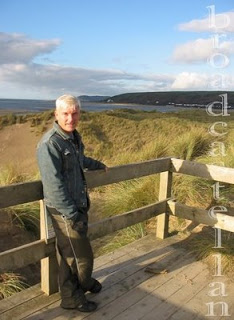
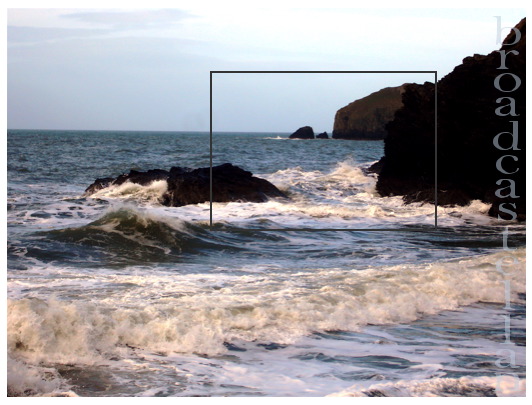
The sky was clear yesterday, and the afternoon seemed right for a jaunt, a break from the radio waves in which I tend to immerse myself to the point of drowning. So, off we three went. Montague, my lover, and I. We drove down the Ceredigion coast to a secluded little seaside town called Llangrannog. We climbed down the steps to Cilborth Beach, which we had all to ourselves. My eye was drawn to the mysterious Carreg Bica, the rock you see me (and Montague) contemplating here. Legend has it that it is the tooth of a giant; it has become more scraggly through the years after a large chunk of it was claimed by the Irish sea.

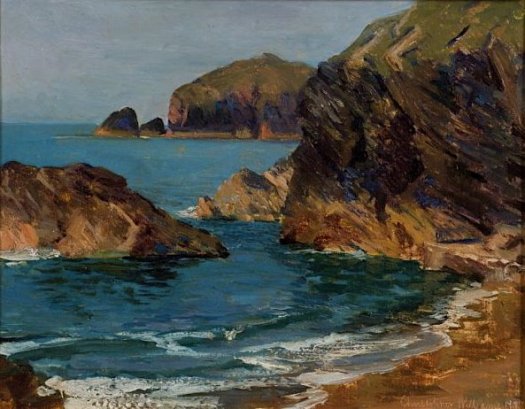
What I did not know until we got to Llangrannog is that this was to be an excursion into the picturesque. We had come in search of a specific scene as shown in this painting by the Welsh artist Christopher Williams (1873–1934). And there it was, ninety years later, the same seascape, that ever changing, never changing scene. Bica’s decaying tooth excepting. The tide was right in; so we did not get to see the coastline just as it appeared to the artist back in 1917, when its a rock solidity must have been welcoming and reassuring, far removed as it stood from the all-consuming whirlpool uncertainties of the Great War, the horrors of which Williams captured in The Welsh at Mametz Wood (1918).

Now, as I learned upon our return home, that painting is to be ours; it will join a portrait by Williams’s son, Ivor (“Suffolk Farmer,” shown in this Wikipedia entry). Whatever happened to holiday snapshots? I wondered, all the while enjoying the sheer extravagance of this picturesque experience.