
Delayed Exposure: A Man, a Monument, and a Musical

Well, I don’t know why I took it. This picture, I mean. Over the years, I must have walked past that plaque hundreds of times without paying attention to it. A few months ago, returning for a visit to my old neighborhood in Manhattan, it insisted I take notice at last. I went to an exhibition at the Cooper-Hewitt Museum on the corner of Fifth Avenue and 91st Street. Erected in memory of the journalist W. T. Stead, this modest cenotaph stands opposite the museum, on the Central Park side of the avenue. I had no knowledge and little interest in the life of Mr. Stead, which (the plaque tells you as much) ended spectacularly aboard the Titanic. Last weekend, some three months after my return from New York, the man insinuated himself into my life once again, this time in the guise of a character in a Welsh musical.

Amazing Grace, staged at the local Arts Centre, tells the story of Evan Roberts, a Welsh miner turned preacher who, in the words of Mr. Stead, became the “central figure” of the early 20th-century “religious awakening in Wales.” Stead followed the movement, interviewed Roberts, and reported about this so-called Welsh Revival. In Mal Pope’s play, he appropriately serves as narrator and commentator on Roberts’s fabulous rise and his equally sudden disappearance from public view.

Unfortunately, Stead doesn’t get all that much to say or sing about Roberts, and the musical, which, in this particular production, featured the aforementioned Peter Karrie as a fierce reverend envious of the enigmatic upstart, suffers from a serious case of anticlimax: whether daunted by his fame or no longer driven to preach, Roberts simply shuts up—a silencing that doesn’t make for a rousing finale.

Unimpressed by Pope’s 1980s-styled power ballads and his by-the-numbers approach to biography, I was easily and gratefully distracted when I saw Mr. Stead walking across the stage and back into my conscious, as if to demand the leading role denied to him in this production. Now I find myself compelled to follow up on Stead’s life and writings.

As it turns out, Stead was fascinated by the spiritual, by premonition and second sight, by ghostly doubles and “long-distance telepathy.” For instance, he wrote about a case in which a telegram, then presumably the fastest means of telecommunication, was several hours slower in conveying a story than a message alleged to have been transmitted by a “disembodied spirit.” It is the extra-scientific (rather than the supernatural) speculated about by those growing up in the age of Darwin, an age of industrialism and shattered systems of belief.

Researching Etherized Victorians, my study on old-time radio, I came across one such comment on modernity by one of Stead’s contemporaries, Rudyard Kipling, whose 1902 short story “Wireless” marvels at psychic phenomena while questioning scientific progress: telepathy as the ultimate wireless connection.

It seems Mr. Stead is anxious to continue the debate from the beyond. I have unwittingly become a ghost writer for the late journalist; recalling him to life in word and image, I am merely his chosen amanuensis.

Dylan Thomas, the Man Who Sounded Dreams

To “begin at the beginning”: 27 October 1914. Birth of Dylan Thomas, the poet who put the town of Llareggub on the map—an imaginary, sound-wrought community whose Welsh enough sounding name takes on an everyday crudeness when reflected upon in the mirror, a curse of the visual that the ear does not appreciate. Nor could it have been uttered on national radio back in the late 1940s, when Thomas began to work on the play that would, after years of revisions, become “Under Milk Wood.” Yet it is far from muted, this “Play for Voices,” which eventually went on the air in January 1954, just weeks after Thomas’s binge drinking-induced death in New York City.

“To begin at the beginning.” It is with this sound plan of action that Thomas’s narrator ushers us into the world of “Under Milk Wood,” a fourth-dimensional non-space, the anti-matter of a dreamscape unfolding in time. Listen, and you “can hear the dew falling, and the hushed town breathing. Only your eyes are unclosed to see the black and folded town fast, and slow, asleep. And you alone can hear the invisible starfall, the darkest-before-dawn minutely dewgrazed stir of the black, dab-filled sea [. . .].”

“Time passes. Listen. Time passes,” we are reminded. “Come closer now,” the voice beckons. “Only you can hear and see, behind the eyes of the sleepers, the movements and countries and mazes and colors and dismays and rainbows and tunes and wishes and flight and fall and despair and big seas of their dreams.” It is an irresistible invitation, this: to close ones eyes and conceive of imaginings beyond images. “Under Milk Wood” is a play unfit to be seen.

It certainly wasn’t suited for the big screen, as I found out in my attempt to celebrate the anniversary of Thomas’s birth this evening. I rarely shut down the projector before a film has flickered out; but I was grateful to a friend of ours who interrupted Andrew Sinclair’s 1972 adaptation, a tawdry spectacle of ill-conceived literal-mindedness. Starring Burton and featuring Elizabeth Taylor, the film shows us horses and cats and false teeth in a glass whenever Thomas speaks of them (and “cocklewomen” at work when he tells us they are sleeping). It offers visuals for visions, a prosaic fidelity that is the very death of poetry.

I decided not to pick up where we had left off. Instead, I’ll turn down the lights and listen to the 1954 radio version (also narrated by Burton). I might drift off; but I will let it happen and even will this mingling of dreams, allowing Thomas’s word-made world to stream in and out of my consciousness, catching his redolent names and hyphenate-strung metaphors only to let them sink in the “black, dab-filled sea” amid the coasting boats of my unguarded thoughts.

For years, while researching my study on so-called old-time radio, I have been resentful of Thomas’s reputation among the radio dramatists. It irks me still that so much attention is being paid to this one piece, a zooming in on Llareggub that did not lead to a sustained effort in charting radio’s vast and varied soundscapes or to a widespread awareness of radio as a poetic medium. “Under Milk Wood” has been singled out and set apart as literature, glorified at the expense of a great number of unheralded and silenced performances.

Tonight, I am going to stifle this resentment—an anger rightly aimed at blinkered critics, not at the poet at play—and slide between the eyelids of Thomas’s dreamers to ease my way into that town made of time, a town made by those taking a moment, and by them only.

Moby-Dick, Squeezed into a Can of Sardines

Well, call me . . . whatever you like, but I am prickly when it comes to the protection of endangered species; those of the literary kind, I mean. Take Moby-Dick, for instance. Go ahead, so many have taken it before you, ripped out its guts and turned it into some cautionary tale warning against blind ambition and nature-defying obsession. Moral lessons are like sardines: readily tinned and easily stored until dispensed; but they become offensive when examined closely and exposed for much longer than it takes to swallow them.

Not far from where I live now, in the Welsh town of Fishguard (pictured), Gregory Peck was once seen impersonating the mad Captain Ahab, who, in the eyes and minds of many non-readers, became the scene-chomping villain in control of Herman Melville’s tough-to-steer vessel of a book. On this day, 19 October, in 1946, Moby-Dick was being chopped to pieces for the airwaves. It had come under the knife of Ernest Kinoy. who did this sort of hack job on a weekly basis; the remains were tossed onto the soundstage of the Columbia Workshop, ready to be delivered to American homes like a quick if none too nutritious meal.

Radio was a regular cannery row back then. Now, the Workshop was a classier establishment than most of radio’s story factories. As I last mentioned here, it was billed as “radio’s foremost laboratory of writing and production technique.” Its producers knew better than to present the entire volume in a twenty-five minute synopsis. A little better, that is. Instead, as if inspired by the hyphen that harpoons the original title, they allotted two installments for its audio-dramatic rend(er)ing of the old mammal. They had done as much in their treatments of Hamlet and Alice in Wonderland (as well as its sequel). They were still a thousand nautical miles away from approaching what E. M. Forster referred to as “the song” of the book.

As Forster remarked, Moby-Dick is “an easy book, as long as we read it as a yarn or an account of whaling interspersed with snatches of poetry. But as soon as we catch the song in it, it grows difficult and immensely important.” The “prophetic song” of Moby-Dick “flows athwart the action and the surface morality like an undercurrent. It lies outside words.” It certainly “lies outside” the domain of sound effects and choric shanties—the readily reproduced impressions of the sea.

I wonder whether Hemingway was listening in or taking notes that day (and on 26 October, when the Workshop presumed to have done justice to—or simply be done with—the book ). On radio, at least, Moby-Dick sounded like an extended version of The Old Man and the Sea, written a century later. Aside from the famous opening line and the hunt for the titular creature (which takes up the three concluding chapters of Melville’s 135-chapters-spanning tome), little blubber and less bone remains of Moby-Dick; or, The Whale, a book known to many and read by few.

To those picking it up for the first time, the humanity and gentle mankindliness of Moby-Dick—especially its tenth chapter—must come as a surprise. What has happened to popular culture in America that it balks at such pre-Wildean sentiment but gorges instead on the book’s supposed machismo appeal? Is it possible, perhaps, to take another look at this Brokeback Mountain of a whale?

“All my books are botches,” Melville declared to Nathaniel Hawthorne, to whom the book is inscribed. They most certainly are, once they fall into the hands of adaptors like Mr. Kinoy.

Many Happy Reruns: Herman Melville and M. R. James

Well, August is coming across a lot like autumn. Fierce winds, cool temperatures, and short intervals of rain put an end to the July heat here in Ceredigion, Wales. Undoubtedly, I will return to hothouse climes next week, when I am back in New York City, where, on this day, 1 August, in 1819, a child was born that would eventually become one of the most celebrated authors of the 19th century: Herman Melville. Moby-Dick, his most famous work—a story everyone knows but a book hardly anyone reads—was filmed, starring Gregory Peck, not far away from here in the Welsh town of Fishguard, where, last summer, I had the misfortune to drown a cellular phone.

Losing a chance to keep in touch with humanity—that is not altogether un-Melvillian. Melville’s yarns, apart from his early Omoo and Typee, are not primarily seafaring adventures. They are stories of the forlorn, of friendlessness and frustrated ambitions. Teaching American literature in New York, I once assigned Melville’s novel Redburn, a devastatingly triste tale of a young man unable to establish meaningful and fulfilling personal relationships. It is a subject to which Melville returned frequently in his work, his Kafkaesque story “Bartleby, the Scrivener” being a prime example. It is also a fine example of literature being well served by radio; and such instances are quite rare.

Those adapting literature for the airwaves were often asked to synopsize popular pieces of 19th-century fiction, to produce hurried rehashes that rarely captured the varied aspects, let alone the experience of epic tomes like Moby-Dick. The far shorter story of “Bartleby,” however, was well translated for radio by the creative team of Jerome Lawrence and Robert E. Lee. As the host of the series, Ronald Colman, told listeners of Favorite Story back in the late 1940s (the series was transcribed and syndicated, rather than broadcast live on network radio), “The Strange Mr. Bartleby” was an obscure work of fiction. It was owing to actor Robert Montgomery, who allegedly chose it as his favorite, that the story was picked up by Favorite Story and dramatized starring William Conrad and Hans Conried (as Bartleby).

As a short story, it is far more suitable for a twenty-minute dramatization than the novels that were generally bowdlerized in the process. Despite the changed title (the word “scrivener” being deemed rather too quaint and alienating, no doubt), Favorite Story‘s rendering of “Bartleby”—a dark tale in which communication failure is having a “dead letter” day—is probably the most satisfying and faithful Melville adaptation heard on American radio.

A similar success in adaptation may be reported in the case of another author born on this day (in 1862), a spinner of a very different sort of yarn: M. R. James, who shares his first name with our terrier, Montague (pictured). Still somewhat outside the canon of western literature—a canon that now includes Frankenstein and Dracula—James is a highly regarded teller of antiquarian ghost stories.

A decade before it was adapted for the movies, his “Casting the Runes” was readied for radio by Irving Ravetch and John Dunkel. With a score composed by the recently deceased Cy Feuer (commemorated here), it was heard on the thriller anthology Escape on 19 November 1947. Unlike Tourneur’s Night of the Demon, which exists in two versions and points up the Curse of visualizing terror as horror, the sound-only adaptation is both literate and liberating, depending on the listener’s imagination rather than showy yet inadequate special effects.

was often and not unjustly accused of playing fast and loose with literary classics. It reduced novels like Moby-Dick to skeletons best left in the closets of those who were commissioned to strip the meat from the bones of such meaty fictions. Shorter works like “Bartleby” and “Casting the Runes,” concentrating on one central idea and exploring a key situation involving a few main characters, fared considerably better on the air. These two plays are worthy of the men who conceived them without a microphone in mind.

We Now Resume Our Regularly Scheduled Life

It has been a week of local excursions here in Wales, days spent sunbathing and splashing in the radioactive sea, bookhunting in Hay-on-Wye (the world-renowned “Town of Books”), dining al fresco, stargazing outdoors and on screen, playing with Montague, our unruly terrier, and being among friends (even after having been critiqued with the candor I reserve for those who matter to me). The occasion of it all was a weeklong visit by my closest if mostly long distance friend, the fatherland I haven’t set foot on for seventeen years. It is to him that I owe the wonderful book pictured above, a splendid addition to my collection of Claudette Colbert memorabilia.

Whenever I venture out to Hay, I return home with a few treasures. This time, I added a book on Harold Lloyd (my favorite silent screen comedian, whose films The Kid Brother, The Cat’s Paw and Girl Shy we screened during the past few days), as well as a coffee-table topper on screwball comedies (a book which I had previously gifted to abovementioned best pal, but with which I was pleased to get reacquainted). However convenient and economic it might be to browse and shop online, the thrill of the hunt (as previously described here), is something a carnivore of a booklover like me does not like to go without.

Now, the people of Film Pictorial, a British publication, are full of it. Legend, I mean, which is a term I much prefer to trivia when it comes to describing pieces of nothing from which to weave whatever your mind is up to at the moment. Trivia is for the mercenary; legend for the mercurial. I shall raid said volume from time to time here on these virtual pages. Where else might you learn whether or not you have a “Film Hand” from a writer who examines the “long little finger on the hand of Katharine Hepburn” or the “thickish fingers” of John Boles and Warren William to tell their temperament and acting skills?

The book also contains longer articles on “The Gallant Life of Norma Shearer” and takes readers to the homes of stars like Harold Lloyd, Bette Davis, and . . . Gordon Harker? Robert Montgomery, meanwhile, debates, along with Jeanette MacDonald, “At What Age Are Women Most Charming” and Myrna Loy reveals her “Own Ideas.” It’s all glossy but telling gossip, which I am looking forward to sharing, along with old news from , over the next few days.

Of course, my week was not without pain and what there is of sorrow in my life, among which my tumble down the slippery steps to my room and the breaking down of our car are the most dramatic examples. My lower back and my left toe still ache; the car might not be salvageable at all. In a matter of weeks, I reckon, such woes—which led to dipped feet in cooling springs and a ride through Wales in an Auto Club truck—will be nothing but cheerful anecdotes to be shared among chums. For now, they are inconveniences, at most.

As I have mentioned before, the weeks to come will be somewhat less than regular. On 7 August, I shall return, however briefly, to my old home in New York City. In the meantime, I resume my journal, hoping it will be appreciated by those who make it a habit to keep up with someone as gleefully out-of-date as yours truly, broadcastellan.

Old-time Radio Primer: H Stands for Hiatus

Well, how are you feeling today? According to one British study, 23 June is the happiest day of the year. Montague and I were perfectly content, playing and dozing in the garden and going for walks along the lane. Perhaps, the folks down in the nearby town of Aberystwyth were even happier last Tuesday, when they had several thousand pounds thrown at them on the street by a stranger who just wanted to “spread a little sunshine.”  Apparently, this local story had already travelled around the world (both my sister and my best friend in Germany had heard of it) before it came to my ears, which, no doubt, were too busy picking up the sounds of .
As grateful as I am for ready access and instant replay, recording technology can render our present-day listening quite unlike the experience of tuning in back then. It is difficult to get a sense of a weekly broadcasting schedule, of certain parts of the day being associated with particular programs, of the anticipation of their airing and the space such periodically scheduled events occupied in the minds of the audience in the interim.

To be sure, the middle of June would have been meant a rather prolonged wait for the next tune-in opportunity. It was during this month (rather than May, as on US television nowadays) that most of the crowd-pleasing drama series and comedy-variety shows went on their summer hiatus. Hiatus, from the Latin hiare, meaning “to yawn.”

As I suggested a while ago, the off-season in radio had initially been a response to technical difficulties of broadcasting during the long, bright days of the year. Now, a hiatus can be a precarious wait, which is why I’d never attempt one for broadcastellan. The question is: will the audience greet the news of your return with excitement, or a resounding yawn? That is, will your show go on even in its absence, circulating in the minds of the multitude? Not, perhaps, if your season finale is as disastrous as the second one of Desperate Housewives.

To be sure, broadcasters did not shut down the microphones and close the studios for the duration. Before resorting to reruns, which became customary in the 1950s, they scheduled replacement programs, some of which, like the Forecast series, were designed to test the potential of untried fare. It wasn’t all filler during those summer months. The Mercury Theater, for instance, was first heard in July 1938. Besides, a prestigious timeslot, one occupied by the Lux Radio Theatre demanded high-profile or at least adequate replacements. One of the most highly regarded programs to have its premiere during the summer was the thriller anthology Escape.

On this day, 23 June, in 1950, Escape offered the western melodrama “Sundown,” the “story of a boy who never owned anything . . . but a gun.” The cast was headed by Barton Yarborough, best remembered today for his portrayal of Texan daredevil Doc Long in Carlton E. Morse’s I Love a Mystery serial. Doc and his pals did not break for the summer; they kept audiences suspended, from one cliffhanger to the next. On the very day Yarborough was heard in “Sundown,” another Doc Long (played by Jim Boles) set out for a new adventure in “The Snake with the Diamond Eyes.”

There was time as well for summer schooling. On this day in 1957, Edward R. Murrow introduced the listeners of the CBS Radio Workshop to a word far more ominous than “hiatus,” precisely because it denotes a lingering presence:

A new word has been added to our ever increasing vocabulary.  It’s a small word, dressed in fear.  To pronounce, not very difficult.  To envision, staggering.  This scientific word may well become the most important in all languages and to all peoples. It is pronounced “fallout.” “Fallout.”  Rather a simple word to describe so much.  “Fallout.”  Radiation withheld by quantities of atmosphere that may eventually descend to pillage, burn, kill not only you and me, but the scores of generations unborn.  Quite a word, “fallout.”

Countering the politics of terror, Murrow suggested that this lexical novelty could also denote the harvest of knowledge, as “words, thoughts, ideas,” withheld in an “atmosphere of ignorance,” eventually descend on future generations. Perhaps, this intellectual fallout is rather too gradual and the radiation too slight. With atomic energy once again on the political agenda in Britain, and threats of nuclear warfare not quite a thing of the past, little seems to have been learned from past horrors.

I wish political leaders could be forced to go on hiatus to make room for summer replacements—especially since some of them seem as perverse as that ill-treated teenager in Escape, seeking retribution beyond reason in an atmosphere of fear and its inevitable fallout. To the restless mind, “hiatus” can mean “pause for thought.”

More Milestone Reflections; or, Quo Vadis, broadcastellan?

Well, I have been away taking pictures. Taking pictures away, to be precise. It was an entirely manual engagement with the arts, involving nothing more than hauling some large canvasses—paintings by the late British artist David Tinker—for an upcoming exhibition. The things we do for a meal and a daytrip to a place where sheep are outnumbered by people (in this case, Cardiff). It so happens that the artist’s widow is Tracy Spottiswoode, who writes for television and radio. She is currently working on a radio play for the BBC, based on a story related to her by her father. It is an incident in the life of Hollywood actor Robert Vaughn, who found himself caught up in the turmoil of the Prague Spring while filming on location in Czechoslovakia, anno 1968. Considering that another successful radio writer, silent film music composer Neil Brand (last seen on UK television in Paul Merton’s Silent Clowns series, which concludes today with a portrait of Harold Lloyd) is coming to visit this weekend, I decided to give writing for the medium another try and return to my own audiodramatic tinkerings (first and last hinted at here).

I have written much about radio, but never for it. And since this 200th entry into my journal marks another milestone (the last one having been contemplated here) it is a convenient moment to reflect on my writings, their uses and purposes. “Quo Vadis” is meant here as a way of mapping out a way, of asking myself what to do next with and within this forum, another opportunity of looking back, listening ahead, and saying thanks to all those who have been reading and commenting over the past five months. Writing in such a marginalized field—and writing in such a marginalizing style about it—can be a rather lonely pursuit.

Perhaps I am craving a larger audience than I am enjoying here; but writing an audio play (for the first time since high school) is merely another creative response to my ongoing engagement with radio. And, if the lacking response to Larry Gelbart’s recent radio satire “Abrogate” (as discussed here) is any indication, there may not be a large audience—or a large vocal one—for such writing either.

That said, there will be less of me, here, in the next few weeks, weeks that will involve gathering new impressions elsewhere, in London and New York City. As you may recall, when last I was in New York, I very nearly went out of my mind going in search of a wireless network to post my writings—not the kind of part in the theater of the mind I had in mine.

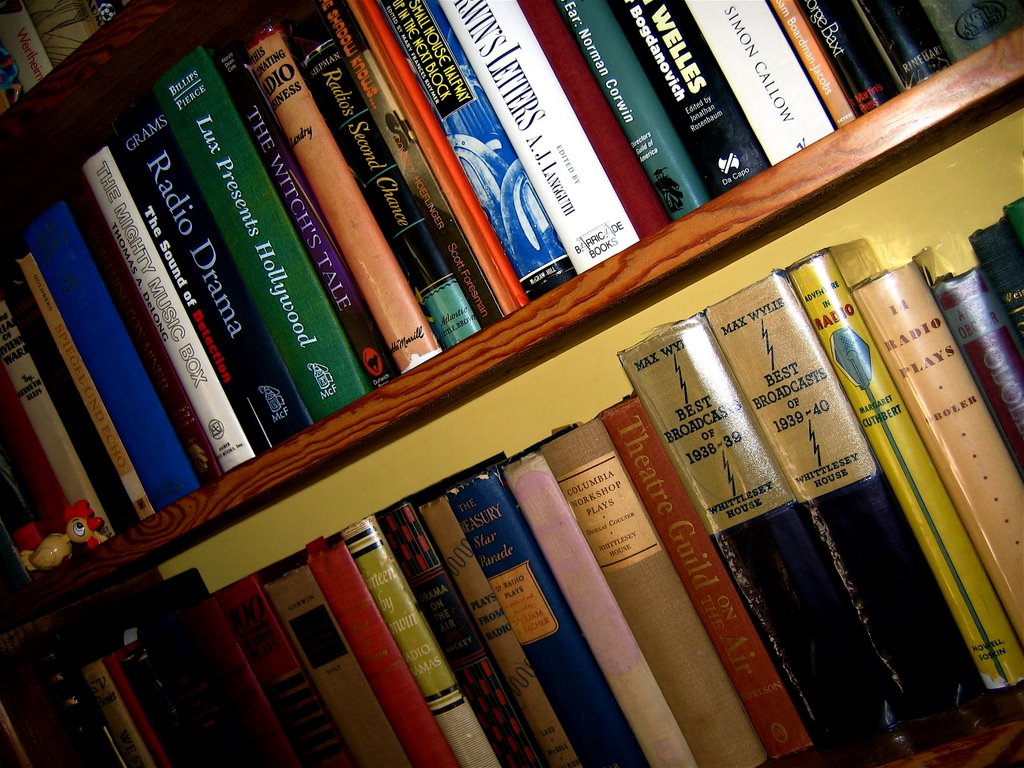
The recent acquisitions you will find on my bookshelf (including Arch Oboler’s Fourteen Radio Plays, Abbot’s Handbook of Broadcasting, and Wylie’s 1938/39 and 1939/40 Best Broadcasts, all pictured above) provide models and instructions for the wireless tyro. Today’s writers can learn a lot from the old practitioners, restraint as they were by commercial ties. Radio plays can be talky and tiresome, so intellectual as to become insipid. A healthy dose of melodrama and a helping of sound effects sure liven things up. At least, I hope they will in my efforts at soundstaging. I might exhibit some of my experiments in radio writing on my podcast site.

So, if you enjoy plays for the ear—or derive pleasure hearing about someone struggling to give prospective listeners an earful—you might find my forthcoming discussions about aural storytelling and sound effects of some interest. Please stay tuned . . .

"The Island of Death," the Radioactive Sea, and the Legacy of U235

Well, I wasn’t aware of it when I moved here. Not that such knowledge would have prevented me from moving; but it might have made me more doubtful about my seemingly pristine environs—or about picking the catch of the day from the menu of a local restaurant. The Irish Sea, I mean, and the nuclear waste it contains. Research suggests that the Irish Sea, which separates Ireland from my present home of Wales, is the most radioactive body of salt water on this planet.

Growing up in cold-war Germany, I could conceive of nothing more terrifying than atomic power. My earliest nightmare, which continued to plague me in my pre-pubescence, was of a gigantic bomb. An enormous cannon ball of mass destruction, it was surrounded by a shadowy group of scientists whose proximity to this ominous orb had, to my childish mind, already proven them to be beyond trust and reason.

It was a tableau right out of Dr. Mabuse, or some such German spy-fi horror, reconstructed in the feverish imagination of a troubled child. I have never learned to love the bomb—and never doubted that splitting the atom was nothing short of abject, indefensible madness.

There is no need to conceive of scientists as fiendish or sinister to realize the destructive force of nuclear energy. Whatever the nature of their tamperings with nature, the madmen of melodrama, figures like H. G. Wells’s Doctor Moreau help us cope with our anxieties about scientific experimentation by rendering the unfathomable so grotesque as to classify it as something entirely unrealistic and thus safely distant in the realm of futuristic or fantastic fiction.

On this day, 28 April, in 1947, for instance, one of Moreau’s lesser cousins appeared on US radio’s long-running series of Sherlock Holmes adventures, luring a group of sideshow “freaks” on his remote “Island of Terror” to serve as the guinea pigs for his secret experiments, a study designed to show that the “glandular defects” of his subjects “produce psychological alterations.”

As Holmes endeavored to prove in this decidedly unexceptional piece of run-of-the-mill hokum, truth is “stranger than anything which the mind of man could invent.” Truth is, however, that fanciful ideas may become physical fact, as the inquisitive minds of the few force man-made realities upon the suffering bodies of the many.

In the aftermath of the Hiroshima and Nagasaki bombings, little was known as yet about the long-term effects of radiation, of the cancers and mutations to threaten future generations. Radio dramatist Norman Corwin was among the first to address the tremendous legacy of the Enola Gay and its deadly mission. “Do not smile, do not smile as though knowing better,” he admonished the nonchalant in “Set Your Clock at U235,” a monologue read on 29 October 1945 by Paul Robeson (pictured above, on the cover for a recording of another radio performance).

Corwin asked Americans the uncomfortable question of what was to become of their “dear-bought, blood-begotten, towering, and grave victory”:

The secrets of the earth have been peeled back, one by one, until the core is bare:

The latest recipe is private, in a guarded book, but the stink of death is public on the wind from Nagasaki:

The nations have heard of the fission of the atom and have seen the photographs: skies aboil with interlocking fury, mushrooms of uranium smoke ascending to where angels patrol uneasily.

Perhaps, Corwin had rather too much trust in mythological figures, in those “angels” on “patrol.” He believed—or at least suggested—that the “chemicking that could destroy us, together with our pots and pans and allies, can also do as bidden by us: outperform whole teams of genii: be servile to the meek: reform our wayward systems peacefully.”

The nuclear disasters of the 1970s and ‘80s should have convinced us that the genii do not feel in any way obliged to “do as bidden by us.” Here, science must be content for once to play itself out on paper. To keep those determined to doctor with or deal in that most lethal of Promethean sparks enchained on the rocks of common sense is our debt to future generations. It’s “elementary.”

Rattigan’s “Tables” (Up)set at the Royal Exchange, Manchester

Well, I couldn’t get away from it after all, even at the theater. Not the protests-provoking Condoleezza Rice visit to Britain, from which, to my relief, business-as-usual Manchester is being spared during my stay there this weekend. The stereotyping, I mean. As I remarked in my previous entry, the English up north are tiresomely prejudicial in their approach to the Welsh. Now, I am not from Wales; but I happen to have moved there. And it is beginning to irk me that I am being subjected to scoffs, sneers, or petty remarks whenever my present residence, which is not readable in my Germanic features, becomes known.

Asked for my zip code at the box office of the Royal Exchange Theatre—a compliant response to which one ought to resist rather than giving it readily—I was treated to some mild sarcasm, partly encouraged by my generally self-deprecating sense of humor. Perhaps I am too sensitive, but I think a line is being crossed when a salesperson calls you “confused” for having relocated from New York City to Wales.

At any rate (and perhaps at a rather too high one, considering this low moment of high-hatting), I got myself a ticket for a production of Terence Rattigan’s Separate Tables (1954), which is on at the aforementioned Royal Exchange Theatre until 13 May 2006. The two plays so called are set at a hotel by the sea, just respectable enough to be tolerated by those who have seen better days and affordable enough to shelter them with a modicum of comfort in their waning ones.

The predominantly elderly clientele of the Beauregard Private Hotel, Bournemouth, exchange pleasantries—and unpleasantries—while seated apart from one another at their meals. Among them, the impoverished but stately Lady Matheson, the myopic, horse-betting Miss Meacham, the lonely ex-schoolmaster Mr. Fowler, and the formidable Mrs. Railton-Bell and her mousy daughter (excellently portrayed by Janet Henfrey and Clare Holman, respectively).

Now, the fastidious Mr. Rattigan, who insisted on writing plays of ideas—rather than character and narrative—had the seating arrangements all figured out, providing drawings of the stage with descriptions of each, reading, for instance,

Table (down L): white cloth, cruet, menu, napkin in ring, bottle of Vichy water, tumbler, sauce, table lamp, flowers, soup spoon, large knife and fork, small knife, dessert spoon and fork, side plate, roll, plate of soup, ashtray.

The Royal Exchange production does serve the food—which, if the staff is to be believed, is rather awful (“I shouldn’t have that, if I were you”); but does so with admirable swiftness and little clutter. While the tables are less personal than Rattigan prescribes, the isolation and forlornness of the characters and the tensions between them become more expressive, more tangible in an austere setting.

As it turns out, Rattigan’s play is far better suited to a theater in the round like the Royal Exchange than a more traditionally narrative drama like What Every Woman Knows, which I previously saw at the same venue. I felt like sitting at dinner (not at a dinner theater, mind you), at a table way in the back, observing fellow guests. Sure, I only saw the back of Mrs. Meacham for most of the time and did not catch her every word as a result; but I could appreciate the play’s ideas, its commentary on modernity, all the more for it.

Not having found a radio adaptation of this highly successful play, which was exported to America at a moment in theater history when radio was no longer seriously considered as a potential medium for drama, I am trying to imagine how a soundstaging of it could work, with varying levels of volume indicating the distance between the tables. Would the microphone sit in middle of the room? Would it move from table to table, along with the dishes being served? Would it favor any one character or would it eliminate differences in class and fortunes by having the neutrality of volume control?

Now, that’s what I call a play giving me ideas as I continue to think about my own attempts at radio playwrighting.