“Mine ear, I thank it, brought me to thy sound”: Will Shakespeare and the Radio

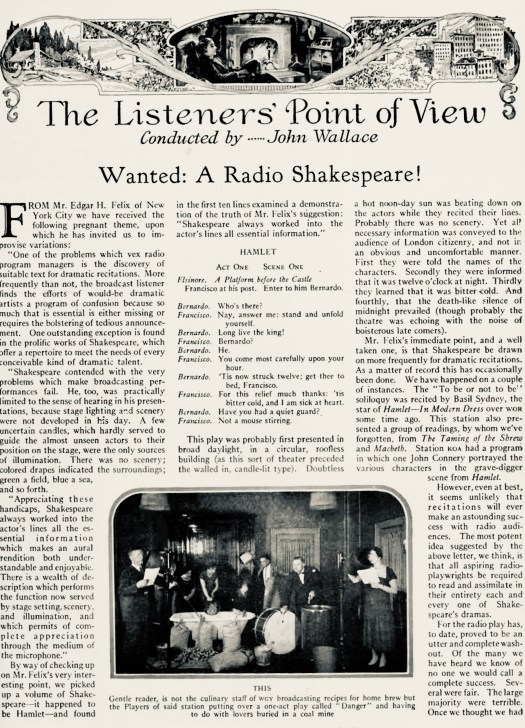
“Wanted: A Radio Shakespeare!” That is the title of an article in Radio Broadcast, published in the spring of 1926. Radio drama was still in its infancy back then, and those fed up with the theatrical entertainments on the air were quick to point out what many would claim thereafter: that Shakespearean drama was an excellent model for unseen theatricals, being that the bard relied less on scenery or physical action and more on words to create characters and tell their stories.

“In the time of Elizabeth there were no stage-sets such as we know them today,” Gordon Lea remarked in his 1926 study Radio Drama and How to Write It. “I dare to believe that the scene supplied by the imagination of the audience in those conditions gave Shakespeare’s texts a fuller significance than many an elaborate setting of more modern times.”

To commemorate the anniversary of Shakespeare’s birth on this day, 23 April, in 1564, I am going to consider playwright’s fate on commercial radio, whose producers, as The Magnificent Montague drove home, were less concerned with the cultural than with the popular. Then again, Shakespeare could always be relied upon to assuage those who looked upon radio with disdain and who listened far less frequently than they talked back. Among the Shakespearean plays readied for the airwaves were The Taming of the Shrew (soundstaged for the John Barrymore Theater on 26 July 1937, Hamlet (presented by the Theater Guild on 4 March 1951), Othello (adapted for Suspense as a two-parter broadcast on 4 May and 11 May 1953), as well as Julius Caesar (in a Mercury Theater production already discussed here).

Owing to the CBS Radio Workshop, we even get an audience with the immortal bard whose stained-glass likeness (shown above) faces me whenever I step inside my library to reach for a piece of pulp. Conjured up for an interview broadcast on 24 February 1956, he was asked: “Who wrote the plays of William Shakespeare.” Not one of those “Who was buried in Grant’s tomb?” kind of questions, to be sure.

Hermia’s words in Midsummer Night’s Dream downplay the challenges of being sightless. A keen ear will succeed where the eye is rendered useless:

Dark night, that from the eye his function takes,
The ear more quick of apprehension makes;
Wherein it doth impair the seeing sense,
It pays the hearing double recompense.
Thou art not by mine eye, Lysander, found;
Mine ear, I thank it, brought me to thy sound.
But why unkindly didst thou leave me so?

Radio listeners need not be left in the dark. They find an audio guide in the narrator, a voice we can trace to the chorus in ancient Greece. From Shakespeare, the wireless playwright may freely borrow the aside, a convention much used in Victorian melodrama, but considered outmoded in 20th-century theater. In radio, those whispered confidences gained force and significance.

Tuning in, we are being addressed, as if singled out, to receive privileged information, although often from the mouths of questionable personages with much to answer for. On the radio, the soliloquy became a convention in soap operatics, causing James Thurber to sneer:

The people of Soapland are constantly talking to themselves [. . .]. The soap people also think aloud a great deal of the time, and this usually is distinguished from straight soliloquy by being spoken into a filter, a device that lends a hollow, resonant tone to the mental voice of the thinker.

Whether it attests to the bard’s radio readiness or simply suggests a conservative approach to his works, adaptations for radio rarely went beyond abridgments. On the air, listeners were presented with a Streamlined Shakespeare, with mere scraps from King Lear, snippets from Romeo and Juliet, or digests of As You Like It.

“Poor Hamlet, he has never been so interrupted” the narrator of Norman Corwin’s “Seems Radio Is Here to Stay” sighs facetiously as the engineer in the broadcasting studio effect the prince’s execution: “Stand by to hear a Dane evaporate.” There was that time, though, when Hamlet went his own way, escaping the play that takes his name.

How would Shakespeare have fared as a radio dramatist, dealing with that special brand of patronage known as advertising? Just listen to his misadventures in Hollywood, as imagined in this Jerome Lawrence-Robert E. Lee comedy, in which a frustrated “Mr. Shakespeare” (voiced by Vincent Price) discovers that one of his plays is being considered as a “summer replacement for Milton Berle,” to be called A Date With Juliet.

Shaking the Spear: How an All-Male Cast Can Tame a “Shrew”

It’s been a while since last I saw The Taming of the Shrew performed onstage—and I didn’t even get to see the feat accomplished. Halfway through, a curtain of rain descended on the players (Tracey Ullman and Morgan Freeman among them), putting a premature end to one of those open-air affairs at New York’s Delacorte Theater. Maybe Kate was lucky that night, for Petruchio sure rains on what might have been her parade. The ending is a challenge for today’s producers and can be an ordeal for the audience, especially those who regard the theater as a political correctional facility of post-modern society. It’s an ending that can make or break both Kate and the play she’s stuck in; for, depending on how The Taming is framed, the bride may well be. So, when I finally got to see Kate reach the end of the matrimonial tether last Friday, in a production by the touring Propeller company, I felt that something had gone terribly wrong.

Propeller stages Shakespearean dramas with an all-male cast, an approach at once traditional and revisionist, considering that female roles used to be performed by male actors and that we, more than four hundred years on, are not at all conditioned to see such casting as conventional, no matter how open-minded we might think ourselves.

Last year’s Propeller production of The Winter’s Tale was so sensitive and engrossing as to de-politicize gender, despite the fact that the guys in gowns sport prominent chest hair and bald spots. It was a revelation to see those tokens of testosterone atomized in tender humanity. The man-handled Shrew, by comparison, is as subtle as the Birdcage—and that nut-strewn coop is no place for a chick-lit contender like Katherine. Strangely enough, cross-dressing had little to do with her mistreatment.

As adapted by Edward Hall and Roger Warren, The Taming refuses to put Petruchio in his place by taking advantage of the apparatus provided, a frame that, as in the 1937 radio version starring John Barrymore, is often removed, leaving the make-believe sparring of Kate and Petruchio unmediated. Petruchio is, after all, a character in a play staged for the purpose of making fun of Christopher Sly, an irresponsible, common drunkard. The frame, to be sure, can be set up as a ready excuse for the misogynist picture within. It is the shaming of Sly that can make the taming of Kate tolerable—and the Propeller players won’t have it that way.

Their version adds a prologue in which Sly is seen standing up his bride at the altar; but instead of getting his come-uppance by becoming the plaything for a nobleman disgusted by the looks of a vagrant lout he encounters, Sly himself is being cast in a raucous shrew-taming comedy and, instead of being a confused if fascinated onlooker, gets to don the mask of Petruchio, a stage costume that becomes an extension of Sly’s macho persona. He is not so much humiliated than humored. And while he has to be reminded in the end that what he performed was merely the illusion of a taming, he is still free to exit the stage as he entered it, free to take women or leave them hanging.

It is the revision of the opening scene that makes the ending so troubling. If Sly gets to play out a fantasy, one he so clearly relishes, without having to deal with the responsibilities of matrimony, the framed Taming is like an episode of the Jerry Springer show featuring the antics of a self-centered, insensitive, and hormonally overcharged jerk. Impersonated with swagger and brawn by Dugald Bruce Lockhart, Sly (in the role of Petruchio) gets considerably more sinister and less likable as the taming proceeds; but, without any chastising or moralizing, he still comes out on top, whereas Kate is reduced to a stoic Victorian heroine, suffering yet submissive.

Taming is a domestic comedy that turns on you in its bitterness; yet Simon Scardifield’s Kate is hardly in on what fun there is to begin with. Instead, she comes across like a desperately mousy housewife so little in need of taming—as all the flamboyant and badly behaved men around her are fiercer far than she—that we pity her before we had much of a chance to cheer her on. I appreciate a fresh take, if fresh it be; but, this time around, Propeller seems to have spun its gay blades out of control.

"This . . . is London": "Searching for Shakespeare" at the Novello, the National Portrait Gallery, and on My iPod

Well, I hardly need to travel all the way down to London to go in search of him. After all, the man—or a stained-glass likeness of him—looks over my shoulder each time I fetch a volume from my bookshelves. His raised eyebrow and faint smile seem to say, “Come now, there must be something else beside radio drama to pique your interest.” For some time now, Shakespeare’s works, along with those of many other acknowledged topnotchers of western prose and poetry, have been relegated to the shelves upstairs to make room for my growing collection of books on American broadcasting and radio dramatics. Yet the bard need not consider himself debarred; even on American radio, he enjoyed a prominent position.

The Radio Guild, the first major American drama anthology for the airwaves, chose Romeo and Juliet for its premiere back in 1929. Subsequently, Orson Welles brought his acclaimed production of Julius Caesar to radio’s Mercury Theater (as discussed here), the irreverent Norman Corwin invited audiences to “[s]tand by to hear a Dane evaporate” as he faded out a production of Hamlet, and the CBS Radio Workshop went so far as to stage an interview with the playwright to investigate just “who wrote the works of William Shakespeare?”

As has often been argued, few dramatic works are as radiogenic as Shakespeare’s plays. They were written for the “wooden O” of an almost bare stage and, though hardly without action, rely much more on the spoken word than the elaborate masques, pantomimes, and melodramas of subsequent generations of playwrights.

When Shakespeare is translated for the contemporary boards, for big screen or small, text is often in competition and at times at odds with context, as costumes and stagecraft conspire to make the spoken word sound dated or the settings seem anachronistic. On the other hand, producers who opt for the blank canvas of a stripped stage in an effort to let Shakespeare’s words speak for themselves, give the eye so little to play with or feast on that they might as well lead us to the theater of the mind by handing out headphones and recordings.

The Royal Shakespeare Company production of As You Like It, now playing at the newly refurbished Novello Theatre in London’s West End, reduces the forest of Arden (or Ardenne) to a single tree. Yet it proves entirely sufficient to suggest a pastoral setting, to allow for some hide and seek among lovers, and to give poor Orlando, pining for his Rosalind, the requisite branches on which to pin his clumsy (and double entendre peppered) verse:

If a hart do lack a hind,
Let him seek out Rosalind.
If the cat will after kind,
So, be sure, will Rosalind.
Wintered garments must be lined,
So must slender Rosalind.
They that reap must sheaf and bind,
Then to cart with Rosalind.
“Sweetest nut hath sourest rind,”
Such a nut is Rosalind.
He that sweetest rose will find
Must find love’s prick, and Rosalind.

Orlando, of course, doesn’t altogether mind the prick of Rosalind (charmingly portrayed by a somewhat Ellen DeGeneresque Nia Williams); professing to cure his aching heart, she makes love to him while disguised as Ganymede, a simulated shepherd whose name spells boytoy of the gods. To be sure, the gender illusions of dramas designed for an all-male cast play out differently for today’s audiences (unless those of the all-male Propeller Company, whose production of The Winter’s Tale I saw last December). It is in these explorations of gender that radio can be more sophisticated and mature by being less provoking.

Non-visual theater can either obscure differences and tone down what may strike some as Charley’s Auntics and encourage us to look past gender markers like skirts and trousers to discover the humanity underneath. As cross-dressing all but fades into thin air, the sexual confusions take on a new subtlety, however drastic the cuts and unfortunate the synopsizing. Hear for yourself in Margaret Webster’s soundstaging of As You Like It, which was produced by the Columbia Workshop on 7 December 1939, and in which Webster gives her vocal chords a winningly understated if all too brief Victor/Victoria workout.

Regrettably, the single-trunk woods where Orlando woos Rosalind will be felled this weekend, when the Novello will stoop so low as to present an adaptation of the faux ’60s musical Footloose. If you care to go “Searching for Shakespeare” elsewhere, there is an exhibition of artifacts and portraits on display at the nearby National Portrait Gallery, my impressions of which I shall share tomorrow.

On This Day in 1938: The Mercury Players “dismember Caesar”

“Let’s be sacrificers, but not butchers,” Brutus implores his co-conspirators prior to the assassination of Julius Caesar. This line might have served as a motto for the Mercury Players when Orson Welles and company decided to adapt their stage success Julius Caesar for radio. They needed to butcher Shakespeare’s play, or at least trim it down considerably; and they were making such a sacrifice to accommodate a larger audience—millions who might not have had the opportunity to take in a production of such a play in their rural communities. It was the butchery of high art and a sacrifice to lowly commerce.

“O, that we then could come by Caesar’s spirit,
And not dismember Caesar!” Brutus (played by Welles), exclaimed. “But, alas,

Caesar must bleed for it. And, gentle friends,
Let’s kill him boldly, but not wrathfully.
Let’s carve him as a dish fit for the gods,
Not hew him as a carcass fit for hounds.

The 11 September 1938 broadcast of Julius Caesar is remarkable for several reason. To begin with, it offered an alternative to the not always inspired programming of the commerce and common denominator oriented networks. And not only was the radio-readied production an ingenious exercise in adaptation but a poignant and timely commentary on the crisis in Europe that was about to plunge the world into war.

11 September 1938 was certainly no less innocent than the day we now commemorate as 9/11. “This is the history of a political assassination,” we are told about the story of Julius Caesar, a “dictator for life” upon whom were bestowed “honors” that “seemed to exceed the limits of ordinary human ambition.” As in the Mercury stage production, the radio adaptation dropped the togas to lay bare the urgency of Shakespeare’s drama, a play that was at once a revenge fantasy and a call to reason. Could a people under the rule of a despot be expected to rise against their leader? Could the forceful removal of such a ruler bring about a new and better world?

To drive home that the broadcast was not an invitation to a literary soiree but a call for a political debate, the Mercury Theater on the Air drew upon the services of H. V. Kaltenborn as a narrator. Kaltenborn was among the most prominent and respected radio commentators of his day. What he uttered was news, not ancient history; and it was certainly not highbrow hooey. His commentary, based upon Plutarch’s Parallel Lives (the source for Shakespeare’s play) but sounding thoroughly contemporary, helped to bridge the gaps in this considerably abridged script, which was acted out by the chief players original cast (Welles as Brutus, Martin Gabel as Cassius, George Coulouris as Antony, and Joseph Holland as Caesar). Kaltenborn assumed a role well suited to Shakespearean theater, which relied on eloquent words rather than elaborate stagecraft to relate its stories.

“How many ages hence” Cassius remarks shortly after the assassination, “Shall this our lofty scene be acted over, / In states unborn and accents yet unknown!” In the Mercury Theater on the Air production, these lines are uttered by Brutus, Welles’s ego being comparable to that of Caesar. Yet, rather than playing the ham and exulting the hoped-for glories of the crime—“peace, freedom, and liberty”—Welles’s Brutus is subdued and plaintive, adding a question mark to the lines. After all, the very “peace, freedom, and liberty” of the West was at stake if fascism continued to spread in Europe and threaten the world. A voice like that of the noble, thoughtful conspirator Brutus might not be heard in future “states unborn” or “accents yet unknown.”

Of course, the Mercury Players also had to deal with the limits of liberty and freedom at home—and on the air. In a climate controlled by advertisers and the FCC, a climate that did not allow for overt political commentary, the Mercury Theater on the Air production of Julius Caesar war remarkably bold and as cunningly executed as Caesar’s assassination. To the “common eye” (or ear), Brutus insists, “We shall be purgers, not murderers.” The Mercury Players’ butchery of lines and characters was a worthwhile sacrifice . . .

Could a people under the rule of a despot be expected to rise against their leader? Could the forceful removal of such a ruler bring about a new and better world? Surely the crisis in the Middle East raised similar questions—but when was the last time CBS television presented a play like Julius Caesar?