
by Harry Heuser
[These gallery texts were written for the exhibition Unmaking the Modern: The Work of Stanley Anderson, which was on show at the School of Art Museum and Galleries, Aberystwyth, from 1 February until 11 March 2016. Links to the other texts for this exhibition are provided at the bottom of this page under the heading “Navigating the Exhibition.”]
Unmaking the Modern: Stanley Anderson, Critic of Modernity
“What a Piece of Work is Man!‘ (1936)
In his work as in his correspondences, Anderson was a fierce critic of modern culture, art and science. He dreaded scientific ‘tendencies’ to ‘fit mankind into a rigidly rational scheme.’ His ‘pet aversion’ was the attempt of scientists to ‘make a square peg fit a round hole’. That metaphor is rendered concrete in The Biometrician (1919).
“What a Piece of Work is Man!‘ (1936), shown below, expresses Anderson’s attitudes toward the contemporary press. The title is a line borrowed from Hamlet. The newspapers on the stands of a public library feature images of warfare. A bishop blesses the troops while men kneel in worship of the machine. Juxtaposed are an advertisement for slimming pills and an article on ‘Hollywood Divorce.’ Meanwhile, a woman with a hole in her stocking studies the help wanted section.
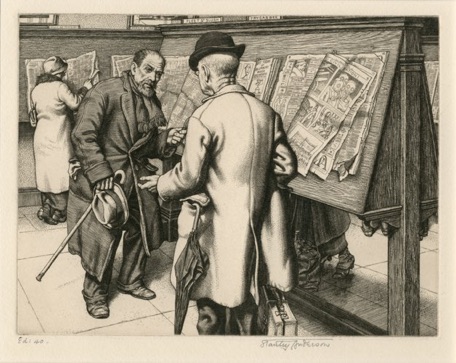
In the same engraving, a magazine editorial ridicules the views of the art critic Herbert Read. A tribal mask mocks Read’s advocacy of modernism. A stick figure drawing slams Read’s championing of children’s art.
As Anderson saw it, modernity was too much concerned with fads and fashions. Diligence and sincerity were rejected in favour of speed and expediency.
‘Progress’
During the 1920s. figures became increasingly prominent in Anderson’s prints. Yet even his earlier city views are never strictly architectural. They are scenes of everyday struggles for survival in an urban environment whose stark contrasts are expressive of rapidly changing times.
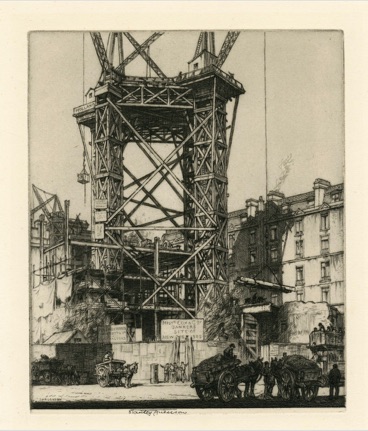
In the etching Cox’s New Site, Pall Mall (1922), pictured above, the contrast of old and new is heightened by the horse-drawn vehicles in front of a towering steel construction. The building site marked the merger of two bank and shipping agencies. Years later, Anderson expressed his dismay at the godlessness of such architectural marvels: ‘How can work be a Te Deum in building a modern church – Woolworth’s or an Insurance Corporation edifice!’
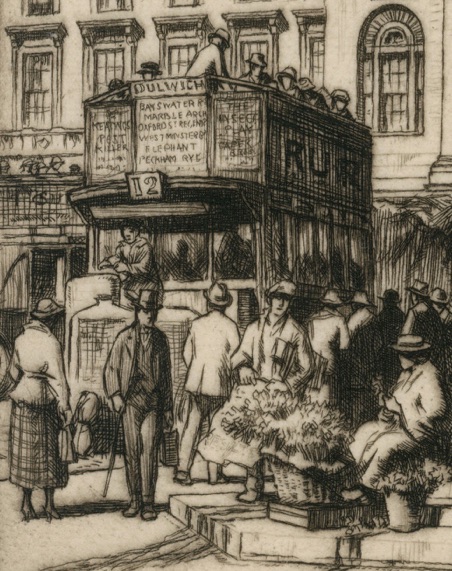
In Piccadilly Circus (1923), pictured below, a sign on a crowded omnibus advertises a pest killer while a billboard on the opposite side announces The Insect Play, a satire by Karel and Josef Čapek. Another reference to Karel Čapek can be spotted in the letters R. U. R. It is the title of the writer’s most famous play, Rossum’s Universal Robots, which introduced the word ‘robot’ into the English dictionary.
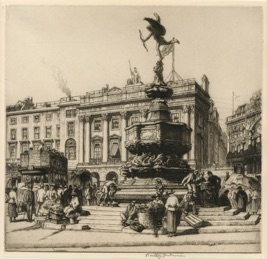
In juxtapositions like these, Anderson communicated his unease about modern business and the spiritual toll it had on the individuals that made up the workforce.
A Mayfair Backwater; or, Crabb’s Opponent (1930)
In the interwar years, the bohemian atmosphere of Shepherd Market in the London borough of Mayfair proved irresistible to artists and writers. Its allure grew with the publication of Michael Arlen’s novel The Green Hat (1924), for which it served as a setting. Creating a play of shadow and light, Anderson draws viewers into an unfolding melodrama of urban life.
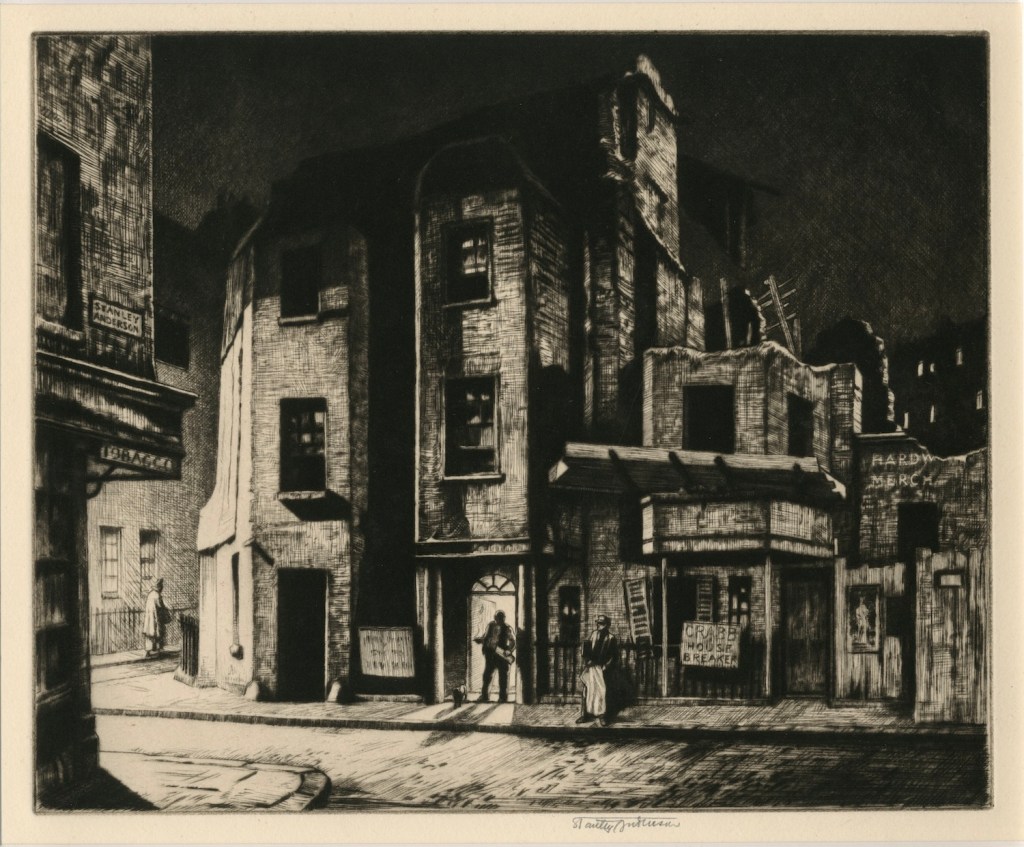
Carrington House, the building with the open door, had once been occupied by Lord Nelson and his mistress, Lady Hamilton. Now it was awaiting demolition. A lone holdout refuses to vacate the roofless shell. Anderson captures the ongoing battle of wits by placing the ‘Opponent’ in the lighted doorway. His defeat is foreshadowed by the writing on the wall.
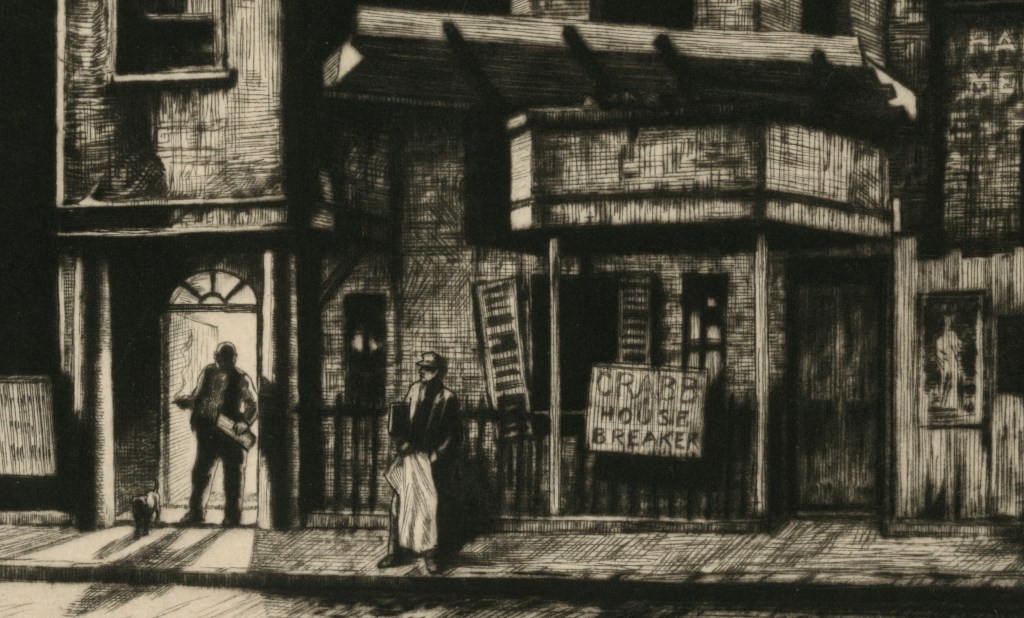
A few years earlier, one of Anderson’s etchings had appeared in a book illustrating a Disappearing London. Chronicling sites of construction and demolition, Anderson brought his opposition to ‘progress’ home.
Gleaners (1932)
Until the death of the last holdout in the mid-1990s, Farringdon Road in Finsbury was teeming with second-hand booksellers. Literature – especially lines of poetry – served Anderson as an inspiration for many of his works.
As a printmaker who frequently relied on words to convey meaning, Anderson deliberated on the titles of the volumes on display here. Between the first and second states of this engraving, he turned ‘Gas Piping as Art’ into ‘Sermons’ by ‘Inge.’ The latter is a reference to the writer William Inge (1860–1954), an Anglican priest known for his pessimistic outlook on progress and civilisation.
The substitution suggests that Anderson meant to portray the gleaning of the humble stalls as a spiritually enriching quest rather than a frivolous pastime. Gleaning – or gathering the leavings that harvesters deem unprofitable – well describes Anderson’s sustained engagement with overlooked and underappreciated subjects.
By-Products (1922)
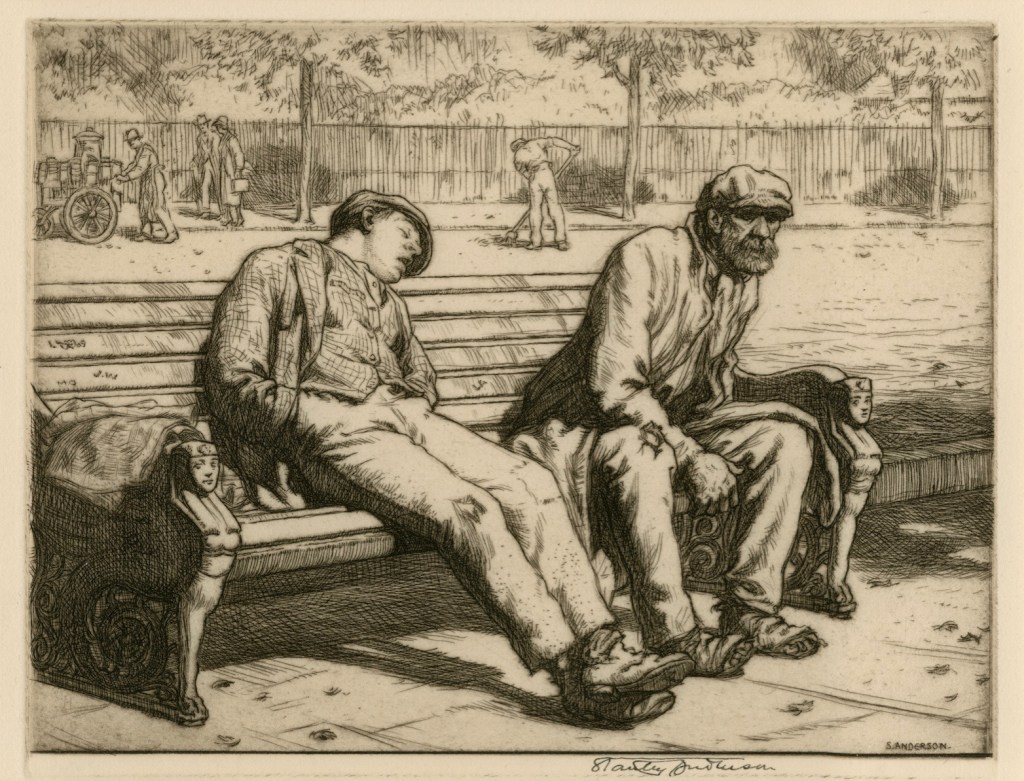
Anderson’s figure subjects of the 1920s and 1930s are distinguished by their compassion for the aged, the vulnerable and poor. Beggars, day labourers and itinerant musicians were among his subjects. In works like these, Anderson insists on making society’s disregard visible by letting modernity’s outcasts take centre stage. They are shown to occupy – to take possession of – public spaces such as park benches, museums and libraries.
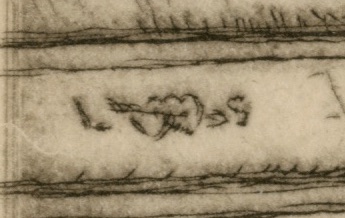
In By-Products (1922), pictured above, Anderson shows his solidarity with the homeless by placing a carving of the letters ‘L’ and ‘S‘ onto the bench. This was a tribute to his wife Lilian, whose initials are also etched into the surface. After the Great War, Lilian Anderson returned to her work as a nurse to support her husband and their two sons. Their fortunes, Anderson suggests, were not far removed from those of his subjects.
Anderson drew the line at romanticising ignorance. The National Gallery (1925), pictured below, mocks a lack of receptiveness to the culturally and spiritually uplifting arts. The visitors he shows have not come to the museum to be enlightened or stimulated. They are merely seeking shelter.
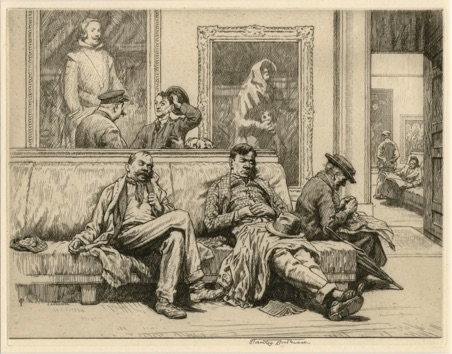
‘Perhaps a little unkind,’ Anderson remarked in retrospect.
Eventide (1937)
Anderson set this scene in a cottage near his home in Towersey, Oxfordshire. As the title suggests, Eventide is an allegorical reflection on the transience of life. To bring this across, Anderson makes references to the grim reaper and the three Fates.
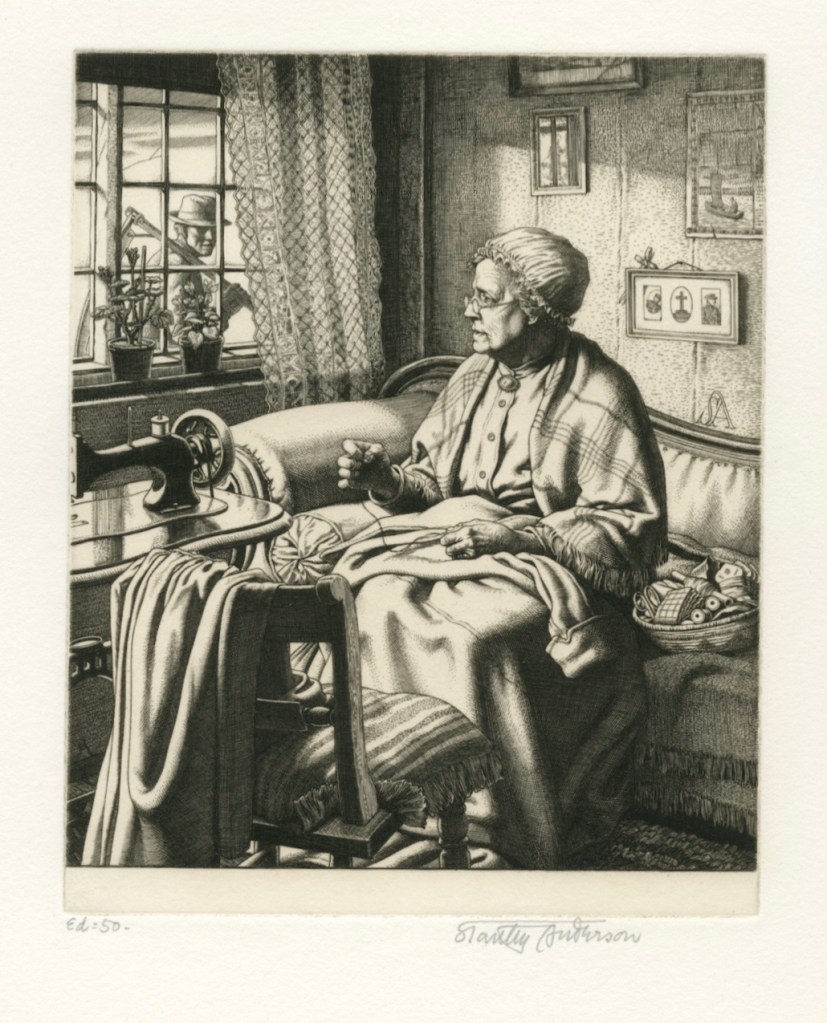
The old woman is temporarily distracted from her needlework by the passing shadow of a farm labourer. His scythe foreshadows her end. For now, though, she is holding on to life. She clutches the thread as the wheel of her sewing machine awaits another spin.
The photographs on the wall tell of lives lost during the Great War – the woman’s husband and son, according to Anderson. A Palm Sunday token is stuck behind the frame. A Christian World Calendar hangs above it. The pattern of the cross is repeated throughout.
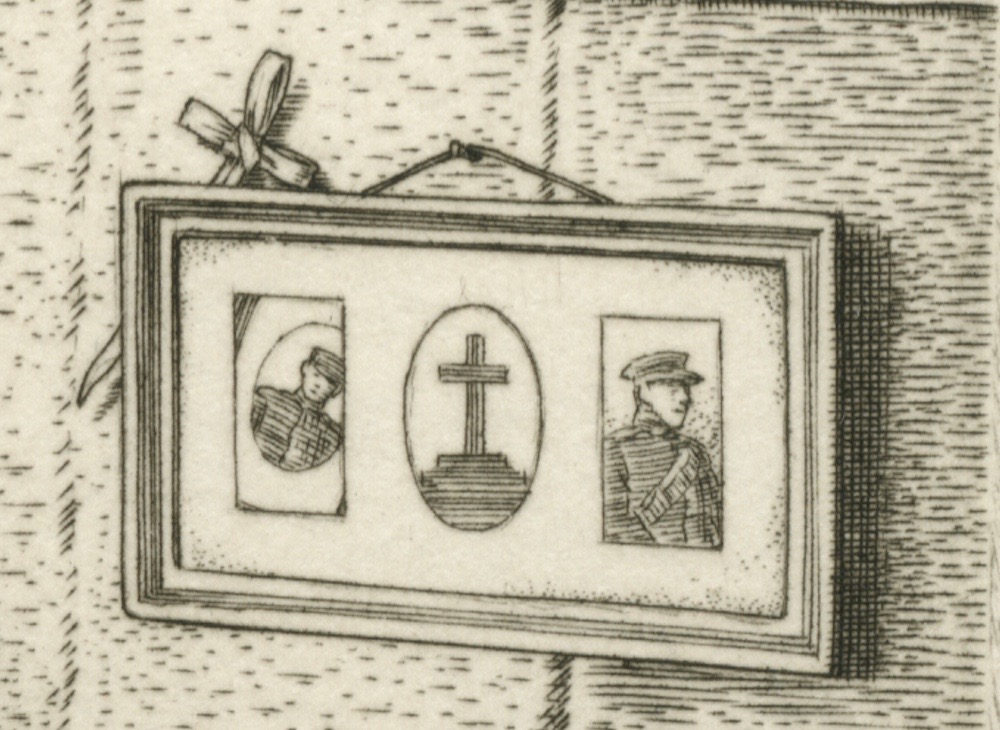
The plate was engraved not long after the air raid on Guernica. It conveys a premonition of things to come.
False Gods (1949)
With False Gods, Anderson came closest to a pictorial representation of his worldview. It is a belated manifesto that sums up what he fought against in his life’s work. He couched his rejection of modernity in allegorical terms that are reminiscent of Renaissance engravings and Gothic architectural forms.

Anderson stated that his ‘general idea’ was to critique the ‘heartless, doctrinaire, materialistic ideology’ of modern Britain. Such beliefs, he argued, resulted from the wartime destruction of the ‘spiritual values underlying men’s thought and activity.’ The manifestations and consequences he observed filled Anderson with ‘utter disgust.’
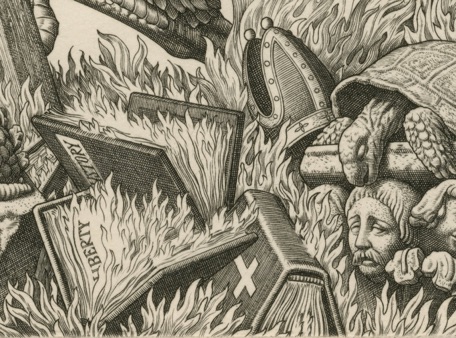
Christianity – emblematized by dove, Bible and mitre – is shown to be consumed by flames. Fire also engulfs a knight, who represents ‘tolerance, charity and dignity.’ Crushed by a giant tortoise are three heads that represent ‘Family’, the ‘basic unit of a sane society.’ In their stead, the ‘evil bird of bogus Democracy’ rises from the flames.
 Harry Heuser