
by Harry Heuser
[These gallery texts were written for the exhibition Unmaking the Modern: The Work of Stanley Anderson, which was on show at the School of Art Museum and Galleries, Aberystwyth, from 1 February until 11 March 2016. Links to the other texts for this exhibition are provided at the bottom of this page under the heading “Navigating the Exhibition.”]
Unmaking the Modern: Tradition, Not Fashion
‘I’m a staunch traditionalist,’ Anderson once declared. ‘It is healthy, robust and engenders a respect for abiding values.’ Those values are expressed in his subjects. They are also apparent in the exactitude with which Anderson executed his prints.
The Sister (1931)
Referencing Dürer, as he does in a 1931 portrait of his wife, Lilian (shown below), or paying homage to the crafts of the Middle Ages, Anderson knew himself to be on the margins of the contemporary art world.
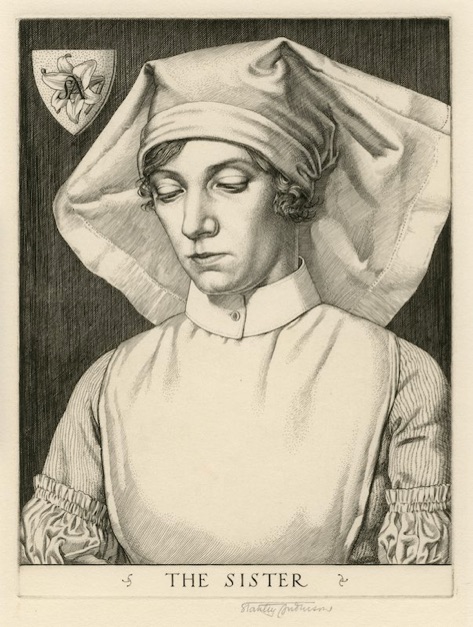
‘Nowadays,’ he wrote, ‘If you display any professional skill you are indeed damned as an artist.’ And yet, the ‘mastery’ of the medium, as apparent in the works of Botticelli or Titian, was ‘greatly envied’ by twentieth-century artists – if only they had the courage to ‘speak true.’
The modern age was ‘too prone to demand and accept the “isms” of the pedagogue,’ Anderson protested. Artists were up against a ‘raging sea of propaganda and piffle.’ Those who refused to ‘conform to the fashionable ethic or aesthetic’ were ‘abused as reactionaries.’
Anderson did not dismiss fellow artists. He defied the critics and academics who tell us what contemporary art should be.
Self Portrait (1933)
The engraving below show Anderson at the height of his career. He had just enjoyed a successful retrospective of his prints, drawings and paintings. That same year, the first catalogue of Anderson’s etchings and engravings was published. In the following year, Anderson would be elected Associate of the Royal Academy of Arts.
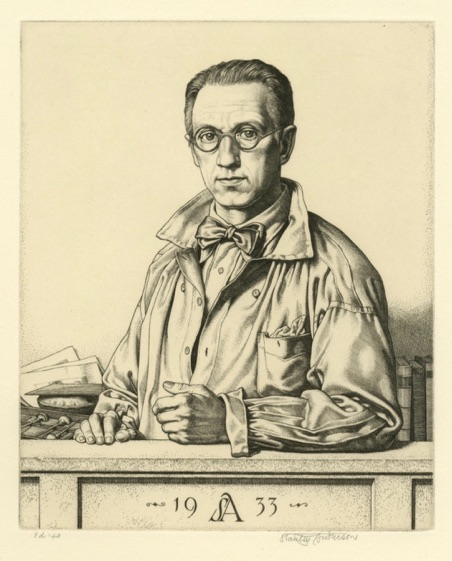
Anderson has been described as shy and reticent. Here, though, his confidence is apparent. He proudly displays his gravers and trial proofs. A copper plate rests on a sandbag.
The portrait acknowledges the Old Masters that Anderson revered: Titian’s portrait Man with a Quilted Sleeve and Rembrandt’s etched Self Portrait Leaning on a Stone Sill. Referencing Dürer, Anderson indulged in the flourish of incising his triangular, dated monogram onto the sill.
All works featured here are reproduced and discussed in the book Stanley Anderson RA. Prints: A Catalogue Raisonné by Robert Meyrick and Harry Heuser (Royal Academy, London, 2015).
 Harry Heuser