
by Harry Heuser
[These gallery texts were written for the exhibition Unmaking the Modern: The Work of Stanley Anderson, which was on show at the School of Art Museum and Galleries, Aberystwyth, from 1 February until 11 March 2016. Links to the other texts for this exhibition are provided at the bottom of this page under the heading “Navigating the Exhibition.”]
Unmaking the Modern: What Matters and What Sells
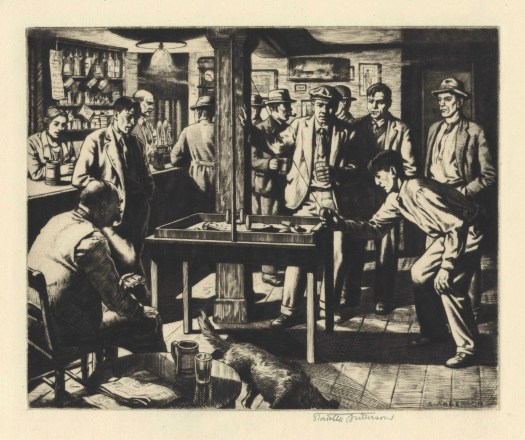
Thematically, Anderson worked in the tradition of the genre etchers and painters of seventeenth-century Holland. Tavern interiors and outdoor markets were among his preferred subjects.
‘Art, for me, is a companionable thing,’ Anderson once declared. Beer and Skittles (1933), below, reflects this. It is a group portrait of neighbours and friends.
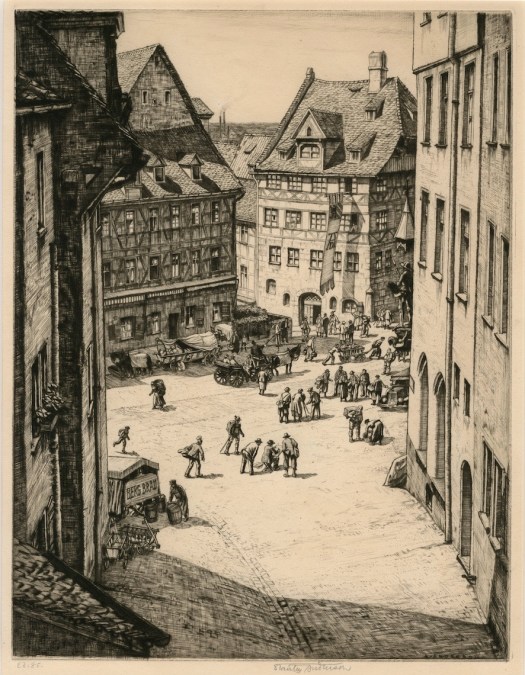
During the interwar years, however, there was a greater demand for architectural subjects. To supply them, Anderson made several visits to Europe. ‘I was merely forced abroad’, he told a friend, because there was little interest in anything other than ‘foreign subjects.’ With the exception of Dürer’s house in Nuremberg (pictured below), landmarks and celebrated views had no personal appeal for Anderson.
In 1925, Anderson was appointed as an etching instructor at the University of London’s Goldsmiths’ College. The steady income made it possible for him to abandon commissions for architectural subjects. He increasingly focussed on scenes rather than sites.
Anderson was ‘at last coming into his own’, the print connoisseur and art critic Malcolm Salaman commented in 1926. Anderson’s ‘presentations of places are always alive.’ They demonstrate a ‘sincere and sympathetic interest in his fellow creatures, whatever their circumstances.’
All works featured here are reproduced and discussed in the book Stanley Anderson RA. Prints: A Catalogue Raisonné by Robert Meyrick and Harry Heuser (Royal Academy, London, 2015).
 Harry Heuser