
“Ladies and gentlemen. We have grand news for you tonight, for the Lux Radio Theater has moved to Hollywood. And here we are in a theater of our very own. The Lux Radio Theater, Hollywood Boulevard, in the motion picture capital of the world. The curtain rises.”
Going up with great fanfare on this day, 1 June, in 1936, that curtain, made of words and music for the listening multitude in homes across the United States, revealed more than a stage. It showed how an established if stuffy venue for the recycling of Broadway plays could be transformed into a spectacular new showcase for the allied talents at work in motion pictures, network radio, and advertisement.
“Frankly, I was skeptical when the announcement first reached this office,” Radio Guide’s executive vice-president and general manager Curtis Mitchell declared not long after the Hollywood premiere. The program was “an old production as radio shows go,” Mitchell remarked, one that was “rich with the respect and honors” it had garnered during its first two years on the air. Why meddle with an established formula?
Mitchell’s misgivings were soon allayed. The newly refurbished Lux Radio Theater had not been on the air for more than two weeks; and Radio Guide already rewarded it with a “Medal of Merit”—given, so the magazine argued, “because its sponsors had the courage to make a daring move” that, in turn, had “increased the enjoyment of radio listeners.” There’s nothing like a new wrinkle to shake the impression of starchiness.
“I cannot help but feel,” Mitchell continued, that the “two recent performances emanating from Hollywood have lifted it in a new elevation in public esteem. Personally, listening to these famous actors under the direction of Cecil De Mille, all of them broadcasting almost from their own front yards, gave me a new thrill.”
That DeMille had, in fact, no hand in the production did little to diminish the thrill. An open secret rather than a bald lie, the phony title was part of an elaborate illusion. The veteran producer-director brought prestige to the format, attracted an audience with promises of behind-the-scenes tidbits, and sold a lot of soap flakes throughout his tenure; and even if the act wouldn’t wash, he could always rely on the continuity writers to supply the hogwash.
As DeMille reminded listeners on that inaugural broadcast (and as I mentioned on a previous occasion), Lux had “been a household word in the DeMille family for 870 years,” his family crest bearing the motto “Lux tua vita mea.” Oh, Lever Brother!
Perhaps the motto should have been “Manus manum lavat.” After all, that is what the Lux Radio Theater demonstrated most forcibly. In the Lux Radio Theater, one hand washed the other, with a bar of toilet soap always within reach. As I put it in Etherised Victorians, my doctoral study on the subject of radio plays, it
was in its mediation between the ordinary and the supreme that a middlebrow program like Lux served to promote network programming as a commercially effective and culturally sophisticated hub for consumers, sponsors, and related entertainment industries.
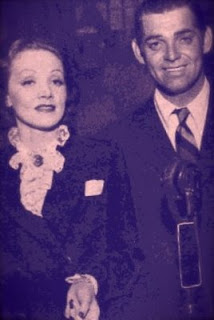
With DeMille as nominal producer and Academy Award-winner Louis Silver as musical director, the new productions came at a considerable cost for the sponsor: some $300 a minute, as reported in another issue of Radio Guide for the week ending 1 August 1937. Of the $17,500 spent on “The Legionnaire and the Lady,” the first Hollywood production, $5000 went to Marlene Dietrich, while co-star Clark Gable received $3,500. Those were tidy sums back the, especially considering that the two leads had not even shown up for rehearsals.
The investment paid off; a single Monday night broadcast reportedly attracted as many listeners as flocked to America’s movie theaters on the remaining days of the week. As DeMille put it in his introduction to the first Hollywood broadcast, the audience of the Lux Radio Theater was “greater than any four walls could encompass.” Besides, the auditorium from which the broadcasts emanated was already crowded with luminaries.
“I see a lot of familiar faces,” DeMille was expected to convince those sitting at home: “There’s Joan Blondell, Gary Cooper (he stars in my next picture, The Plainsman), Stuart Erwin and his lovely wife June Collier.”
Also present were Al Jolson, Ruby Keeler, and Franchot Tone. “And I, I think I see Freddie March,” DeMille added in a rather unsuccessful attempt at faking an ad lib. While there is ample room for doubt that any “nine out of ten” of those stars named actually used Lux, as the slogan alleged, they sure made use of the Lux Radio Theater. It was an excellent promotional platform, a soapbox of giant proportions.

As I was reminded on a trip to the Lady Lever Art Gallery in Port Sunlight last year, Lever Brothers had always been adroit at mixing their business with other people’s pleasure. Long before the Leverhulmes went west to hitch their wagon on one Hollywood star or another, they had disproved the Wildean maxim that the greatest art is to conceal art and that art, for art’s sake, must be useless.
It is owing to the advertising agents in charge of the Lever account that even the long frowned upon “commercial” did no longer seem quite such a dirty word.
Related recording
“The Legionnaire and the Lady,” Lux Radio Theater (1 June 1936)
Related blog entries
“Cleaning Up Her Act: Dietrich, Hollywood, and Lola Lola’s Laundry”
Tyrone Power Slips Out to War on a Bar of Soap”
“After Twenty Years of Pushing Stars and Peddling Soap, a Hollywood Institution Closes Down”
Discover more from Harry Heuser
Subscribe to get the latest posts sent to your email.
 Harry Heuser
Interesting bit of history there. Do you know whether that theater still exists?Also interesting: the Related writings. Do you choose those or did a robot collect all of your soapy titles?
LikeLike
It does, Doug:http://www.you-are-here.com/theatre/musicbox.htmlNot so glamorous now, huh? The Music Box accommodated the Lux Radio Theater from June 1936 to May 1940, when productions moved to the Vine Street Playhouse. The history of the program has been excellently told in Billips and Pierce's Lux Presents Hollywood (1995). For the above, I used contemporary sources, which I very much enjoy doing.Robots? No, just me checking whether I am repeating myself. I started this after you (justly) complained about the profusion of links in my posts.The top link is usually the most relevant or the one I like best; I did link to the bit about The Blue Angel since a box of Lux was prominently displayed in that movie.
LikeLike
Got it. And I don't complain, I discourage. (Feel free to use a Bette Davis voice for that one.)
LikeLike
Why, I believe I've seen that, by golly.I wondered if the list was aggregated from titles with soap references.
LikeLike
Well, whatever you call it, you were convincing. I simply checked the entries filed under \”Lux Radio Theater\” and picked three. There's plenty more \”soap\” in my journal, though, along with \”opera.\”
LikeLike