
“Notice anything different since your last visit?” asked a friend of mine—himself a former New Yorker now living in the wasteland of discarded values that is the Sunshine State of emergency known as Florida. We were chatting on the phone some time after my arrival in the estival Big Apple, a stew seasoned with the smoke of Canadian wildfires.
I had not been in town for about eight months, so I was bound to spot some change beyond the odd coin left in my wallet. My bank account was taking a sustained beating while I was trying to enjoy a few drinks with friends at my favorite watering holes. But that was to be expected.
Apart from air pollution, price hikes and the relentless bulldozing of neighborhood community, continuity and character wrought by the wrecking of the architecture for a glimpse of which we will soon have to refer to painting by Edward Hopper—nothing new there, either—what struck me most was an outbreak different from but related to the pandemic that, in the form of COVID-19 testing tents on Manhattan street corners, still dominated the sidewalks in the autumn of 2022. At one of them, I had tested positive for the first time.
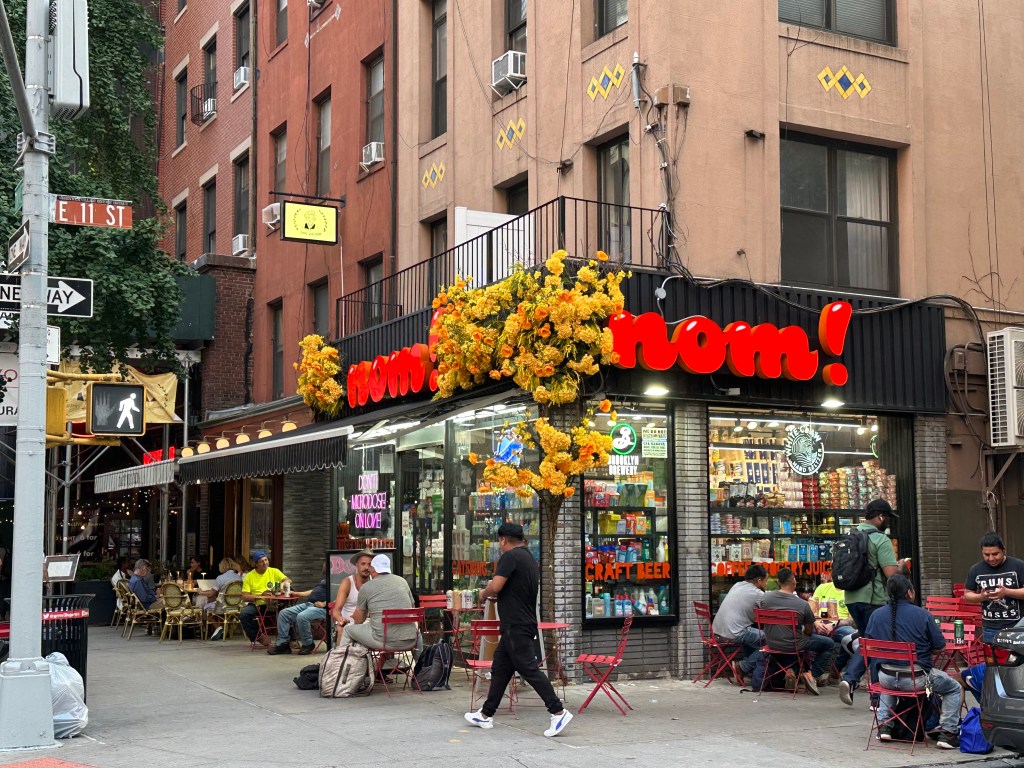
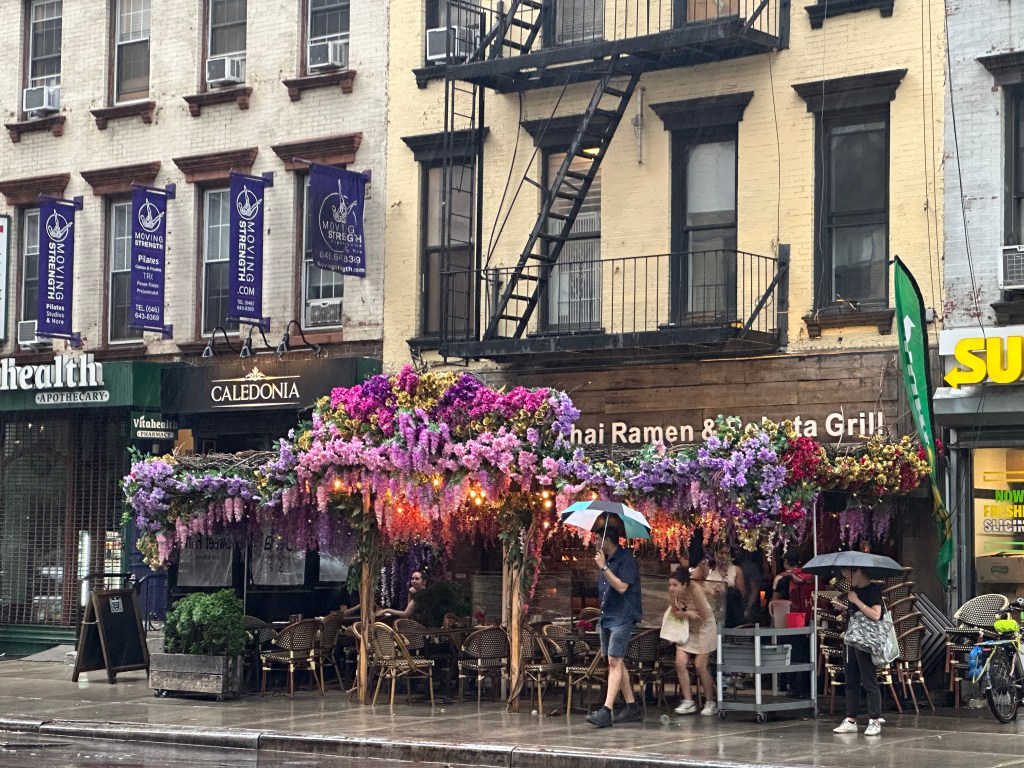
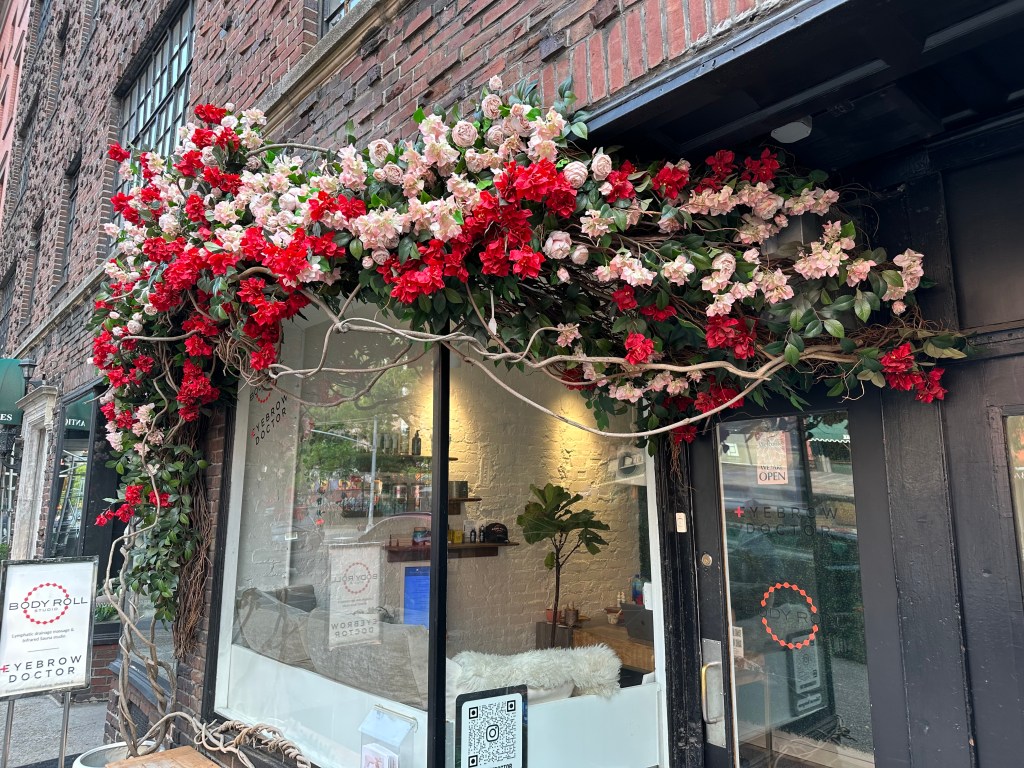
Arriving as I did not long after the summer solstice, I expected a cityscape richer in natural adornments than in the comparative bleakness of a soggy late October. Instead, what I encountered was a florescence of environmentally hazardous excess in the form of garishly coloured plastic flowers supplanting the nakedness of brick and mortar as if it were Greek and Roman statuary that, after thousands of years in the buff, was now deemed to be in need of weatherproof and reason-resisting fig leaves. Suddenly Seymour!


Designed to dupe desperate restaurateurs into assuming that what it takes to attract customers is to bedrape the shabby structures of the makeshift outdoor dining spaces that emerged during the Covid pandemic, those outgrowths of nature-mimicking material culture now spread well beyond the city’s overspill eateries. They have taken hold of storefronts for businesses of all description, from shops selling hardware to establishments providing massages and pedicures. Not even flower shops—which presumably still traffic in genuine ancestors of the wayward and vengeful Triffids—are spared from this invasion of petroleum-based floral fakery.

Bloom!, an outdoor performance in front of the Lincoln Center library – Hearst Plaza, yikes!—that was billed as a “colorful and spirited 17-minute-long aerial spectacle performed atop SWAY’s bespoke 15-foot sway pole” took the homage to nature in the absence of it a step further: three dancers sprouting giant faux petals and twirling dizzily like wind-propelled blossoms—ostensibly “[i]nspired by the beautiful flowers of the Smoky Mountains”— awaiting pollination and death in the midday heat.

Well, the mountains are now more smoky than ever. So, in light of every environmental catastrophe upon us now—from deadly heatwaves to rising waters—how might we account for this New York minute when benightedness was in flower?
Witnessing the Disneylandification of nature and culture alike—a history in the faking that now extends to the merging of the virtual and the real through VR and AR technology, as well as to the AI-generated art now on view at the Museum of Modern Art—I was reminded of Umberto Eco’s Travels in Hyperreality, a journey undertaking in search of “instances where the American imagination demands the real thing and, to attain it, must fabricate the absolute fake,” “where the boundaries between game and illusion are blurred” and “falsehood is enjoyed in a situation of ‘fullness,’ of horror vacui.”
Eco’s decades-old observations reverberate with new urgency. “Disneyland tells us that faked nature corresponds much more to our daydream demands,” he reasoned; it “tells us that technology can give us more reality than nature can.” Except that, now, nature no longer can, at least not with the efficiency we came to expect from it.
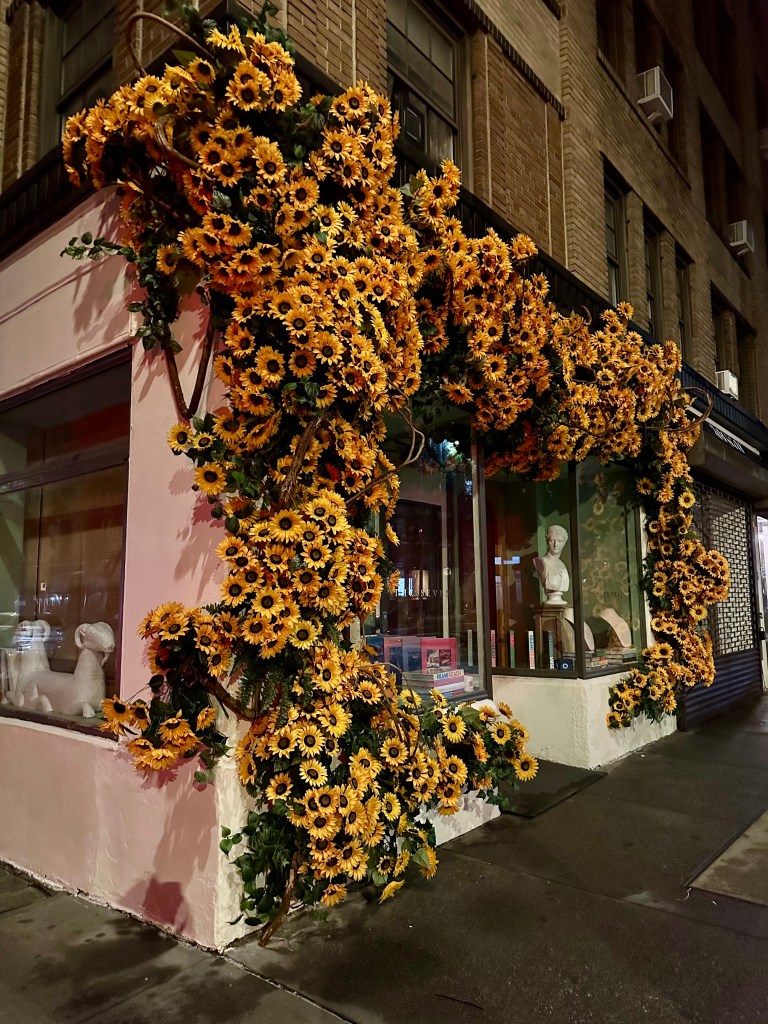
I suppose that is just it: a sign of surrender to the new normal. Weather extremes are making it less likely for flowers to bloom in droughts or endure in torrential rains, now that even the cacti of Arizona a collapsing in the heat. Phoney vegetation may not require watering, thus saving precious natural resources, but they will wilt all the same in the exposure to sunlight and are doomed to look faded after a season of spurious bloom. They are tomorrow’s waste reminding us of the wastefulness of today.
A memorial to the anthropocentric hubris that consumes us, those dead flowers now mark the grave we have dug for ourselves.
Discover more from Harry Heuser
Subscribe to get the latest posts sent to your email.
 Harry Heuser
Indeed… I have never liked fake flowers, unless they are made to break down naturally.
LikeLike