

What is this sound and fury? Just who is behind it all? And why? Rather than making assumptions about the receptiveness—or perceptiveness—of radio listeners back in October 1924, I asked myself those questions as I tuned in belatedly and indirectly, via the internet, to a 1962 recreation of the orchestrated chaos that is Hans Flesch’s Zauberei auf dem Sender.
Subtitled “Versuch einer Rundfunkgroteske” (“an attempt at a radio grotesque”), Zauberei is widely considered to be the earliest exponent of the Hörspiel (literally, “ear-play”) to be broadcast in Germany, or, to be precise, that nation’s Weimar variant, Germany’s first, flawed and spectacularly failing experiment in democracy.
In December 1924, a few weeks after the play was performed live in a studio in Frankfurt am Main, the script appeared in an issue of Funk, a German periodical devoted to radio technology and broadcasting.
Now, “Funk” in German refers to wireless transmission—but, when it comes to Zauberei auf dem Sender, the “funk” you may be left with could well be blue.
Then again, “funk,” in English, can denote “panic” or “depression,” depending on whether you consult a British or US American English dictionary. As my preferred spelling suggests, the latter comes first to my mind. After all, even though Zauberei is a precursor of The War of the Worlds, the infamous “panic” broadcast of 1938, its mischievous make-believe—the trompe-l’oreille of overhearing history in the making or, at least, broadcasting in the unmaking—concludes not in a mock annihilation of humankind but in a return to business as usual.
Set in a broadcasting studio and taking place, in real time, as a live broadcast that has gone awry but, due to technical difficulties brought about through practical magic, proves impossible to take off the air, Zauberei is taking issue with the notion that radio is chiefly a means of propagation. Instead, it makes a case for broadcasting not as a means but as an end—demonstrating the inextricability of medium and form, content and channel of distribution.
That is, Zauberei aims to be art for and of the wireless rather than merely being a product presented on but not particular to the airwaves; a drama, for instance, that could also be performed on the stage or a narrative that was previously published in print. In his first and only original play for radio, Flesch reflects playfully on the medium’s potentialities and the limitations imposed on that medium by the system of broadcasting as delimited by the policies and politics that govern it.
Zauberei is the “funk,” in the new-world sense of the word, in which the stifled development of radio art left writers and producers at a time when a such a critique was at least still possible—less than a decade before German radio became a propagandist apparatus of the Reich, the fascist regime that would prosecute Flesch, by then the Director of Radio Berlin, and systematically quell the creativity with which he had set out to inspirit government-controlled broadcasting, a spirit he sought to conjure by means of the medium itself.
In Zauberei, the instrument of “sorcery,” “wizardry” or “magic” (and, surely, these possible translations of Zauberei are not interchangeable)—is a trickster who infiltrates and hexes a broadcast in progress in an attempt to claim the medium as his domain after having been derided as a peddler of legerdemain not suited for sightless display.
In the end, the spirit that plays havoc with a performance of “The Blue Danube” waltz by Johann Strauss II is subdued and reduced to a mere blip—a momentary disturbance of the order of the broadcast day, as memorable as it may have been to those turning in.
I first mentioned Zauberei auf dem Sender in a conference paper I presented at Ghent University in 2019, where I cited it as an early—and perhaps the earliest—example of the self-reflexivity, or self-consciousness, that is one of the hallmarks of writing for a medium that, by virtue of its immateriality, impermanence and invisibility, was—and is—often looked upon, unless overlooked altogether as so lacking in the tangible qualities of screen, stage and print media as to be prone to cultivating an inferiority complex.
So what, a nutshell—or in a poodle’s kernel—is the point of Zauberei? “Des Pudels Kern” (the kernel or core of the poodle) is a German expression derived from Goethe’s Faust (Part One), in which the devil, Mephistopheles, takes on and is observed to have shed the guise of a black dog of a breed, widely considered to be of German origin and/but not generally known for its ferocity. Flesch’s play demonstrate that to extract the kernel—to have it all figured out so it can perform like clockwork—is to extinguish the spirit of broadcasting.
While “The Blue Danube” plays on relentlessly if beautifully, the conclusion of Flesch’s script nonetheless calls for voices shouting “Where is the magician?” and expressing an “astonishment” about his disappearance (“Man hört Rufe: ‘Wo ist der Zauberer?’ Erstaunen, dass er weg ist.”)—a clamor or chorus that is not heard in the 1962 production.
To me, those voices are at the heart of Flesch’s broadcast, a critique of broadcasting that opens with the interference of the “Märchentante” (the fairy-tale auntie), who bursts in on a musical broadcast being announced to request two minutes of time to argue for an enchantment by radio, a magic that need not be relegated to the children’s hour. Everything in broadcasting is so “terribly grown-up,” she insists (“Aber alles das ist so schrecklich erwachsen”).
At the same time, the play comments on the reality that a broadcast lasts only for the duration of its transmission, that it is “da” (“here”) and “weg” (“gone”). In that sense, it can only be as mature as a fruit fly ever gets to be. Meanwhile, the director of broadcasting needs to ensure that whatever follows has the same chance of a brief life on the air. Experimentation cannot be anarchy if the channel of experimentation is to remain open.
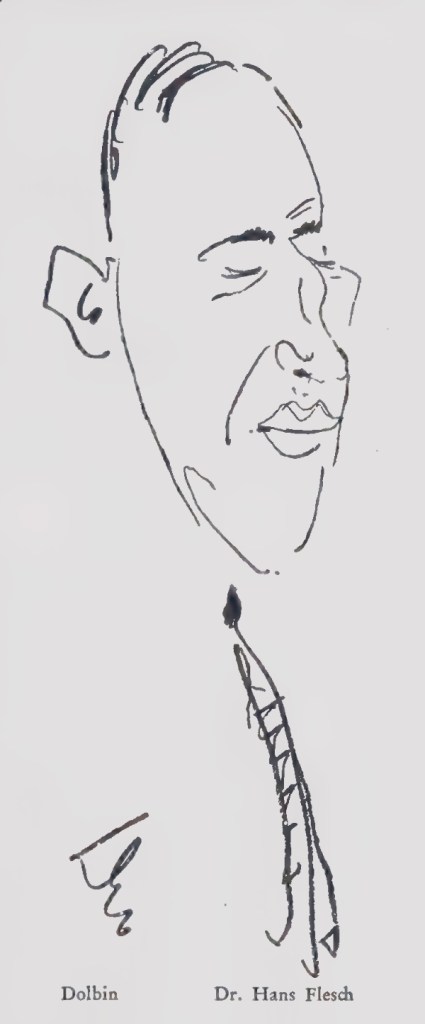
Hans Flesch, a reluctant medical doctor turned wireless wizard who, toward the end of the war, was called upon, as a “Halbjude” (“half-Jew”) barred from practice, to become a physician once more, vanished without a trace just weeks before Victory in Europe was declared. In vain, the allies went in search of him, hoping to reinstate him as a broadcasting director.
“Where is the magician,” you ask? Well, as hard as the Reich tried to discredit him and erase his legacy, the wizard has never left. His playfulness and inquisitive nature remain readable in the printed script. The spirit of Herr Doktor Flesch—a pioneer born on this day, 18 December, in 1896—is alive in the practicable magic of “Zauberei auf dem Sender.”
Discover more from Harry Heuser
Subscribe to get the latest posts sent to your email.
 Harry Heuser
Fascinating! Wonder what became of Flesch? I wonder if I am a Halbjude, although I think my mother being Jewish would make me a full Jew. Who knows? Bill
LikeLike
Yes, Bill, a fascinating story and life. Why did Flesch, unable to work in radio or medicine for over a decade, remain in Germany? He had a family, of course, and at least had the support of friends. He was the brother-in-law of the composer Paul Hindemith, who emigrated to Switzerland and later became a US citizen. Hans Flesch is one among hundreds of thousands of individuals to have remained verschollen (missing) in Germany after the Second World War.
LikeLike