
“What is the basic force that makes the human mind function?” The question was posed not at a symposium attended by noted philosophers and physicians, but to the readers of the 27 February 1926 issue of Radio Digest, who were subsequently asked:
What is telepathy? Is it not fundamentally Radio activity, a form of Radio transmission[?] Can the energy that starts a mass of brain cells into motion, that formulates thought and speech[,] be propelled as the voice is propelled from the vibration of the fragile filament in a vacuum tube? Does this energy ever die? Can it be attuned, converted into controlled ether wave movement, refined to audible sensitiveness?
Whoa! One question at a time, if you please—and, thinking as a public speaker—if you expect a question to sink in and elicit a response. Other than “Whoa!” that is. A bit of context would be helpful.
The above is not a passage from Upton Sinclair’s Mental Radio, a treatise written in the late 1920s, published in 1931, and endorsed by Albert Einstein. As the notion that telepathy was “fundamentally” a form of wireless transmission suggests—apart from the fact that it was published in Radio Digest—the context in which the question was posed was wireless transmission—and radio “drama” in particular.
Offering listeners “an opportunity to win fame, honor and bags of gold” for the solution of a mystery about to commence, the editors of Radio Digest got more specific, explaining:
These are questions to be considered in the strange case of Peleg Turner in the first two chapters of A Step on the Stairs, appearing in this issue of Radio Digest. Was it the voice of the dead Peleg that manifested itself, as he had predicted, through the Radio horn for the benefit of his heirs?
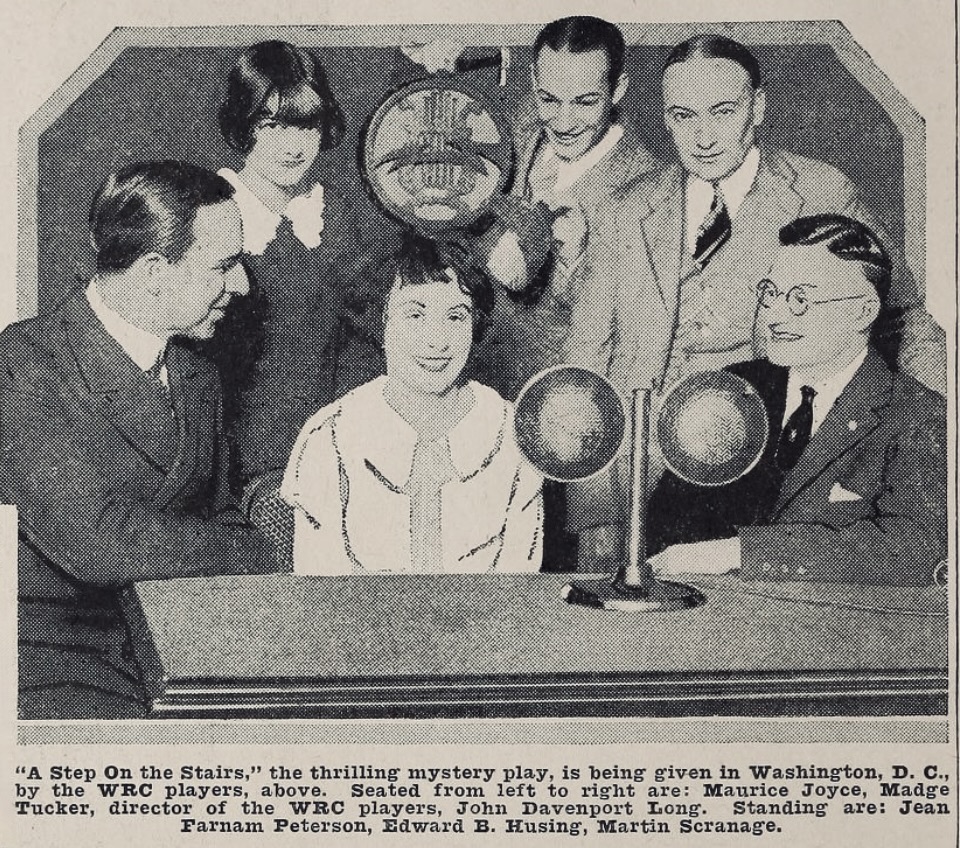
Call it ballyhoo or baloney, with those words, one of the earliest radio serials was launched in February 1926.
Depending on where listeners lived, and to which station they tuned in, the ten-part serial got under way as early as 26 February, when it was broadcast over WOC, Davenport, the station of the Palmer School of Chiropractic. Folks tuning in to WMAQ, the famed station of the Chicago Daily News, had to wait until 10 March for the first fifteen-minute instalment.
This was not merely a matter of airing a program but of staging a play. In the days before chain (or network) radio, each station had its own cast, producers, and technical staff. WRC, which had not yet determined a start for the serial when the 27 February 1926 issue of Radio Digest went to print, featured a personality that would become one of the foremost sportscasters of the 1940s and ‘50s, Ted Husing. Husing mentions A Step on the Stairs in passing in his 1935 biography Ten Years Before the Mike, stating that he served as the announcer of the program.
I, too, made scant mention of A Step on the Stairs in Immaterial Culture: Literature, Drama, and the American Radio Play, 1929-1954 (Peter Lang, 2013), my study of the development of the radio play in the United States in relation, as the subtitle is meant to signal, to previously established forms of storytelling. While my research has continued, and is shared here in broadcastellan, my online journal devoted largely to erstwhile popular culture, the omission was not the result of a lack thereof.
My interpretations of radio plays in Immaterial Culture are based on listening experiences and readings of published scripts—which, apart from its date, ruled out a discussion of A Step on the Stairs, a thriller narrative adapted for radio of which only the source material appeared in print.
Trying to catch up with it now, one hundred years after its premiere on 26 February in 1926, I am confronted with the hybridity, marginalization and relative failure of the radio play to develop and survive as a form relatively independent of, or at least distinct from narratives created for print, stage and screen.
In his epic Encyclopedia of American Radio, 1920-1960, Luther Sies calls A Step on the Stairs, an “unusual mystery serial, perhaps the first to be broadcast on radio.” The statement is not—and could not be—rooted in a listening experience, however. It concerns the nature of the serial’s production, as mentioned above, which can be gleaned from the pages of Radio Digest, the sponsor of the program.
No wonder, then, that A Step on the Stairs was heralded by that publication as the “fruition of a new and significant phase of Radio literature.” A work of “literature,” almost in spite of itself, which would be put into “Radario Form”—a short-lived term meaning “radio scenario”—and broadcast live from stations across the United States.
Radio Digest’s publicity campaign went so far as to advance the claim that A Step on the Stairs “came at the psychological moment when a change in the trend of broadcast programs seemed imperative.” A matter of taste, perhaps, or of demand and supply. Just who was having that “psychological moment,” and why at this point in time precisely? Little would be written about the psychology in relation to radio plays until the “The War of the Worlds” broadcast more than two decades later.
Responsible for the material to be prepared for broadcasting—a story, rather than a radario, “written especially for Radio Digest”—was Robert L. Casey, whom Radio Digest’s unnamed hyperbolist declared to be a “world-famed author” with “over two hundred creepy, mystery stories” to his credit. “He is easily the peer of climax builders; the master mind of imaginative intrigue; the apex of creators of thrilling episodes and unforget[t]able complexities.”
Casey, the editors of Radio Digest insisted, was a writer “technically familiar with Radio broadcasting,” who knew the
possibilities from the transmission end through his staff connection with the Chicago Daily News broadcasting station, WMAQ. In his own home he has a specially building and equipped laboratory for experimenting in Radio reception.
Given his experience as a thriller writer, coupled with his technical expertise, the argument went, Casey was capable of
bring[ing] out the latent effects concealed in the mystery of the average box receiving set. He is opening a box of tricks new to readers and the listening world. He knows the art of weaving adroit situations that make the reader shiver with ghostly apprehensions, cry with tragic climaxes and laugh at comical incidents.
The advantage Casey had was that, as Radio Digest put it, there was, to the “average listener,”
a magic about the cabinet and the speaker bring[ing] voices out of the silent air that from all parts of the world. It is enveloped mystery that seems almost supernatural. It is capable of emitting sounds and noises created by the ephemeral atmosphere itself.
Casey, the editors claimed, had written a story that would “bring out sounds from the Radio horn hitherto unheard” and that “in all probability,” would “mystify even the most skilled of Radio engineers as to their cause.” Might they “be called forth from the world of the departed dead?”
If all that is magical and marvelous about the ether were not enough to induce anyone to tune in—and there must have been some doubt, apparently—Radio Digest offered $500 in gold to listeners who wrote in with the “best” solution to the story.
Now, what puzzles me—or frustrates, rather, given that I have studied the no-matter of radio long enough to know better—is that Radio Digest did not publish the broadcast script, despite the claim that Casey’s A Step on the Stairs had been adapted by “one of the most experienced Radio dramatists in the country.” Fred Smith, the publication grandiloquently stated, had “taken Mr. Casey’s story and converted it into living and spiritual personalities who will come to you through the air.”
Had Smith’s script been published it would enable us better to appreciate how the medium was understood and employed back in 1926 to achieve a dramatic experience worth staying tuned for, week after week.
That not as much as a sample of the script make it onto the pages of a magazine devoted to the wireless speaks volumes about the status and development of the radio play in the United States, a hybrid form of drama and storytelling that, even in its heyday, was lamented to be “orphan child of accepted literature.”
Left only with Casey’s serialized print narrative as a source, readers, if any of them should stumble on this obscure story, might well find it challenging to imagine just what A Step on the Stairs might have sounded like on the air. Not unlike the aforementioned Sue ‘Em, the first radio play to be published in the United States—a play actually written for the medium—the story, as printed in Radio Digest, made me doubt, at least initially, that the potentialities of sound-only storytelling was quite grasped either by the editors of Radio Digest or by Casey, the writer whose thriller the magazine had commissioned.
Consider the introductory paragraph, for instance, as it appeared in the 27 February 1926 issue of Radio Digest:
Under the whispering cedars one-armed man stood motionless, shielding his eyes with his hand and peering through the blizzard—almost impenetrable now that twilight was falling—toward the little boat landing at the foot of the driveway. There was a footfall on the brittle ice along the shore and then, presently, a ringing step on the packed snow near the park. The one-armed man stepped suddenly out of his shelter to confront a youthful figure in a heavy ulster. Recognition in such a light would have been impossible, even had the newcomer’s face not been shielded by the long bill of a cap and the folds of a plaid muffler that crept up over his chin. Still, the one-armed man peered at him for a long time, silently and appraisingly.
Apart from those “whispering cedars,” the “ringing step,” and a “Who’s there!” encounter complicated by a lack of visibility that recalls the premise of Richard Hughes’ Comedy of Danger (1924)—the centennial of which “first” in British radio play I had the pleasure of commemorating at an event I co-hosted at the National Library here in Wales—the opening of A Step on the Stairs does not sound like a creative product sufficiently in tune with the advantages of sound-only storytelling.
The intrigue of the scene, its mysteriousness, is derived from the description of visuals to such an extent that listeners would have to be guided by a narrator. A “plaid muffler” would be an altogether pointless accoutrements in a blizzard howling on the air.
Nor is a “one-armed man” peering “silently” any more radiogenic than a two-armed one—unless a sound effect artist took such a character as an opportunity creatively to respond to the Buddhist riddle “What is the sound of one hand clapping?” And how might sound effects be employed to capture the act of stepping out of an automobile whose “door swung open with the noiselessness of oiled hinges”—cue sound effects artists scratching their heads, or banging them—while a “tall dark man in the garments of the East stood facing her…. Indian, perhaps, or Malaysian.”
Station WHO, Des Moines, at least had the distinction of being “favored,” as the editors of Radio Digest put it, “with a real Hindu,” a graduate of Iowa State University, in the part of Hari Singh, a character whose name, I assume, was inspired by the Maharaja who ascended to the throne of Jammu and Kashmir in February 1926, just as the radio serial got underway.
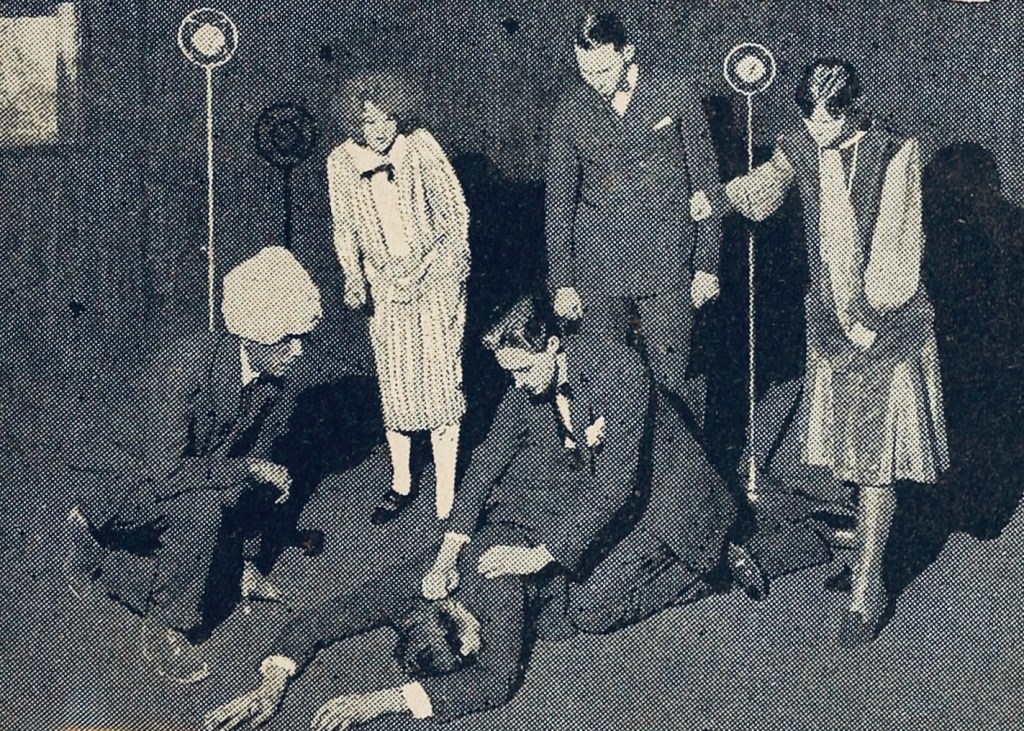
The staff of WGY, Schenectady, New Jersey, meanwhile, could rely on the expertise of Ten Eyck Clay, actor-director of the WGY Players. According to an article on radio sound effects published in the 21 November 1926 issue of the New York Times, Clay was a “seasoned actor of the stage ‘prop’” who had “found that the most difficult problem” of “radio drama,” one “demanding most in time and energy,” was the “production of sound-scenery,” as the “obvious sound”—meaning, probably, the most “obvious” because actual source of sound—was “not always the most suitable to produce a certain effect.”
Technical challenges of its staging notwithstanding, A Step on the Stairs is essentially an old dark house thriller, the craze for which dates back at least to Seven Keys to Baldpate, a 1913 novel by Charlie Chan creator Earl Derr Biggers that was dramatized by George M. Cohan and, by 1925, long before it was retrofitted for radio comedian Jack Benny, had already been adapted three times for the screen.
A more direct ancestor of Casey’s brainchild is John Willard’s 1922 comedy-thriller The Cat and the Canary, a play in which a group of characters are summoned to a remote mansion for the reading of a will. Rather than simply borrowing that premise, however, Casey’s serial novel for Radio Digest puts a reflexive spin on the material by installing a lawyer who baffles the assembled parties by conveying the intention of their dead relative, Peleg Turner, to transmit the content of his last will via the wireless:
“At midnight tonight […] I shall attempt to communicate with you by the only instrument that gives a voice to the great unfathomable ether—the Radio. I shall speak to those assembled here and I shall tell them what I have learned of the secrets of this cursed house. The lights must be turned out and the guests whom I have caused to be gathered here will sit quietly before the radio receiver, the dials of which have been set to the markings hereinafter designated.”
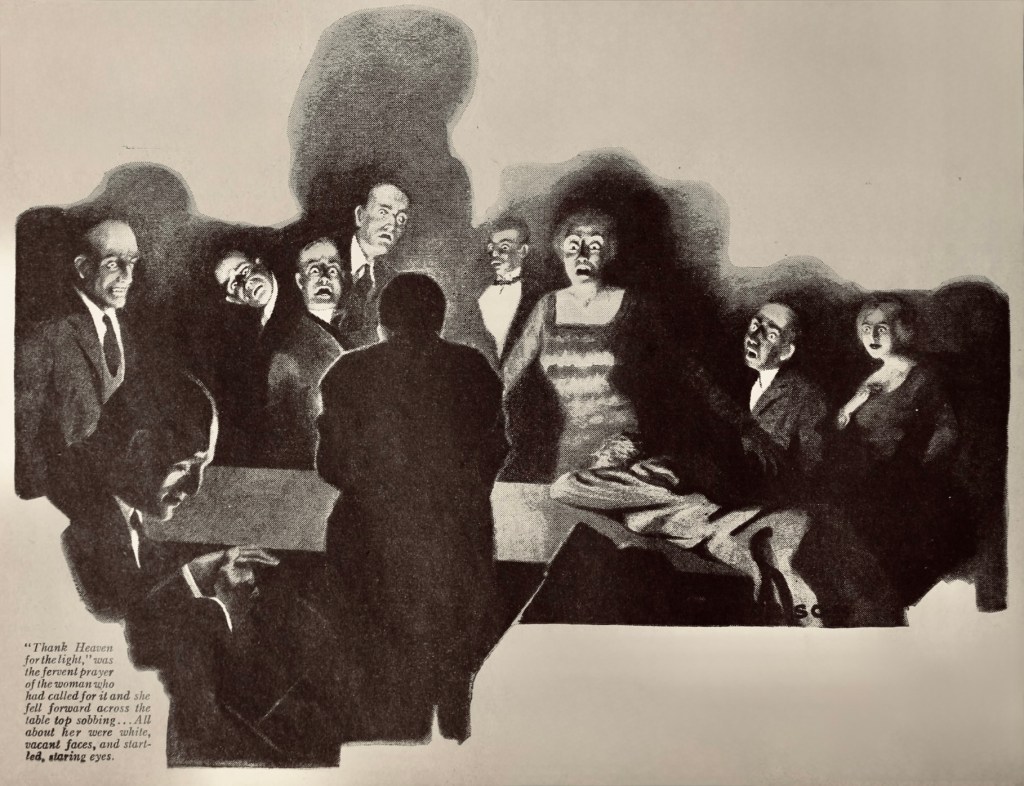
Sure enough, when the candles are snuffed out, the radio begins to “whisper,” just as the “seldom used” front door of the Turner manse opens, a door through which only bodies on their “last journey” are known to exit.
“This,” boomed the voice of the Radio with sudden clarity and volume. “This is Station FYX. We are about to broadcast.”
The groaning of Aunt Helen … the wild sobbing of men and women, speechless in the panic of the dark, were suddenly silenced by a crash from the Radio.
“Something’s gone wrong at FYX,” declared the lawyer Ardwyn, shaken out of his complacency for the first time.
A smashing of glass followed the first reports. Muffled cries filtered through the speaker.
“Help!” shouted a choking voice. “Don’t let him get me … don’t.”
An echoing report, terribly real and convincing despite the distortion of the curving horn, ended the appeal.
“A pistol shot,” murmured someone in the hunt-room. And then once more the voice of the announcer almost unrecognizable in its terror:
“There has been a murder at FYX,” it repeated over and over again. “For the love of God send the police.”
Granted, a play featuring a radio, however prominently, is not ipso facto a radio play—J. B. Priestley’s Dangerous Corner (1932) comes to mind, as does the British mystery novel Death at Broadcasting House (1934)—the self-consciousness of “SOS,” the acronym by which A Step on the Stairs was being promoted in the press, pulled in its listening audience by thrusting them into a circle of characters who, like the listener, were sitting in front of a wireless receiver, an instrument known to be temperamental and unreliable.
The act of tuning-in to a play that, before the first instalment is completed, appears to end in murder on the air, thus becomes an immersive event, the participatory framework of which was extended by way of the contest that promised listeners and readers a reward for playing detective.
More than the mystery of the convoluted plot, it was the mysteriousness of the set-up and atmosphere that rendered A Step on the Stairs a no doubt thrilling listening event no synopsis could adequately capture. Radio Digest’s weekly inducement to continued engagement with the serial lays bare the claptrap of melodrama, reducing magic to hokum:
Who bit Lawyer Ardwyn on the wrist and stole the letter taken from the motorcycle cop? Who shot the engineer at FYX? Why did sweet Mary Williams faint—if she really did faint? What became of the bearded pirate? The next installment will offer new clews and present new complications for those who are hoping to get some of that $500 in gold to be awarded by Radio Digest for the correct solution at the finish. Be sure to read the next installment!
And yet, even a synopsis as preposterous as that published in the 6 March 1926 issue of Radio Digest, manages to foreground the audile quality of Fred Smith’s “radario” script as performed on the air:
Following the indicated opening of the awful and symbolic front door, through which no Turners have passed except in death, and the fight in the broadcasting station which was heard over the Turner receiver, pandemonium is king. Ghostly shrieks rent the darkness. Cries of terror-crazed women and the futile cursing of men are heard, with the crashing of overturned furniture and the vain beating of fists against the heavy oak panels of the doors of the locked room—the room that has been the scene of strange and mysterious crimes.
Whereas the serialized novel published in the pages of Radio Digest from 27 February to 1 May 1926 was accompanied by illustrations, the radio adaptation staged by as many as eighteen stations across the US was augmented by a “special musical score of weird tunes and orchestral effects.” The latter serves to evoke, while the former interprets, fixing the images that radio magic conjures.
Four-and-a-half years before The Trial of Vivienne Ware (1930), a serialized courtroom drama touted as the “first radio novel,” hit the airwave with similar fanfare, A Step on the Stairs, for all its second-handedness as an adaptation and its dubiousness as a publicity stunt, emerged as an electrifying spectacle for the ear that, I suspect, thrived due to “the distortion of the curving horn,” not despite of it.
Far from being aurally stunted, the novel intended to be a radario managed to play with the gothic possibilities of an emerging mass medium that, in 1926, still had an air of mystery about it—an enchantment of spirit telephony few of us who now consume serial thrillers via practical streaming services are ever likely to experience.
Discover more from Harry Heuser
Subscribe to get the latest posts sent to your email.
 Harry Heuser