“A piece of ice”: Greenland, a US Mission, and the Drafting of Another War Below Zero

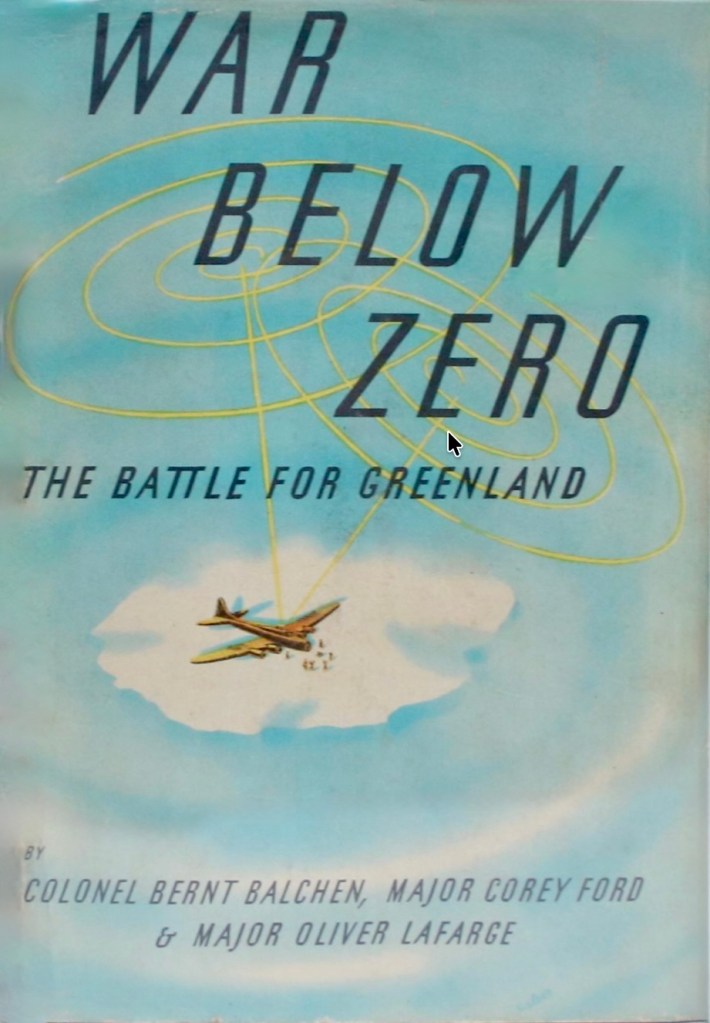
The dust jacket of War Below Zero (1944)

When, at the 2026 World Economic Forum in Davos, the forty-seventh and perhaps last elected President of the United States, in one of his characteristic falsehood-and-insult-littered tirades, referred to Greenland, an autonomous territory of Denmark he had long coveted, as “a piece of ice,” his imperialism, imperiousness and imperviousness to historical facts were once again on blindingly stark display.

Greenland, Iceland, or whatever the misleader of the fabled free world may call the largest island of them all—if indeed it is land, or a land, rather than a frozen asset on the verge of liquidation—it needed to be his, outright.  Until, that is, Number 47 (previously 45 but never adding up to more than number two) was duped into settling for cubes portioned out in a deal existing since 1951.  Put that in your Diet Coke and drink it, sucker!

“A piece of ice.”  Is not Melania enough? Well, not according to the Epstein files, if ever we get to see them entire and unredacted.  The likely scenario of hell freezing over comes to mind, boggled though it is.

“A piece of ice.”  That, clearly, is what cultures and communities—history and humanity—are to a rapacious tyke-oon, a petulant plutocrat whose crude, rudimentary vocabulary and short attention span remind us daily how limited his definition of “great” is and how precisely that limitation sums up the narrow mind of a bottom feeder—a Moron-roe Doctrinaire?—raised, none too loftily, on the notion that anyone aspiring to be a big fish needs to swallow whatever comes or gets into his way.  

Greatness, thus conceived, means little more than to amass much to amount to more in the eyes of the world he, in a less-than-popular deviation from his America First agenda, has set his greedy peepers on.

“A piece of ice,” indeed! The word is chilling enough as an acronym, when it refers to a deadly experiment in cryotherapy involving the deep-freezing of democracy until it falls off the body politic as if it were an unwelcome and unsightly growth.

While I could not gauge the degree of ire among the largely undemonstrative audience at Davos, the phrase certainly made my blood boil, as does pretty much every exhausting waste of air emanating from a hothead whose actions are raising the global temperature as perilously as the actual warming his administration has chosen to deny for the opportunity of raking in a final few billions.  When Number 47 talks Greenland, you can bet he means greenbacks.

It is undeniably global warming that makes the island of Kalaallit Nunaat more strategic a region than it ever was, now that melting ice caps open routes and facilitate access to the Arctic.

Climate change was not yet an issue during the so-called “Battle for Greenland”—the subtitle and subject of War Below Zero, a book published in 1944.  And yet, atmospheric conditions and the ability to forecast them on location were apparently key to the US interest in the region in a pre-satellite age.

According to War Below Zero, the conflict in question was not a war for “territory” but “a war for weather.”

Continue reading ““A piece of ice”: Greenland, a US Mission, and the Drafting of Another War Below Zero”

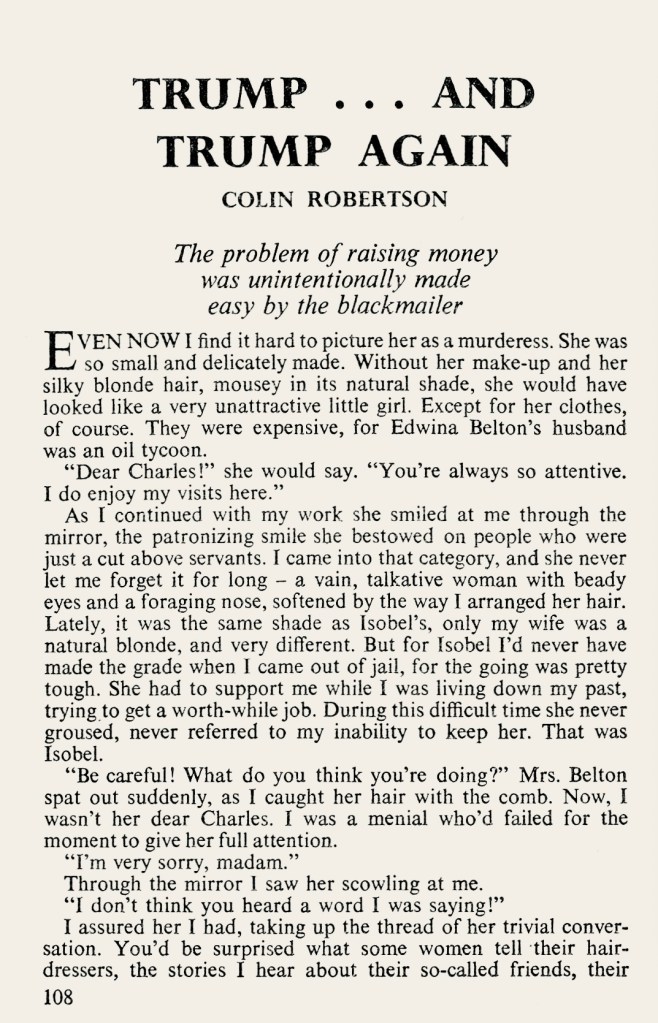
“Trump … and Trump Again”: Pulp, Politics and the Impossibility of Getting Away from the One Who Gets Away with Murder

A page from Edgar Wallace Mystery Magazine, May 1965

Over the past few months, enervated by minor illnesses and the lingering nuisance of ingrown eyelashes that make reading for pleasure less than pleasurable, I have been busying myself performing the mentally undemanding task of cataloguing my digital collection of detective and mystery magazines, most of which, for the reason aforementioned, still await my perusal.

Not one to embrace chaos or relish disorder, I derive comfort from such indexing.  The virtue of record-keeping is not simply its own reward, however.  After all, owing to a dogged determination that some may prefer to label “anal retentiveness” or look upon as signs of life “somewhere on the spectrum,” I now have a fairly comprehensive overview of twentieth-century British and US American crime fiction, especially by writers active during the so-called golden age of murder mysteries between the two world wars, authors whose rules-governed puzzles resonate with us once more in a period of heightened global uncertainties and the attendant anxieties to which they gives rise.

I was just completing, for the time being, my currently 139-page-long single-spaced crimino-bibliography, replete with cross-references and annotations, when I happened on an item that brought home again how elusive and downright illusory any attempts are to escape, via fictional chronicles of crimes long solved, from the actual and ongoing illegalities of today, not least the enforced lawlessness in the rewilded West of the by now all but nominal United States.

Continue reading ““Trump … and Trump Again”: Pulp, Politics and the Impossibility of Getting Away from the One Who Gets Away with Murder”

“It gets something off my chest, doesn’t it?”: Keeping Norman Corwin’s “Appointment” (1941) Because Liberty Won’t Keep in the Heat of Hatred

Cover of Thirteen by Corwin,
containing “Appointment,”
from my collection of radio-related literature

Speaking out against fascism—publicly and nationally, via the airwaves—used to be regarded in the United States of America as a moral imperative, or at least, in the terms of the Federal Communications Commission (FCC), as an act “in the public interest.”

These days, in the era of MAGA on steroids—and, to be clear, the first “A” in the acronym can be readily substituted to designate any number of imperiled democracies—fascism is no longer the anathema to democratic rule that it used to be understood as constituting.  

This is mainly because democracy itself—as a construct, an ideal and a reality—has become anathema to the members of a growing movement that is celebratory of autocracy and that, perversely and perfidiously, argues anti-fascism to be a threat to autocracy as a preferred system of streamlined government in which checks and balances are discarded and in which oppositional forces and alternative voices are denounced as deleterious and traitorous.

I had been meaning to write about the weaponization of the FCC in the wake of the cancellation and temporary or partial silencing of late night talk shows critical of the Trump administration; but for some reason, and via a route too tedious to trace, I happened, quite fortuitously, as it turns out, on a script for a radio play by poet-journalist Norman Corwin, the unofficial “poet laureate” of US radio during the early to mid-1940s.

I have already devoted a dozen or so posts to Corwin and his work, including plays as diverse as “A Man with a Platform,” “My Client Curley,” and “Seems Radio Is Here to Stay.”   

To this day, one of the most rewarding acknowledgments of my scholarly pursuits, such as they are, remains receiving word from Corwin expressive of his approval of my academic writings on him.

Although I have discussed many of Corwin’s writings for radio in Immaterial Culture, I had somehow failed to show up for his “Appointment”—a play first produced on 1 June 1941 as part of the cycle Twenty-six by Corwin.

Continue reading ““It gets something off my chest, doesn’t it?”: Keeping Norman Corwin’s “Appointment” (1941) Because Liberty Won’t Keep in the Heat of Hatred”

“The First Radio Play Printed in America”: “Sue ‘Em” (1925) and the Ensuing Question of Legitimacy

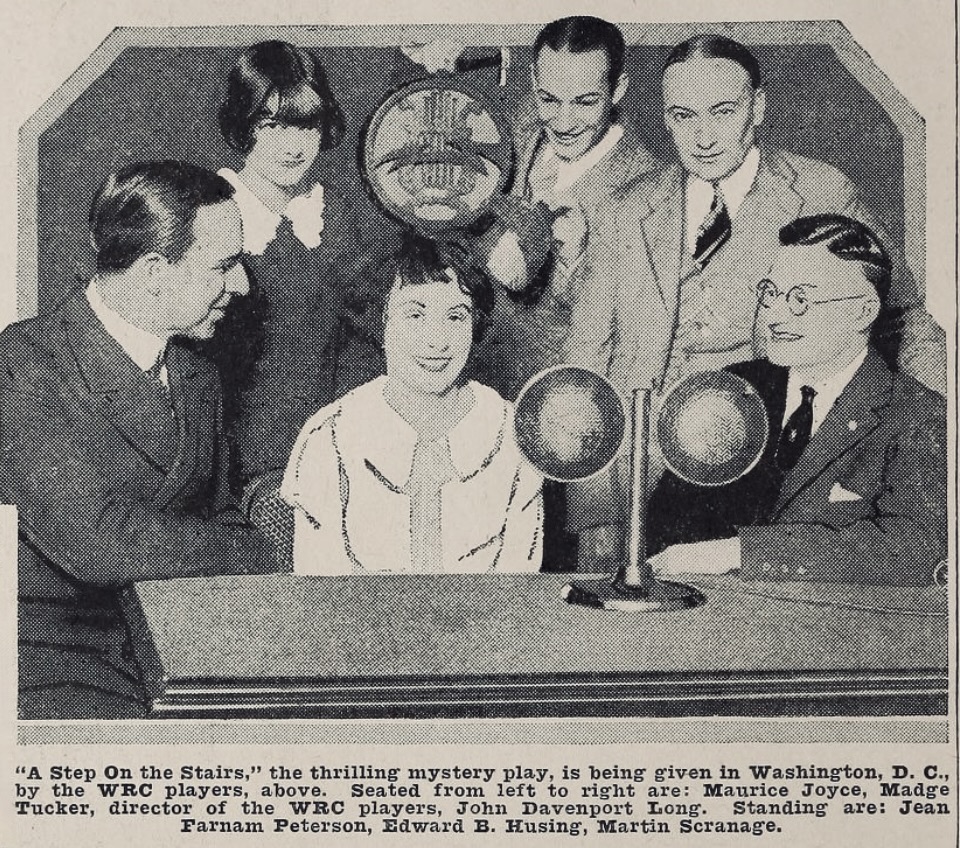
A photograph published in the April 1926 issue of Radio Broadcast
showing a young John Huston (left) and fellow members of the Provincetown Players

Here I go again.  Another broadcasting centenary, another radio “first.”  This “First,” mind, is wrapped in quotation marks, as the claim is not mine.  I am not going to dispute it, either, or challenge someone else to have the last word in the old “Who’s on First?” routine.  I have been there before.

Picture it: Early 2024.  I am commemorating the one-hundredth anniversary of radio “drama” at an event I staged with British playwright Lucy Gough at the National Library of Wales.  I set out by acknowledging the widely held assumption that Comedy of Danger by playwright-novelist Richard Hughes was the “first” original radio play to be broadcast … anywhere.

The claim served as a hook.  It was designed to underscore the international significance of the event.  At the same time, I tried to justify its happening in Wales by drawing attention to the play’s Welsh setting and the playwright’s affinity with the country.  More important to me than arriving at a definitive answer to the vexed question of whether Comedy of Danger should be regarded as the “first” of its kind are the shifting definitions of the term “radio play” on which, to my mind, hinges the answer to that question—or rather, its unanswerability and ultimate pointlessness.

After all, it is difficult to say what is “first” in any field if the field itself is not clearly delimited first, or if the field is so limitless that it defies delineation in the first place.  In the case of “radio play,” Hörspiel (play for listening) or radio drama—relatively arcane though this field of study may be—definitions not only vary greatly but are often not even attempted.

When is a play a radio play? That is a question I have been asking for a long time in my musings on the wireless, and it is a question I keep asking myself.  “When is a play a radio play” strikes me as a more useful way of framing the debate than the more obvious question “What is a radio play?” because the former encourages us to avoid the most perfunctory of answers: A radio play is a play written for and/or heard on the radio.  

Sure, on the surface it barely scratches, that statement sounds reasonable enough.  But are all plays written and produced for radio broadcasting radio plays by default? Is it the medium, then, that makes a play—any play—a radio play?

Not that “radio” as we understand or know it these days bears a close resemblance to “radio”—as a receiver set, a system, and a phenomenon—anno 1925, the year when Sue ‘Em, proclaimed by its publisher to be the “first radio play printed” in the USA, successfully made a play for first place in a radio playwrighting contest.

Continue reading ““The First Radio Play Printed in America”: “Sue ‘Em” (1925) and the Ensuing Question of Legitimacy”

“Ministry of All Fools”: Carol Carnac’s Murder as a Fine Art (1953), “Cozy” Crime, and the Crisis of the “Contemporary”

Digging into my collection of British Library Crime Classics

You do not need to be a card-carrying member of the Thursday Murder Club to have spotted the signs, superabundant as they are.  Like red herrings surreptitiously slipped into a vegan barbeque, the pattern of mischief and deceit is too conspicuous to go unnoticed: murder mysteries, whether freshly prepared, reheated or rehashed à la mode, are back with the vengeance particular to them.

Fictional murders are just what we assume the doctor would order if reliable medical advice, especially in this age of unfounded attacks on science—were within easy reach of our purse.  I won’t go so far as to call mysteries the patent medicine of our day; but I am convinced they are taken freely and frequently as a temporary remedy for the widespread malady of which they are symptomatic.

Not to generalize from the small sample of my experience, but only yesterday—and “yesterday” only because I can never get my act together so as to leave “today” unedited—I walked home after paying an overdue visit to the Gayberystwyth Books, that indispensable local dispensary of diversity-affirming queerness, with a copy of Jaime West’s Death on the Pier (2022), a murder mystery set in 1933 Brighton.  All the while, I am screaming bloody murder at the sight of division sowers like Trump and Farage who are determined to push the democracies they blight ever closer toward Berlin 1933.

Meanwhile, so-called “cozy crime” is back on the pop-cultural menu.  Mysteries have become part of a regular diet, healthy or otherwise, followed, like a regimen of killer recipes from a keto cookbook, by millions of contemporary fiction bingers, be they bookworms or streaming service subscribers.  Defying the warning label, I am currently ingesting Not to Be Taken (1937-38), a serialized whodunit by Anthony Berkeley published in the US under the title “A Puzzle in Poison.”

“One Man’s Poison” might be a suitable alternative title for Murder as a Fine Art (1953), my previous dose of the genre, even though the weapon employed by “another man”—whose identity I shall refrain from divulging here—is, despite its material refinement, rather less sophisticated once applied: a pompous government employee at the fictional Ministry of Art is brought down—splatter of brains and all—by a giant Canova bust, for which the victim had long expressed a violent dislike.

The crime novelist determining upon that choice weapon was Edith Caroline Rivett (1894-1958), writing as Carol Carnac.  Some five years before assuming this guise, Rivett had started her career as a mystery writer under the decidedly more ambiguous name of E. C. R. Lorac.

Continue reading ““Ministry of All Fools”: Carol Carnac’s Murder as a Fine Art (1953), “Cozy” Crime, and the Crisis of the “Contemporary””

Static and Spirits: Anarchic Airwaves, Prohibition, and the Return of Philo Gubb, Correspondence School “Deteckative”

Illustration for “The McNoodle Brothers’ Radio Mystery” in Radio News, Sept. 1923

Philo … Gubb? Never heard of him.  Nor, in all my years—make that decades—as a reader of detective fiction, had I come across, or become aware of, Ellis Parker Butler (1869–1937), the writer who brought Philo Gubb—“a tall, thin man, with the face and gait of a flamingo,” a paperhanger with a hankering for “deteckative” work—into a flurry of being.  Not until recently, that is.

Generally, I do not mind stumbling onto what might have been got at with greater ease and efficiency through methodical research.  I am aware that any perceived surprise on my part—that “Eureka!”-inducing moment of discovery—may be owing to an absence of assiduity.  That said, some of the most memorable encounters are made by chance, along circuitous routes.

In the case of Ellis Parker Butler and his brainchild Philo Gubb, though, I regret not having made the acquaintance of either of them sooner, given that this particular route led me back, unexpectedly, to the early days of broadcasting, about which Butler had much to say that might have been of interest and use to me in Immaterial Culture, my study of so-called old-time radio.

Now, Immaterial Culture does not pick up on the story of broadcasting until the network days of the late 1920s.  To gain an understanding how radio evolved, a look at prehistoric transmissions, albeit largely in the absence of sound recordings, is nonetheless instructive.  You cannot expect to “get” the cream of old-time broadcasting if you neglect an inspection of the cat’s whiskers for traces of same.

“There is a [loose] cannon”: Stephen Vincent Benét’s “Undefended Border” Revisited

The published script as it appeared in We Stand United, an anthology of radio plays by Stephen Vincent Benét and “decorated” by Ernest Stock.

I commenced this journal back in 2005.   It was intended as a continuation of, and promotional vehicle for, my doctoral study “Etherized Victorians: Drama, Narrative, and the American Radio Play, 1929–1954.”  Its title, broadcastellan, was meant to declare me to be keeper of a vast Luftschloss—a neglected alcazar of the air, immaterially composed of numberless radio recordings I determined to play back.

As of this post, broadcastellan is nearing its twentieth anniversary.  While I do not take this as an opportunity, let alone an excuse, to reissue older posts, I nonetheless wonder: When history seems to be repeating itself, perhaps I may be justified to do the same, if only to demonstrate that not every “been there” necessarily translates into a feeling of “done that,” and that not all twice-told tales are a rehash—not, at least, when you approach them from a perspective that has profoundly, even fundamentally, changed along with the context, your life experience and your attitude toward the world.

I devoted one early entry to “The Undefended Border” (1940), a play by Pulitzer Prize-winning poet Stephen Vincent Benét (1898–1943).  Revisiting it now, in the age of the MAGA tariff wars and annexation threats, I cannot but think of the loose cannon that is recklessly flouting, or at any rate tarnishing, the legacy of the rusty “lone cannon” commemorated in Benét’s play.

Continue reading ““There is a [loose] cannon”: Stephen Vincent Benét’s “Undefended Border” Revisited”

“… I prefer to explain all differently”: A Specious Rationalization of the Criminal Impulse to Possess Forbidden Fruit in Eden Phillpotts’ “The Iron Pineapple”

The Bookshop by the Sea, where I purchased A Century of Detective Stories

The Welsh seaside town of Aberystwyth, where I live, has no shortage of bookstores, first-hand and otherwise.  At one of them—The Bookshop by the Sea, which sells both old and new volumes—I purchased, some time ago, A Century of Detective Stories.  Published in 1935, it is an anthology of crime and mystery tales introduced by G. K. Chesterton, whose outrageous “Fad of the Fisherman” I found occasion to discuss here previously.

Ystwyth Books, where I purchased Death by Marriage by E. G. Cousins on the day I posted this blog entry.

Trying to live up to its title, A Century of Detective Stories is a brick of pulp, and it is not easy to handle when you are reclining in a lounge chair hoping to catch those rare vernal rays that are the oft unfulfilled promise of summer on the typically temperamental and frequently bleak west coast of Britain.  

Oxfam Bookshop, Aberystwyth, where someone beat me to a large selection of Three Investigators books on the day of writing this entry.

Aberystwyth and its environs have, in part for that reason, been the setting of murder mysteries, among them the noirish detective series Hinterland and the quirky retro-noir novels of Malcolm Pryce.  And, as I am writing this, the place is a veritable crime scene, with local booksellers displaying mystery novels and hosting literary events dedicated to the art of murder.  It is all part of Gwyl Crime Cymru, billed as “Wales’ first international crime fiction festival.”

Waterstones, Aberystwyth, where I tend to purchase copies of British Library Crime Classics.

Meanwhile, I am still catching up with A Century of Detective Stories.  Selections include narratives by Edgar Allan Poe, Wilkie Collins and Marie Belloc Lowndes, as well as works by some of the biggest names in crime fiction written between the two World Wars: Agatha Christie, H. C. Bailey, Dorothy L. Sayers, and Edgar Wallace, to drop just a few.  The diversity of this collection is part of its strength and appeal.  Its title is nonetheless misleading.

Continue reading ““… I prefer to explain all differently”: A Specious Rationalization of the Criminal Impulse to Possess Forbidden Fruit in Eden Phillpotts’ “The Iron Pineapple””

“You Can’t Do Business With Hitler”: A “picture of Nazi trade methods” Re-Viewed in the Second Age of MAGA

First page of the script for the first episode of You Can’t Do Business with Hitler

“This is Douglas Miller speaking. I’ll be very blunt and to the point.  I want to give you a picture of Nazi trade methods and Nazi business methods as I saw them during my fifteen years in Berlin.”  Intimate and immediate in the means and manner in which, in the days before television and internet, only network radio could reach the multitudes of the home front, the speaker addressed anybody and somebody—the statistical masses and the actual individual tuning in.  The objective was to persuade the US American public that “You Can’t Do Business with Hitler.”

The statement served as the title of a radio program that first went on the air not long after the US entered the Second World War in the aftermath of Japan’s attack on Pearl Harbor, an act of aggression that prompted the United States, and US radio, to abandon its isolationist stance.  Overnight, the advertising medium of radio was being retooled for the purposes of propaganda, employed in ways that were not unlike the methods used in Nazi Germany.

You Can’t Do Business with Hitler was also the title of a book by Miller on which the radio series was based.  Upon its publication, lengthy excerpts appeared in the July 1941 issue of The Atlantic Monthly, the editor of which introduced the article by pointing out that Miller had personally “observed German industry and particularly noted the ruthless determination with which it was directed after Hitler came to power.”

During the 1920s and ‘30s, Miller had served as Commercial Attache to the American Embassy in Berlin and had subsequently written an account of his experience.  In You Can’t Do Business with Hitler, he argued that his long record of service “entitle[d]” him “to make public some of [his] experiences with the Nazis and—after drawing conclusions from them, discussing Nazi aims and methods—to project existing Nazi policy into the future and describe what sort of world we shall have to live in if Hitler wins.”

Posting this—the 855th—entry in my blog, on the day after the national election in Germany in 2025, in which the far-right, stirred by Elon Musk and JD Vance, chalked up massive gains, and in the wake of the directives and invectives with which the second Trump administration redefined US relations with many of its global trading partners—I, too, am projecting, anticipating what “sort of world” we shall find or lose ourselves if “Nazi methods” take hold in and of western democracies.

Far from retreating into the past with a twist of the proverbial dial, I am listening anew to anti-fascist US radio programs of the 1940s to reflect on the MAGA agenda in relation to the strategies of the Third Reich regime, asking myself: Can the world afford to do business with bullies?

Continue reading ““You Can’t Do Business With Hitler”: A “picture of Nazi trade methods” Re-Viewed in the Second Age of MAGA”

“… an America that must never happen—that will never happen!”: Revisiting US American Anti-Third Reich Propaganda in the Second Age of MAGA

The script for “Chicago, Germany” as it appeared in the June 7-13 issue of Radio Life

Delving into the “Draft and Ideas” folder set aside for this blog, I came across a fragment titled “‘Chicago, Germany’: A 1940s Radio Play for Our Parallel Universe.”  It was intended for posting on 10 November 2016 as a response to a “Trump administration having become a reality.”  The draft was abandoned, but no other piece of writing was published in its place.  

In fact, the next entry in this journal did not appear until 15 May 2017, and it coincided with the opening of Alternative Facts, an exhibition I staged with students at the School of Art, Aberystwyth University, in Wales.

As the abandoned fragment and the ensuing hiatus suggest, the “reality” of the Trump presidency had so rattled me that I could not bring myself to continue a blog devoted to the popular culture of yesteryear, as much as I had always tried to de-trivialize bygone trifles not only by examining them in the context of their time but also by relating them to the realities of the present day.

The exhibition project that kept me busy in the interim, had similar aims.  Alternative Facts provided me, as a curator and educator, with an opportunity creatively to engage with the outrage of MAGA by appropriating a phrase that encapsulated the duplicity and travesty of those early days of spurious swamp-draining.

Fast forward to 20 January 2025, the day that Trump returned to office, by the popular demand that is a product of his populist brand, with the singular and single-minded vengeance of a MAGA-loomaniac.  Pardon the execrable pun, but I find no words other than that crass neologism adequately to describe a US President who pardons rioters storming the Capitol and defecating on democratic principles, much to the Nazi-salute inspiring enthusiasm of enabling, super-empowered and quite literally high-handed oligarchs who, I suspect, will, rather than Elon-gate this reign, eventually assume the gilded let’s-lay-democracy-to-rest-room that, in the interim, is the seat of Trump’s throne,

It struck me that the time was ripe for—and indeed rotten enough—to pick up pieces of that draft in light or dimness of the current and perhaps irrevocably changed political climate, which, far from incidentally, is the only human-made climate change we are likely to hear about from the US government for the duration, as dramatically shortened for our species and for most lifeforms on our planet as that time may have become in the process.

As a melodramatist who staged the end of the earth both on radio and for the movies (in the 1951 nuclear holocaust thriller Five), Arch Oboler would have much to say about all this—except that what Albert Wertheim has called his “penchant for altered reality” was being “married to his anti-fascist zeal” in propaganda plays sponsored by or at least aligned with the objectives of the US government during the FDR years.

Continue reading ““… an America that must never happen—that will never happen!”: Revisiting US American Anti-Third Reich Propaganda in the Second Age of MAGA”