Letters of a [Class] Betrayed: Opera Without Soap

I am not inclined to manual labor. If I lift a finger, it is likely to come down on what isnโ€™t grammatically up to scratch or else to add a few scrapes to my scalp as I take some rambling bull by the inkhorn. There has been a little more of that going on latelyโ€”teaching and editingโ€”and, my furrowed pate notwithstanding, I am heartily glad of it. Yet as much as I relish being back in the game after suffering the indignity of being benched for the betterโ€”or, rather, worseโ€”part of the past five seasons, the academy has never felt like a home court to me. It is as if, carved into the trunk of my family tree however rotten, puny and lacking in shelter it might be, are memos more emphatic than the certificates of achievement now gathering dust in the drawer I am so little inclined to tidy. Instead of considering myself invited as I enter places of culture and learning, I still feel at times as if I were crashing a party.

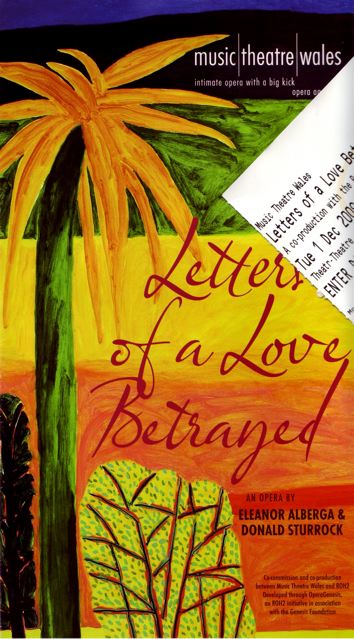
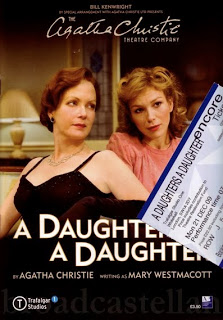
Program and ticket stub for Letters of a Love Betrayed

You see, I was born into that endangered social stratum known as the working class. It is an origin of which I am mindful, though neither proud nor ashamed. At least, I am not ashamed of it now. I used to be as thrilled about it as Ann Blythโ€™s character in Mildred Pierce, even though my parents bore a closer resemblance to Lana Turner in Imitation of Lifeโ€”that is, too busy to notice that living up to their aspirations left their offspring in the dust they raised as they tried to shake the dirt clinging to their roots. At any rate, stuck in that cloud of dust was I, an asthmatic kid who couldnโ€™t afford to hold his breath at the off chance of parental attention.

Not to suffocate under the rubble of post-Second World War Germany, my parents had to put their noses far closer to the proverbial grindstone than I ever did. Their generation, aided by American interests, pulled off the Wirtschaftswunder or โ€œeconomic miracle,โ€ a sleight-of-hands-on approach to the lasting trauma caused by total war and final solution, the coming to terms with which would have required equipment far more difficult to handle than shovel and broom.

I am not so disingenuous as to pass off my staying put as a form of sit-down strike, of giving the clean-and-cover-up efforts of my parentsโ€™ generation the spotless finger; but apart from the months I ill served my country working as a hospital orderly or the hours I spent cleaning apartments in New York City to help finance my college education, I remained sedentary for much of my life.

So far, itโ€™s been a life spent lost in thoughts, ensconced in writing, and plunked down for performances that artists work on studiously for our delight and instructionโ€”the kind of delight my father found it difficult to accept as serious work and the instruction he thought less of than the empirical knowledge that, along with calluses, is the badge and perquisite of the experience-hardened laborer.

I suppose it is easier for the workerโ€”not to be equated here with the impecuniousโ€”to aspire to material possessions instead of culture and learning, since exposing yourself to something that poses a challenge rather than promising instant gratification requires still more work on the part of those who have little time and less energy to spare.

Now, my comparatively indolent existence permits me to spare that time; yet, as if my conscience and buttocks alike had been shaped by Protestant work ethics, I often feel rather uncomfortable. Iโ€™m not one to pooh-pooh the benefits of resting on oneโ€™s Popo (as dainty Germans call the posterior); but, there is nothing like wriggling in my seat in hopes of improving my mind to convince me that the callusesโ€”and Iโ€”belong elsewhere.

I had that impression sitting through Letters of a Love Betrayed, a new opera by Eleanor Alberga (libretto by Donald Sturrock). Reading about it, I was intrigued by the promised fusion of Latin rhythms and a neo-Gothic romance based on a story by Isabel Allende, but felt let down by a score that to my untrained ear sounded forbidding, unmelodious, and, worse still, forgettable. Perhaps, the perceived cacophony was the result of a clanging together of too many stereotypes. Whatever melo- Letters possesses is all in the drama; derivative and contrived, it is creakier than a chair that has been squirmed out of too often.

I didnโ€™t get it. I didnโ€™t like it. I felt like a tired, vitamin deprived miner lured into a soup kitchen of the arts, the drama being a concession to what is assumed to be his tastes as he is being fed a presumably healthy diet with a none too musical spoon.

As I sat down again to express my thoughts on the matter of whatโ€™s the matter with me, I kept wondering whether what I was responding to so angrily was utter musical rubbish, dreck worse than the grime to which I chose not to expose myself, or whether my inability to open my mind was dictated to me by my past, a past unfolding in letters of a class betrayed.

โ€œMarching backwardsโ€: โ€œThe Great Tennessee Monkey Trialโ€ Is Back on the Air

The Darwin bicentenary is drawing to a close. Throughout the year, exhibitions were staged all over Britain to commemorate the achievements of the scientist and the controversy his theories wrought; numerous plays and documentaries were presented on stage, screen and radio, including a new production of Inherit the Wind (1955), currently on at the Old Vic. I was hoping to catch up with it when next I am in London; but, just like last month, I my hopes went the way of all dodos as only those survive the box office onslaught who see it fit to book early.

Not that setting foot on the stage of the Darwin debate requires any great effort or investment once you are in the great metropolis. During my last visit to the kingdomโ€™s capital, I found myselfโ€”that is to say, I was caught unawares as I walked through the halls of the Royal Academy of Artsโ€”in the very spot where, back in 1858, the papers that evolved into The Origin of Species were first presented.

This week, BBC Radio 4 is transporting us back to a rather less dignified scene down in Dayton, Tennessee, where, in the summer of 1925, the theory of evolution was being put on trial, with Clarence Darrow taking the floor for the defense. Peter Goodchild, a writer-producer who served as researcher for and became editor of the British television series on which the American broadcast institution Nova was modeled, adapted court transcripts to recreate the media event billed, somewhat prematurely, as the “trial of the century.”

Like the LA Theatre Works production before it, this new Radio Wales/Cymru presentation boasts a pedigree cast including tyro octogenarians Jerry Hardin as Judge John Raulston and Ed Asner as William Jennings Bryan, John de Lancie as Clarence Darrow, Stacy Keach as Dudley Field Malone, and Neil Patrick Harris as young biology teacher John Scopes, the knowing if rather naive lawbreaker at the nominal center of the proceedings who gets to tell us about it all.

โ€œI was enjoying myself,โ€ the defendant nostalgically recalls his life and times, anno 1925, as he ushers us into the courtroom, for the ensuing drama in which he was little more than a supporting player. โ€œIt was the year of the Charleston,โ€ of Louis Armstrongโ€™s first recordings, โ€œthe year The Great Gatsby was written.โ€ Not that marching backwards to the so-called โ€œMonkey trialโ€ isโ€”or should ever becomeโ€”the stuff of wistful reminiscences. โ€œBut, in the same year, Hitler wrote Mein Kampf, Scopes adds, โ€œand in Tennessee, they passed the Butler Act.โ€

Darrow called the ban on evolution as a high school subjectโ€”and any subsequent criminalization of intellectual discourse and expressed beliefsโ€”the โ€œsetting of man against man and creed against creedโ€ that, if unchallenged, would go on โ€œuntil with flying banners and beating drums, we are marching backwards to the 16th century.”

He was not, of course, referring to the Renaissance; rather, he was dreading a rebirth of the age of witch-hunts, superstitions and religious persecution. โ€œWe have the purpose of preventing bigots and ignoramuses from controlling the education of the United States, and you know it, and that is all,โ€ Darrow declared.

It is a line you wonโ€™t hear in the play; yet, however condensed it might be, the radio dramatization is as close as we get nowadays to the experience of listening to the trial back in 1925, when it was remote broadcast over WGN, Chicago, at the considerable cost of $1000 per day for wire charges. According to Slate and Cookโ€™s It Sounds Impossible, the courtroom was โ€œrearranged to accommodate the microphones,โ€ which only heightened the theatricality of the event.

I have never thought of radio drama as ersatz; in this case, certainly, getting an earful of the Darrow-Bryan exchange does not sound like a booby prize for having missed out on the staging and fictionalization of the trial as Inherit the Wind.


Related post
โ€œInherit the . . . Air: Dialing for Darwin on His 200th Birthdayโ€

A Room With a View-Master; or, Four-Eyes in the Third Dimension

What the Bwana Devil! Iโ€™ve been trying on various kinds of glasses to take in Channel 4โ€™s 3D festโ€”but none transport me into the third dimension. Turns out, viewing the weeklong series of films and specials, culminating in a โ€œ3-D Magic Spectacularโ€ and a clipfest of โ€œThe Greatest Ever 3-D Momentsโ€โ€”requires special goggles that can only be obtained from a certain chain of supermarkets whose reach does not extend to Mid Wales. By the time we got around to driving some 100 miles down south, the glasses had already been snatched up. The thought of having a digital recording of โ€œThe Queen in 3-D”โ€”contemporary film footage of the 1953 coronationโ€”without being able to take it in makes me want to jump out and hurl flaming arrows at whoever devised this regionally biased marketing scheme.
Had the coronation taken place only a year or two later, this experimental and previously unseen documentary might never have been shot right at you. After all, 1953 was a big year in three-dimensional filmmaking; but it proved little more than a fad. By the time Hitchcockโ€™s Dial M for Murder was released in the spring of 1954, the novelty had already worn off and, to this day, few viewers get to experience the climactic scene in the way it was re-conceived for the film.

I caught up with the stereoscopic movies of the 1950sโ€”among them It Came from Outer Space, House of Wax, and Miss Sadie Thompsonโ€”when they aired on German television back during the early 1980s 3D craze, which was similarly brief yet decidedly less distinguished: Parasite, Metalstorm, Spacehunter, and the inept Indiana Jones knockoff El Tesoro de las cuatro coronas.

Ever since I got my first stereoscope, known as a View-Master, I have been enthralled by three-dimensional images, or at least by the idea thereof. Rather peculiar, this, considering that those of us fortunate enough to have a set of matching peepers get to experience the same effect without having to sport ill-fitting, nausea-inducing eyewear.

So far this year I have put up with putting on special spectacles to see five 21st-century 3D movies, among them Coraline, The Final Destination, and Up (not counting the partially 3D IMAX presentation of Harry Potter and the Half-Blood Prince). ย It seems that 2009 is even a bigger year for 3D than 1953. Yet while I rejoice in the prospect of further excursions into space, it strikes me that, as 3D goes mainstream at last, the technology has lost some of its rogue appeal.

Movies like Ice Age: Dawn of the Dinosaurs do not exploit the potentialities of the medium with the abandon the added dimension invites. I mean, why throw money at 3D films if they donโ€™t throw anything back at you? Maybe Iโ€™m wearing rose-colored glasses, but I am still hoping for a throwback to those 1950s throwaways. In the meantime, Iโ€™ll gladly return to radio drama, the invisible, immaterial theater whose action unfolds in the fourth dimension.

Listen, Learn, and Log

I am hardly the go-getter type. My goals are even more modest than my needs, which is to say that a full and fulfilling present day matters more to me than any future success for the prediction and preparation of which I lack the foresight. Among my few ambitions is it to amass volumes enough to have one of the most comprehensive private libraries devoted to turning the volume upโ€”to American and, to a lesser degree, British radio and to the dramatics of the air in particular: published scripts, contemporary criticism, and latter-day assessments of the so-called โ€œgolden ageโ€ of radio.

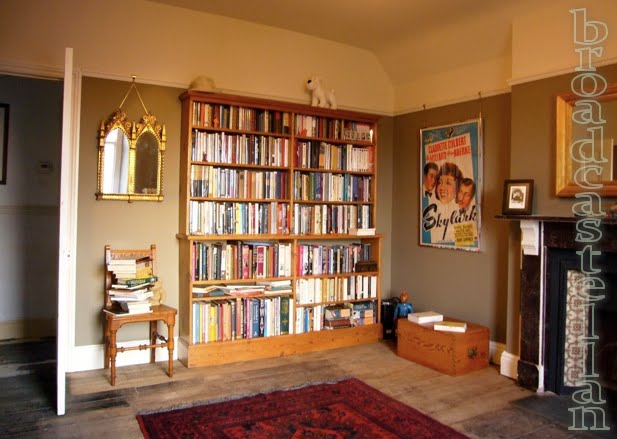
Until now, matters were complicated by the fact that I never had my own shelves on which to store such records of radioโ€™s past. Well, Iโ€™ve got the bookshelves set up in my room at last. Nearly five months after moving into our new old house, I once again enjoy ready access to the appreciable if generally unappreciated literature of the air.

Back in November 1923, a critic of Radio Broadcast magazine observed that since libraries and radio have similar aims, it was

surprising that they have not cooperated nearly as fully as they might. Much of the radio broadcasting is instructive and entertaining; and so is it with the books on the library shelves. Radio is ever improving the musical and literary tastes of thousands of listeners-in, who, having their interest aroused, may find increased pleasure from music or literatureโ€”and the libraries can supply the latter.

Some twenty years later, what there was of radio literature hardly reflected the programs enjoyed by millions on radio. Calling it a โ€œsad observation,โ€ Sherman H. Dryer remarked in Radio in Wartime (1942) that

in the twenty-five years of its life few serious or critical books have been written about radio. The literature of radio is divided into two main parts: anthologies of โ€œbestโ€ broadcasts, or vocational textsโ€”How to Write for Radio, Radio Direction, How to Become an Announcer.

To these two kinds of books, Dryerโ€”among a few others like Robert Landry, Francis Chase, and Charles Siepmannโ€”added a small number of critical studies on radio broadcasting; and, two decades later, there emerged a market for nostalgia and history.

As Max J. Herzberg put it in Radio and English Teaching (1941), radio โ€œneed not be a substitute for the library; it can result in more and not less frequent use of books.โ€

I find that, tuning in, I not only turn to books on radio, but go in search of related material, original sources and histories. In other words, radio does not merely compel me to set up a shelf for books devoted to the subject; it continues to educate me about Western culture, the histories in which it dealt and out of which it arose. Looking at the faces of long forgotten performers and reading about their once famous acts tells me a lot about the boundaries and hazards of any pursuit of happiness defined by popularity and the statistical apparatus relied upon for its measurement.

The by now unpopular culture of radio dramatics has proven an academic and professional cul-de-sac for me; but my interest in and commitment to its study has remained nearly undiminished. As I said, I am not very ambitiousโ€”which is precisely why I feel free to continue the pursuit of what doesnโ€™t seem to get me anywhere . . .

This, by the way, is my 701st entry into the broadcastellan journal.

โ€œI’ve Got a Little Listโ€ (and the Hot Mikado Isnโ€™t on It)

At the risk of sounding like a loser at a Vegas spelling bee, I am a serious eye roller. Like a roulette wheel on an off night, each circulation marks the extent of my displeasure. The other night, I was really taking my peepers for a spin. Judging from such ocular proof, you might have thought that more than eyeballs were about to roll. Indeed, it seemed as if I were going to face the Lord High Executioner himself. Instead, we were merely going to a production of The Hot Mikado. I just couldnโ€™t warm to the idea of going camp on a classic that seems least in need of burlesqueโ€”or Berlesques, for that matter. Not that this stopped middle-aged troupers like Jack Benny, Bob Hope, and Groucho Marx to play โ€œThree Little Maidsโ€ (as part of a war relief benefit broadcast); but, at least, those tuning in were spared the visuals.

If I was less than enthusiastic, it was mainly on account of Charleyโ€™s Aunt. That dubious Victor/Victorian dowager had way too many nephewsโ€”and โ€œthey’d none of them be missed, they’d none of them be missed.โ€ Cross-dressing has long been on the none too little list of circus and sideshow acts that are more of a source of irritation than of hilarity. One strategically placed banana peel does more for me than two oranges nestling in a bed of chest hair. Itโ€™s a fruitโ€™s prerogative.

The origins of my aversion date back to the time when I began to realize that what I needed to get off my chest one day was something other than the fur I was not destined to grow in profusion. I was about twelve. Still without a costume on the morning of the annual school carnival, I let my older sister, who was as resourceful as she was bossy, talk me into wearing one of the skirts she had long discarded in favor of rather too tight-fitting jeans. Being dressed in my sisterโ€™s clothes was awkward for me, considering that I was fairly confused about my gender to begin with, certain only about the one to which I was drawn. More than a skirt was about to come out of the closet, and I was not equipped to deal with it.

Responding to my calculatedly nonchalant remark that the costume was some kind of last-minute ersatz, our smug, self-loving English teacher, Herr Julius, told the assembled class that, during carnival, folks tended to reveal what they secretly longed to be, which, apparently, went well beyond the common desire not to be humiliated. No wonder Herr Julius did not bother to don a mask other than the one with which he confronted us all the scholastic year round.

Matters were complicated further by my wayward anatomy. Letโ€™s just say that it didnโ€™t require oranges to make a fairly convincing girl out of me; I was equipped with fleshy protuberances that earned me the sobriquet โ€œbattle of the sexes.โ€ I wondered whether I was destined to shroud myself in one pretense in order to drop another. That, in a pair of coconut shells, is why cross-dressers and any such La Cage faux dollies were never to become my bag. And Iโ€™ve got a lot of baggage.

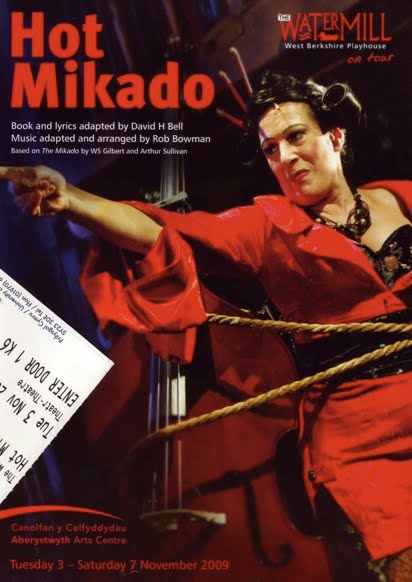
What has that to do with The Hot Mikado, the show I was so reluctant to clap my eyes on? As it turns out, not very much. I had been mistaken about the gender of the performer playing Katisha, the character on the poster (pictured above) that was advertising the Watermill production I caught at Aberystwyth Arts Centre.

Far from being some newfangled cabaret act, The Hot Mikado is seventy years old this year. Appropriating presumably WASPish entertainment for a younger and less exclusive audience, it was first performed in 1939 with an all-black, extravagantly decked out cast headed by the legendary Bill โ€œBojanglesโ€ Robinson in the title role. The currently touring Watermill productionโ€”which is soon to conclude in Girona, Spainโ€”updates the carnivalesque spectacle in retro-1980s colors, with Manga and movie inspired costumes, as well as assorted references to Susan Boyle and British politics. The music is still jazz-infused Gilbert and Sullivan.

Set โ€œsomewhere in Japanโ€ and produced at a time when Mr. Moto was forced to take an extended Vacation, the anachronistic Hot Mikado was all jitterbug without being bugged down by pre-war jitters. It is outlandish rather than freakish, amalgamated rather than discordant, qualities reassuring to anyone who has ever felt mixed up or unable to mix. A few bum notes aside, the production was hardly an occasion for any prolonged orbiting of orbs. The joyous spectacle of it kept even my mindโ€™s eye from rolling, from running over the bones, funny or otherwise, that tend to tumble out of this Fibber McGeean closet of mine . . .

Related recordings
Greek war relief special (8 February 1941), featuring Frank Morgan, Bob Hope, Jack Benny and Groucho Marx singing songs from The Mikado
โ€œHollywood Mikadoโ€, starring Fred Allen (11 May 1947)
Chicago Theater production of โ€œThe Mikadoโ€ (22 October 1949)
The Railroad Hour production of โ€œThe Mikadoโ€ (5 December 1949

“. . . in fire and blood and anguishโ€: An Inspector Calls Repeatedly

As I was saying: what is wanting here is continuity, some sort of story on the go, a sense of goings-on ongoing, of the so on and so on and so on. It would be laziest to claim, as I have done, that what prevents me from turning a seemingly random clipbook into the attraction that is the yet-to-come is largely owing to the kind of clippings for which this (mis)nominal journal is reserved.

Instead of looking ahead, I keep on hearkening back. As I recall, which is what my kind of introspective retrospection calls for, my life always seemed to unfold in hindsight, not so much enveloped as developing. I know better than to regard history as a series of acts perpetrated rather than ideas perpetuatedโ€”but that knowledge does not prevent me from living ahistorically. According to J. B. Priestley, I am bound to regret this.

For the most part, mine has been a life apart; many are the instances, momentous events even, in which I just was not in the moment. What was I feeling when the Berlin Wall fell? My diary wonโ€™t tell you. It only refers to the event in passingโ€”and with detachmentโ€”as something that would have been โ€œnoch vor kurzem undenkbarโ€ (unthinkable even a short time ago). โ€œUndenkbar,โ€ perhaps, since I had never given it much Gedanke.

I recall being revolted by David Hasselhoffโ€™s โ€œLooking for Freedom,โ€ a 1989 chart topper all over Europe, but was not aware that the songโ€™s popularity was owing to political events then in the making, let alone that Hasselhoff was part of the revolution (as claimed, with tongue firmly in cheek, in a current BBC Radio 2 retrospective). I never made the connection. Nothing seemed to connect, least of all with me. My existence, as I saw it, was coincidental and inconsequential.

It is not for nothing that my generation was known as the โ€œno futureโ€ generation. Life in the Western middle of Europe was, to many, solely dependent on the whim or disposition of two world leaders, on a red telephone, and a scientistโ€™s finger on a long-range missile switch.

I came briefly into contact with my past self when, on a recent weekend in London, I looked into the fresh faces of my nieces, whom I had not seen in over twelve years since I steadfastly refuse to set foot again on German soil. I never did make peace with my native country, and, as much as I enjoy a good Schlachtplatte (literally, a battle or slaughter platter, which is a dish of assorted meats), Iโ€™d much rather rely on German exports than return to the scene of inner turmoil.

The belated realization that, growing up in the Rhineland, I had never witnessed a celebration of Armistice Day, seen a World War I memorial (of which there is one in nearly every village here in Britain) or witnessed the annual spectacle of lapels sprouting poppies, only deepened my suspicion that it was the shame of defeat that rendered causality ineffective in a post-1918 German construct of history, and that what was being commemorated elsewhere was victory rather than the failure to insure it.

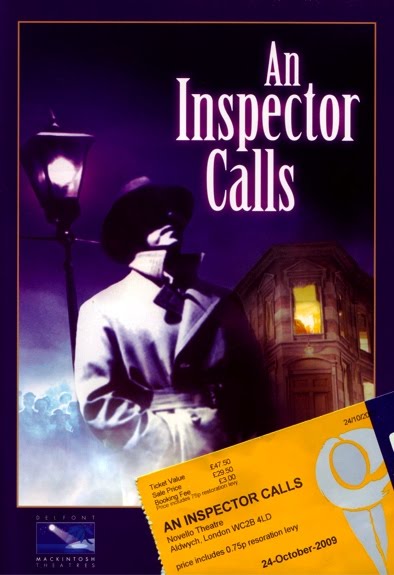
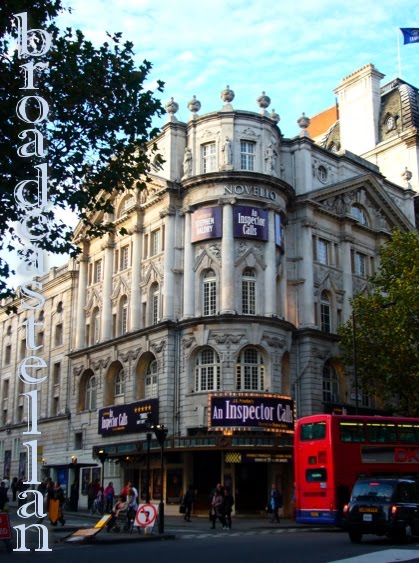
As the fatalism expressed in the grating conclusion of the most recent installment in The Final Destination series of disaster horror suggested to me, causality without social or moral responsibility is a mere exercise in predictability. “We are responsible for each other. And I tell you that the time will soon come when, if men will not learn that lesson, then they will be taught it in fire and glood and anguish.โ€ J. B. Priestley keeps saying as much in An Inspector Calls, the previously maligned 1990s production of which I caught again on said trip to London a few weeks ago.

โ€œYouโ€™ve a lot to learn yet,โ€ pragmatic and presumably self-made Mr. Birling advises the younger generation, anno 1912.

And Iโ€™m talking as a hard-headed, practical man of business. ย And I say there isnโ€™t a chance of war. ย The worldโ€™s developing so fast that itโ€™ll make war impossible. Look at the progress weโ€™re making [. . .]. ย Why, a friend of mine went over this new liner last weekโ€”the Titanicโ€”she sails next weekโ€”forty-six thousand eight hundred tonsโ€”and every luxuryโ€”and unsinkable, absolutely unsinkable. ย That what youโ€™ve got to keep your eye on, facts like that, progress like thatโ€”and not a few German officers talking nonsense and a few scaremongers here making a fuss about nothing. ย Now you three young people, just listen to thisโ€”and remember what Iโ€™m telling you now. ย In twenty or thirty yearsโ€™ timeโ€”letโ€™s say in 1940, you mighty be giving a little party like thisโ€”your son or daughter might be getting engagedโ€”and I tell you by that time youโ€™ll be living in a world thatโ€™ll have forgotten all these Capital versus Labour agitations and all these silly little war scares. ย Thereโ€™ll be peace and prosperity and rapid progress everywhereโ€”except of course in Russia, which will always be behindhand, naturally.

Mr. Birling is blind not only to the signs of the time but also to his responsibilities in designing the future while consigning the present to waste and ruin. Even when given the chance in Priestleyโ€™s fantastic setup, he is incapable of turning hindsight into insight. Knowledge, after all, is not synonymous with understanding. As much as I keep rejoicing in Mr. Birlingโ€™s fallโ€”a delight dimmed by the knowledge that his is our downfall by proxyโ€”logic dictates that I fall well short of understanding the consequences of my own ahistorical ways.

Back to Back-to-Back; or, Serialization of Schemes

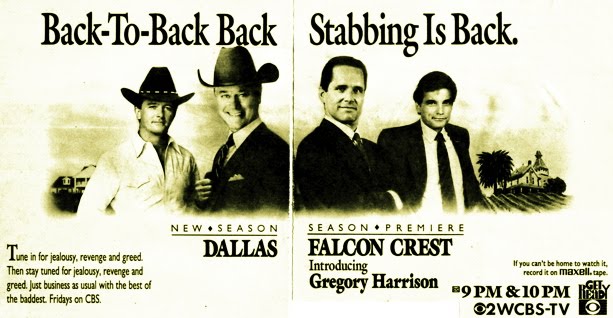
A long time (well, okay, make that โ€˜about four and a half yearsโ€™) ago I came to the realization that the key to keeping an online journalโ€”and oneโ€™s fingers regularly on the keyboard in its serviceโ€”is serialization: some kind of evolving plot that, like life and Stella Dallas on a diet, keeps thickening and thinning from Monday till Doomsday until the inevitable sundown that not even Guiding Light could outshine.

Despite this realization, though, I have never managed to make a success of stringing together the latest on my follies and failures, mainly because I did not set out to make my person the axis around which this less than celestial body of essays spins. That, in recent months, the revolutions have ground to a near halt and affairs have become all but devolutionary is largely owing to the series of friction that is my one life to live beyond these virtual pages. These days, writing in installments begins and ends in โ€˜stall,โ€™ which is the least I tend to do best.

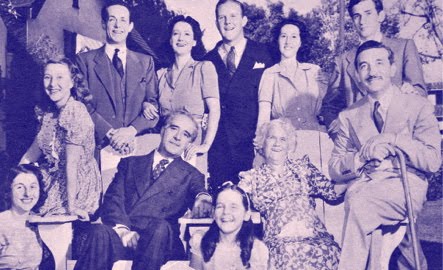
The cast of One Man’s Family

Not that the contemplation of the presumably out-of-date lends itself to frequent updates. I mean, whatโ€™s the point of being current when your harvest is raisins? For the love of ribbon mikes, how many times can you run away with the A & P Gypsies and still expect anyone to follow the run-down caravan in which you survey the bygone scene? Good for how many yarns are the bewildering progeny of the Happiness Boys, that old โ€œInterwoven Pair,โ€ until any attempt at catching up with the catโ€™s whiskers and its litter unravels like knitting gone kittyโ€™s corner? Why go on circulating gossip from the Make Believe Ballroom as the world turns the radio off?

Clearly, there is room for a chorus line of doubt when I now announce the beginning of a new chapter in the cancellation dodging saga of broadcastellan. Anyone hoping for a weekly quintuplet of All My Mindโ€™s Children should be advised that this is going to be more a case of One Manโ€™s Family Planning . . .

"2X2L calling CQ. . .": The Night They Made Up Our Minds About Realism

Radio Guide (19 November 1938)

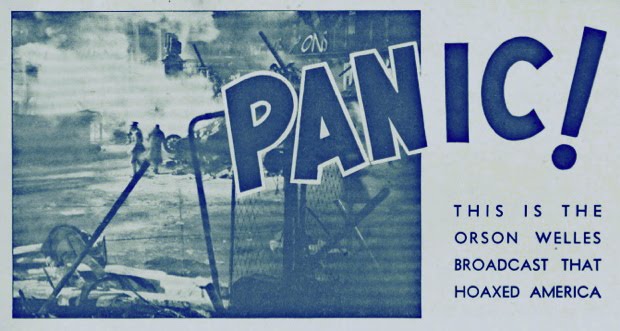
This is just the night for a returnโ€”a return to that old, beloved yet woefully neglected hobbyhorse of mine. You know, the Pegasus of hobbyhorses: the radio. After all, it is the anniversary of the Mercury Theatreโ€™s 1938 โ€œWar of the Worldsโ€ broadcast, a date that lives in infamy for giving those who say that โ€œseeing is believingโ€ an ear-opening poke in the eye. These days, the old Pegasus doesnโ€™t get much of an airing. It may have sprung from the blood of Medusaโ€”but that old Gorgon, television, still has a petrifying grip on our imagination.

What made โ€œThe War of the Worldsโ€ so convincing was that it treated fantasy to the trickery of realism, by turning an old sci-fi yarn into what, too many, sounded like a documentary. As the programโ€™s general editor, John Housemanโ€”who gave up the ghost on Halloween in 1988โ€”recalled about the Mercuryโ€™s holiday offering, not even the script girl had much faith in the material: โ€œItโ€™s all too silly! Weโ€™re going to make fools of ourselves. Absolute idiots.โ€ Instead, the broadcast made fools of thousands by exploiting their pre-war invasion anxieties.

As I put it in Etherized Victorians, broadcast fictions could

tap into what McLuhan argued to be โ€œinherent in the very natureโ€ of radioโ€”the power to turn โ€œpsyche and society into a single echo chamber.โ€

The more urgent concern for broadcasters had always been whether it was proper for radio dramatists to exploit this power at all, especially after the codes of radioโ€™s surface realism had been so forcefully violated by Howard Kochโ€™s dramatization [. . .]. In one of the most disturbing scenes of the play, a speaker identified as a CBS announcer addresses the public to document the end of civilizationโ€”โ€œThis may be the last broadcastโ€โ€”until succumbing to the noxious fumes that spread across Manhattan and extinguish all human life below. ย His body having collapsed at the microphone, a lone voiceโ€”rendered distant and faint by a filterโ€”attempts to establish communication.ย 

It is the voice of a radio operator: โ€œ2X2L calling CQ. . . . 2X2L calling CQ . . . . 2X2L calling CQ . . . New York. Isnโ€™t there anyone on the air? [Isnโ€™t there anyone on the air?] Isnโ€™t there anyone. . . .โ€ ย The Mercury Playersโ€™ โ€œholiday offeringโ€ had not only โ€œdestroyed the Columbia Broadcasting System,โ€ as Welles jested at the conclusion of his infamous Halloween prank, but had pronounced the death of its receiversโ€”the listening public. ย Considering the near panic that ensued, was it advisable to open the realm Esslin called a โ€œregion akin to the world of the dreamโ€ without clearly demarcating it as fantasy by resorting to the spells of Trilby, Chandu, or The Shadow?

After that night, the aural medium as governed by those in charge of the realties of commerce and convenience seemed destined to perpetuate what Trilling referred to as the โ€œchronic American beliefโ€ in the โ€œincompatibility of mind and reality.โ€

Related writings
โ€œโ€˜War of the Worldsโ€™: A Report from the Sensorial Battlefieldโ€
โ€œโ€˜War of the Worldsโ€™: The Election Editionโ€
โ€œThousands Panic When Nelson Eddy Begins to Singโ€

โ€œAnyone we know?โ€: An Absentminded Review of The Royal Family

What a tramp my mind has turned into lately. I would like to think that I still got one of my own, to have and to hold on to, for richer or poorer, and all that; but every now and again, and rather too frequently at that, the willful one takes off without the slightest concern for my state of it. It used to be that I could gather my thoughts like keepsakes to store a mind with; these days, I wonder just whoโ€™s minding the store. And just when I feel that Iโ€™ve lost it completely, there it comes ambling in, disheveled, unruly, and well out of its designated head. With a little luck, the suitcase of mementoes with which it absconded turns up again, similarly disorganized, rarely complete if at times strangely augmented. Perhaps, minds resent being crossed once too often. That has crossed mine, to be sure.

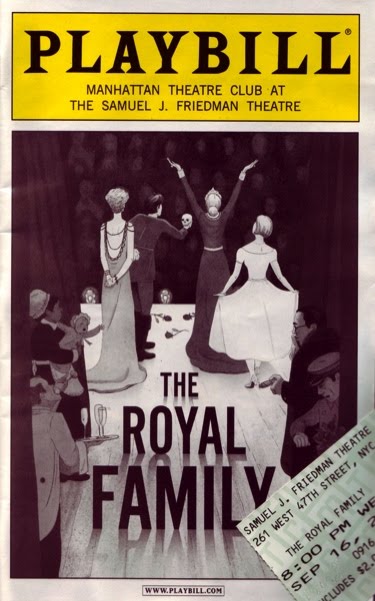
Anyway, where was I going with this? Ah, yes. Straight back to New York City. The Biltmore Theatre. Make that the Samuel J. Friedman, as it is now called. Built in 1925 and steeped in comedy theater tradition, the former Biltmore is just the venue for the current revival of The Royal Family, of which production, scheduled to open 8 October 2009, I had the good fortune to catch the second preview a few weeks ago. Classic crowd-pleasers like Poppa (1929), Brother Rat (1936-38), My Sister Eileen (1940-42), and the long-running Barefoot in the Park (1963-67) were staged here, where Mae West caused a sensation in October 1928 with Pleasure Man, a play they let go on for all of two performances.

While Ethel Barrymore might have wished a similarly compact run for The Royal Family, the play amused rather than scandalized theatergoers who appreciated it as a wildly flamboyant yet precisely cut gem of wit set firmly in a mount of genuine sentimentโ€”which is just what youโ€™d expect from a collaboration of George S. Kaufman and Edna Ferber. Histrionics, theatrical disguises, a bit of swashbucklingโ€”this screwball of a jewel still generates plenty of sparks, even if the preview I attended needed a little polish to show it off it to its full advantage.

Informed that her son may have killed a man, the matriarch of the family inquires: โ€œAnyone we know?โ€ Among the somebodies we know to have slain them with lines like these in the past are Broadway and Hollywood royals like Otto Kruger, Ruth Hussey, Eva Le Gallienne, Fredric March, Rosemary Harris, and . . . Rosemary Harris. As is entirely in keeping with the playโ€™s premiseโ€”three generations of a theatrical family congregating and emoting under one roofโ€”Ms. Harris is now playing the mother of the character she portrayed back in 1975. Regrettably, unlike Estelle Winwood in the cleverly truncated Theatre Guild on the Air production broadcast on 16 December 1945, Ms. Harris as Fanny Cavendish was not quite eccentric or electric enough, although she certainly possesses the curtains-foreshadowing vulnerability her character refuses to acknowledge.

Decidedly more energetic and Barrymore or less ideally cast were the other members of the present production, which includes Jan Maxwell as Julie, Reg Rogers as Tony, Tony Roberts as Oscar, John Glover as Herbert Dean and Saturday Night Live alumna Ana Gasteyer as Kitty. Whenever the pace slackened and the madcap was beginning to resemble a nightcap or some such old hat, I could generally rely on Ms. Gasteyerโ€™s gestures and facial expressions to keep me amused.

There was a moment, though, when my attention span was being put to the testโ€”and promptly failed. I looked at the fresh though not especially fascinating face of Kelli Barrett (as Gwen) and found myself transported to the 1920s, those early days of the Biltmore. I started to think of or hope for a youthful, vivacious Claudette Colbert performing on Broadway at that time, a few years before she left the stage to pursue a career in motion pictures. Why, I wondered, was my mind walking off with her?

Well, eventually it all came home to meโ€”my mind sauntering back in with a duffle bag of stuff I didnโ€™t remember possessingโ€”when I perused the playbill to learn about the history of the Biltmore. Colbert, I learned, had performed on that very stage back in 1927, the year in which The Royal Family was written, enjoying her first major success in The Barker. Decades later, she returned there for The Kingfishers (1978) and A Talent for Murder (1981). So, there was something of a presence of Ms. Colbert on that stage, even though she never played young Gwen.

Today, researching a little to justify what still seemed like a mere digression in a half-hearted review of the play, I discovered (consulting the index of Bernard F. Dickโ€™s recent biography of Colbert) that the actress did get hold of a minor branch of the Royal Family tree when she seized the opportunity to portray Gwenโ€™s mother in a 1954 television adaptation of the play. That version, the opener for CBSโ€™s The Best of Broadway series, was broadcast live on 16 Septemberโ€”which happens to be the day I stepped inside the Biltmore to catch up with The Royal Family.

Perhaps it is just as well that I give in and let my mind go blithely astray. For all the exasperation of momentary lapses, of missed punch lines, plot lines or points my thoughts are beside of, the returns are welcome and oddly reassuring. Besides, the old tramp wouldnโ€™t have it any other way . . .

They Also Sell Books: W-WOW! at Partners & Crime

Legend has it that, when asked what Cecil B. DeMille was doing for a living, his five-year-old grand-daughter replied: โ€œHe sells soap.โ€ Back then, in 1944, the famous Hollywood director-producer was known to million of Americans as host and nominal producer of the Lux Radio Theater, from the squeaky clean boards of which venue he was heard slipping (or forcefully squeezing) many a none-too-subtle reference to the sponsorโ€™s products into the behind-the-scenes addresses and rehearsed chats with Tinseltownโ€™s luminaries, lines scripted for him by unsung writers selling out in the business of making radio sell.

No doubt, the program generated sizeable business for Lever Brothers; otherwise, the theatrical spin cycle conceived to bang the drum for those Lads of the Lather would not have stayed afloat for two decades, much to the delight of the great (and only proverbially) unwashed. For all its entertainment value, commercial radio was designed to hawk, peddle and tout; and although the spiel heard between the acts of wireless theatricals like Lux has long been superseded by the show and sell of television and the Internet, old radio programs still pay off, no matter how freely they are now shared on the web. In a manner of speaking, they still sell, albeit on a far smaller and downright intimate scale.

Take W-WOW! Radio. Now in its fourteenth season, the opening of which I attended last month, the W-WOW! Mystery Hour can be spentโ€”heard and seenโ€”on the first Saturday of every month (July and August excepting) from a glorified store room at the back of one of the few remaining independent and specialty booksellers in Manhattan: Partners & Crime down on Greenwich Avenue in the West Village. The commercials recited by the cast are by now the stuff of nostalgia, hilarity, and contention (“In a coast-to-coast test of hundreds of people who smoked only Camels for thirty days, noted throat specialists noted not one single case of throat irritation due to smoking Camels“); but the readings continue to draw prospective customers like myself.

Whenever I am in town, I make a point of making a tour of those stores, even though said tour is getting shorter and more sentimental every year. There are rewards, nonetheless. Two of my latest acquisitions, Susan Wareโ€™s 2005 โ€œradio biographyโ€ of the shrewdly if winningly commercial Mary Margaret McBride and John Housemanโ€™s 1972 autobiography Run-through (signed by the author, no less) were sitting on the shelves of Mercer Street Books (pictured) and brought home for about $8 apiece. The latter volume is likely to be of interest to anyone attending the W-WOW! production scheduled for this Saturday, 3 October, when the W-WOW! players are presenting the Mercury Theatre on the Air version of Dracula as adapted by none other than John Houseman.

As Houseman puts it, the Mercuryโ€™s โ€œDraculaโ€โ€”the seriesโ€™s inaugural broadcastโ€”is โ€œnot the corrupt movie version but the original Bram Stoker novel in its full Gothic horror.โ€ Indeed, Housemanโ€™s outstanding adaptation is a challenge worthy of W-WOW!โ€™s voice talent and just the kind of material special effects artist DeLisa White (pictured above, on the right and to the back of those she so ably backs) will sink her teeth into, or whatever sharp and blunt instruments she has at her disposal to make your hair stand on end.

Rather more run-of-the-mill were the scripts chosen for W-WOW!โ€™s September production, which, regrettably, was devoid of vamps. You know, those double-crossing, tough-talking dames that enliven tongue-in-cheek thrillers like The Saint (โ€œLadies Never Lie . . . Muchโ€ or โ€œThe Alive Dead Husband,โ€ 7 January 1951) and Richard Diamond (โ€œThe Butcher Shop Case,โ€ 7 March 1951 and 9 March 1952), a story penned by Blake “Pink Panther” Edwards and involving a protection racket. The former opened encouragingly, with a wife pretending to have killed a husband who turned out to be yet living, if not for long; but, as it turned out, the dame had less lines than any of the ladies currently in prime time, or any other time for that matter. Sure, crime paid on the air; but sex, or any vague promise of same, sells even better.

That said, I still walked out of Partners & Crime with a book in my hand. As I passed through the store on my way out, an out-of-print copy of A Shot in the Arm caught my eye and refused to let go. Subtitled โ€œDeath at the BBC,โ€ John Sherwoodโ€™s 1982 mystery novel, set in Broadcasting House anno 1937 and featuring Lord Reith, the dictatorial Baron who ran the place, is just the kind of stuff I am so readily sold on, as I am on browsing in whatever bookstores are still standing offlineโ€”if only to give those who are still in the business of vending rare volumes a much-deserved shot in the open and outstretched arm.

Related recordings
“Ladies Never Lie . . . Much,” The Saint (7 January 1951)
“The Butcher Case,” Richard Diamond (7 January 1950)
“The Butcher Case,” Richard Diamond (9 March 1951)